Detailed slide-by-slide text content extracted from this presentation.
Slide 01
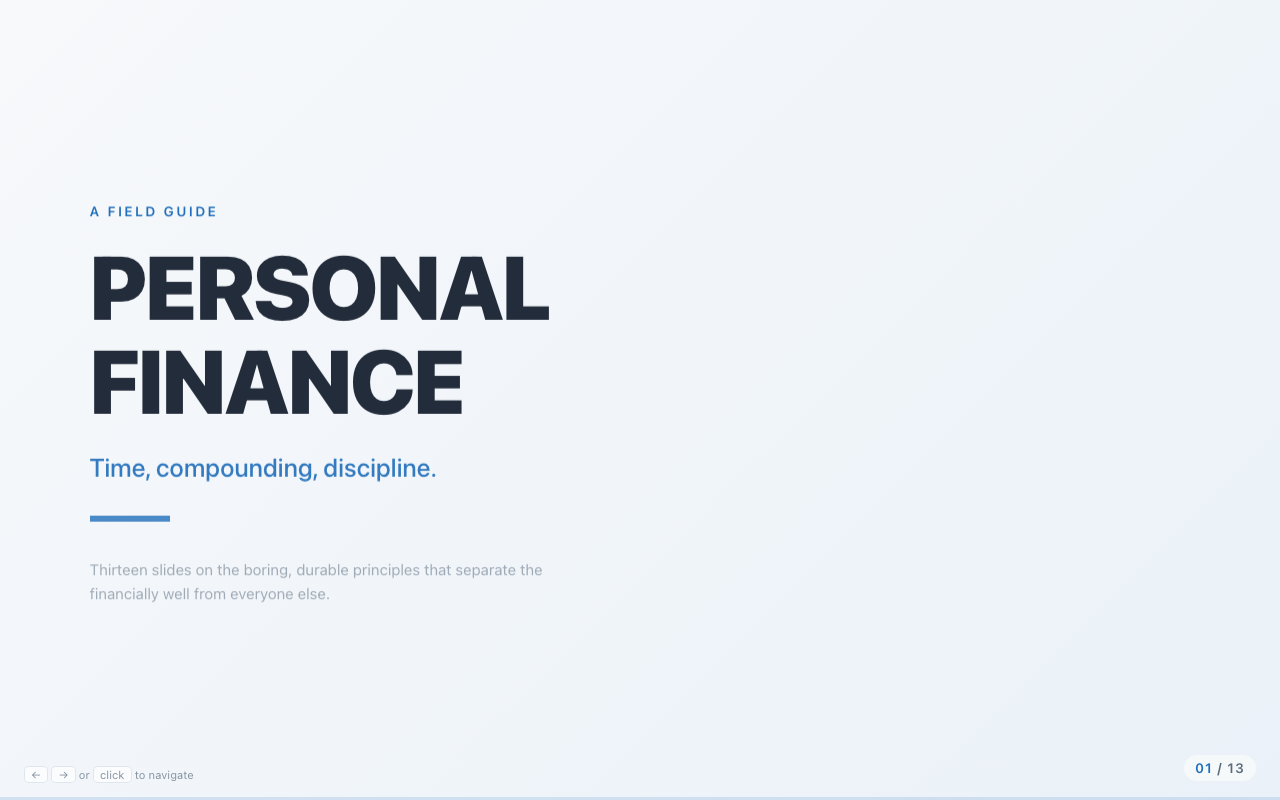
Personal Finance
Building Wealth for Life
- Your Money, Your Future
- Master the fundamentals of money management, saving, investing, and reaching financial independence through proven principles.
- 1 / 30
Slide 02
Why Most People
Struggle Financially
- The Problem
- 56%
- can't cover a $1,000 emergency
- $17K
- average US household credit card debt
- 33%
- have zero retirement savings at retirement age
- 0 hrs
- personal finance taught in most schools
- Financial literacy is a skill — and it can be learned at any age.
- 2 / 30
Slide 03
The Four Pillars of
Personal Finance
- Framework
- Earn
- Maximize Income
- Career growth, skills, and side streams increase your raw material for wealth.
- Save
- Spend Less Than You Earn
- Build reserves before investing. Your savings rate is the #1 wealth driver.
- Invest
- Put Money to Work
- Assets that grow in value or generate income accelerate wealth over time.
- Protect
- Guard Against Loss
- Insurance, estate planning, and emergency funds prevent catastrophic setbacks.
- 3 / 30
Slide 04
The Budget: Your
Financial Blueprint
- Pillar One — Save
- Income − Savings − Needs − Wants = $0
- Zero-based budgeting assigns every dollar a purpose before the month begins.
- 50%
- Needs
- housing, food, utilities
- 30%
- Wants
- dining, travel, hobbies
- 20%
- Save/Invest
- future self
- 4 / 30
Slide 05
Track Every Dollar
- Budgeting in Practice
- Review bank and credit card statements monthly
- Separate fixed vs. variable expenses
- Find spending leaks — unused subscriptions, impulse buys
- Compare actuals against budget targets each category
- Adjust as income or life circumstances change
- Popular Tools
- ● YNAB (You Need A Budget)
- ● Copilot / Monarch Money
- ● Empower (Personal Capital)
- ● Simple spreadsheet works too
- 5 / 30
Slide 06
The Emergency Fund:
Your Financial Airbag
- Foundation First
- 3–6
- months of expenses to save
- HYSA
- high-yield savings account
- Only
- for true emergencies — not vacations
- Separate account from checking reduces temptation
- Replenish immediately after any withdrawal
- Self-employed or variable income: target 9–12 months
- This comes before any investing — full stop
- 6 / 30
Slide 07
Understanding Debt:
Good vs. Bad
- Debt Management
- Good Debt
- Low interest rate (under ~6%)
- Builds an appreciating asset
- Mortgage on a home
- Student loan for high-ROI degree
- Business loan with positive return
- Bad Debt
- High interest rate (15%+)
- Funds depreciating consumption
- Credit card revolving balances
- Payday loans (300%+ APR)
- BNPL misuse and car loans on luxury vehicles
- 7 / 30
Slide 08
Avalanche vs. Snowball
Method
- Debt Payoff
- Avalanche Method
- Highest Interest First
- Pay minimums on all debts, then throw every extra dollar at the highest-rate debt first. Mathematically optimal — saves the most total interest.
- Best for: disciplined, numbers-driven people
- Snowball Method
- Smallest Balance First
- Pay off the smallest debt entirely first, then roll that payment to the next. Quick wins build motivation and psychological momentum.
- Best for: those who need emotional wins
- Research confirms: consistency matters more than which method you pick.
- 8 / 30
Slide 09
Credit Scores:
What They Are & Why They Matter
- Credit
- FICO Score Ranges
- 800–850 — Exceptional
- 740–799 — Very Good
- 670–739 — Good
- 580–669 — Fair
- What Builds Your Score
- 35% Payment history — never miss
- 30% Credit utilization — keep under 30%
- 15% Length of credit history
- 10% Credit mix (cards, loans)
- 10% New inquiries
- 9 / 30
Slide 10
Savings Rate:
The #1 Wealth Driver
- The Key Metric
- Savings Rate = (Income − Spending) ÷ Income × 100
- 10%
- Retire in ~43 years
- 25%
- Retire in ~32 years
- 50%
- Financial independence in ~17 years
- 10 / 30
Slide 11
Compound Interest:
Time Is Your Greatest Asset
- The Eighth Wonder
- Invest $5,000 at 25
- $73K
- by age 65
- Wait until 35
- $37K
- by age 65 — half as much
- Wait until 45
- $19K
- by age 65 — a quarter
- Same $5,000 investment. 7% annual return. The only variable is when you start.
- 11 / 30
Slide 12
Asset Classes:
What You Can Invest In
- Investing
- Stocks
- Ownership in companies. Historical average ~10%/year. Higher volatility. Best for long time horizons (10+ years).
- Bonds
- Loans to governments or companies. Lower returns, lower risk. Stabilize portfolios and provide income streams.
- Real Estate
- Physical property or REITs. Rental income plus appreciation. Excellent inflation hedge with leverage potential.
- Cash / Equivalents
- Savings accounts, CDs, T-bills. Lowest return, highest safety and liquidity. Emergency fund territory.
- 12 / 30
Slide 13
Index Fund Investing:
Why Simple Wins
- Best Strategy for Most People
- Tracks a market index (S&P 500, Total Market)
- Ultra-low expense ratios: 0.03–0.2% vs. 1%+ for active
- Instant diversification across hundreds of companies
- Over any 15-year period, beats ~92% of active managers
- No research skill required — just buy and hold consistently
- Available as ETFs or mutual funds
- Core Fund Options
- VTI — Vanguard Total US Market
- VXUS — International Stocks
- VOO — Vanguard S&P 500
- BND — Total Bond Market
- FZROX — Fidelity Zero Expense
- 13 / 30
Slide 14
Retirement Account Types
- Tax-Advantaged Investing
- 401(k) / 403(b)
- Employer Plans
- Pre-tax contributions reduce taxable income. $23,000 limit (2024). Always capture the full employer match — it's a 50–100% instant return.
- Traditional IRA
- Deductible Now
- Contributions may be tax-deductible. Taxes owed on withdrawal in retirement. $7,000 limit. Best if you expect lower income in retirement.
- Roth IRA
- Tax-Free Growth
- After-tax contributions. All growth and withdrawals completely tax-free. Best if you're young or expect higher future tax rates.
- HSA
- Triple Tax Advantage
- Tax-deductible in, tax-free growth, tax-free out for medical costs. After 65, works like a traditional IRA for any expense.
- 14 / 30
Slide 15
The Optimal Investment
Order of Operations
- Decision Framework
- Emergency fund (3–6 months)
- Non-negotiable foundation in a high-yield savings account.
- 401(k) up to employer match
- 100–200% instant return. Never leave this on the table.
- Pay off high-interest debt (>6%)
- Guaranteed return equal to interest rate. Avalanche method.
- Max Roth IRA ($7,000)
- Tax-free growth for decades. Priority for most earners under income limits.
- Max 401(k) ($23,000)
- Additional pre-tax investing space for high earners.
- Taxable brokerage / real estate
- After all tax-advantaged space is maximized.
- 15 / 30
Slide 16
Insurance: Protecting
What You've Built
- Protection
- Health Insurance
- Medical bankruptcy is the #1 cause of personal financial ruin in the US. Never go uninsured.
- Disability Insurance
- Your income-earning power is your greatest asset. 1 in 4 become disabled before retirement.
- Term Life
- Required only if others depend on your income. 20–30 year term. Buy young and healthy.
- Auto Insurance
- State-required. Liability coverage protects assets from lawsuits. Raise deductibles on older cars.
- Renters / Home
- Renters insurance is ~$15/month — one of the best deals in personal finance. Never skip it.
- Umbrella Policy
- Extends liability $1–5M beyond auto/home. ~$200/year. Essential for significant net worth.
- 16 / 30
Slide 17
Taxes: Your Largest
Lifetime Expense
- Tax Strategy
- Key Concepts to Understand
- Tax brackets are marginal — only income within each bracket is taxed at that rate
- Long-term capital gains (held 1+ yr) taxed at 0%, 15%, or 20% — far below income rates
- Tax-loss harvesting: sell losers to offset capital gains
- Credits are dollar-for-dollar better than deductions
- Retirement contributions lower your Adjusted Gross Income
- Effective vs. Marginal Rate
- A $100K earner is NOT taxed 22% on everything. Only dollars above ~$47K reach that bracket.
- Effective Rate = Total Tax ÷ Total Income
- 17 / 30
Slide 18
Rent vs. Buy:
The Real Calculation
- Big Decisions
- When Buying Makes Sense
- Plan to stay 5+ years
- Price-to-rent ratio under 20 locally
- 20% down payment ready
- Stable employment and income
- Credit score 740+ for best rates
- When Renting Makes Sense
- Uncertain about location or lifestyle
- High price-to-rent ratios (NYC, SF, LA)
- Investment opportunity cost favors market
- No emergency fund or down payment yet
- Career in early high-growth phase
- "Rent is throwing money away" ignores taxes, maintenance, opportunity cost, and flexibility.
- 18 / 30
Slide 19
Net Worth: Your
Financial Scorecard
- Measuring Progress
- Net Worth = All Assets − All Liabilities
- Assets
- Cash, savings, investments, retirement accounts, real estate equity, business value, vehicles, valuables
- Liabilities
- Mortgage balance, car loans, student loans, credit card balances, personal loans, business debt
- Track monthly or quarterly. The trend line matters more than any single data point.
- 19 / 30
Slide 20
The Biggest Threat to
Your Wealth: Yourself
- Psychology of Money
- Loss Aversion
- Losing $100 feels twice as painful as gaining $100 feels good. Causes panic selling at market bottoms.
- Herd Mentality
- Buying at market peaks and selling at troughs because "everyone else is." The classic wealth destroyer.
- Lifestyle Inflation
- Every raise consumed by a larger house or nicer car. Savings rate stays flat despite growing income.
- Present Bias
- We heavily discount future rewards vs. immediate pleasure. Tomorrow's wealth loses to today's spending.
- Mental Accounting
- Treating a tax refund or bonus differently from earned pay leads to irrational spending decisions.
- Sunk Cost Fallacy
- Holding a bad investment because you don't want to "admit" a loss. Make future decisions forward-looking.
- 20 / 30
Slide 21
Automate Your
Entire Financial System
- Systems Over Willpower
- Paycheck → Checking account
- Direct deposit into one central hub account.
- Checking → 401(k) deduction
- Pre-tax — you never see this money. Maximize it.
- Checking → Roth IRA transfer
- Scheduled on payday. Fund the IRA before lifestyle spending.
- Checking → Emergency fund / savings
- Auto-transfer to HYSA. "Pay yourself first" made automatic.
- Remaining → Spend freely
- No guilt, no tracking obsession — the system handled it.
- 21 / 30
Slide 22
Increasing Income:
The Other Half of the Equation
- Income Growth
- Career Levers
- Negotiate at every job offer and annual review
- Change companies strategically (10–20% avg. bump)
- Build rare, high-value, in-demand skills
- Seek promotion or high-impact roles
- Side Income Streams
- Freelancing in your core professional skill
- Content creation (YouTube, writing, podcasting)
- Rental income — room, car, storage space
- Online courses, coaching, consulting
- Dividend income from growing portfolio
- Saving has a hard floor (you can't spend less than $0). Income has no ceiling.
- 22 / 30
Slide 23
Financial Independence:
The 4% Rule
- The Goal
- Your FI Number = Annual Expenses × 25
- Spend $40K/year
- $1M
- needed
- Spend $60K/year
- $1.5M
- needed
- Spend $100K/year
- $2.5M
- needed
- Trinity Study: withdrawing 4%/year survived 95%+ of historical 30-year retirement periods.
- 23 / 30
Slide 24
Real Estate as
an Investment Vehicle
- Asset Class Deep Dive
- Direct Ownership
- Rental income cash flow
- Appreciation over time
- Leverage: control $300K with $60K down
- Tax benefits: depreciation, 1031 exchange
- Requires active management or PM fees
- REITs (Passive Route)
- Buy real estate like buying stock
- Highly liquid — trade any market day
- Diversified across many property types
- Must pay 90%+ of income as dividends
- Can hold inside a Roth IRA for tax efficiency
- 24 / 30
Slide 25
Estate Planning:
Not Just for the Wealthy
- Often Overlooked
- Will
- Directs asset distribution. Names guardian for minor children. Without one, state law decides — often poorly.
- Beneficiary Designations
- 401(k) and life insurance bypass your will. Update after marriage, divorce, or death of a beneficiary.
- Power of Attorney
- Authorizes someone to manage finances if you become incapacitated. Critical at any age.
- Healthcare Directive
- Living will specifies your medical wishes. Prevents family conflict and legal battles in a crisis.
- Revocable Trust
- Avoids probate, maintains privacy. Most useful with significant assets or complex family structures.
- Digital Legacy
- Document accounts, passwords, and crypto keys. A critical but often forgotten part of modern estate planning.
- 25 / 30
Slide 26
10 Costly Financial
Mistakes
- What to Avoid
- ✗ No emergency fund at all
- ✗ Carrying a credit card balance
- ✗ Missing the employer 401(k) match
- ✗ Trying to time the market
- ✗ Buying too much house
- ✗ Lifestyle inflating every raise away
- ✗ Forgetting to update beneficiaries
- ✗ Paying high fund expense ratios
- ✗ Cashing out a 401(k) when changing jobs
- ✗ No written financial plan
- 26 / 30
Slide 27
Financial Milestones
by Decade
- Life Stages
- 20s — Foundation
- Emergency fund, destroy student debt, open Roth IRA, live below your means, invest aggressively in your career and index funds.
- 30s — Accumulation
- Max retirement accounts, consider home ownership, target 2× annual salary saved by 35, grow income substantially.
- 40s — Peak Earning
- Supercharge savings rate, 4× salary saved by 45, protect income with disability insurance, plan for college costs if applicable.
- 50s–60s — Sprint
- Catch-up contributions (extra $7,500/year for 401k), de-risk gradually, plan Social Security timing, build bridge funds.
- 27 / 30
Slide 28
When and How to Work
with a Financial Advisor
- Getting Professional Help
- Fee Structures
- Fee-only: Flat or hourly. No commissions. Fiduciary. Best option.
- AUM-based: ~1% of managed assets. Compounds against you over time.
- Commission: Paid to sell products. Conflict of interest — avoid.
- Robo-advisor: Automated, 0.25% AUM. Good starting point.
- When to Hire One
- Major life events: marriage, inheritance, divorce
- Complex taxes: business owner, equity comp, RSUs
- Retirement planning — decumulation strategy
- Estate planning with significant assets
- Always ask: "Are you a fiduciary?" A fiduciary must legally act in your best interest.
- 28 / 30
Slide 29
Essential Personal Finance
Reading List
- Keep Learning
- The Little Book of Common Sense Investing
- John Bogle — The definitive case for index funds from Vanguard's founder. Timeless and short.
- The Psychology of Money
- Morgan Housel — Why behavior matters more than knowledge. The best modern personal finance book.
- I Will Teach You to Be Rich
- Ramit Sethi — Practical, automated money system for your 20s and 30s. No-nonsense and actionable.
- The Millionaire Next Door
- Stanley & Danko — Data on how real US millionaires actually live: frugally, consistently, without flash.
- 29 / 30
Slide 30
Five Steps to Start
This Week
- Your Action Plan
- 1. Calculate your current net worth
- 2. Open or fund a Roth IRA today
- 3. Set up an automatic savings transfer
- 4. List all debts with their interest rates
- 5. Confirm you're capturing your full employer 401(k) match
- Financial independence is not about luck or income level. It's a system anyone can build.
- 30 / 30