Detailed slide-by-slide text content extracted from this presentation.
Slide 01
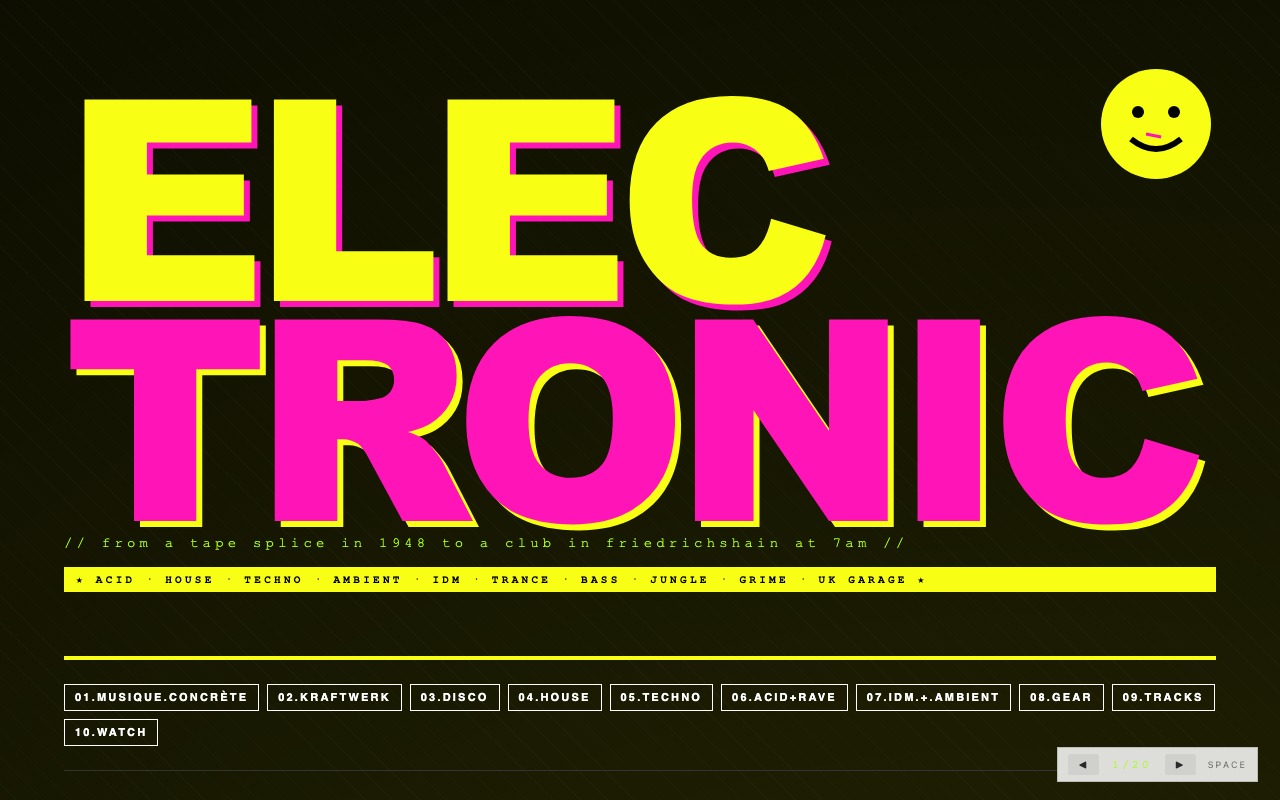
Electronic
Music
- Music
- When electricity became an instrument — the story of music made from machines
- 01 / 30
Slide 02
What Is Electronic Music?
- Definition
- Electronic music encompasses any music produced using electronic instruments, synthesizers, computers, or signal processing — from early experimental tape music to today's stadium EDM, ambient soundscapes, and AI-generated compositions.
- Synthesis
- Creating sound from scratch using oscillators, filters, and envelopes — sculpting waveforms that never existed in nature before electronics.
- Sampling
- Recording and manipulating real-world sounds as musical material — turning the entire audible world into a palette of infinite instruments.
- Processing
- Transforming acoustic or electronic sounds through effects — reverb, delay, distortion, pitch shifting — creating spaces that defy physical acoustics.
- 02 / 30
- Electronic Music
Slide 03
Before the Beat: Early Pioneers
- Origins
- 1897
- Telharmonium
- Thaddeus Cahill's 200-ton electric organ — the world's first electronic instrument, transmitting music via telephone lines.
- 1920
- Theremin
- Leon Theremin's touchless instrument — played by moving hands near antennas, producing eerie, wavering tones without contact.
- 1928
- Ondes Martenot
- Maurice Martenot's keyboard-based electronic instrument — used in Messiaen's "Turangalîla-Symphonie" and countless film scores.
- 1948
- Musique Concrète
- Pierre Schaeffer at Radio France manipulates recordings of trains and spinning tops as abstract musical composition — the first electronic music studio.
- 1951
- Elektronische Musik
- WDR Cologne studio: Karlheinz Stockhausen and Herbert Eimert create music purely from electronic oscillators — no acoustic sound sources.
- 1964
- Moog Synthesizer
- Robert Moog's voltage-controlled synthesizer with keyboard — making electronic sound creation accessible to composers and performers.
- 03 / 30
- Electronic Music
Slide 04
The Synthesizer Revolution
- Instruments
- The synthesizer transformed music creation from acoustic craftsmanship to electronic architecture — putting infinite sonic possibility into keyboard-playing hands.
- Moog Modular (1964) — First commercially successful synthesizer; used by Wendy Carlos on "Switched-On Bach" (1968)
- ARP 2600 (1971) — Semi-modular design used by Stevie Wonder, The Who, and to create R2-D2's voice
- Minimoog (1970) — First portable synthesizer; brought electronic music to live performance
- Roland TB-303 (1981) — A failed bass simulator that accidentally invented acid house when repurposed in Chicago clubs
- Roland TR-808 (1980) — The drum machine that defined hip-hop, trap, and electronic dance music — still in heavy use today
- DX7 (1983) — Yamaha's FM synthesis revolutionized pop music; the distinctive electric piano of the 80s
- "The synthesizer is the most radical new musical instrument since the piano — it's not just a new instrument, it's a new way of thinking about sound."
- — Robert Moog
- 1968"Switched-On Bach" — first electronic music Grammy winner
- 04 / 30
- Electronic Music
Slide 05
Kraftwerk and the German Revolution
- Krautrock
- The 1970s German experimental scene — "Krautrock" — forged the template for nearly all modern electronic music through radical experimentation with rhythm machines and synthesizers.
- Kraftwerk — Düsseldorf's robot band pioneered machine-driven, minimalist electronic pop with "Autobahn" (1974) and "Trans-Europe Express" (1977)
- Can — Avant-garde repetitive grooves and improvisation that directly influenced post-punk and ambient
- Neu! — The "motorik" beat — a relentless, hypnotic 4/4 pulse that became the engine of electronic dance
- Tangerine Dream — Sprawling synthesizer soundscapes from Klaus Schulze that birthed new age and ambient
- Brian Eno's debt — "I'd say that without Kraftwerk, I wouldn't have done what I've done" — the DNA of all electronic music runs through them
- Kraftwerk's Influence
- Virtually every electronic genre from techno to synth-pop to hip-hop traces its lineage to Kraftwerk:
- Afrika Bambaataa sampled them for "Planet Rock" (1982)
- Derrick May called them "the godfathers of Detroit techno"
- David Bowie's Berlin trilogy was directly inspired by Krautrock
- Inducted into Rock and Roll Hall of Fame (2021)
- 05 / 30
- Electronic Music
Slide 06
Disco, Funk & the Birth of Dance
- Disco Era
- The late 1970s saw electronic instruments enter mainstream dance music — drum machines and synthesizers creating the rhythmic foundations of disco, which would seed all dance music to come.
- Giorgio Moroder — Munich producer who created Donna Summer's "I Feel Love" (1977) — the first fully synthesized disco track and blueprint for EDM
- Roland CR-78 — First programmable drum machine (1978); used by Phil Collins, Blondie, and pioneering disco producers
- Roland TR-808 (1980) — Synthetic kick drum that defined the next 40+ years of dance music
- Paradise Garage, NYC — Larry Levan's club where DJ mixing as performance art was invented
- Studio 54 — Culture meets electronics in the most famous nightclub in history
- "When Donna Summer sang 'I Feel Love,' I heard the future. It was like someone had just landed from another planet."
- — Brian Eno, on Moroder's 1977 production
- "I Feel Love" is widely considered the most influential record in electronic music history — essentially predicting and spawning house, techno, trance, and EDM.
- 06 / 30
- Electronic Music
Slide 07
Chicago House Music
- House
- Chicago's underground club scene in the early 1980s accidentally invented house music from disco records, drum machines, and cheap synthesizers — creating a cultural revolution that reshaped global music.
- The Warehouse, Chicago — DJ Frankie Knuckles blended disco with edits and drum machines for a predominantly Black and LGBTQ+ crowd — "house" named after the venue
- Roland TB-303 accident — DJs discovered the bass synthesizer's glitchy, squelching sound when used incorrectly, creating acid house
- Jesse Saunders — "On and On" (1984) — the first house record commercially released
- Marshall Jefferson — "Move Your Body" (1986) — first house track with a piano, defining deep house
- Larry Heard — "Can You Feel It" (1986) — the spiritual deep house masterpiece that defined the genre's soul
- The Acid Revolution
- When DJs in Chicago repurposed the Roland TB-303 bass synth (designed for practice, not performance) and turned all the knobs wrong, acid house was born — accidentally creating the most distinctive sound in electronic music history.
- 1984Year house music was formally born in Chicago
- 07 / 30
- Electronic Music
Slide 08
Detroit Techno
- Techno
- In the industrial ruins of post-automotive Detroit, three young Black DJs synthesized Kraftwerk's machine music with Chicago house and Black American funk — creating techno: the sound of the future.
- The Belleville Three — Juan Atkins, Derrick May, and Kevin Saunderson created techno from scratch in Detroit's suburbs
- Model 500 — Juan Atkins' label releasing "No UFOs" (1985) — the first true techno record
- Strings of Life — Derrick May's 1987 masterpiece combining Roland piano stabs, drum machines, and raw energy; one of the most influential records ever made
- Inner City — Kevin Saunderson's "Big Fun" and "Good Life" bringing techno to mainstream pop audiences
- Metroplex, Transmat, KMS — Detroit labels distributing techno globally before major label interest
- "Techno is the future of music. It's the product of the Detroit mindset — industrial, precise, emotionally powerful."
- — Derrick May
- Critical context: Techno was invented by Black American artists drawing on African-American musical traditions. Its later white European appropriation often erased this origin story.
- 08 / 30
- Electronic Music
Slide 09
UK Rave Culture & Second Summer of Love
- Rave
- In 1988, American house and acid house music crossed the Atlantic and exploded into Britain's youth culture — triggering the "Second Summer of Love" and changing British culture permanently.
- Ibiza catalysis — Shoom and Future clubs in Ibiza where DJs Alfredo and Danny Rampling brought American sounds to British tourists
- Shoom, London (1988) — Danny Rampling's legendary club with smiley logo — ground zero for UK acid house
- M25 orbital raves — Unlicensed parties of 10,000+ people on motorway service roads around London
- Criminal Justice Act (1994) — UK government criminalized raves, defining "music characterized by repetitive beats" as illegal assembly
- Legacy — From Massive Attack to The Chemical Brothers to Burial — UK dance music remains globally influential
- Genres Born from UK Rave
- Jungle
- Drum & Bass
- Hardcore
- Happy Hardcore
- UK Garage
- Grime
- Dubstep
- Trip-Hop
- 09 / 30
- Electronic Music
Slide 10
Berlin: Capital of Techno
- Berlin
- After the Berlin Wall fell in 1989, abandoned East German buildings became the global epicenter of electronic music — a lawless creative space that defined modern techno culture.
- Tresor (1991) — Opened in the vaults of a department store; brought Detroit DJs to Berlin and created the transatlantic techno dialogue
- E-Werk, WMF, Bunker — A constellation of post-reunification clubs in former factories, power plants, and bomb shelters
- Berghain — Former East German heating plant, now the most mythologized club on Earth; 12-hour sets, notoriously strict door
- Ostgut Ton label — Berghain's label releasing Panorama Bar and techno music that defined the Berlin sound globally
- Techno tourism — Berlin's club scene adds €1.5 billion to the city's economy annually
- €1.5Bannual contribution of Berlin's club scene to city economy
- 1,500+clubs and venues in Berlin
- 2023Berlin clubs awarded UNESCO Cultural Heritage status
- 10 / 30
- Electronic Music
Slide 11
Ambient: Music as Environment
- Ambient
- Brian Eno invented ambient music in 1978 when, bedridden and unable to turn up a record, he realized music could work as an atmospheric environment rather than a focused listening experience.
- Brian Eno — "Ambient 1: Music for Airports" (1978) defines the genre — designed to merge with environmental sounds, not compete with them
- Harold Budd — Eno's collaborator; sparse piano over synthesizer washes creating infinite space
- Aphex Twin — "Selected Ambient Works Vol. II" (1994) — the definitive modern ambient album; entirely mood-based, emotionally ambiguous
- Stars of the Lid — Orchestral ambient using guitars through extreme processing; emotional density without lyrics
- Burial — London's anonymous producer creating urban ambient from fragments of 2-step, rain sounds, and ghostly vocals
- "Ambient music must be able to accommodate many levels of listening attention without enforcing one in particular; it must be as ignorable as it is interesting."
- — Brian Eno, 1978
- Modern ambient: Streaming playlists of ambient music collectively gather billions of monthly streams — the genre has found mass audience for the first time in its history.
- 11 / 30
- Electronic Music
Slide 12
Hip-Hop & the Art of Sampling
- Hip-Hop
- Hip-hop transformed electronic music by using sampling as its core compositional technique — building new music by chopping, looping, and layering fragments of existing records.
- Grandmaster Flash — Invented the "breakbeat" technique in the Bronx, looping drum breaks from funk and soul records
- Akai MPC60 (1988) — The sampler that changed everything — J Dilla, Pete Rock, and RZA built golden era hip-hop on this machine
- Public Enemy — "It Takes a Nation of Millions" (1988) built from dozens of samples in each track; pioneered sonic collage
- J Dilla — "Donuts" (2006) — created on an MPC in a hospital bed; transformed sampling from technique to high art
- Sample clearance crisis — Grand Upright v. Warner (1991) forced hip-hop to buy sample licenses, reshaping the economics of the genre
- Essential Sampled Breaks
- "Amen, Brother" — The Winstons (1969): most sampled break in history; engine of drum & bass
- "Think" — James Brown (1960): used in 1,000+ hip-hop and funk records
- "Apache" — The Incredible Bongo Band (1973): foundational hip-hop break
- "Funky Drummer" — James Brown (1970): the DNA of modern trap and hip-hop
- 12 / 30
- Electronic Music
Slide 13
Drum & Bass & Jungle
- D&B
- Emerging from UK rave culture in 1992–1994, jungle and drum & bass pushed electronic rhythm to its most complex extreme — chopped breaks at 160-180 BPM over sub-bass pressure that rewired the brain.
- Jungle — Mixing ragga, dancehall, and hardcore with hyper-chopped breaks; invented by Black British Caribbean communities in London
- Goldie — "Timeless" (1995) bringing D&B to mainstream consciousness with cinematic ambition
- Grooverider & LTJ Bukem — Defining the liquid / intelligent D&B path; jazz influences and floating atmospheres at 170 BPM
- Aphex Twin "Ventolin" — Hardcore techno and early electronica pushing tempo to extremes
- Ed Rush & Optical — Dark, mechanical, "Neurofunk" D&B; the heaviest evolution of the form
- 160–180 BPM — D&B tempo was twice that of house music, creating a sense of controlled chaos and hyper-kinetic energy.
- 170 BPMStandard drum & bass tempo
- 13 / 30
- Electronic Music
Slide 14
The EDM Explosion
- EDM
- The 2010s saw decades of underground electronic music mainstream in America for the first time — spawning stadium festivals, celebrity DJs, and a $9.9 billion industry.
- David Guetta — Bridged French house and US pop with Black Eyed Peas and Rihanna collaborations
- Skrillex — "Scary Monsters and Nice Sprites" (2010) brought dubstep to American mainstream; 3 Grammys in one night
- Avicii — "Levels" (2011) and "Wake Me Up" (2013) defined melodic, anthemic EDM for mass audiences
- Daft Punk — "Random Access Memories" (2013) — the synthesis of electronic and human music; GRAMMY Album of the Year
- Ultra, Tomorrowland, EDC — Festival culture replacing nightclub as primary electronic music experience
- $9.9Bglobal EDM industry revenue (2023)
- 400MEDM fans globally
- $35MCalvin Harris annual earnings at peak (2013)
- 14 / 30
- Electronic Music
Slide 15
Daft Punk: Robots Forever
- Icons
- Thomas Bangalter and Guy-Manuel de Homem-Christo — two French musicians behind robot helmets — created the definitive electronic music of the late 20th and early 21st centuries.
- "Homework" (1997) — French house meets Chicago and Detroit influences; "Around the World" defining the filtered house sound
- "Discovery" (2001) — The most beloved electronic album ever; sampling, vocoder, and pure joy
- Coachella 2006 — The pyramid set — the greatest festival performance in electronic music history
- "Random Access Memories" (2013) — A love letter to 70s disco and funk recorded with live musicians; GRAMMY AOTY
- The Helmet — Transforming anonymity into mythology; the music is the art, not the artists
- 40M+albums sold across career
- 6Grammy Awards won
- 2021Broke up after 28 years — an era ended
- 15 / 30
- Electronic Music
Slide 16
IDM: Intelligent Dance Music
- IDM
- In the early 1990s, a strand of electronic music pushed away from dance floors into pure experimentation — complex rhythms, alien textures, and emotional depth over danceability.
- Aphex Twin — Richard D. James, the most influential electronic experimentalist; "Selected Ambient Works Vol. II" and "Richard D. James Album" are canonical
- Boards of Canada — Scottish duo creating nostalgic, tape-degraded synthesizer music of uncanny emotional power
- Autechre — Mancunian duo pushing rhythmic complexity to the limit of human perception
- Warp Records — Sheffield label that defined IDM through the Artificial Intelligence compilations and artist roster
- Squarepusher — Merging jazz bass virtuosity with hyper-complex programmed beats
- Warp Records Artists
- Aphex Twin
- Boards of Canada
- Autechre
- Squarepusher
- Flying Lotus
- Rustie
- Kelela
- Grimes
- 16 / 30
- Electronic Music
Slide 17
The DAW Revolution
- Production
- Digital Audio Workstations (DAWs) put recording studios into laptops — democratizing electronic music production and enabling a global explosion of bedroom producers.
- Pro Tools (1991) — First professional digital recording system; still the industry standard for mixing and mastering
- Ableton Live (2001) — Changed everything; session view for live performance, warping for time manipulation, clips for non-linear composition
- FL Studio (1997) — Fruity Loops' step sequencer became the beat-making tool of hip-hop and trap; free to pirate democratized access
- Logic Pro (Apple) — GarageBand gateway leading producers to professional tools; the Mac-based studio standard
- Bedroom producer era — Billie Eilish recorded "When We All Fall Asleep" in her brother's bedroom; a Grammy winner from a laptop
- +500%increase in music releases per year since DAW democratization
- 100Mestimated global music producers using DAWs
- $299Ableton Live price — a full recording studio for cost of one session
- 17 / 30
- Electronic Music
Slide 18
The Electronic Genre Universe
- Genres
- Electronic music has spawned hundreds of distinct sub-genres — a constantly branching family tree of rhythm, texture, and culture.
- Dance / Club
- House · Techno · Trance · Garage · Drum & Bass · Jungle · Dubstep · Footwork · Grime · UK Bass
- Experimental
- IDM · Noise · Glitch · Musique Concrète · Electroacoustic · Microsound · Acousmatic
- Atmospheric
- Ambient · Chillout · Downtempo · Trip-Hop · New Age · Drone · Dark Ambient · Vaporwave
- Electronic Pop
- Synth-pop · Electropop · Nu-disco · Indietronica · Hyperpop · PC Music · Alt-R&B
- Every Noise at Once — Glenn McDonald's map of 6,000+ music genres demonstrates that electronic music's family tree is effectively infinite, with new micro-genres emerging every year.
- 18 / 30
- Electronic Music
Slide 19
Dubstep: From Croydon to the World
- Dubstep
- Dubstep began in South London around 2000 as a minimal, slow-motion evolution of UK garage — before exploding into an American "brostep" phenomenon that transformed global bass music.
- FWD>> — Rinse FM's night at Plastic People, Shoreditch — ground zero for early dubstep
- Digital Mystikz, Skream, Benga — The original South London dubstep architects; minimal, eerie, deep
- Burial — "Untrue" (2007) — arguably the most critically acclaimed electronic album of the century; anonymous, emotional, essential
- Skrillex splits — American "brostep" (Skrillex, 2010) took dubstep's wub-bass and amplified it 10× for festival audiences
- Legacy genres — UK dubstep spawned trap, future bass, riddim, and shaped virtually all bass-heavy electronic music since
- Burial: The Anonymous Artist
- "Untrue" was created anonymously in East London housing estates, using pirated software on a laptop — without knowing the producer's identity, critics placed it alongside Led Zeppelin and Beethoven in canonical importance.
- Half-step rhythm: Dubstep's defining feature — a kick on beat 1 and snare on the "and" of beat 3, creating a lurching, off-kilter feel unlike any previous dance music.
- 19 / 30
- Electronic Music
Slide 20
Electronic Music Live
- Live
- Electronic music's relationship with live performance is one of its most debated and evolving aspects — from the DJ as conductor to elaborate instrument performances.
- DJing as performance art — From Grand Wizard Theodore (scratch inventor) to Carl Cox to Nina Kraviz — the DJ as creative force, not just playlist curator
- Daft Punk's pyramid — 2006 Coachella — 100,000 people at a festival, the duo inside a light pyramid; electronic music as spectacle
- Modular synthesis live — Patching cables in real time; Clark, Objekt, and others treating modular synths as unpredictable instruments
- Aphex Twin's chaos sets — Unpredictable, often uncomfortable, always unique — performance as anti-performance
- Radiohead's electronics — Integration of synthesizers and laptop manipulation with traditional instrumentation
- "The DJ is the musician of the future. They transform recorded music into an improvised, social experience — more responsive than any orchestra."
- — Ellen Allien, Berliner DJ & label founder
- 20 / 30
- Electronic Music
Slide 21
Vaporwave & the Internet Genre
- Internet Era
- The 2010s saw electronic music's first genres born entirely on the internet — vaporwave, hyperpop, and PC Music existing primarily as meme-music aesthetic movements before they were "real" genres.
- Vaporwave (2011) — Slowed, looped 80s corporate pop and smooth jazz; nostalgia made eerie; commentary on consumer capitalism via Tumblr and YouTube
- Macintosh Plus — "リサフランク420" (2011) — the iconic vaporwave track; Fleetwood Mac slowed 50% becomes unrecognizable and transcendent
- PC Music (2013) — A.G. Cook's UK label producing hyper-synthetic pop that sounds like a PlayStation game with feelings
- Hyperpop — 100 gecs, SOPHIE, Charli XCX pushing digital distortion, pitch-shifting, and maximalism to absurd extremes
- SOPHIE — "Product" and "Oil of Every Pearl's Un-Insides" — the most radical rethinking of pop music in a generation
- SOPHIE (1986–2021)
- The Scottish producer's music used extreme pitch manipulation and synthetic sounds to explore gender identity, bodily transformation, and post-human experience. Her death at 34 was a profound loss.
- Hyperpop influence: Charli XCX, Kim Petras, and mainstream pop absorbed hyperpop's aesthetic — proving internet micro-genres eventually shape all of pop music.
- 21 / 30
- Electronic Music
Slide 22
Electronic Music Goes Global
- Global
- South Africa: Gqom
- Durban's township-born sound — raw, minimal, pounding 4/4 kick with township aesthetics. DJ Lag and Afrotainment bringing gqom globally.
- Nigeria: Afroelectro
- WizKid, Burna Boy fusing Afrobeats with electronic production. Sarz, Killertunes producing synthesized Afropop crossing Atlantic.
- Brazil: Baile Funk
- Rio favela-born funk carioca with Miami bass roots; Anitta and MC Kevinho bringing electronic favela music to global charts.
- Japan: J-Core
- Tokyo's hyper-fast, anime-influenced electronic music; Happy Hardcore at 200 BPM blended with video game aesthetics.
- Korea: K-Pop Electronic
- BTS, BLACKPINK, and NewJeans blending K-pop's precision with hyperpop, Y2K nostalgia, and EDM drops.
- India: Electronic
- Nucleya blending Bollywood samples with bass music; Karsh Kale fusing Indian classical rhythms with electronic production.
- 22 / 30
- Electronic Music
Slide 23
AI and the Future of Electronic
- AI + Music
- Artificial intelligence is becoming a new instrument in electronic music — generating melodies, completing tracks, creating voices, and raising profound questions about authorship and creativity.
- Suno & Udio (2024) — AI generating complete songs with vocals, instruments, and production from a text prompt in seconds
- Splice AI — Machine learning suggesting loops, fills, and sounds from Splice's 4+ million sample library
- LANDR mastering — AI mastering matching human-level output for bedroom producers at $4/track
- Ghostwriter controversy — AI Drake track with synthetic vocal went viral; UMG demanding AI-generated music be removed from Spotify
- Holly Herndon — "Holly+" AI trained on her voice and artistic identity, used collaboratively and ethically as creative extension
- "AI will make music that sounds like everything that's ever existed. The question is: what will make music that sounds like the future?"
- — Holly Herndon, electronic musician and AI researcher
- The real question: As AI tools become indistinguishable from human-produced music, what does "electronic music" — born from humans embracing machines — even mean?
- 23 / 30
- Electronic Music
Slide 24
Festival Culture
- Culture
- Electronic music festivals have grown from illegal raves to massive commercial events — creating cultural rituals around collective sound experience unlike any other music.
- Tomorrowland (Belgium) — 400,000 attendees over two weekends; the world's largest dance music festival; $50M+ annual revenue
- Ultra Miami — Annual February pilgrimage of 165,000 electronic music fans; launch pad for artists and trends
- Electric Daisy Carnival — US-focused 240,000 person event in Las Vegas; family-friendly ethos vs. Berghain's exclusivity
- Sonar, Barcelona — The festival that bridges underground electronic and experimental art with commercial dance music
- Burning Man — 80,000 person temporary city in Nevada desert; electronic music as backdrop to participatory utopia
- 400Kattendees at Tomorrowland
- $9.9Bglobal EDM market revenue (2023)
- 1988Year UK rave culture normalized festival-scale dance events
- 24 / 30
- Electronic Music
Slide 25
Electronic Music & Queerness
- Identity
- Electronic dance music has deep roots in Black, Latino, and LGBTQ+ communities — born in queer-friendly underground spaces and carrying a political dimension often obscured by mainstream adoption.
- The Warehouse — Frankie Knuckles' original Chicago club was a predominantly Black and gay space; house music as liberation
- Sylvester — "You Make Me Feel (Mighty Real)" (1978) — the first explicitly gay dance anthem made with synthesizers
- Larry Levan — Gay Black DJ turning Paradise Garage, NYC into a church of collective joy in the AIDS crisis
- SOPHIE, ABRA, Planningtorock — Trans and non-binary artists centering body and identity transformation in electronic sound
- Club kids and drag — NYC and London ballroom culture deeply intertwined with electronic music from the beginning
- "House music is survival music. It came from communities that were being killed by AIDS, by poverty, by racism. The 4/4 kick is a heartbeat that refuses to stop."
- — Derrick May, Detroit techno pioneer
- 25 / 30
- Electronic Music
Slide 26
Streaming & the New Economics
- Business
- Streaming has transformed the business of electronic music — enabling global discovery while creating new economic inequalities between festival headliners and working DJs.
- Spotify's algorithmic advantage — Playlist placement can make an unknown track reach millions overnight; electronic music's lack of lyrics helps algorithmic discovery
- DJ Mag Top 100 — Annual ranking that drives booking fees; Martin Garrix, Hardwell, and Tiesto command $250K+ per set
- Streaming rates — $0.003–0.005 per stream means an artist needs 250,000 streams per month to earn minimum wage
- Direct-to-fan — Bandcamp remains the ethical streaming platform for underground electronic; full price paid to artists
- NFT experiment — Artists like 3LAU and RAC sold music as NFTs in 2021; interest has waned but ownership model survives
- $0.004per stream on Spotify — average payout
- 250Kmonthly streams needed for one minimum wage
- $250Kper set: top DJ festival booking fees
- 26 / 30
- Electronic Music
Slide 27
Essential Albums
- Canon
- Kraftwerk — "Trans-Europe Express" (1977) — Machine rhythms and European futurism; the original template
- Brian Eno — "Ambient 1: Music for Airports" (1978) — Invented ambient music from first principles
- Aphex Twin — "Selected Ambient Works Vol. II" (1994) — The definitive experimental electronic masterpiece
- Daft Punk — "Discovery" (2001) — Filtered house, vocoder pop, and pure joy; the most beloved electronic album
- Burial — "Untrue" (2007) — Urban alienation made beautiful; dubstep's canonical artifact
- Four Tet — "There Is Love in You" (2010) — Intimate, warm electronic music as emotional expression
- Boards of Canada — "Music Has the Right to Children" (1998) — Nostalgic deterioration and mysterious warmth
- Chemical Brothers — "Exit Planet Dust" (1995) — Big beat's most explosive debut
- Massive Attack — "Blue Lines" (1991) — Trip-hop's foundation and the template for electronic soul
- The Prodigy — "Music for the Jilted Generation" (1994) — Rave energy captured as album-length argument
- SOPHIE — "Oil of Every Pearl's Un-Insides" (2018) — Radical, body-transforming, future-defining
- Daft Punk — "Random Access Memories" (2013) — Electronic music's love letter to human music-making
- 27 / 30
- Electronic Music
Slide 28
Post-Internet Club Music
- Club 2020s
- The 2010s–2020s saw a proliferation of club music micro-genres from around the world — each rooted in specific communities but spread globally through the internet.
- Footwork / Juke — Chicago's RP Boo and DJ Rashad creating 160 BPM syncopated rhythms for competitive footwork dance; Traxman taking it global
- Jersey Club — Pitch-shifted vocals, 130 BPM "shuffle" beat — the sound of New Jersey house parties reaching global audiences via TikTok
- Amapiano (South Africa) — Johannesburg's log drum, slowed-down deep house, and jazz piano fusion; global streaming phenomenon from 2019
- UK Drill beats — Menacing, minor-key trap influenced by Chicago drill; ShySFX and Carns Hill producing for Dave, Central Cee
- Afro house — Black Coffee, Enoo Napa blending African rhythms and house music; South African sound conquering global dance floors
- "Every five years, the future of club music comes from somewhere unexpected. That's what makes it alive."
- — Kieran Hebden (Four Tet)
- Amapiano: Originated in Soweto townships in 2012, now the fastest-growing dance music genre on Earth — Spotify streams up 4,000% between 2019 and 2024.
- 28 / 30
- Electronic Music
Slide 29
Electronic Music's Lasting Impact
- Legacy
- Democratized music production — anyone with a laptop and DAW can now make professional-quality music
- Transformed what an instrument can be — the world itself became a sound source through sampling
- Created entirely new social rituals — the rave, the club, the festival as collective experience
- Gave marginalized communities — Black, LGBTQ+, immigrant, working class — a creative space to define culture on their own terms
- Challenged the human-machine divide — exploring what it means to make art with and through technology
- Continuously renewed popular music — hip-hop, R&B, pop, and rock have all been transformed by electronic production tools
- "The history of popular music in the 20th century is the history of technology. Electronic music is just the most honest genre about that fact."
- — Mark Fisher, music critic
- 29 / 30
- Electronic Music
Slide 30
The Sound of Now
- Summary
- From Thaddeus Cahill's 200-ton machine to Suno's instant AI generation in 127 years — electronic music is both the most radical and the most democratic art form humans have ever created. Every generation reinvents it from scratch.
- 127yrfrom Telharmonium to AI music
- $9.9Bglobal electronic music industry
- ∞new genres still being invented
- 30 / 30
- Electronic Music