shipslides
Music13 slides0 views

Folk Traditions

A definition by Cecil Sharp, the English collector who first systematized the term: folk music is music handed down by oral tradition, varying as it passes...

StandaloneDownload
Sandboxed deck
Open raw

About this HTML presentation

This Shipslides page presents Folk Traditions as an interactive HTML presentation deck in the Music catalog with 13 slides. The share page keeps the uploaded deck sandboxed while exposing readable context, topics, and a slide outline for viewers and search engines.

A definition by Cecil Sharp, the English collector who first systematized the term: folk music is music handed down by oral tradition, varying as it passes from person to person, with no fixed authoritative version. Key sections include: Folk Traditions; What is folk ?; Appalachian; The Blues; Celtic; Fado; Mariachi; Other living traditions; The revivals; The songbook.

Key sections

  • 01Folk Traditions
  • 02What is folk ?
  • 03Appalachian
  • 04The Blues
  • 05Celtic
  • 06Fado
  • 07Mariachi
  • 08Other living traditions
  • 09The revivals
  • 10The songbook
  • 11The Smithsonian & the field
  • 12Folk instruments
  • 13Watch this performance

Topics covered

Slide outline
  1. 01Folk Traditions
  2. 02What is folk ?
  3. 03Appalachian
  4. 04The Blues
  5. 05Celtic
  6. 06Fado
  7. 07Mariachi
  8. 08Other living traditions
  9. 09The revivals
  10. 10The songbook
  11. 11The Smithsonian & the field
  12. 12Folk instruments
  13. 13Watch this performance
Page data
Canonical
https://shipslides.com/d/music-folk-traditions
Category
Music
Size
29.4 KB
Updated
2026-05-17
LLM text
https://shipslides.com/d/music-folk-traditions/llms.txt

Presentation Transcript

Detailed slide-by-slide text content extracted from this presentation.

Slide 01

What is folk?

  • Page 01
  • A definition by Cecil Sharp, the English collector who first systematized the term: folk music is music handed down by oral tradition, varying as it passes from person to person, with no fixed authoritative version.
  • That definition was already wobbly when Sharp wrote it in 1907, and it is wobblier now. But it points to something real. Folk traditions are local music made by communities — agricultural, religious, occupational — without the apparatus of professional composition, copyright, or mass marketing. The same song shows up in Kentucky and County Clare; the singer's grandmother knew it; nobody can tell you who wrote it.
  • What follows is a small selection of living traditions, each a world unto itself.
Slide 02

Appalachian

  • Page 02
  • The mountain South — eastern Tennessee, Kentucky, the Virginias, western North Carolina — preserved English, Scottish, and Irish balladry through three centuries of relative isolation. Cecil Sharp traveled the region in 1916–18 collecting songs and was astonished to find variants of Barbara Allen and The Cuckoo that had vanished from England itself. Sharp's collection includes Jean Ritchie of Viper, Kentucky, born in 1922 — the youngest of fourteen — who became one of the great American folk singers and helped launch the urban revival.
  • Instruments: the 5-string banjo (African in origin via the Caribbean; Joel Sweeney popularized the modern form in the 1830s); the fiddle; the dulcimer (Appalachian, lap-played, three or four strings); the autoharp. Styles: old-time (the Carter Family from Maces Spring, VA — Sara, Maybelle, A.P. — recorded for Ralph Peer at the Bristol Sessions, 1927, alongside Jimmie Rodgers, the founding event of country music); bluegrass (Bill Monroe, born Rosine, KY 1911 — assembled the Blue Grass Boys in 1939; Earl Scruggs's three-finger banjo style joined in 1945).
Slide 03

The Blues

  • Page 03
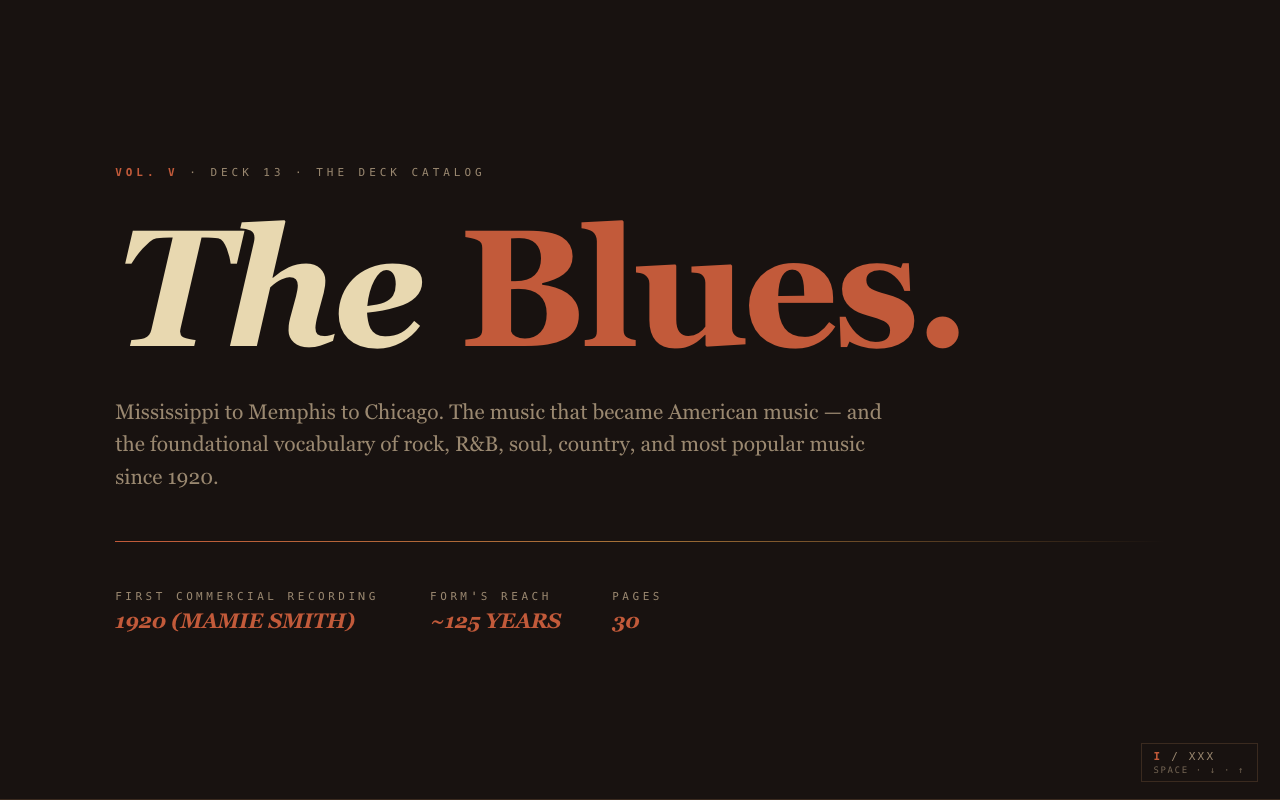
  • Born in the Mississippi Delta and the lumber and turpentine camps of the South in the late 19th century. Twelve bars, three lines, a mode that bends the third and the seventh. The most influential American folk tradition, full stop.
  • The first published "blues" sheet music was W. C. Handy's Memphis Blues (1912) and St. Louis Blues (1914). Field-collector recordings of "country blues" begin in 1920 (Mamie Smith's Crazy Blues on Okeh). Paramount, Vocalion, and Columbia put out hundreds of "race records" in the 1920s and '30s. Charley Patton, Son House, Skip James, Blind Lemon Jefferson, Mississippi John Hurt. Robert Johnson recorded 29 songs across two San Antonio sessions in 1936–37 and died at 27, allegedly poisoned.
  • The Great Migration carried the blues north. Muddy Waters (McKinley Morganfield) leaves Stovall plantation, Mississippi, in 1943 and arrives in Chicago. By 1948 he has signed with Chess and the music is electric. Howlin' Wolf, Little Walter, Willie Dixon, Buddy Guy. The British rediscover Chess in the early 60s and feed it back to America.
Slide 04

Celtic

  • Page 04
  • Ireland and Scotland share a related but distinct tradition of dance music (jigs, reels, hornpipes, slip jigs) and sean-nós ("old style") unaccompanied vocal singing. Instruments: the uilleann pipes (bellows-blown, indoor cousin to the Highland bagpipe; Séamus Ennis, Liam O'Flynn, Paddy Keenan); the fiddle; the tin whistle; the concertina; the bodhrán (frame drum). Modern groups: The Chieftains (Paddy Moloney, formed 1962); Planxty; The Bothy Band; Altan; in the U.S. revival, The Pogues brought Irish folk into punk.
Slide 05

Fado

  • Page 05
  • Lisbon's urban song tradition, born in the working-class neighborhoods of the Alfama and Mouraria in the early 19th century. Two singers (a fadista and the audience) accompanied by Portuguese guitar (a 12-string, pear-shaped, teardrop-resonator instrument descended from the English cittern) and viola (the Spanish-style classical guitar). The keyword is saudade — a longing that has no English equivalent. Amália Rodrigues (1920–1999) was fado's voice in the 20th century. Mariza, Camané, Carminho, Ana Moura have carried it into the 21st. Coimbra has a separate, university-bound tradition sung only by men.
Slide 06

Mariachi

  • Page 06
  • From Jalisco, western Mexico, by way of the haciendas of the 18th and 19th centuries. The classical mariachi ensemble is six to eight players: violins, two trumpets, vihuela (small high-pitched guitar), guitarrón (large bass guitar), guitar. The repertoire: son jalisciense, ranchera, bolero, huapango. Mariachi Vargas de Tecalitlán (founded 1898) is the canonical ensemble. José Alfredo Jiménez wrote some of the form's most enduring songs ("El Rey," "Caminos de Guanajuato"). Lola Beltrán, Vicente Fernández, Lila Downs, Natalia Lafourcade.
Slide 07

Other living traditions

  • Page 07
  • Cajun & Zydeco
  • SW Louisiana
  • French-speaking Acadians and Black Creole Louisianans. Accordion, fiddle, washboard. Clifton Chenier, the Balfa Brothers, Beausoleil.
  • Norteño / Tex-Mex
  • N. Mexico / S. Texas
  • Accordion + bajo sexto. Polka and waltz rhythms via German immigrants. Flaco Jiménez, Ramón Ayala, Los Tigres del Norte.
  • Klezmer
  • Ashkenazi Eastern Europe
  • Wedding music. Clarinet, violin, accordion. Naftule Brandwein; revival via Andy Statman, Klezmatics.
  • Flamenco
  • Andalusia
  • Romani, Andalusian, Moorish synthesis. Cante (voice), toque (guitar), baile (dance). Camarón de la Isla, Paco de Lucía.
  • Tango
  • Buenos Aires
  • Started in port-side brothels c. 1880. Bandoneón at the center. Carlos Gardel, Astor Piazzolla.
  • Choro
  • Rio de Janeiro
  • Instrumental urban music, predates samba. Pixinguinha, Jacob do Bandolim. Still played in Lapa bars.
  • Rebetiko
  • Greek Asia Minor
  • The "Greek blues." Hashish dens of Piraeus, 1920s. Bouzouki and baglamas. Markos Vamvakaris.
  • Hawaiian Slack-Key
  • Hawai'i
  • Open-tuned acoustic guitar. Gabby Pahinui, Sonny Chillingworth, Keola Beamer.
  • Sea Shanty
  • North Atlantic
  • Working songs of merchant sail. Call-and-response. Briefly viral on TikTok in 2021.
Slide 08

The revivals

  • Page 08
  • Folk has been rediscovered repeatedly: by Cecil Sharp's English Folk Dance and Song Society (1911); by John and Alan Lomax's Library of Congress field recordings (the 1930s and '40s, including the recordings of Lead Belly at Angola Prison and Muddy Waters at Stovall); by the Greenwich Village folk revival (Pete Seeger, the Weavers, Joan Baez, Bob Dylan, Phil Ochs, the Newport Folk Festival starting 1959); by Harry Smith's Anthology of American Folk Music (1952), six LPs of 1920s commercial recordings that became the urban revival's textbook.
  • The British folk revival of the 1960s — Ewan MacColl, Shirley Collins, Anne Briggs, Bert Jansch, John Renbourn, Pentangle, Fairport Convention, Sandy Denny, Nick Drake, the Watersons — produced an entirely separate canon. The 21st century: Gillian Welch & David Rawlings, Rhiannon Giddens, Sam Amidon, Anaïs Mitchell, the post-Mumford folk-pop wave.
Slide 09

The songbook

  • Page 09
  • 01Pretty PollyTrad. Appalachian — Dock Boggs (1927); B.F. Shelton (1927)
  • ≪1700s
  • 02Cross Road BluesRobert Johnson, San Antonio · ARC
  • 1936
  • 03Goodnight, IreneLead Belly (Huddie Ledbetter)
  • 1933
  • 04Wildwood FlowerThe Carter Family · Bristol Sessions
  • 1928
  • 05Blue Moon of KentuckyBill Monroe & His Blue Grass Boys
  • 1947
  • 06Coisas do Arco da VelhaAmália Rodrigues
  • 1952
  • 07Cielito LindoMexican standard, attrib. Quirino Mendoza, 1882
  • trad.
  • 08El ReyJosé Alfredo Jiménez
  • 1971
  • 09She Moved Through the FairTrad. Irish · Margaret Barry, Anne Briggs
  • trad.
  • 10The Parting GlassTrad. Scottish/Irish · The Wailin' Jennys
  • trad.
  • 11Por una CabezaCarlos Gardel · tango
  • 1935
  • 12Mal HombreLydia Mendoza · Tex-Mex
  • 1934
  • 13Hang Me, Oh Hang MeTrad. · Dave Van Ronk; Inside Llewyn Davis (2013)
  • trad.
  • 14Time (The Revelator)Gillian Welch · Acony
  • 2001
  • Harry Smith Anthology — watch on YouTube →
Slide 10

The Smithsonian & the field

  • Page 08b
  • Where the recordings live.
  • Folkways Records was founded by Moses Asch in 1948 with a stated commitment to publish anything of cultural significance, regardless of commercial appeal. By the time Asch died in 1986, Folkways had released over 2,000 records — Pete Seeger, Lead Belly, Woody Guthrie, Mississippi John Hurt, the entire Anthology of American Folk Music, language documents, animal sounds, the music of Bali, the music of Madagascar. The Smithsonian Institution acquired the catalog after Asch's death and has kept every title in print ever since.
  • Other essential archives: Alan Lomax's recordings at the Library of Congress and the Association for Cultural Equity at Hunter College; the Topic Records catalog (UK, founded 1939, the longest-running indie label in the world); Rounder Records (Cambridge, MA, 1970, with the multi-volume Alan Lomax field-recording series); Arhoolie Records (Chris Strachwitz, 1960, blues and Tex-Mex); Tompkins Square (Josh Rosenthal, 2005, contemporary folk reissues).
Slide 11

Folk instruments

  • Page 09b
  • A short hardware catalog. Most of these can be made by hand.
  • 5-string banjo
  • Africa via the Caribbean
  • The fifth string is shorter, runs alongside the neck, sounds drone-like.
  • Mountain dulcimer
  • Appalachia
  • Three or four strings, fretted diatonically, played on the lap with a noter.
  • Resonator guitar
  • Dopyera Bros · 1928
  • Aluminum cone amplifies the strings. The Dobro of bluegrass; the steel-bodied National of Delta blues.
  • Uilleann pipes
  • Ireland · 18c
  • Bellows-blown bagpipe, played seated. Quieter than the Highland pipe.
  • Bouzouki
  • Greek / Irish
  • Long-necked lute, four courses of double strings. Greek rebetiko; transplanted to Irish folk in the 1960s.
  • Bandoneón
  • Argentina via Germany
  • Square-shaped concertina, 38 buttons, the voice of tango.
  • Guitarrón mexicano
  • Jalisco
  • Six-string acoustic bass with a deep convex back. The bottom of every mariachi.
  • Bodhrán
  • Ireland
  • Goat-skin frame drum, played with a wooden tipper.
  • Hammered dulcimer
  • Persia / Eastern Europe / America
  • Trapezoidal box with metal strings struck by light hammers.
Slide 12

Watch this performance

  • Page 10
  • Illustrative placeholder porch image (picsum.photos) · domestic folk setting.
  • Featured
  • Doc Watson · "Deep River Blues"
  • The blind flatpicker from Deep Gap, North Carolina, demonstrating Travis-style fingerpicking on his Gallagher guitar. Recorded for the Folkways label and various TV broadcasts; this is folk music as it actually sounds when carried by a single person who knew how to do it.
  • Jean Ritchie · Appalachian ballads →
  • Amália Rodrigues · fado →
  • Mariachi Vargas de Tecalitlán →
Remove this deck