shipslides
Music13 slides0 views

Music Theory

A pitched sound is a periodic vibration. Its perceived pitch corresponds to its fundamental frequency in cycles per second (hertz, Hz).

StandaloneDownload
Sandboxed deck
Open raw

About this HTML presentation

This Shipslides page presents Music Theory as an interactive HTML presentation deck in the Music catalog with 13 slides. The share page keeps the uploaded deck sandboxed while exposing readable context, topics, and a slide outline for viewers and search engines.

A pitched sound is a periodic vibration. Its perceived pitch corresponds to its fundamental frequency in cycles per second (hertz, Hz). Key sections include: Music Theory; The acoustic basis of pitch; Notation; Scales and modes; Intervals; Triads and seventh chords; Functional harmony; The circle of fifths; Rhythm and meter; Form.

Key sections

  • 01Music Theory
  • 02The acoustic basis of pitch
  • 03Notation
  • 04Scales and modes
  • 05Intervals
  • 06Triads and seventh chords
  • 07Functional harmony
  • 08The circle of fifths
  • 09Rhythm and meter
  • 10Form
  • 11Counterpoint
  • 12Beyond tonality
  • 13A listening list to test the concepts
Topics covered

Slide outline
  1. 01Music Theory
  2. 02The acoustic basis of pitch
  3. 03Notation
  4. 04Scales and modes
  5. 05Intervals
  6. 06Triads and seventh chords
  7. 07Functional harmony
  8. 08The circle of fifths
  9. 09Rhythm and meter
  10. 10Form
  11. 11Counterpoint
  12. 12Beyond tonality
  13. 13A listening list to test the concepts
Page data
Canonical
https://shipslides.com/d/music-music-theory
Category
Music
Size
472.5 KB
Updated
2026-05-17
LLM text
https://shipslides.com/d/music-music-theory/llms.txt

Presentation Transcript

Detailed slide-by-slide text content extracted from this presentation.

Slide 01

The acoustic basis of pitch

  • p. 1
  • § 1
  • A pitched sound is a periodic vibration. Its perceived pitch corresponds to its fundamental frequency in cycles per second (hertz, Hz).
  • The standard reference today is A4 = 440 Hz. Doubling the frequency raises the pitch by an octave (A5 = 880 Hz; A3 = 220 Hz). Within an octave, the equal-tempered Western system divides the octave into 12 logarithmically equal half-steps, so each half-step is a frequency ratio of 2^(1/12) ≈ 1.05946.
  • Pure intervals — those produced by simple integer frequency ratios — sound consonant: the octave (2:1), the perfect fifth (3:2), the perfect fourth (4:3), the major third (5:4). Equal temperament approximates these with small deviations (the ET fifth is about 2 cents flat of pure; the ET major third is 14 cents sharp). Older tuning systems — Pythagorean, just intonation, mean-tone, well-tempered — handled the trade-off differently.
Slide 02

Notation

  • p. 3
  • § 2
  • Pitch is written on a five-line staff. The treble (G) clef anchors G4 on the second line; the bass (F) clef anchors F3 on the fourth line. A single ledger line below the treble staff (or above the bass staff) is middle C (C4).
  • Rhythm is notated by note-shape: whole (𝅝), half (𝅗𝅥), quarter (♩), eighth (♪), sixteenth (𝅘𝅥𝅯). Each is half the duration of the preceding. A dot adds half its value. A time signature gives beats per measure (top) and which note value gets one beat (bottom): 4/4 = four quarter-notes per bar.
Slide 03

Scales and modes

  • p. 5
  • § 3
  • A scale is an ordered set of pitches within an octave. The major scale's interval pattern is W–W–H–W–W–W–H, where W is a whole step (two half-steps) and H a half-step. Starting on C: C-D-E-F-G-A-B-C, with the only half-steps between E–F and B–C.
  • ModePattern (from C)Character
  • Ionian (= major)C D E F G A Bbright, stable
  • DorianC D E♭ F G A B♭minor with raised 6th — folk, jazz
  • PhrygianC D♭ E♭ F G A♭ B♭flamenco, metal
  • LydianC D E F♯ G A Bmajor with raised 4th — Debussy, film
  • MixolydianC D E F G A B♭dominant 7th feel — blues, rock
  • Aeolian (= natural minor)C D E♭ F G A♭ B♭somber
  • LocrianC D♭ E♭ F G♭ A♭ B♭unstable; rare as tonic
  • Other useful collections: pentatonic (5 notes), blues scale (6 notes with the lowered "blue" 5th), harmonic minor (raised 7th), melodic minor, the diminished and whole-tone symmetric scales used by Debussy and bebop players.
Slide 04

Intervals

  • p. 7
  • § 4
  • An interval is the distance between two pitches, named by its size in scale degrees and its quality. From C: a major 2nd to D, major 3rd to E, perfect 4th to F, perfect 5th to G, major 6th to A, major 7th to B, perfect octave to C.
  • Quality reduces a step: major → minor (one half-step smaller); perfect or major → diminished; perfect or minor → augmented. The tritone — three whole steps, e.g. C to F♯ — was called diabolus in musica in medieval theory and is the unstable interval at the center of the dominant 7th chord.
Slide 05

Triads and seventh chords

  • p. 9
  • § 5
  • A triad is three notes stacked in thirds. The four basic triad qualities, in C:
  • TypeNotesIntervals
  • MajorC–E–GM3 + m3
  • MinorC–E♭–Gm3 + M3
  • DiminishedC–E♭–G♭m3 + m3
  • AugmentedC–E–G♯M3 + M3
  • Adding another third on top gives a seventh chord: Cmaj7 (C–E–G–B), C7 (C–E–G–B♭, the dominant 7th), Cm7, Cm7♭5 (half-diminished), C°7 (fully diminished).
Slide 06

Functional harmony

  • p. 11
  • § 6
  • Within a key, each scale degree builds a triad with a function. In C major: I (C, tonic — home), ii (Dm, predominant), iii (Em), IV (F, predominant), V (G, dominant — wants to resolve to I), vi (Am, relative minor), vii° (Bdim).
  • Cadences — phrase endings
  • Authentic: V → I (the strongest resolution). Plagal: IV → I ("amen"). Half: ends on V (open). Deceptive: V → vi (sets up surprise). ii–V–I: the most common chord progression in jazz.
Slide 07

The circle of fifths

  • p. 13
  • § 7
  • Moving up by perfect fifths from C cycles through all 12 chromatic pitches and returns: C–G–D–A–E–B–F♯–C♯–G♯–D♯–A♯–E♯–B♯ (= C). Each step adds one sharp (or removes one flat) from the key signature. Counter-clockwise gives the cycle of fourths.
Slide 08

Rhythm and meter

  • p. 15
  • § 8
  • Meter is the periodic grouping of beats. Common: simple meters (2/4, 3/4, 4/4) where each beat divides into 2; compound (6/8, 9/8, 12/8) where each beat divides into 3. Asymmetric meters group unequally: 5/8 = 3+2 or 2+3, 7/8 = 2+2+3 or 3+2+2 (Bulgarian dances; Brubeck's Take Five; Money by Pink Floyd in 7/4).
  • Polyrhythm vs. polymeter
  • 3 against 2 (a hemiola): three notes evenly spaced over the time of two. Universal in West African music; appears in Brahms; Steve Reich's Clapping Music is built on it. Polymeter: two parts in different time signatures simultaneously — 3/4 against 4/4 — common in jazz and prog.
Slide 09

Form

  • p. 17
  • § 9
  • Music is organized in time. Common forms:
  • Binary (AB): two contrasting sections. Many Baroque dances. Ternary (ABA): a return after contrast. The minuet, the da capo aria. Rondo (ABACA): a refrain alternating with episodes. Common as final movements in Classical-era sonatas.
  • Sonata-allegro: exposition (theme group I in tonic, theme group II in dominant) — development (modulating, fragmenting) — recapitulation (both theme groups in tonic). The structural engine of Western art music 1750–1900. 12-bar blues: I (4) – IV (2) – I (2) – V (1) – IV (1) – I (2). The structural engine of post-1900 American popular music.
  • Verse–chorus–bridge: the contemporary pop default. Through-composed: no repeats; many art songs and tone poems. Variation form: a theme stated, then transformed (Bach's Goldbergs; Beethoven's Diabellis; Brahms-Haydn).
Slide 10

Counterpoint

  • p. 19
  • § 10
  • Counterpoint is the combination of two or more melodic lines sounding together. Species counterpoint, as taught by Johann Joseph Fux's Gradus ad Parnassum (1725), is still the standard pedagogical method.
  • Five rules of strict counterpoint (paraphrased)
  • 1. Begin and end on tonic. 2. No parallel fifths or octaves between voices. 3. Approach perfect intervals by contrary motion. 4. Resolve dissonances downward by step. 5. The leading tone resolves up by half-step to tonic.
  • A fugue states a subject in one voice, answers it in another at the dominant, and combines them through stretto, augmentation, inversion, and retrograde. Bach's The Art of Fugue, BWV 1080, is the encyclopedic specimen.
Slide 11

Beyond tonality

  • p. 21
  • § 11
  • From the late 19th century onward, composers explored alternatives to functional tonality. Debussy used parallel chords and the whole-tone scale (Voiles, 1909). Schoenberg in 1908 wrote his first "freely atonal" works (Three Piano Pieces, Op. 11) and by 1923 had codified the twelve-tone method: arrange all twelve chromatic pitches in a row, then transform that row by transposition, inversion, retrograde, and retrograde-inversion (48 forms total).
  • Other 20th-century languages: Bartók's modal-tonal hybrid, Messiaen's modes of limited transposition and additive rhythms, the integral serialism of Boulez and Babbitt, the indeterminacy of Cage, the spectralism of Grisey, the minimalism of Reich and Glass, the post-minimal Pärt and Górecki.
Slide 12

A listening list to test the concepts
  • p. 23
  • § 12
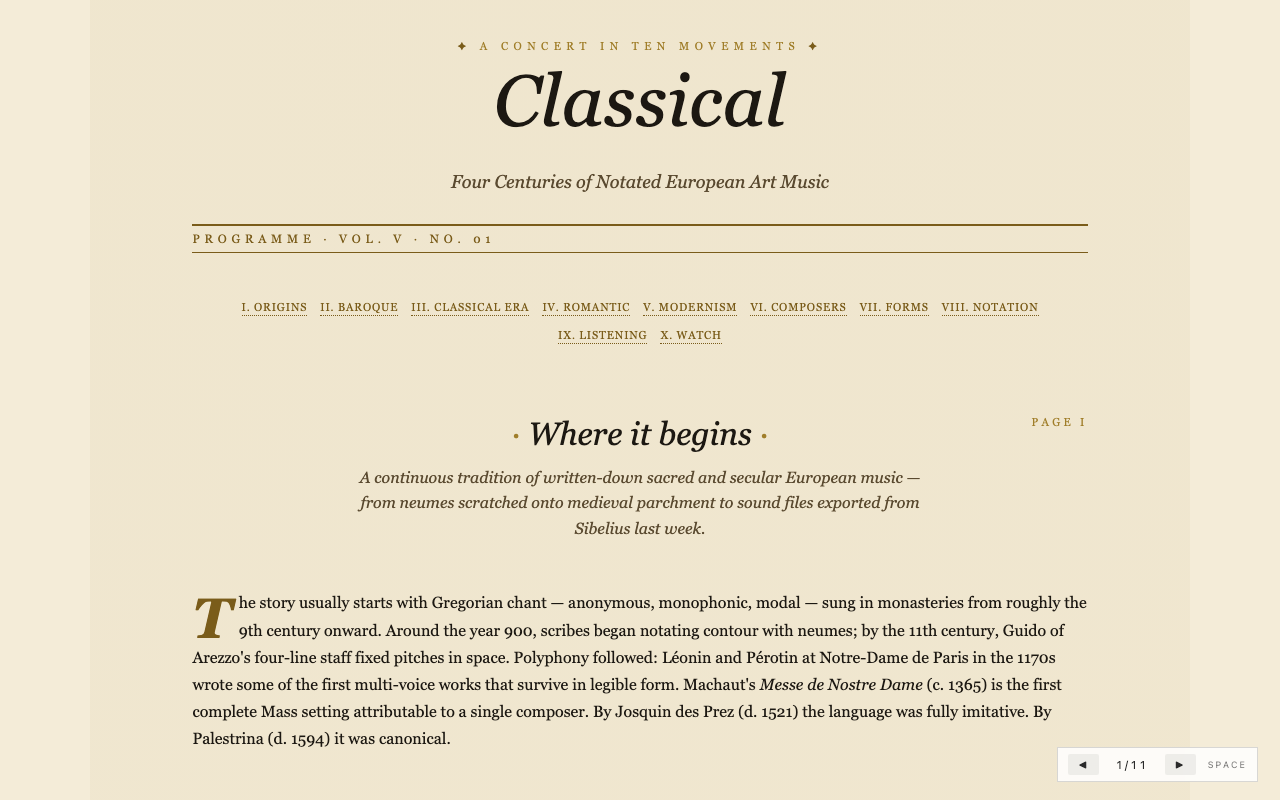
  • Illustrative placeholder score detail (picsum.photos); meaning emerges only on the second reading.
  • Tonality / common practice: Bach, Two-Part Invention No. 1 in C (BWV 772). Modal: Vaughan Williams, The Lark Ascending. Pentatonic: Debussy, Pagodes (from Estampes). 12-bar blues: Robert Johnson, "Cross Road Blues" (1936). Polyrhythm: Steve Reich, Clapping Music. Sonata form: Mozart, Piano Sonata K. 545, first movement. Twelve-tone: Webern, Symphony Op. 21. Spectral: Grisey, Partiels.
  • Featured · explainer
  • Leonard Bernstein · "What Makes Music Symphonic?"
  • From the Young People's Concerts series, CBS television, 1958. Bernstein at the piano explaining sonata form, development, and orchestration — still the gold standard of music-theory pedagogy on screen.
  • Watch · Bernstein Young People's Concerts →
Remove this deck