Detailed slide-by-slide text content extracted from this presentation.
Slide 01
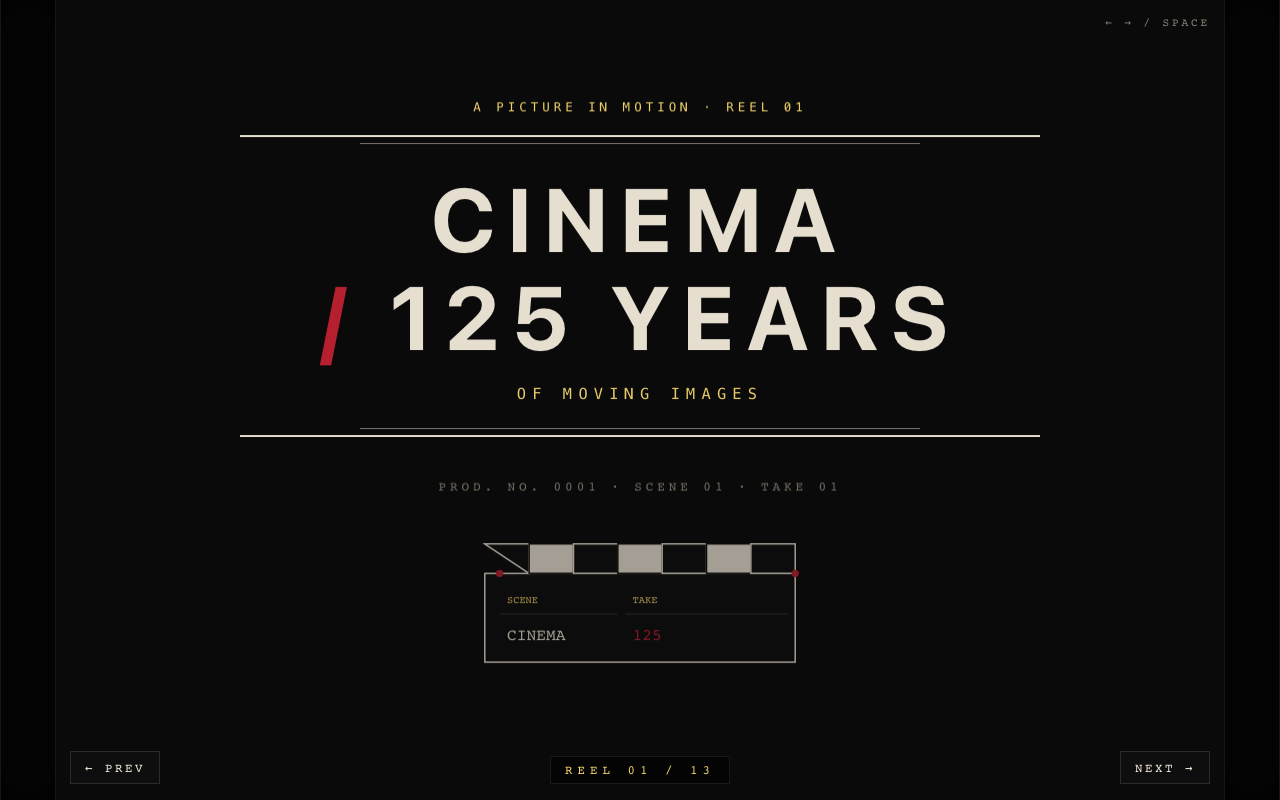
Cinema
- The Seventh Art
- Born in 1895 from a lightbulb and a spinning reel, cinema became the defining art form of the 20th century — the medium through which humanity dreamed collectively, processed its fears, and reimagined itself across every culture on earth.
- 01 / 30
Slide 02
The Birth of Moving Images
- Origins
- 1872
- Eadweard Muybridge photographs a galloping horse in sequence using 24 cameras — proving all four hooves leave the ground simultaneously; first motion-capture study.
- 1888
- Louis Le Prince films workers leaving the Roundhay Garden in Leeds — possibly the oldest surviving motion picture footage, predating the Lumières by seven years.
- 1891
- Edison and Dickson's Kinetoscope: single-viewer peephole device; motion pictures as individual commodity rather than shared spectacle.
- 1895
- Auguste and Louis Lumière project Workers Leaving the Lumière Factory to a paying audience in Paris — the first public cinema screening. Tickets: 1 franc.
- 1902
- Georges Méliès creates A Trip to the Moon — the first science fiction film, first narrative film, first use of special effects. Cinema discovers it can lie beautifully.
- 02 / 30
Slide 03
The Language of Images
- Silent Era
- Silent cinema (1895–1927) developed a complete visual grammar without recourse to dialogue — establishing every technique that sound film would inherit and refine.
- D.W. Griffith
- The Birth of a Nation (1915) codified film grammar: close-up, cross-cutting, tracking shot — while simultaneously encoding the most virulent racism into cinema's foundational techniques.
- Charlie Chaplin
- The Tramp character crossed every cultural and language barrier; The Kid, City Lights, Modern Times; physical comedy as political critique of industrial capitalism.
- Soviet Montage
- Eisenstein's Battleship Potemkin (1925): the Odessa Steps sequence; theory that meaning is created in the collision between two shots — montage as argument, not continuity.
- German Expressionism
- The Cabinet of Dr. Caligari (1920); Nosferatu (1922); painted shadows, distorted geometry; psychological menace expressed through mise-en-scène rather than narrative alone.
- 03 / 30
Slide 04
The Talkies Revolution
- Sound
- The Jazz Singer (1927) did not merely add dialogue — it restructured the entire film industry, destroyed thousands of careers, and forced cinema to become a genuinely international medium mediated by language for the first time.
- Warner Bros. introduced synchronized sound via Vitaphone disc system; studios raced to wire their theaters with amplification equipment within two years
- Stars with thick accents, speech impediments, or voices that didn't match their image were unceremoniously replaced
- Microphones were initially immobile, forcing actors to cluster around concealed recording equipment — killing fluid camera movement temporarily
- International markets fragmented: silent films crossed borders effortlessly; talkies required dubbing or subtitling industries that did not yet exist
- Music and dialogue became inseparable from visual storytelling; the film score emerged as a distinct artistic discipline under composers like Bernard Herrmann and Erich Wolfgang Korngold
- 04 / 30
Slide 05
The Studio System
- Hollywood
- The Hollywood studio system (1920s–1950s) operated as a vertically integrated industrial complex — studios owned production, distribution, and exhibition simultaneously and employed directors, writers, and stars on exclusive long-term contracts.
- The Big Five
- MGM, Paramount, Warner Bros., RKO, 20th Century Fox controlled first-run theaters in every major city. A stranglehold on distribution enforced by block-booking practices.
- The Production Code
- Hays Code (1934–1968) forbade explicit sexuality, crime being rewarded, and dozens of other "indecencies." Creativity channeled into innuendo, genre, and stylized violence.
- Golden Age genres
- Musical, Western, noir, screwball comedy, gangster — each with defined conventions, iconography, and audience expectations. Genre as industrial shorthand and artistic constraint.
- Antitrust breakup
- Paramount Decree (1948) forced studios to divest their theater chains, ending vertical integration and beginning the slow fragmentation of the classical studio system.
- The Star System
- Bogart, Garbo, Davis, Cagney — stars were property, contracted exclusively; their image carefully managed across multiple films per year to maximize box office reliability.
- Contract directors
- John Ford, Howard Hawks, William Wyler — some thrived within constraints; auteur theory would later find distinctive voices in this industrial production context.
- 05 / 30
Slide 06
Darkness and Desire
- Film Noir
- Film noir (roughly 1941–1959) was a style more than a genre — defined by low-key lighting, moral ambiguity, urban paranoia, and femme fatales, frequently shot by German emigre cinematographers who brought Expressionist shadows to American genre filmmaking.
- Double Indemnity (Wilder, 1944) — insurance fraud and murder as middle-class American tragedy; Stanwyck's ankle bracelet as cinema's most menacing accessory
- Out of the Past (Tourneur, 1947) — Mitchum's definitive noir performance; three-way betrayal; fate as absolute and inescapable as the Venetian blind shadows across every face
- Touch of Evil (Welles, 1958) — 3.5-minute opening tracking shot without a cut; Welles as corrupt sheriff; borderland as moral geography
- Sunset Boulevard (Wilder, 1950) — Hollywood itself as the femme fatale; Swanson as a decaying industry in human form; narrated by a corpse floating in a swimming pool
- Neo-noir never truly ended: Chinatown, Blade Runner, LA Confidential, Drive — the style proved infinitely adaptable to new anxieties
- 06 / 30
Slide 07
The French New Wave and Its Offspring
- New Waves
- The French New Wave (La Nouvelle Vague, 1958–1968) was a revolution in both style and theory — critics-turned-filmmakers who rejected the "cinema of quality" and made films with handheld cameras, location shooting, non-linear narratives, and direct address to the audience.
- Truffaut — The 400 Blows (1959)
- Semi-autobiographical; Antoine Doinel's final freeze-frame on the beach became one of cinema's most quoted images — the exact moment childhood possibility forecloses into adult uncertainty.
- Godard — Breathless (1960)
- Jump cuts as deliberate style; direct address to camera; Belmondo as French James Dean imitating Bogart; narrative deliberately violated at every convention it approached.
- Cahiers du Cinéma
- The journal where Truffaut, Godard, Chabrol, Rivette, and Rohmer formulated auteur theory — the director as the author whose vision unifies all elements of a film.
- Global offspring
- Brazilian Cinema Novo; Czech New Wave (Forman, Chytilová); New Hollywood (Coppola, Scorsese, Altman); each adapting the Nouvelle Vague's formal license to local conditions and anxieties.
- 07 / 30
Slide 08
American Cinema Grows Up
- New Hollywood
- Between 1967 and 1980, a generation of film school-trained American directors briefly seized control of the major studios and produced the most artistically adventurous mainstream American cinema in history.
- Bonnie and Clyde (Penn, 1967) — Violent, playful, ambivalent; announced that American cinema would no longer follow the Production Code's moral universe
- The Godfather (Coppola, 1972) — $6M budget, $245M gross; studio confidence restored; Brando's performance, Gordon Willis's shadows; America as crime family as America
- Chinatown (Polanski, 1974) — Noir without redemption; the powerful win; Robert Towne's perfect screenplay; the film that proved cynicism and art were not incompatible
- Taxi Driver (Scorsese, 1976) — Travis Bickle's pathology as urban American portrait; Bernard Herrmann's final score; New York City as psychic landscape
- Apocalypse Now (Coppola, 1979) — Vietnam through Conrad; production as existential crisis mirroring its subject; "the horror" became a cultural shorthand for a decade
- Raging Bull (Scorsese, 1980) — Shot in black and white; La Motta's self-destruction as the last gasp of the New Hollywood's self-examination before the blockbuster age
- 08 / 30
Slide 09
Jaws, Star Wars, and the Summer Movie
- Blockbuster Era
- Two films restructured the economics of Hollywood permanently — shifting the industry toward wide-release event movies marketed on television before opening weekend.
- Jaws (Spielberg, 1975)
- First film to gross $100M domestically. Wide simultaneous release on 400+ screens with saturation TV advertising — a distribution model that replaced slow platform releases for major pictures.
- Star Wars (Lucas, 1977)
- $43M budget; $775M global gross; franchise, merchandise, and sequel as the new studio business model. Lucas invented modern blockbuster economics almost by accident while making a personal B-movie.
- The franchise imperative
- Studios shifted from individual films toward IP libraries. Character recognition replaced directorial reputation as the primary marketing hook. Risk concentration in tentpoles.
- The art film casualty
- Mid-budget adult dramas — the New Hollywood's core product — became economically marginal. The "risky" film shrank; the "safe" blockbuster expanded; the gap between them widened.
- 09 / 30
Slide 10
Cinema Beyond Hollywood
- World Cinema
- Hollywood has never been cinema. Parallel traditions have produced work of comparable or surpassing depth, often invisible to North American audiences until streaming democratized global access.
- Japanese cinema — Kurosawa's Rashomon (1950) shocked Venice; Ozu's Tokyo Story; Mizoguchi's Ugetsu; pillow-shot compositions and tatami-level framing as distinct formal systems
- Italian neorealism — Rossellini, De Sica; non-professional actors; location shooting; Rome, Open City, Bicycle Thieves; documentary texture applied to fiction as moral stance
- Iranian cinema — Kiarostami, Panahi, Makhmalbaf; working around censorship through allegory; Close-Up, A Separation — among the most formally inventive cinema of the late 20th century
- South Korean cinema — Park Chan-wook, Bong Joon-ho, Hong Sang-soo; Parasite (2019) became first non-English film to win Best Picture Oscar — a tectonic shift
- Nollywood (Nigeria) — World's third-largest film industry by volume; direct-to-video then streaming; 2,500+ films annually; predominantly domestic distribution and African diaspora audiences
- Indian cinema — Bollywood, Tamil, Telugu, Malayalam; 1,800+ films annually; song-dance sequences not as interruption but as emotional intensification; emotional registers distinct from Western narrative conventions
- 10 / 30
Slide 11
Capturing the Real
- Documentary
- Documentary cinema has always been haunted by its central paradox: the camera's presence changes what it records; editing constructs arguments from reality's raw material; "objectivity" is a stylistic claim, not a neutral fact.
- Dziga Vertov — Man with a Movie Camera (1929)
- No narrative; no intertitles; city-symphony; explicitly self-reflexive about cinema's constructedness — the camera reveals itself filming, the editor edits footage of editing.
- Cinéma vérité
- Rouch, Leacock, Wiseman; lightweight 16mm cameras and synchronized sound enabled following subjects without staging; observational mode as ethical and aesthetic choice.
- Errol Morris
- The Thin Blue Line (1988) secured the release of an innocent man on death row; Interrotron device enabling subjects to look directly into camera while maintaining eye contact with interviewer.
- Contemporary documentary
- Shoah (9.5 hours; no archival footage); Bowling for Columbine; Amy; 13th; documentaries now routinely compete for cultural attention with fiction features.
- 11 / 30
Slide 12
The Camera as Author
- Cinematography
- Cinematography — the art of capturing moving images — encompasses lens choice, lighting design, camera movement, and color palette. The DP is the director's closest collaborator and frequently their artistic equal.
- Gregg Toland — Citizen Kane (1941) — Deep focus; low angles; ceilings visible (previously hidden to conceal lighting rigs); a visual grammar for psychological complexity that rewrote cinematographic possibility
- Gordon Willis — "The Prince of Darkness" — Underlit Godfather trilogy; faces emerging from shadow; refusal to illuminate what the narrative wanted hidden; earned four posthumous Oscar nominations he never won during his career
- Nestor Almendros — Natural light as aesthetic commitment; candles in Days of Heaven; "magic hour" photography for Malick; available light as moral position
- Emmanuel Lubezki — "Chivo" — Children of Men, Gravity, Birdman, The Revenant; three consecutive Oscars; long takes and wide angles as immersive strategy; natural light in extreme conditions
- Roger Deakins — Blade Runner 2049, 1917, Empire of the Sun; 15 Oscar nominations before first win in 2018; extraordinary precision of classical lighting design
- 12 / 30
Slide 13
The Invisible Art
- Editing
- Editing is the only art form unique to cinema — the assembly of disparate images into a temporal experience that creates meaning neither image contains alone. The greatest editors are among cinema's most important artists, almost never known to audiences.
- Continuity editing
- The dominant Hollywood grammar: match cuts, eyeline matches, 180° rule; invisibility as goal. The audience should experience space and time as continuous without noticing the hundreds of cuts per film.
- Soviet montage
- Eisenstein's theory: two shots in collision produce a third meaning neither contains. The Odessa Steps sequence in Battleship Potemkin is the textbook demonstration — still studied after 100 years.
- Walter Murch
- Apocalypse Now, The Godfather, The English Patient; first editor to win Oscar for sound editing; "Rule of Six" — cut on emotion, story, rhythm, eyeline, 2D, 3D in that priority order.
- Thelma Schoonmaker
- Scorsese's editor across 50 years; Raging Bull, Goodfellas, The Departed; the rhythmic violence of these films emerges from her choices as much as from any other contributor.
- 13 / 30
Slide 14
What We Hear
- Score and Sound
- Sound design and music are perhaps cinema's most manipulative elements — shaping emotional response below conscious awareness, making audiences afraid, tender, or exhilarated through frequencies they barely notice.
- Bernard Herrmann — Hitchcock's sonic mirror: Vertigo's obsessive spirals, Psycho's all-string shower sequence that makes the audience hear stabbing from silence and harmonic dissonance alone
- Ennio Morricone — Spaghetti Western soundscapes; electric guitar and whistling as instruments of landscape; later worked with Leone, Pontecorvo, Argento; 500+ scores across 60 years
- John Williams — Jaws, Star Wars, Schindler's List; leitmotif tradition inherited from Wagner applied to popular cinema; the most recognizable film themes of the 20th century
- Walter Murch's sound design — THX 1138, Apocalypse Now; "worldizing" — playing recorded sounds back in physical spaces and re-recording to add acoustic reality; coined the term "sound designer"
- Silence as device — No Country for Old Men has almost no score; the Coens weaponize ambient silence against the audience's expectation of musical cues
- 14 / 30
Slide 15
The Power of Convention
- Genre
- Genre is cinema's most powerful organizing principle — setting audience expectations in order to either fulfill, subvert, or transcend them. Genre is not a limitation but a language.
- Western
- America's founding mythology; manifest destiny and its violence; Ford's Monument Valley; Leone's moral ambiguity; Eastwood's revisionism; Unforgiven as the genre's most honest self-examination.
- Horror
- Externalizing internal fears; every era gets the monsters it deserves — Cold War nuclear anxiety (Them!), AIDS allegory (The Fly), racial terror (Get Out), pandemic dread (It Comes at Night).
- Science Fiction
- The genre of ideas; speculation as thought experiment. Metropolis to 2001 to Blade Runner to Annihilation — the best SF uses the future to diagnose the present.
- Musical
- Song as emotional truth; bodies expressing what language cannot contain. From Busby Berkeley's geometric ecstasy to Minnelli's interior worlds to Chazelle's melancholy ambivalence.
- Comedy
- The hardest genre to make well and the least seriously considered. Chaplin, Wilder, Tati, Keaton — physical comedy as philosophical inquiry; timing as the most exacting technical discipline.
- Drama
- The unmarked category; everything not otherwise labeled. Absorbs the widest range of ambition, from intimate character study to epic social panorama.
- 15 / 30
Slide 16
The Director as Author
- Auteur Theory
- Auteur theory, formulated at Cahiers du Cinéma in the 1950s, argued that the director — even within industrial filmmaking — could impose a consistent personal vision across films. Not all directors are auteurs; the ones who are are cinema's most discussed figures.
- Alfred Hitchcock
- Suspense as a mathematics of information — the audience knows the bomb is under the table; the characters do not. Vertigo, Rear Window, Psycho, The Birds: a complete theory of cinema as controlled dread.
- Stanley Kubrick
- Perfect symmetry; dehumanization; adaptation as deconstruction; extraordinary preparation; 2–3 year gaps between films. 2001, A Clockwork Orange, The Shining, Eyes Wide Shut: no two films in the same genre.
- Ingmar Bergman
- Metaphysical crisis expressed through close-up human faces; the silence of God; death as interlocutor; The Seventh Seal, Persona, Scenes from a Marriage — theatre and cinema fused.
- Akira Kurosawa
- Widescreen as compositional canvas; weather as psychological expression; humanist epic. Every major American director of the 1970s cites him. Influenced more films than any other non-Hollywood director in history.
- 16 / 30
Slide 17
A Partially Recovered History
- Women in Cinema
- Women were central to early cinema — as directors, writers, and producers — before the industry professionalized and systematically excluded them from positions of creative authority.
- Alice Guy-Blaché directed over 1,000 films (1896–1920), ran her own studio, and pioneered narrative filmmaking — largely forgotten until film historians recovered her work in the 1990s
- Lois Weber — most commercially successful American director of the 1910s; addressed contraception, capital punishment, and poverty before the Hays Code made such topics impossible
- Dorothy Arzner — only woman directing in classical Hollywood; invented the boom microphone to free actors from stationary recording setups
- Agnès Varda — French New Wave's female voice; Cléo from 5 to 7, Vagabond, The Gleaners and I; honorary Palme d'Or 2015; still directing short films at age 90
- Contemporary moment — Chloé Zhao, Kathryn Bigelow, Jane Campion, Greta Gerwig, Céline Sciamma — women winning major awards at a rate with no historical precedent, though structural barriers persist in financing
- 17 / 30
Slide 18
The Animated Imagination
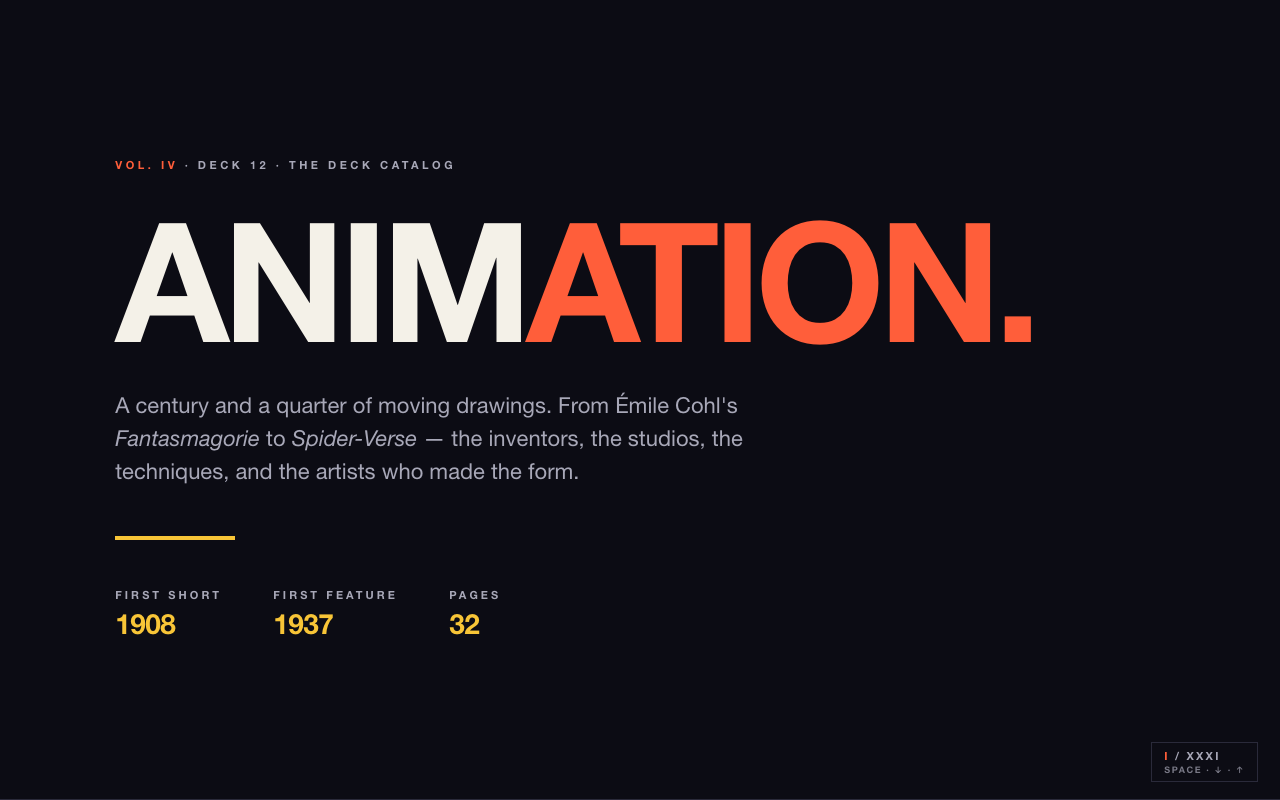
- Animation
- Animation is not a genre but a medium — as capable of addressing adult themes with formal sophistication as any live-action work, despite being persistently categorized in the West as children's entertainment.
- Disney and the Feature
- Snow White (1937) proved feature animation was commercially viable; Fantasia (1940) attempted to make animation a vehicle for classical music; the Disney formula established expectations that Studio Ghibli and Pixar would eventually supersede.
- Studio Ghibli
- Miyazaki's Spirited Away, Princess Mononoke, My Neighbor Totoro; Takahata's Grave of the Fireflies; hand-drawn animation as philosophical and ecological argument; among the most beloved films in world cinema.
- Pixar
- Computer animation as emotional instrument; Toy Story to Soul; technical innovation in service of narrative warmth; raised the bar for what animated storytelling could ask of adult audiences.
- Experimental animation
- Norstein's Hedgehog in the Fog; Švankmajer's stop-motion surrealism; Bill Plympton's fluid grotesquerie; Hertzfeldt's existential hand-drawn philosophy — animation as fine art, unconstrained by commercial imperatives.
- 18 / 30
Slide 19
The Chromatic Revolution
- Color
- The transition from black and white to color was not a simple technological upgrade — it changed what stories could be told, what emotions could be expressed, and how mise-en-scène communicated meaning.
- Early Technicolor (1930s) required enormous light levels; saturated primaries; lenses that couldn't easily capture subtlety — leading to the lush artificiality of classic Hollywood musicals and epics
- Douglas Sirk's 1950s melodramas used Technicolor's excess deliberately: saturated reds and greens as emotional pressure — the color palette expressing what the Production Code wouldn't let characters say aloud
- Michelangelo Antonioni's Red Desert (1964) had walls repainted to control color across entire locations — treating the environment as a color field painting serving psychological ends
- Wong Kar-wai and Christopher Doyle developed a palette vocabulary for memory, desire, and loss — warm amber, neon green, oversaturated primaries that feel emotionally specific to Hong Kong's late-colonial moment
- Digital color grading (2000s onward) allows total control: Mad Max: Fury Road's bleached desaturation with orange-teal contrast; Parasite's contrast between the rich family's cool tones and the poor family's warm underground hues
- 19 / 30
Slide 20
How We Think About Film
- Theory
- Film theory has developed multiple frameworks for understanding what cinema does — as language, as ideology, as psychoanalytic machine, as sensory experience — each illuminating different aspects of the medium's power.
- Semiotics
- Cinema as sign system; Christian Metz's grande syntagmatique — the basic units of cinematic language and their possible combinations. Film not as transparent window on reality but as coded system of representation.
- Ideological critique
- Screen theory (Althusser, Lacan applied by Baudry, Metz): cinema positions the spectator as a subject within dominant ideology; the apparatus itself is ideologically loaded before any content is added.
- Feminist film theory
- Laura Mulvey's "Visual Pleasure and Narrative Cinema" (1975): the "male gaze" — the camera positions the spectator to look at women as spectacle for male desire. Changed how cinema studies read every film.
- Phenomenology
- Merleau-Ponty, Sobchack: cinema as embodied experience; film meaning felt in the body before it is processed conceptually; "haptic visuality" — images that produce tactile sensation through the eye.
- 20 / 30
Slide 21
Everything Within the Frame
- Mise-en-Scène
- Mise-en-scène — "placing on stage" — refers to everything the director arranges within the frame: set design, costume, lighting, actor placement, and movement. It is the cinematic equivalent of a painter's composition.
- Orson Welles — Deep-focus compositions that express psychological hierarchies spatially; the opening of Touch of Evil; Charles Foster Kane's immensity emphasized by low angles and high ceilings
- Andrei Tarkovsky — Long takes; water, fire, and levitation as recurring motifs; the image as poem; time as material. Stalker, Andrei Rublev, Solaris — cinema as spiritual experience
- Wes Anderson — Symmetrical compositions, deadpan color palettes, overhead shots; the mise-en-scène as character revelation; every frame tells you something about how the world has been ordered to keep pain at bay
- Wong Kar-wai — Handheld intimacy vs. controlled stillness; 2046; In the Mood for Love's slow-motion fantasy sequences; space and time as emotional states rather than physical realities
- 21 / 30
Slide 22
From Celluloid to Pixels
- The Digital Revolution
- The transition from photochemical to digital cinema between roughly 1995 and 2015 changed every aspect of filmmaking — from production through exhibition — and is still being evaluated in its aesthetic consequences.
- Digital cameras
- RED, ARRI Alexa: high-resolution sensors without film cost; shooting ratios exploded from 10:1 to 100:1; directors could improvise more freely; the "filmlike" image remains contested as aesthetic ideal or commercial nostalgia.
- CGI and visual effects
- Terminator 2 (1991) first mass-market digital character; Jurassic Park (1993) proved photo-real creatures possible; Avatar (2009) redefined scale; the question of whether VFX have become cinema's primary aesthetic is unresolved.
- Digital intermediary
- All analog-shot films now pass through digital color grading in post-production; the "look" of a film is no longer fixed at camera — it is constructed in the color suite. Empowers and homogenizes simultaneously.
- Death and revival of film
- 35mm prints virtually eliminated; Kodak nearly bankrupt. Then: Nolan, Quentin Tarantino, Ari Aster, and others insist on shooting and projecting film — now a premium aesthetic choice rather than technical default.
- 22 / 30
Slide 23
Cinema in the Age of Netflix
- Streaming
- Streaming platforms have transformed film financing, distribution, and consumption in less than a decade — a disruption as profound as the arrival of television in the 1950s, still unfolding.
- Netflix's $15B+ annual content budget exceeds every Hollywood studio; it finances films that major studios refused — Scorsese's The Irishman, Cuarón's Roma, Fincher's Mank
- Day-and-date simultaneous streaming and theatrical release (accelerated by COVID-19) challenged the theatrical window that studios and exhibitors had maintained as essential for decades
- The "prestige TV" phenomenon: HBO, Amazon, Netflix drama series attracted film-caliber directors (Fincher, Campion, Fukunaga) — the cultural conversation fragmented across far more hours of content
- Film festivals (Sundance, Cannes, Berlin) adapted: streaming premieres, hybrid models; the acquisition price for a hot Sundance documentary jumped from $1M to $12M overnight as platforms competed
- Algorithm-driven recommendation made niche world cinema more accessible than ever while simultaneously creating new visibility hierarchies based on engagement metrics rather than critical assessment
- 23 / 30
Slide 24
Contemporary Masters
- Directors Today
- Bong Joon-ho
- Memories of Murder, Snowpiercer, Parasite; genre as social critique; class rage in genre film; first Korean Palme d'Or and first non-English Best Picture Oscar.
- Chloé Zhao
- The Rider, Nomadland; non-professional actors in real landscapes; Buddhist impermanence meets American myth; first woman of color to win Best Director Oscar (2021).
- Paul Thomas Anderson
- There Will Be Blood, The Master, Phantom Thread; American capitalism as character study; Daniel Day-Lewis collaborations; maximum-density screenwriting.
- Céline Sciamma
- Portrait of a Lady on Fire; the female gaze as formal argument; queer desire under patriarchal constraint; painting as metaphor for the ethics of representation.
- Denis Villeneuve
- Arrival, Blade Runner 2049, Dune; science fiction as philosophical cinema; Deakins cinematography; slow-build tension at blockbuster scale.
- Ryusuke Hamaguchi
- Drive My Car, Wheel of Fortune and Fantasy; Chekhov adaptations; language as intimacy; listening as cinematographic act; Best International Feature Oscar 2022.
- 24 / 30
Slide 25
The Industry Awards Themselves
- The Oscars
- The Academy Awards are simultaneously cinema's most prestigious recognition, its most critiqued institution, and an industry marketing exercise that shapes which films reach audiences worldwide.
- Founded 1927; first ceremony lasted 15 minutes; Douglas Fairbanks hosted; honorees were notified in advance — no suspense desired
- Consistently privileged prestige drama over comedy, horror, and genre film — genres require more formal innovation to achieve their effects but receive less recognition for doing so
- #OscarsSoWhite (2015–2016) forced Academy membership to diversify after all 20 acting nominees were white; membership expanded from 6,000 to 9,000 with significantly more international and non-white members
- Parasite (2020): first non-English-language Best Picture winner in 92 years of the ceremony; Bong's acceptance speech: "Once you overcome the 1-inch-tall barrier of subtitles, you will be introduced to so many more amazing films"
- The ceremony's global audience declined from 43M (1998) to 10M (2021) as cultural attention fragmented; its cultural influence paradoxically remains disproportionate to viewership
- 25 / 30
Slide 26
The Festival Circuit
- Cannes
- Film festivals — Cannes, Venice, Berlin, Sundance, Toronto — function as cinema's critical and commercial infrastructure: premieres, acquisitions, career launches, and cultural conversation happen here before wider distribution.
- Cannes Film Festival
- Founded 1946; Palme d'Or is arguably the most prestigious prize in world cinema. Competition jury determines outcomes rather than industry voting — a fundamentally different critical frame than the Oscars.
- Venice Film Festival
- World's oldest film festival (1932); Golden Lion; frequently the launch platform for Oscar contenders. Roma, Brokeback Mountain, Nomadland all won here first.
- Sundance
- Robert Redford's festival, founded 1978; primary market for American independent cinema; January launch platform for films that define the art house year. Acquisition prices now reflect streaming competition.
- Toronto International
- Audience award winners at TIFF (People's Choice) correlate most reliably with eventual Best Picture Oscar — the festival as audience barometer rather than critical judgment.
- 26 / 30
Slide 27
What Cinema Is Not Allowed to Show
- Censorship
- Every society has attempted to control what cinema shows — the history of censorship is a history of how power defines acceptable representation, and of artists finding ways around every barrier erected.
- Hays Code (1934–1968) — Prohibited crime being shown to pay, sexuality, blasphemy, inter-racial relationships, childbirth; filmmakers responded with double entendre, allegory, and Code-compliant films of remarkable formal ingenuity
- Soviet censorship — Eisenstein's Bezhin Meadow destroyed on Stalin's orders; entire careers defined by negotiation with censors; Tarkovsky's Andrei Rublev suppressed for years after completion
- Iranian cinema under the Islamic Republic — Women must wear hijab on screen; physical contact between sexes prohibited; no music; filmmakers like Jafar Panahi jailed and banned; yet A Separation won the Oscar — contradictions that defy simple narratives
- The MPAA rating system (1968–present) — Replaced Code with age-based ratings (G, PG, R, NC-17); NC-17 commercial death sentence drives filmmakers to self-censor or appeal for R-rating
- China's box office — World's second-largest market; films require approval; Hollywood studios regularly self-censor for Chinese market access; geopolitical conditions shifting this calculus rapidly
- 27 / 30
Slide 28
The Canon — and Its Gaps
- 100 Greatest
- Every decade's list of the "greatest films ever made" reveals the values and blind spots of the critics compiling it as much as the objective quality of the films listed.
- Sight & Sound Poll (2022)
- Jeanne Dielman, 23 quai du Commerce, 1080 Bruxelles (Chantal Akerman) voted greatest film ever made — a 201-minute film about a widow's daily domestic routine, with minimal camera movement; the slowest possible filmmaking speed as feminist argument.
- Previously: Citizen Kane
- Kane topped the Sight & Sound poll for 50 consecutive years (1962–2012) before dropping to #2 in 2012; its formal innovations have been so thoroughly absorbed that the film can seem merely impressive rather than revolutionary to audiences encountering it fresh.
- What the canon misses
- Horror, comedy, musical, action — structurally underrepresented. Global South cinema. Indigenous cinema. Films produced outside the festival circuit. The canon reflects who has access to festivals, critical platforms, and the institutions that make lists.
- Why canons matter anyway
- Canons create curricula; curricula shape what gets funded and what gets taught; what gets taught determines what future filmmakers have seen. The canonical film changes film history by being in the canon.
- 28 / 30
Slide 29
Cinema's Next Chapter
- Future
- Cinema is in the middle of a transformation as profound as the arrival of sound in 1927 — and the outcome is genuinely uncertain in ways that parallel that earlier moment of creative and commercial disruption.
- AI and synthetic media — AI-generated footage, voice replication, digital de-aging; the ethical questions of consent and authenticity arrive faster than any regulatory framework can address them
- Immersive and spatial cinema — VR film festivals (Tribeca, Venice Immersive); Apple Vision Pro spatial video; cinema that surrounds rather than confronts; still searching for its formal language
- The theatrical future — Premium large format (IMAX, Dolby Cinema) growing; standard multiplex shrinking; exhibition polarizing between event cinema and streaming-everything
- Creator economy filmmaking — Short-form video native filmmakers (TikTok, YouTube) building audiences directly; some transitioning to features; vertical video as an emerging formal convention
- What won't change — The fundamental desire to watch people go through things, to see other lives, to experience emotions safely, to dream collectively — this predates cinema and will outlast every disruption to how it is delivered
- 29 / 30
Slide 30
The Dream Factory
- Conclusion
- Cinema is barely 130 years old — younger than many living grandparents, younger than jazz, younger than the automobile. In that span it has given humanity a new form of memory: a way of preserving not just events but the quality of light, the sound of a specific voice, the texture of emotion that historical records cannot capture.
- It is also the art form that has reached the largest number of human beings simultaneously — a shared dream machine that has shaped how we fall in love, how we understand justice, what we fear, and who we want to become.
- "Cinema is a mirror by which we often see ourselves." — Martin Scorsese
- 30 / 30