Detailed slide-by-slide text content extracted from this presentation.
Slide 01
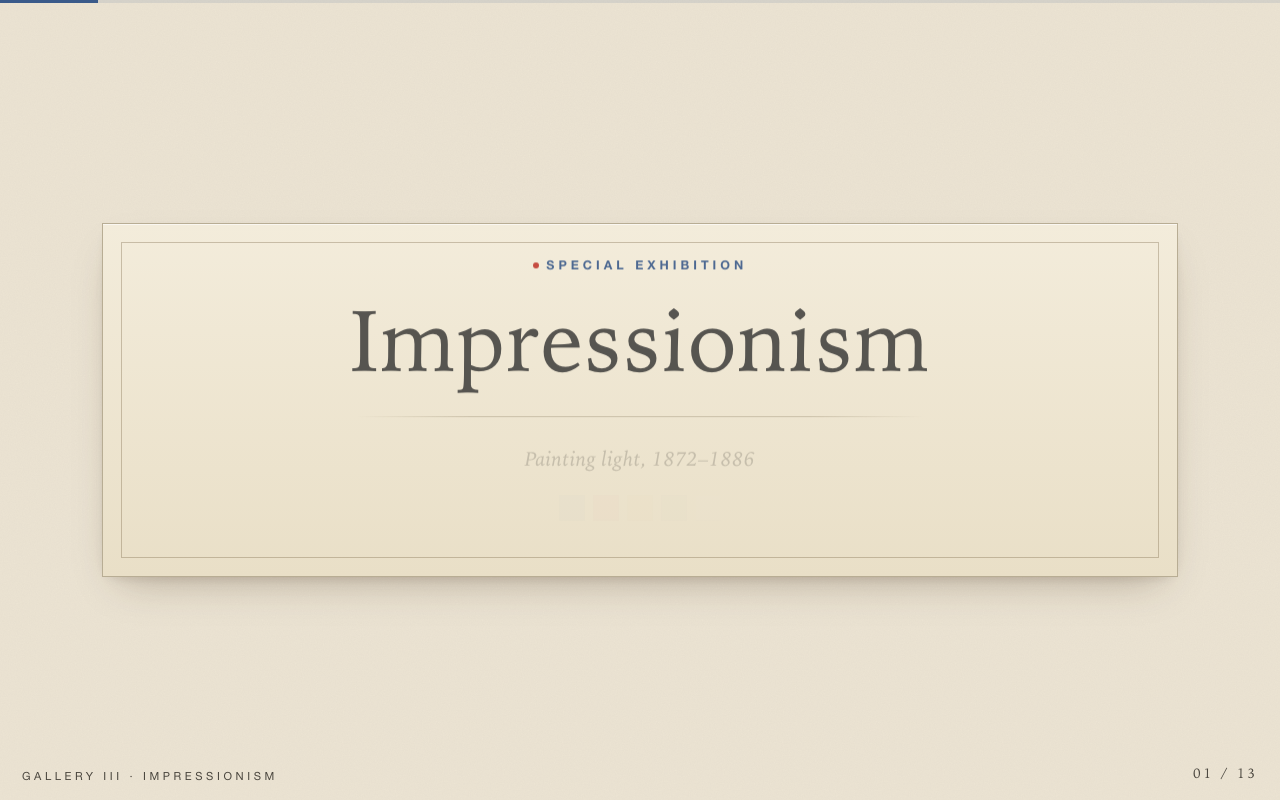
Impressionism
- Art / Painting
- The revolutionary movement that shattered academic painting conventions and taught the world to see light, color, and the fleeting beauty of modern life.
- Paris, 1860s--1880s
- 1 / 23
Slide 02
Origins: Rebellion Against the Academy
- In mid-19th century France, the Academie des Beaux-Arts controlled artistic taste through the annual Salon exhibition. Paintings were expected to depict historical, mythological, or religious subjects with precise, polished technique. A group of young artists had other ideas.
- The Academic Standard
- The Salon jury favored "licked" surfaces with no visible brushstrokes, somber palettes, and grand narrative subjects. Artists spent years copying Old Masters in the Louvre before attempting original work.
- Seeds of Change
- Eugene Delacroix's expressive color, Gustave Courbet's realism of everyday life, and the Barbizon School's plein air landscape painting all laid groundwork. The invention of portable paint tubes in 1841 by John Goffe Rand made outdoor painting practical.
- 2 / 23
Slide 03
The Salon des Refuses, 1863
- When the Salon jury rejected over 3,000 works in 1863, Emperor Napoleon III allowed a "Salon of the Refused" to let the public judge for themselves. Among the scandalous works:
- Edouard Manet's Le Dejeuner sur l'herbe depicted a nude woman picnicking with clothed men -- not a goddess or allegory, but a contemporary Parisian woman staring directly at the viewer.
- The painting was mocked by critics and the public alike, but it electrified young artists who saw in it a bold new direction. Manet became the reluctant figurehead of the avant-garde, though he never exhibited with the Impressionists and continued submitting to the official Salon throughout his career.
- 3 / 23
Slide 04
The First Impressionist Exhibition
- On April 15, 1874, thirty artists opened their own independent show at the studio of photographer Felix Nadar, 35 Boulevard des Capucines, Paris. They called themselves the "Societe anonyme des artistes peintres, sculpteurs et graveurs."
- Artists exhibited
- 165
- Works shown
- 3,500
- Visitors attended
- Total exhibitions (1874-1886)
- The critic Louis Leroy, writing in Le Charivari on April 25, 1874, used Claude Monet's painting Impression, Sunrise to mock the entire show, calling the artists "Impressionists." They adopted the name.
- 4 / 23
Slide 05
Claude Monet (1840--1926)
- The most emblematic Impressionist. Monet pursued the effects of light with obsessive devotion across six decades, painting the same subjects under different conditions to capture what he called "instantaneity."
- Key Works
- Impression, Sunrise (1872) -- the painting that named the movement
- Woman with a Parasol (1875) -- his wife Camille, radiant plein air
- Gare Saint-Lazare series (1877) -- steam and light in the modern city
- Haystacks series (1890-91) -- 25 paintings of the same subject
- Rouen Cathedral series (1892-94) -- 30+ paintings of facade light
- Water Lilies (1897-1926) -- 250 paintings spanning 29 years
- Life & Legacy
- Born in Paris, raised in Le Havre. Studied with Eugene Boudin who taught him plein air painting. Endured decades of poverty -- his first wife Camille died in 1879, aged 32. Found financial success in the 1880s with dealer Paul Durand-Ruel. Created his famous garden at Giverny in 1883, painting it until his death at 86. His Meules sold for $110.7 million in 2019.
- 5 / 23
Slide 06
Pierre-Auguste Renoir (1841--1919)
- Where Monet painted landscapes and light, Renoir devoted himself to people -- the warmth of skin in sunlight, the joy of social gatherings, the sensuality of the human form.
- Key Works
- Bal du moulin de la Galette (1876) -- dappled sunlight on dancing Parisians, sold for $78.1M in 1990
- Luncheon of the Boating Party (1881) -- his future wife Aline among friends on the Seine
- Dance at Bougival (1883) -- full-size couple mid-waltz
- The Bathers (1887) -- his "dry" period, classical influence
- Life & Legacy
- Son of a tailor from Limoges. Began as a porcelain painter at 13. Developed severe rheumatoid arthritis in the 1890s; by 1912 he was wheelchair-bound but painted with brushes strapped to his hands. Created over 4,000 works. Said near death: "I think I am beginning to understand something about it."
- 6 / 23
Slide 07
Edgar Degas (1834--1917)
- Degas resisted the Impressionist label, preferring "Realist." He rarely painted outdoors, instead capturing the artificial light of theaters, rehearsal rooms, and racecourses with unconventional compositions influenced by Japanese prints and photography.
- Key Works
- The Dance Class (1874) -- ballet master and students in rehearsal
- L'Absinthe (1876) -- melancholy cafe scene, radical cropping
- The Star (1878) -- ballerina under stage lights, pastel on paper
- Little Dancer Aged Fourteen (1881) -- wax sculpture with real fabric and hair
- Technique
- Master draftsman who studied under Ingres disciple Louis Lamothe. Used pastel, oil, monotype, and sculpture. Known for asymmetric compositions, unusual viewpoints (from above, from the wings), and cropped figures that suggest a snapshot quality. Created about 1,500 paintings of dancers -- roughly half his oeuvre.
- 7 / 23
Slide 08
Camille Pissarro (1830--1903)
- The "dean of Impressionism" -- the only artist who exhibited in all eight Impressionist exhibitions. A mentor to Cezanne, Gauguin, and later the Neo-Impressionists, Pissarro was the moral center of the movement.
- "Blessed are they who see beautiful things in humble places where other people see nothing."
- -- Camille Pissarro
- Key Works
- Boulevard Montmartre series (1897) -- 14 views of the same boulevard in different weather and times of day
- The Red Roofs (1877) -- rural village through winter trees
- Apple Picking at Eragny (1888) -- Neo-Impressionist period
- Life
- Born on the island of St. Thomas in the Danish West Indies to a Sephardic Jewish family. Moved to Paris at 25. Lost hundreds of paintings when Prussian soldiers occupied his home in the Franco-Prussian War (1870). An anarchist who saw art as inseparable from social justice.
- 8 / 23
Slide 09
Berthe Morisot (1841--1895)
- The most prominent woman among the Impressionists, Morisot exhibited in seven of their eight shows. She painted with a fluid, translucent brushwork that was among the most radical in the group.
- Key Works
- The Cradle (1872) -- her sister watching over her sleeping baby, exhibited at the first Impressionist show
- Summer's Day (1879) -- two women boating in the Bois de Boulogne
- In the Dining Room (1886) -- domestic interior with bold, loose strokes
- Context
- Great-granddaughter of Fragonard. Studied with Corot. Married Eugene Manet (Edouard's brother). As a woman of the bourgeoisie, she could not visit cafes or studios freely, so she painted domestic scenes, gardens, and women in private spaces -- giving voice to experiences largely invisible in male-dominated art.
- 9 / 23
Slide 10
Mary Cassatt (1844--1926)
- The only American to exhibit with the Impressionists. Degas invited her in 1877, and she became central to introducing Impressionism to American collectors.
- "I have not done what I wanted to, but I tried to make a good fight."
- -- Mary Cassatt
- Key Works
- Little Girl in a Blue Armchair (1878) -- child sprawled casually, radical composition
- The Child's Bath (1893) -- mother and child, Japanese-influenced pattern
- Woman with a Pearl Necklace in a Loge (1879) -- opera theater, Degas's influence
- Legacy
- Born in Pittsburgh to a wealthy family. Studied at the Pennsylvania Academy, then in Paris. Persuaded major American collectors -- the Havemeyers, the Palmers -- to buy Impressionist works. Their purchases formed the core of Impressionist collections at the Metropolitan Museum and Art Institute of Chicago.
- 10 / 23
Slide 11
Alfred Sisley & Others
- Alfred Sisley (1839--1899)
- Born in Paris to English parents. The purest landscape painter among the Impressionists -- devoted almost exclusively to skies, rivers, and the Ile-de-France countryside. His Flood at Port-Marly (1876) captures the eerie beauty of disaster. Died in poverty; his works now sell for millions.
- Frederic Bazille (1841--1870)
- Tall, wealthy, generous -- Bazille financially supported Monet and Renoir during lean years. His Family Reunion (1867) merged plein air light with figure painting. Killed in the Franco-Prussian War at age 28, before Impressionism had a name.
- Gustave Caillebotte (1848--1894)
- Engineer-turned-painter whose Paris Street; Rainy Day (1877) combined Impressionist light with perspectival precision. A wealthy patron, he bought works by his friends. His bequest of 67 paintings to the state formed the core of the Musee d'Orsay's Impressionist collection.
- Armand Guillaumin (1841--1927)
- The most vivid colorist of the group, anticipating Fauvism. Worked as a government employee while painting. Won 100,000 francs in the lottery in 1891, allowing him to paint full-time. Outlived all other original Impressionists.
- 11 / 23
Slide 12
Technique: Capturing Light
- Impressionist technique was a radical departure from academic painting. Every brushstroke served the sensation of light and atmosphere rather than the description of form.
- Broken Color
- Instead of mixing colors on the palette, Impressionists placed strokes of pure color side by side, allowing the viewer's eye to blend them optically. A shadow might contain violet, blue, and green rather than simply darkened local color.
- Plein Air Painting
- Working outdoors, directly from nature. The portable easel, collapsible paint tubes (invented 1841), and new rail connections to the countryside made this practical. Speed was essential: light changed quickly.
- New Pigments
- Chemistry gave painters new colors: cobalt blue (1802), viridian green (1838), cerulean blue (1860), and synthetic ultramarine. These brighter, more stable pigments enabled the luminous Impressionist palette. Black virtually disappeared.
- Visible Brushwork
- Academic painters hid their brushstrokes through careful blending. Impressionists left visible marks -- short dabs, comma strokes, broad sweeps. The surface texture itself became part of the painting's energy and immediacy.
- 12 / 23
Slide 13
The Impressionist Palette
- Impressionists banished earth tones and bitumen in favor of a prismatic palette derived from the color theories of Michel Eugene Chevreul and Ogden Rood.
- Cobalt Blue -- Ultramarine -- Cerulean -- Viridian -- Chrome Yellow -- Orange -- Vermilion -- Cobalt Violet
- Chevreul's Law
- Simultaneous contrast: colors appear more intense when placed next to their complements. Orange next to blue vibrates. Impressionists exploited this to make shadows luminous -- purple shadows on yellow haystacks, blue shadows on orange-lit snow.
- No Black Shadows
- Renoir declared: "No shadow is black. It always has a color. Nature knows only colors." Impressionist shadows shimmer with reflected light -- blues, violets, and greens where academic painters would have used raw umber or black.
- 13 / 23
Slide 14
Subject Matter: Modern Life
- The Impressionists painted the world around them: Baron Haussmann's new boulevards, the railroads, leisure on the Seine, cafes, theaters, and the emerging middle class at play.
- Urban Paris
- Monet's Gare Saint-Lazare -- steam, iron, and speed
- Caillebotte's Paris Street; Rainy Day -- Haussmann's geometry
- Degas's L'Absinthe -- cafe alienation
- Renoir's Moulin de la Galette -- open-air dance halls
- Landscape & Leisure
- Monet's Regatta at Argenteuil -- sailing on the Seine
- Renoir's Luncheon of the Boating Party -- outdoor dining
- Sisley's Bridge at Villeneuve-la-Garenne -- river towns
- Pissarro's rural villages and market scenes
- "Il faut etre de son temps" -- One must be of one's time.
- -- Honore Daumier, a maxim embraced by the Impressionists
- 14 / 23
Slide 15
Edouard Manet: The Reluctant Revolutionary
- Manet (1832--1883) never considered himself an Impressionist and never exhibited with the group, yet his bold, flat brushwork and modern subjects inspired the entire movement.
- Key Works
- Le Dejeuner sur l'herbe (1863) -- the scandal that started it all
- Olympia (1863) -- a nude courtesan staring defiantly at the viewer, guarded by a black cat
- The Fifer (1866) -- flat color, Japanese-print influence
- A Bar at the Folies-Bergere (1882) -- his final masterpiece, enigmatic mirror
- Bridge Figure
- Manet bridged Realism and Impressionism. He studied Velazquez and Goya but painted with a directness that eliminated halftones. Zola called him "a born classicist." He desperately wanted Salon acceptance and the Legion d'Honneur (which he received in 1882, one year before his death from syphilis at age 51).
- 15 / 23
Slide 16
The Role of Paul Durand-Ruel
- The Impressionists might have starved without their champion dealer, Paul Durand-Ruel (1831--1922). He bought their work when no one else would, organized exhibitions, and opened the American market.
- 1870
- Meets Monet and Pissarro in London during the Franco-Prussian War. Begins buying their paintings.
- 1874-1886
- Supports the Impressionists financially through lean years. Buys over 1,000 Monet paintings, 1,500 Renoirs, 800 Pissarros during his career.
- 1886
- Takes 300 Impressionist paintings to New York. The American exhibition is a turning point -- American collectors begin buying heavily.
- Legacy
- Invented the modern art dealer model: exclusive contracts, solo shows, catalogue raisonnes. Said: "A true picture dealer should be an enlightened patron."
- 16 / 23
Slide 17
Critical Reception
- Early critical response ranged from bafflement to outright hostility. The Impressionists were accused of laziness, incompetence, and even insanity.
- "Wallpaper in its embryonic state is more finished than that seascape."
- -- Louis Leroy, reviewing Monet's Impression, Sunrise, 1874
- "Try to explain to Monsieur Renoir that the torso of a woman is not a mass of decomposing flesh."
- -- Albert Wolff, Le Figaro, 1876
- Yet sympathetic critics like Theodore Duret, Emile Zola, and Jules Castagnary championed the movement. By the 1880s, public opinion was shifting. By the 1890s, Impressionist paintings were hanging in museums and selling for substantial sums.
- 17 / 23
Slide 18
Japanese Influence: Japonisme
- When Japan reopened to trade in 1854 after 200 years of isolation, Japanese woodblock prints (ukiyo-e) flooded into Paris. Their influence on Impressionism was profound.
- What They Borrowed
- Flat areas of color without modeling
- Asymmetric composition and cropped figures
- High viewpoints and diagonal perspectives
- Bold outlines and decorative patterns
- Everyday subjects treated with equal dignity
- Who Was Influenced
- Monet collected 231 Japanese prints (still displayed at Giverny). Degas adopted radical cropping from Hiroshige. Cassatt's later color prints directly emulate Utamaro. Manet included a Japanese screen in his portrait of Zola. Van Gogh copied Hiroshige woodcuts in oil.
- 18 / 23
Slide 19
Photography & Impressionism
- Photography, invented in 1839, threatened painting's monopoly on representation -- but it also liberated painters to pursue something the camera could not: subjective perception and color.
- Photography's Gifts
- Captured fleeting moments, inspiring painters to do the same
- Blurred motion showed that "reality" was not always sharp
- Arbitrary cropping suggested new compositional strategies
- Aerial views from balloons (Nadar) inspired overhead perspectives
- Painting's Response
- Freed from documentary duty, Impressionists could focus on what photography could not capture: color relationships, atmospheric effects, and the subjective experience of seeing. Degas owned a camera and used photographs as sketches. Monet insisted he painted "what the photograph cannot."
- 19 / 23
Slide 20
Post-Impressionism: What Came Next
- By the mid-1880s, younger artists were pushing beyond Impressionism's focus on surface appearances, seeking deeper structure, emotion, and expression.
- Paul Cezanne (1839--1906)
- "The father of modern art." Sought to "treat nature by the cylinder, the sphere, the cone." His structured brushwork and geometric simplification led directly to Cubism. Pivotal works: Mont Sainte-Victoire series, The Card Players.
- Georges Seurat (1859--1891)
- Systematized Impressionist color theory into Pointillism/Divisionism -- tiny dots of pure color applied scientifically. A Sunday Afternoon on the Island of La Grande Jatte (1886) took two years and became an icon.
- Vincent van Gogh (1853--1890)
- Transformed Impressionist color into emotional expression. Thick impasto, swirling lines, vibrant contrasts. Sold one painting in his lifetime. Created 2,100 works in ten years. Starry Night, Sunflowers, Irises.
- Paul Gauguin (1848--1903)
- Rejected naturalism for Synthetism: flat color, bold outlines, symbolic content. Traveled to Tahiti seeking "primitive" authenticity. Influenced the Nabis, Fauvism, and Expressionism. Where Do We Come From? (1897).
- 20 / 23
Slide 21
Impressionism Beyond France
- The movement spread across the globe as artists traveled to Paris, absorbed its lessons, and adapted them to their own landscapes and cultures.
- American Impressionism
- Childe Hassam painted Manhattan streets with Impressionist light. John Singer Sargent adapted plein air brilliance to portraiture. The Ten American Painters group (1897) and art colonies at Old Lyme, Connecticut and Cos Cob brought Impressionism to the American countryside.
- Global Spread
- Australia: Tom Roberts and the Heidelberg School (1880s)
- Germany: Max Liebermann, Lovis Corinth
- Spain: Joaquin Sorolla's luminous beach scenes
- Scandinavia: Peder Severin Kroyer's Skagen painters
- Japan: Kuroda Seiki brought plein air painting from Paris
- Russia: Konstantin Korovin, Valentin Serov
- 21 / 23
Slide 22
Impressionism by the Numbers
- $110.7M
- Record Monet sale (2019)
- Group exhibitions
- 250+
- Monet's Water Lilies
- 4,000+
- Renoir's paintings
- 1,500
- Degas ballet works
- 9.6M
- Musee d'Orsay visitors/yr
- 1841
- Paint tube invented
- Years, movement peak
- The Impressionists' works are now among the most valuable, visited, and reproduced artworks in human history. Monet's Water Lilies panels alone occupy two oval rooms at the Orangerie museum in Paris, bequeathed to France the day after the Armistice in 1918.
- 22 / 23
Slide 23
Legacy: Seeing the World Differently
- Impressionism's greatest legacy is not a style but a permission: the freedom to paint what you see, how you see it, in the moment you see it. Every movement that followed -- Post-Impressionism, Fauvism, Abstract Expressionism, even digital art -- owes a debt to these painters who dared to trust their eyes over tradition.
- "Everyone discusses my art and pretends to understand, as if it were necessary to understand, when it is simply necessary to love."
- -- Claude Monet
- They painted sunlight on water, wind in the poplars, steam above locomotives, and laughter in the garden. In doing so, they taught us that the ordinary world -- this world, right now, in this light -- is worthy of our deepest attention.
- End of presentation
- 23 / 23