shipslides
Art30 slides0 views

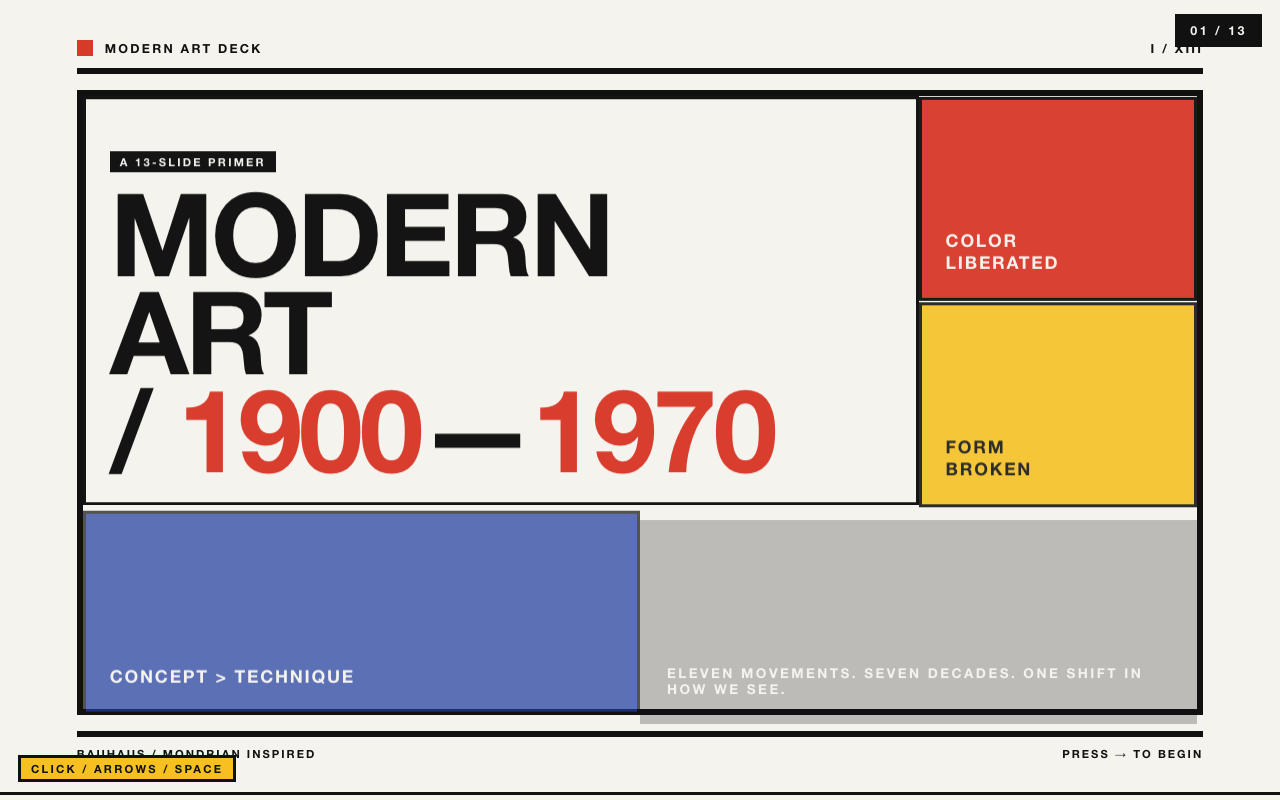
Modern Art Movements

From Impressionism to AI-Generated Art — A Century and a Half of Creative Revolution. Slides: Modern Art Movements · Impressionism · Post-Impressionism · Cubism · Expressionism · Dada · Bauhaus · Surrealism · Abstract Expressionism · Pop Art · Minimalism · Conceptual Art · 1960s–present.

StandaloneDownloadMarkdown
Sandboxed deck
Open raw

About this HTML presentation

This Shipslides page presents Modern Art Movements as an interactive HTML presentation deck in the Art catalog with 30 slides. The share page keeps the uploaded deck sandboxed while exposing readable context, topics, and a slide outline for viewers and search engines.

From Impressionism to AI-Generated Art — A Century and a Half of Creative Revolution Key sections include: Modern Art Movements; Impressionism; Post-Impressionism; Cubism; Expressionism; Dada; Bauhaus; Surrealism; Abstract Expressionism; Pop Art.

Key sections

  • 01Modern Art Movements
  • 02Impressionism
  • 03Post-Impressionism
  • 04Cubism
  • 05Expressionism
  • 06Dada
  • 07Bauhaus
  • 08Surrealism
  • 09Abstract Expressionism
  • 10Pop Art
  • 11Minimalism
  • 12Conceptual Art · 1960s–present
  • 13Fluxus & Performance Art
  • 14Land Art
  • 15Postmodern Art
  • 16Neo-Expressionism
  • 17Video Art & Installation
  • 18Street Art Revolution
  • 19Digital Art
  • 20Feminist Art Movement
  • 21Global Contemporary Art
  • 22NFT & Crypto Art
  • 23AI-Generated Art
  • 24Recurring Themes Across Movements
Topics covered

Slide outline
  1. 01Modern Art Movements
  2. 02Impressionism
  3. 03Post-Impressionism
  4. 04Cubism
  5. 05Expressionism
  6. 06Dada
  7. 07Bauhaus
  8. 08Surrealism
  9. 09Abstract Expressionism
  10. 10Pop Art
  11. 11Minimalism
  12. 12Conceptual Art · 1960s–present
  13. 13Fluxus & Performance Art
  14. 14Land Art
  15. 15Postmodern Art
  16. 16Neo-Expressionism
  17. 17Video Art & Installation
  18. 18Street Art Revolution
  19. 19Digital Art
  20. 20Feminist Art Movement
  21. 21Global Contemporary Art
  22. 22NFT & Crypto Art
  23. 23AI-Generated Art
  24. 24Recurring Themes Across Movements
  25. 25Institutions & Markets
  26. 26Art Criticism & Theory
  27. 27A Century and a Half at a Glance
  28. 28What Modern Art Changed
  29. 29How to Look at Modern Art
  30. 30Modern Art Movements · A Continuing Revolution
Page data
Canonical
https://shipslides.com/d/art-modern-movements
Category
Art
Size
76.8 KB
Updated
2026-05-17
LLM text
https://shipslides.com/d/art-modern-movements/llms.txt

Presentation Transcript

Detailed slide-by-slide text content extracted from this presentation.

Slide 01

Modern Art Movements

  • Art History Series
  • From Impressionism to AI-Generated Art — A Century and a Half of Creative Revolution
  • Scroll to Explore
  • 01 / 30
Slide 02

Impressionism

  • 1874
  • Paris · 1860s–1880s
  • The first modern art movement broke every academic rule: loose brushwork, everyday subjects, the fleeting effects of light. Named mockingly after Monet's "Impression, Sunrise," it became the foundation of modern art.
  • Rejected by the Paris Salon, Impressionists mounted their own exhibition in 1874 — the beginning of the independent art market.
  • Key Artists
  • Claude Monet
  • Pierre-Auguste Renoir
  • Edgar Degas
  • Berthe Morisot
  • Camille Pissarro
  • CERULEAN
  • OCHRE
  • VIRIDIAN
  • ROSE
  • MAUVE
  • LEMON
  • 02 / 30
Slide 03

Post-Impressionism

  • 1886–1910
  • Four visionaries took Impressionism's freedoms and pushed them toward something more personal, structural, and emotionally charged — laying the groundwork for every avant-garde movement to follow.
  • Paul Cézanne
  • Structural
  • Reduced nature to cylinders, cones, spheres. His obsessive analysis of form made him "the father of us all" to Picasso and Braque.
  • Vincent van Gogh
  • Expressionist
  • Swirling brushstrokes and electric color to convey inner turmoil. Largely unknown in his lifetime, now among the world's most beloved painters.
  • Paul Gauguin
  • Symbolist
  • Fled to Tahiti seeking "primitive" authenticity. Flat forms, bold outlines, spiritual themes that prefigured Expressionism.
  • 03 / 30
Slide 04

Cubism

  • 1907–1920s
  • Picasso and Braque shattered the single viewpoint. Objects depicted from multiple angles simultaneously — the most radical departure from Renaissance perspective in 500 years.
  • "I paint objects as I think them,
  • not as I see them."
  • — Pablo Picasso
  • Proto-Cubism
  • 1907–1908. "Les Demoiselles d'Avignon" — Picasso's breakthrough. African mask influence, fractured forms.
  • Analytic Cubism
  • 1908–1912. Monochromatic browns and grays. Objects nearly dissolved into planes and facets.
  • Synthetic Cubism
  • 1912–1920s. Collage introduced. Brighter colors return. Newspapers, wallpaper glued to canvas.
  • 04 / 30
Slide 05

Expressionism

  • Germany · 1905–1930s
  • Where Impressionists captured outer light, Expressionists painted inner anguish. Distorted forms, clashing colors, raw emotion — art as psychological scream.
  • "I have never been able to create my work calmly. It has always been done in the agony of inner conflict."
  • — Edvard Munch
  • Key Groups
  • Die Brücke — Dresden, 1905. Kirchner, Heckel, Schmidt-Rottluff. Raw woodcut aesthetic.
  • Der Blaue Reiter — Munich, 1911. Kandinsky, Marc, Macke. Spiritual abstraction.
  • Vienna Secession — Klimt, Schiele. Erotic intensity, decorative richness.
  • New Objectivity — Post-WWI cynicism. Grosz, Dix. Savage social satire.
  • 05 / 30
Slide 06

Dada

  • Zürich · 1916–1924
  • Born in a Zürich cabaret during WWI, Dada was anti-art art. Nonsense, chance operations, readymades — a deliberate assault on logic, reason, and the bourgeois values that led to industrial slaughter.
  • "The acts of life have no beginning or end. Everything happens in a completely idiotic way."
  • — Tristan Tzara
  • ANTI-ART
  • CHANCE
  • NONSENSE
  • COLLAGE
  • READY-MADE
  • PROTEST
  • IRONY
  • CABARET
  • Key figures: Marcel Duchamp, Hugo Ball, Emmy Hennings, Hannah Höch, Man Ray, Jean Arp
  • 06 / 30
Slide 07

Bauhaus

  • Weimar · Dessau · Berlin · 1919–1933
  • Art + Craft
  • No hierarchy between fine art and applied craft. Painters trained alongside potters, weavers, and metalworkers.
  • Form Follows Function
  • Design should serve human needs. Beauty emerges from purpose, not ornament.
  • Total Work of Art
  • Architecture as the culmination of all arts. The building as complete human environment.
  • Itten, Albers, Klee, Kandinsky — the Bauhaus color and form course revolutionized design education. When the Nazis closed it in 1933, its teachers scattered worldwide, carrying its ideas with them.
  • 07 / 30
Slide 08

Surrealism

  • Paris · 1924–1960s
  • André Breton's 1924 Manifesto launched an art movement dedicated to the unconscious mind. Freud's dream theory translated into canvas, film, and literature.
  • Surrealism sought to resolve waking reality and dream life into a "super-reality" — the surreal.
  • "The dream is not meaningless, not absurd... it is a perfectly valid psychical phenomenon." — Freud, whose theories Breton devoured
  • Automatism
  • Drawing or writing without conscious control. Let the unconscious speak directly.
  • Juxtaposition
  • Unexpected combinations — "Beautiful as the chance meeting of a sewing machine and an umbrella on a dissecting table." (Lautréamont)
  • Dreamscapes
  • Dali's hyper-realism in impossible contexts. Magritte's philosophical visual puzzles.
  • The Uncanny
  • Familiar made strange. De Chirico's empty piazzas. Ernst's forests. Miró's biomorphs.
  • 08 / 30
Slide 09

Abstract Expressionism

  • New York · 1940s–1950s
  • WWII refugees flooded New York, and American artists developed the first uniquely American avant-garde: massive canvases, gestural action, pure emotion. The center of the art world shifted from Paris to New York.
  • Jackson Pollock
  • Drip Painting
  • Mark Rothko
  • Color Field
  • Franz Kline
  • Black & White
  • Lee Krasner
  • Organic Forms
  • 09 / 30
Slide 10

Pop Art

  • UK & USA · 1950s–1970s
  • Art drawn from advertising, comics, packaging, and celebrity culture. A critique of consumer society that also celebrated it — irreverent, accessible, commercial, revolutionary.
  • Andy Warhol — Campbell's Soup, Marilyn silkscreens, "15 minutes of fame" · Roy Lichtenstein — Comic panel magnified to gallery scale · Jasper Johns — Flags, targets, maps · Richard Hamilton — Coined the term in UK · David Hockney — California pools, double portraits
  • POW!
  • ZAP!
  • WOW!
  • BAM!
  • 10 / 30
Slide 11

Minimalism

  • 1960s–1970s · USA
  • Strip to Essentials
  • Remove all reference, symbol, illusion. The work is what it is.
  • Industrial Materials
  • Steel, bricks, fluorescent tubes. Donald Judd's "specific objects."
  • Viewer in Space
  • The relationship between viewer, object, and room is the work.
  • Key Figures
  • Donald Judd, Dan Flavin, Carl Andre, Agnes Martin, Frank Stella
  • 11 / 30
Slide 12

Conceptual Art · 1960s–present

  • "The idea itself, even if not made visual, is as much a work of art as any finished product."
  • Language as Art
  • Joseph Kosuth's "One and Three Chairs" — object, photograph, definition. What is the real chair?
  • Instructions as Art
  • Yoko Ono's "Instruction Paintings." Sol LeWitt's wall drawings executed by others.
  • Documentation
  • The artwork exists in documentation of an action. The gallery holds records, not objects.
  • "Duchamp's urinal was the original provocation — if I choose it, it's art."
  • 12 / 30
Slide 13

Fluxus & Performance Art

  • 1960s–present
  • Art as event, as living action. George Maciunas launched Fluxus in 1962 — international, irreverent, anti-commercial. "Life is art, art is life."
  • Performance art made the artist's body the medium. Marina Abramović tested endurance and presence. Chris Burden was shot for art.
  • Marina Abramović
  • Yoko Ono
  • Chris Burden
  • Joseph Beuys
  • Nam June Paik
  • 1962 · Fluxus Festival
  • Wiesbaden, Germany. Music, poetry, happenings. Maciunas defines the movement as "purge bourgeois sickness."
  • 1974 · Rhythm 0
  • Abramović stands passive for 6 hours. Audience given 72 objects including a gun. Social experiment becomes legend.
  • 1971 · Beuys Social Sculpture
  • "Every human being is an artist." Art as transformative social force, not gallery object.
  • 13 / 30
Slide 14

Land Art

  • 1960s–present · USA & Beyond
  • Art made with and in the natural landscape — too big for galleries, often in remote deserts. A rejection of the commercial art market. Nature as both medium and gallery.
  • Works erode, flood, and change with seasons — time built into the art itself.
  • Spiral Jetty — Robert Smithson (1970)
  • 6,650 tons of basalt forming a 1,500-foot coil in Utah's Great Salt Lake. Appears and disappears with water levels.
  • The Lightning Field — Walter De Maria (1977)
  • 400 stainless steel poles across New Mexico desert. Lightning as artistic event. Visitors stay one night.
  • Wrapped Coastline — Christo (1969)
  • 1.24 million sq ft of erosion-control fabric wrapped around Little Bay, Sydney. Scale as artwork.
  • Sun Tunnels — Nancy Holt (1976)
  • Four concrete tubes aligned to solstice sunrises and sunsets in the Utah desert.
  • 14 / 30
Slide 15

Postmodern Art

  • 1970s–2000s
  • Appropriation
  • Sherrie Levine re-photographed Walker Evans's photographs. Who owns an image? What is originality?
  • Deconstruction
  • All "grand narratives" are suspect. Art exposes the constructed nature of identity, gender, race, and power.
  • Hybridity
  • No pure styles — pastiche, irony, mixing high and low culture. Koons's stainless balloon animals in auction rooms.
  • Identity Politics
  • Art as platform for marginalized voices. Guerrilla Girls, ACT UP posters, queer art, postcolonial perspectives.
  • Jean Baudrillard
  • Simulation & Simulacra
  • Jacques Derrida
  • Deconstruction
  • Michel Foucault
  • Power / Knowledge
  • Jean-François Lyotard
  • End of Metanarratives
  • 15 / 30
Slide 16

Neo-Expressionism

  • 1970s–1980s · Global
  • A return to painting, figuration, and raw emotion after the cool detachment of conceptualism and minimalism. Messy, urgent, unapologetic.
  • Three scenes emerged independently: Germany's Neue Wilden, Italy's Transavanguardia, and the New York East Village.
  • Jean-Michel Basquiat
  • USA · New York
  • Graffiti-trained. Race, identity, mortality — raw poetry on canvas. Died at 27 in 1988.
  • Georg Baselitz
  • Germany · Neue Wilden
  • Painted figures upside down to free form from content. Deliberately crude, monumental.
  • Francesco Clemente
  • Italy · Transavanguardia
  • Personal mythology, the body as spiritual landscape. East-West synthesis.
  • Anselm Kiefer
  • Germany · History painter
  • Germany's Nazi past confronted with scale, lead, ash, and straw. Monumental guilt.
  • 16 / 30
Slide 17

Video Art & Installation

  • 1960s–present
  • Nam June Paik plugged a magnet into a TV set in 1963 and created the first video art. The screen became canvas. Immersive installation transformed the gallery into an environment.
  • Nam June PaikTV Garden, 1974 — 33 plants and monitors. Pioneer of video as art medium.
  • Bill ViolaSlow-motion video as meditation on birth, death, and consciousness.
  • Bruce NaumanCorridors, neon, video. The gallery as disorienting psychological space.
  • James TurrellLight and perception — rooms where light seems solid and space dissolves.
  • Video as primary medium
  • Expanded Cinema
  • Gene Youngblood's 1970 book predicted art dissolving into life through new media — TV, computers, expanded consciousness.
  • Immersive installation
  • Environment as Art
  • Yayoi Kusama's infinity rooms, Olafur Eliasson's weather project — the viewer inside the artwork.
  • 17 / 30
Slide 18

Street Art Revolution

  • 1970s–present
  • From New York subway cars to gallery auctions — graffiti grew from urban outlaw act to global art movement. Public space as democratic canvas.
  • The streets asked: Who owns public space? Whose images fill the city? Street art answers with unauthorized beauty, wit, and protest.
  • Banksy
  • Anonymous UK-based artist. Political stencils in unexpected locations. Shredded his own work at Sotheby's. Market value: millions.
  • Keith Haring
  • NYC subway chalk drawings went global. Bold outlines, dancing figures. AIDS activism made visible.
  • Massive photographic portraits in conflict zones, favelas, borders. TED Prize winner. "Art changes the world."
  • KAWS
  • Hijacked bus stop ads in the 1990s. Now: 18-meter inflatable sculptures at Art Basel.
  • 18 / 30
Slide 19

Digital Art

  • 1960s–present
  • From Vera Molnár's 1968 computer drawings to today's AI-generated images — digital tools transformed what it means to make art. The pixel became the brushstroke.
  • Generative Art
  • Algorithms create form. Manfred Mohr's geometric structures since 1969.
  • Net Art
  • 1990s internet as medium. JODI, 0100101110101101.ORG — art that lives online.
  • 3D & VR
  • Virtual reality as gallery. Art that exists only in digital space — no original, infinite copies.
  • The NFT boom of 2021 created a provenance system for digital art — Beeple's "Everydays" sold for $69 million at Christie's. The debate: is scarcity meaningful when the work can be copied infinitely?
  • 19 / 30
Slide 20

Feminist Art Movement

  • 1960s–present
  • Consciousness-raising in canvas and installation. Women artists demanded visibility and challenged the male-dominated art world and its histories.
  • Judy Chicago's "The Dinner Party" (1974–79) — triangular table with 39 place settings for 39 historical women. The question: why has art history forgotten them?
  • Judy Chicago
  • The Dinner Party — monumental celebration of women's history through ceramics and needlework.
  • Barbara Kruger
  • "Your body is a battleground." Bold graphic text art confronting power and gender.
  • Cindy Sherman
  • Self-portraits as countless characters — exploring female identity as social performance.
  • Guerrilla Girls
  • Anonymous activists in gorilla masks. Data-driven posters exposing sexism in art institutions since 1985.
  • 20 / 30
Slide 21

Global Contemporary Art

  • 1990s–present
  • Americas
  • Kara Walker — slavery's shadow histories in silhouette
  • Gabriel Orozco — everyday objects transformed
  • Doris Salcedo — trauma and memory in furniture
  • Kerry James Marshall — Black figuration reclaimed
  • Asia-Pacific
  • Ai Weiwei — political activism as art form
  • Takashi Murakami — superflat, manga, high-low blur
  • Yayoi Kusama — polka dots and infinity rooms
  • Nalini Malani — video and myth from India
  • Africa & Middle East
  • El Anatsui — bottle caps woven into tapestries
  • Yinka Shonibare — colonial history unpacked
  • Shirin Neshat — Iran, exile, and female identity
  • William Kentridge — apartheid's aftermath in drawing
  • Decolonization
  • Diaspora Identity
  • Climate Crisis
  • Technology
  • Memory & Trauma
  • Gender & Sexuality
  • 21 / 30
Slide 22

NFT & Crypto Art

  • 2017–present
  • Non-fungible tokens gave digital art a scarcity mechanism. For the first time, digital works could be "owned" with verifiable provenance on the blockchain.
  • The result: a $41 billion market in 2021, followed by a 97% crash by 2022 — the fastest boom-bust in art market history.
  • The deeper question remains unanswered: Is a JPEG worth $69 million if it can be copied by right-clicking? Art and ownership have never been so philosophically entangled.
  • 2017
  • CryptoPunks launch — 10,000 pixel characters on Ethereum. Free to claim.
  • 2017
  • CryptoKitties goes viral, clogs Ethereum network.
  • 2021
  • Beeple's "Everydays: The First 5000 Days" — $69.3M at Christie's. First NFT at major auction house.
  • 2021
  • Bored Ape Yacht Club launches. Celebrity culture meets blockchain collectibles.
  • 2022
  • Market collapses with crypto winter. 97% loss of NFT market value.
  • 2023+
  • Artists continue using blockchain for provenance, royalties, and community — minus hype.
  • 22 / 30
Slide 23

AI-Generated Art

  • 2015–present · The New Frontier
  • Generative Adversarial Networks, diffusion models, and large language models can now produce images indistinguishable from human work. Creativity itself is being questioned.
  • DALL-E
  • OpenAI, 2021. Text-to-image.
  • Midjourney
  • Discord-based. Aesthetic power. 2022.
  • Stable Diffusion
  • Open source. 2022. Community tools.
  • Adobe Firefly
  • Commercial, rights-cleared training data.
  • Key Debates
  • Training data scraped from living artists without consent or compensation
  • What is "creativity" if a machine can generate 1,000 variations in seconds?
  • Jason Allen's "Théâtre D'Opéra Spatial" won Colorado art competition — using Midjourney
  • Courts divided: is AI output copyrightable? (Current US ruling: no)
  • New roles emerging: AI art director, prompt engineer, curator of infinite outputs
  • 23 / 30
Slide 24

Recurring Themes Across Movements

  • Rejection of the Past
  • Every movement defines itself against what came before. Impressionists vs. Academy, Dadaists vs. reason, Postmodernists vs. Modernist purity.
  • Impressionism, Dada, Conceptualism, Street Art
  • Technology as Medium
  • Photography freed painting from representation. Film expanded time. Video multiplied screens. AI generates on demand.
  • Bauhaus, Video Art, Digital Art, AI Art
  • Politics & Power
  • Art as protest, as record, as imagination of alternatives. From Expressionist anti-war feeling to Feminist reclamation to climate activism.
  • Expressionism, Postmodernism, Feminist Art, Street Art
  • The Inner Life
  • The unconscious, dreams, trauma, spiritual experience — Surrealism, Expressionism, and Abstract Expressionism all turn inward.
  • Surrealism, Expressionism, AbEx, Performance Art
  • 24 / 30
Slide 25

Institutions & Markets

  • Where Art Lives & Sells
  • MoMA, New York
  • Est. 1929
  • Founded to champion modernism when it was radical. Now defines what "modern art" means globally.
  • Tate Modern, London
  • Est. 2000
  • Bankside power station transformed. Most-visited modern art museum in the world: 6 million/year.
  • Centre Pompidou, Paris
  • Est. 1977
  • Inside-out architecture as radical statement. Europe's premier collection of modern and contemporary.
  • Guggenheim, Bilbao
  • Est. 1997
  • Gehry's titanium curves revived a declining industrial city — the "Bilbao Effect" on urban regeneration.
  • Art Basel
  • Est. 1970
  • World's premier art fair — Basel, Miami, Hong Kong. Where galleries meet collectors and prices are set.
  • Venice Biennale
  • Est. 1895
  • Oldest international art exhibition. National pavilions as cultural diplomacy. The art world's Olympics.
  • The contemporary art market reaches $65 billion annually. Sotheby's and Christie's set records with Basquiat, Hockney, Kusama. Meanwhile, emerging art fairs in Lagos, Seoul, and Jakarta signal a rebalancing of the global art center.
  • 25 / 30
Slide 26

Art Criticism & Theory

  • How We Understand Art
  • Every artwork generates discourse. Critics and theorists shape what gets seen, valued, and remembered. The frame around a work is as powerful as the work itself.
  • From Greenberg's formalism to bell hooks' feminist gaze — critical theory changes how we look and what we see.
  • Clement Greenberg
  • Championed Abstract Expressionism and formalism — art about art's own properties. Shaped 1950s American taste.
  • John Berger
  • "Ways of Seeing" (1972) — how context, gender, and capitalism determine how we look at images. BBC series, essential text.
  • Rosalind Krauss
  • October magazine co-founder. Applied semiotics and psychoanalysis to minimalism and postmodernism.
  • bell hooks
  • The oppositional gaze — how Black women look back at images that exclude or distort them. Art and liberation.
  • 26 / 30
Slide 27

A Century and a Half at a Glance

  • 1860s–80s
  • Impressionism
  • Paris. Light, color, everyday life.
  • 1880s–1910
  • Post-Impressionism & Symbolism
  • Cézanne, van Gogh, Gauguin, Redon.
  • 1900s–1920s
  • Fauvism, Cubism, Futurism
  • Color liberation. Multiple perspectives. Speed.
  • 1905–1930s
  • Expressionism (Die Brücke, Der Blaue Reiter)
  • Emotional distortion. Inner anguish made visible.
  • 1916–1924
  • Dada
  • Anti-art. Chance. Protest against WWI destruction.
  • 1919–1933
  • Bauhaus
  • Art + craft + function. Design revolution.
  • 1924–1966
  • Surrealism
  • Dreams, the unconscious, the uncanny.
  • 1940s–50s
  • Abstract Expressionism
  • New York as new center. Pure gesture and emotion.
  • 1950s–70s
  • Pop Art, Minimalism, Conceptualism
  • Consumer culture. Stripped down. Ideas over objects.
  • 1960s–80s
  • Land Art, Fluxus, Performance, Video
  • Body, earth, time as medium.
  • 1970s–90s
  • Postmodernism, Neo-Expressionism, Feminist Art
  • Appropriation, identity, political urgency.
  • 1990s–2020s
  • Global Contemporary, Street Art, Digital, NFT
  • Decentralized, networked, borderless.
  • 2020s–
  • AI-Generated Art
  • Machines as co-creators. Authorship redefined.
  • 27 / 30
Slide 28

What Modern Art Changed

  • 🏛️
  • The Art Market
  • Independent exhibitions, galleries, auctions, art fairs — modern movements created the commercial infrastructure we still use. The artist as brand emerged with Warhol.
  • Design & Visual Culture
  • Bauhaus principles in your iPhone. Cubist space in every logo. Surrealist imagery in every fashion campaign. Modern art is the visual grammar of everyday life.
  • Global Perspectives
  • The art world de-centered from Paris-New York axis. Lagos, Seoul, Mumbai, Mexico City artists now shape international discourse.
  • What Art Is
  • Duchamp's urinal still hasn't been answered. Modern movements permanently expanded the definition of art to include everything and anything — which is both the problem and the point.
  • 28 / 30
Slide 29

How to Look at Modern Art

  • Give It Time
  • Resist the urge to immediately label or dismiss. Sit with a work. What does your eye do? What feelings arise before your intellect intervenes?
  • Ask What Problem It's Solving
  • Every movement responds to something. What was the artist reacting against? What constraints were they pushing through?
  • Read the Context
  • When was it made? Where? What was happening in the world? Art doesn't exist in a vacuum — history saturates every choice of color and form.
  • Trust Your Response
  • You don't need expert validation to feel something. Your genuine response — confusion, joy, discomfort, boredom — is data about the work.
  • Let It Change Your Seeing
  • After Cézanne, you'll never look at an apple the same way. After Impressionism, you'll notice how light changes everything. Good art rewires perception.
  • 29 / 30
Slide 30

Modern Art Movements · A Continuing Revolution

  • "Every child is an artist. The problem is how to remain an artist once we grow up."
  • — Pablo Picasso
  • From Monet's water lilies to Midjourney's infinite outputs — the fundamental impulse is unchanged: to see more clearly, feel more deeply, and imagine things otherwise.
  • 30 / 30
Remove this deck