Detailed slide-by-slide text content extracted from this presentation.
Slide 01
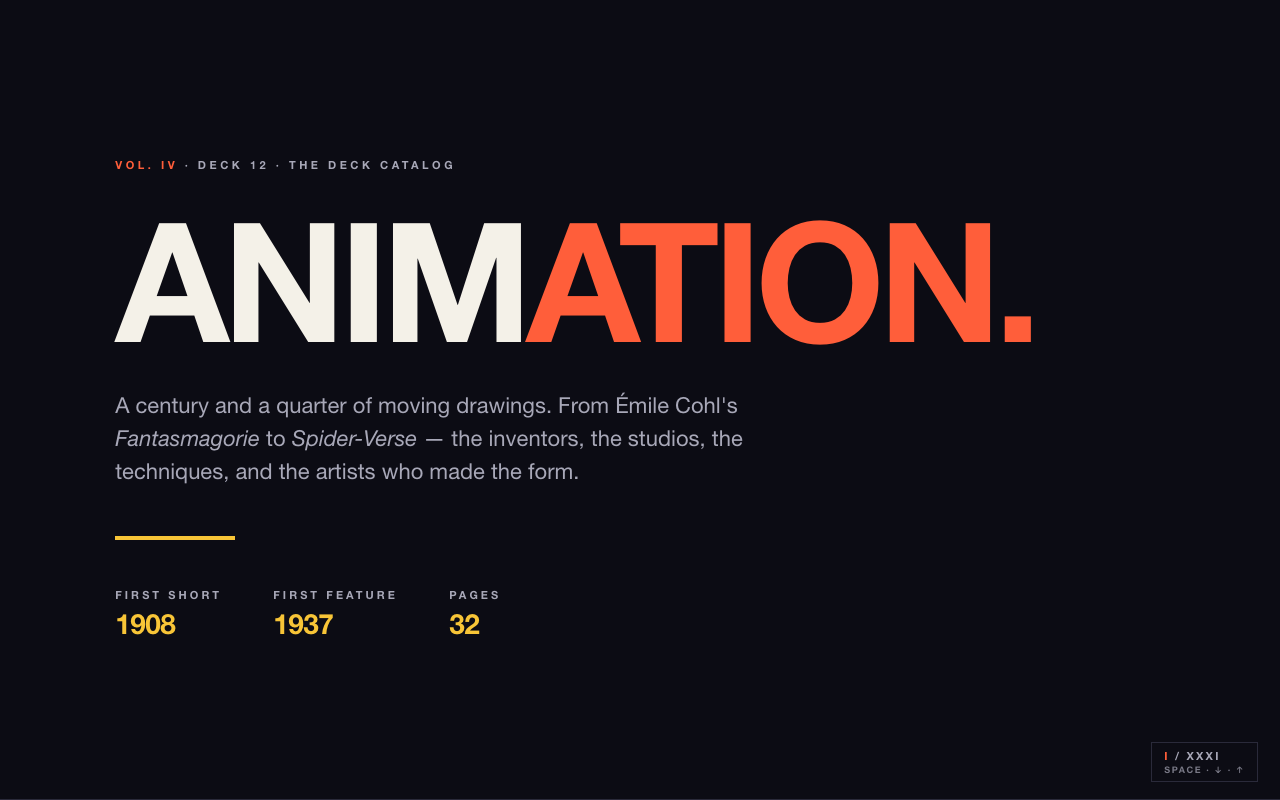
Printmaking.
- Vol. XV · Deck 4 · The Deck Catalog
- Woodblock, engraving, etching, lithography, screenprint. From Hokusai's wave to Dürer's apocalypse, from Rembrandt's etched faces to Warhol's silkscreen Marilyn. The democratic art of the multiple.
- Earliest woodblockChina, ~7th c. CE
- Senefelder's lithography1796
- Pages32
Slide 02
OpeningThe art of the matrix.
- Lede02
- Printmaking is the art that produces multiples. A drawing is unique; a painting is unique; a print is one of an edition of dozens or hundreds. The artist makes a matrix — a carved block, an incised plate, a stone with greasy drawing, a stretched fine-mesh screen — and the matrix is then printed onto paper. The original is not the finished print; the original is the matrix, which can produce many prints over time, all genuinely "the work."
- The technologies are old. Chinese woodblock printing predates 700 CE; the European illuminated woodcut emerged in the 14th century; engraving on metal followed in the 15th; etching in the 16th; lithography in 1796; photolithography in the 1850s; screen printing in industrial form in the 1910s. Each technology produced a distinct visual language; each remains in working use.
- The artists who took printmaking seriously did not treat it as reproduction. They treated it as a primary medium with its own logics — the resistance of the woodblock that produces simplification; the precision of the engraver's burin that allows extraordinary detail; the spontaneity of etching that approaches drawing; the stone-grease lithograph that captures gestural mark; the flat colour mass of screen print that defined Pop. From Dürer to Rembrandt to Goya to Hokusai to Toulouse-Lautrec to Warhol — printmaking has produced first-rank art continuously for 500 years.
- This deck covers the major techniques, the canonical artists, the working print shops, the contemporary editions market, and how to look at and care about prints.
- Vol. XV— ii —
Slide 03
Chapter IThe five techniques.
- Definitions03
- The major printmaking techniques fall into four structural categories, plus the unique digital category that has emerged since 1990:
- ReliefWoodcut, wood engraving, linocut. The image is carved out of a wood (or linoleum) block; ink rolled onto the raised surface that remains; pressed against paper. The high parts print; the carved-away parts don't. Bold, graphic, often expressive of the gouge marks. From Chinese 7th-century woodblock to Dürer's Four Horsemen to Hokusai's Great Wave to Picasso's linocuts.
- IntaglioEngraving, etching, drypoint, mezzotint, aquatint. Lines are incised into a metal plate (copper, zinc, steel); ink rubbed into the lines; the plate's surface wiped clean; pressed into damp paper through a press at high pressure. The ink in the incised lines transfers to the paper. The opposite logic of relief — here the cut-into part prints. Fine line, tonal range, atmospheric possibilities. Dürer's engravings, Rembrandt's etchings, Goya's Disasters of War, Whistler's etchings.
- PlanographicLithography. A flat stone (or zinc plate) is drawn on with greasy crayon or ink; the surface is treated with chemicals (gum arabic, acid) so that grease-drawn areas accept printing ink and undrawn areas repel it. The matrix is flat — neither raised nor incised. Uniquely capable of recording autographic gestural mark. Senefelder (1796), Daumier, Toulouse-Lautrec, Whistler, Bellows, the major 20th-century illustrators.
- StencilScreenprinting (silkscreen, serigraphy). A fine mesh stretched on a frame; some areas of the mesh are blocked; ink is squeezed through the unblocked areas onto paper below. Flat colour, sharp edges, easy multi-colour overlays. Industrial origins (1910s); fine-art adoption from ~1930s; canonical Pop Art technique (Warhol, Lichtenstein, Rauschenberg).
- DigitalInkjet (giclée), digital lithography. Computer-generated or photographically-captured images output through high-resolution inkjet onto archival paper. The matrix is digital. Common in the contemporary editions market since the 1990s. Lower-status historically than the hand-pulled techniques but increasingly normalised.
- Each technique has its visual signature. A literate viewer can usually identify the technique of a print at a glance: the burr-shadow of drypoint; the dot-pattern of half-tone or screenprint; the textured stone of lithograph; the bold graphic mark of woodcut. Reading the technique is part of reading the work.
- Printmaking · Techniques— iii —
Slide 04
Chapter IIChinese woodblock and the Diamond Sutra.
- Woodblock I04
- Printmaking begins in China. The earliest surviving printed text is the Diamond Sutra (a Buddhist scripture, printed 868 CE, found in the Mogao caves at Dunhuang in 1900) — a 5-metre scroll of woodblock-printed Chinese characters, with a frontispiece illustration of the Buddha. It is the world's earliest dated printed book.
- The technology was already mature by 868. Earlier surviving fragments date to the 7th and 8th centuries; the underlying carved-wood-and-ink technique was probably in use earlier. The Tang and Song dynasties (7th–13th c.) developed extensive woodblock book printing — religious scripture, classical texts, almanacs, popular literature.
- The Chinese woodblock developed several distinctive characteristics:
- Multi-block colour. Separate blocks for each colour, registered carefully on the same paper. Achieved early in China; refined to extraordinary precision in 16th–17th century printers.
- Combined text and image. Block-cut text and block-cut illustration on the same printed sheet. The medieval Chinese printed book was a single integrated production rather than a separated text-and-illustration assembly.
- Continuous production. Major Chinese printing operations operated continuously for decades or centuries. Surviving Ming and Qing dynasty woodblock-printed editions were sometimes produced from blocks that had been in use for 100+ years.
- The Chinese tradition transferred to Korea (where movable-metal-type printing was developed earlier than in Europe — the Jikji of 1377, printed in Korea, is the earliest surviving book printed with movable metal type) and to Japan, where it would become the basis of the great Edo-period ukiyo-e tradition.
- The European pickup of woodblock printing occurred from the 14th century onward, almost certainly under Asian influence (the Mongol-era trade across the Silk Road brought Chinese print technology to Europe along with paper). By 1400 European woodblock-printed devotional images and playing cards were being made in commercial quantities.
- Gutenberg's 1450s printing press, with movable metal type, transformed European text printing. But woodblock illustration persisted alongside movable-type books — the early printed European book typically combined Gutenberg-system text printing with woodblock-printed illustrations. The Nuremberg Chronicle (Hartmann Schedel, 1493, 1,809 woodblock illustrations from 645 distinct blocks) is the canonical example of mature 15th-century European woodblock book illustration.
- Printmaking · Chinese— iv —
Slide 05
Chapter IIIAlbrecht Dürer.
- Dürer05
- The northern European master who established printmaking as fine art in its own right. Albrecht Dürer (1471–1528), Nuremberg, son of a Hungarian goldsmith, trained in painting under Michael Wolgemut and engraving under his godfather Anton Koberger. Two trips to Italy (1494–95, 1505–07) brought him into contact with Mantegna's prints and the Italian humanist Renaissance. He returned to Nuremberg as the most-accomplished northern artist of his generation.
- Dürer's printed work falls into two categories:
- Woodcuts. The series Apocalypse (1498) — 15 large folio-size woodcuts illustrating the Book of Revelation, including the canonical Four Horsemen of the Apocalypse. The Large Passion (1497–1511, 12 woodcuts), the Small Passion (1509–1511, 36 woodcuts), Life of the Virgin (1510, 19 woodcuts). Dürer's woodcuts are the most-influential printmaking work of the Renaissance — combining Italianate compositional ambition with northern European linear precision; demonstrating that woodcut could equal the most-ambitious painting in formal achievement.
- Engravings. The three "master engravings" of 1513–1514: Knight, Death and the Devil (1513), Saint Jerome in His Study (1514), and Melencolia I (1514). These are the most-studied prints in Western art history. The technical achievement (the engraver's burin work, the tonal modeling, the spatial complexity) and the symbolic density (each work is filled with referential objects whose meanings have been parsed in scholarly detail for 500 years) together define Dürer's standing.
- Dürer's signature monogram (the AD with the D nestled inside the A) became one of the first artist signatures to function as a commercial brand. Dürer's prints were sold widely across Europe; his widow continued to print and sell from his blocks and plates after his death. The earliest surviving artist's-rights legal action (Dürer vs. Marcantonio Raimondi, 1506, over Raimondi's unauthorised copies of Dürer's work) is also part of his legacy.
- Dürer's working method was integrated with his other practice — many of his most-significant prints have related drawings, paintings, or theoretical writings. He saw printmaking not as a side activity but as one of his major media, capable of the highest art.
- The aggregate effect: Dürer established that printmaking could equal painting in formal achievement; that an artist's printmaking output could constitute a major part of his oeuvre; that prints could circulate art across Europe in ways painting could not. He set the template that 500 years of European printmaking would follow.
- Printmaking · Dürer— v —
Slide 06
Chapter IVRembrandt the etcher.
- Rembrandt06
- The Dutch Golden Age master who took etching from competent technique to first-rank artistic medium. Rembrandt van Rijn (1606–1669), Leiden and Amsterdam, made approximately 290 etchings over his 40-year career. They are, alongside his paintings, his greatest body of work; many critics consider his etchings his single most-significant achievement.
- Rembrandt used etching with extraordinary fluency. The technique — drawing through wax ground on a copper plate, biting the lines with acid, often with multiple states of progressive reworking — allowed him a freedom approaching drawing while producing a distributed printed product. He printed his own plates, often in small editions of 50–100; he reworked plates extensively, sometimes making 4 or 5 distinct "states" of an image as he revised, with each state recognisable as a distinct print.
- The signature etchings:
- The Hundred Guilder Print (Christ Healing the Sick, c. 1647–49). Named for the unusually high price (100 guilders) it commanded in Rembrandt's lifetime. Roughly 28×39 cm. The largest etching in his oeuvre, and a synthesis of his technical mastery — light and shadow, crowd composition, narrative drama, atmospheric depth.
- The Three Crosses (1653, 4 states). The Crucifixion at the moment of darkness. Rembrandt reworked the plate dramatically across states — the fourth state is so heavily worked it is nearly a different image, with much of the original drawing burnished out and replaced.
- Christ Presented to the People (Ecce Homo) (1655, 8 states).
- The Goldweigher's Field (1651). A panoramic landscape — extraordinary for its time and a model for subsequent landscape etching.
- The portraits. Self-portraits at every age (~80 etched self-portraits over the career); the great portraits of contemporaries (Jan Six, the goldsmith Jan Lutma); the Old Man (often Rembrandt's father Harmen Gerritsz., used as a model in many works).
- Rembrandt's etching practice anticipated 19th- and 20th-century artist's-print conventions: the artist working personally at every stage, from drawing through plate-preparation through printing; small editions hand-pulled by the artist; multiple states of the same composition treated as distinct works; the artist's monogram as part of the image. He treated etching as personal artistic practice rather than commercial reproduction.
- The collecting of Rembrandt etchings has been an art-market subject for nearly 400 years. The British Museum, the Rijksmuseum, the Metropolitan Museum, the Albertina (Vienna), and the Museum Boijmans Van Beuningen all have major holdings; specialist Rembrandt-print scholarship continues. Distinguishing Rembrandt's lifetime impressions from posthumous reprints (his plates were reused for centuries after his death) is a core scholarly task; the differences in paper, ink, and platework are the authentication.
- Printmaking · Rembrandt— vi —
Slide 07
Chapter VGoya's prints.
- Goya07
- Francisco de Goya (1746–1828), Spanish court painter and political witness. Goya produced four major print series that together represent perhaps the most-significant body of printmaking by any single artist after Rembrandt. The four:
- Los Caprichos (1797–98, 80 etchings with aquatint). Goya's first major print series. Subtitled "The capricious things." Satire of late-18th-century Spanish society — the corruption of the church, the brutality of the aristocracy, the foolishness of fashion, the persecution of women, the witch-hunts. The famous plate 43, "The Sleep of Reason Produces Monsters," is the canonical Enlightenment-Romantic image. The Inquisition forced Goya to withdraw the series shortly after publication; he traded the unsold plates and remaining stock to King Charles IV in exchange for a royal pension for his son.
- Los Desastres de la Guerra (Disasters of War, 1810–1820, 82 etchings with aquatint). Goya's response to the Peninsular War (1808–1814) — the brutal Napoleonic occupation of Spain and the Spanish guerrilla resistance. Unflinching images of mass execution, mutilation, famine, atrocity by both sides. The plates were not published in Goya's lifetime; the first edition appeared in 1863, 35 years after his death. Considered one of the most-significant anti-war works in Western art.
- La Tauromaquia (Bullfighting, 1816, 33 etchings). A history of bullfighting from antiquity to Goya's contemporary practice. Less politically charged than the other series; closer to documentary art.
- Los Disparates / Los Proverbios (The Follies / The Proverbs, c. 1815–1823, 22 etchings). Goya's late-period dark surrealism. Published posthumously (1864). The 22 plates are filled with grotesque figures and ambiguous narrative — closer to nightmares than to satire.
- Technical innovation: Goya was among the first artists to use aquatint extensively. The technique (a powdered rosin ground that creates a tonal area when bitten by acid) produces broad areas of tonal grey rather than the fine line of conventional etching. Goya's aquatints have a particular brooding atmospheric quality — the dark backgrounds out of which figures emerge — that defined the visual language of his late work.
- Goya's prints were unusual for their political directness. Most artists of his generation produced commercial portraits, religious painting, or landscape. Goya's print series were political — the Caprichos against social corruption, the Desastres against war, the Disparates against the moral collapse of late-Bourbon Spain. They were also private — most were not published in his lifetime, suggesting he understood them as work that would be too dangerous to circulate while he was alive.
- Goya's place in printmaking history: he is, with Rembrandt and Hokusai, one of the three or four artists whose printmaking output equals their painted output in importance. The Desastres de la Guerra, in particular, is one of the canonical 19th-century artistic statements.
- Printmaking · Goya— vii —
Slide 08
Chapter VIHokusai and ukiyo-e.
- Hokusai08
- The Japanese woodblock tradition that produced the most-influential body of Asian art on Western painting. Ukiyo-e ("pictures of the floating world") emerged in late-17th-century Edo as commercial prints depicting the urban entertainment district — courtesans, kabuki actors, sumo wrestlers, scenes of teahouses and brothels. By the 19th century the genre had expanded into landscape, historical narrative, ghost stories, and ambitious series.
- The major masters:
- Hishikawa Moronobu (c. 1618–1694). The first canonical ukiyo-e master. Established the genre as commercial woodblock with prints of women, courtesans, and Edo city life.
- Suzuki Harunobu (1725–1770). Developed full-colour woodblock printing (nishiki-e, "brocade prints") with multiple registered blocks producing rich polychrome images.
- Kitagawa Utamaro (1753–1806). Master of the bijin-ga ("beauty pictures"). Subtle psychological portraits of women — courtesans, geishas, but also ordinary urban women. His prints command high prices in the modern market.
- Tōshūsai Sharaku (active 1794–95). The mystery figure of ukiyo-e. Made about 140 prints in 10 months and then disappeared. His kabuki-actor portraits are the most-distinctive of the genre — exaggerated facial expressions, deeply individuated psychology.
- Katsushika Hokusai (1760–1849). The greatest of the ukiyo-e landscape masters. Hokusai's Thirty-six Views of Mount Fuji (c. 1830–1832) — a series of 36 (later 46) woodblock prints of Mount Fuji from various viewpoints — is the canonical ukiyo-e landscape series. The most-famous individual print, Under the Wave off Kanagawa ("The Great Wave"), is one of the most-reproduced images in world art. Hokusai's Hundred Views of Mount Fuji (1834–35) extended the project further.
- Utagawa Hiroshige (1797–1858). Hokusai's chief rival in landscape. The Fifty-three Stations of the Tōkaidō (1833–34) — 55 prints depicting the post stations along the Tōkaidō road from Edo to Kyoto. The One Hundred Famous Views of Edo (1856–58) — 119 prints of the city. Hiroshige's atmospheric landscapes (rain, snow, mist, twilight) have a softer poetic quality than Hokusai's geometric ambition.
- The technical process: an ukiyo-e print typically required a four-person team — the artist (who designed the image), the carver (who cut the blocks; one block per colour), the printer (who applied ink and pressed paper onto the blocks in correct registration), and the publisher (who organised the project, sold the prints, and absorbed the financial risk). The artist's name appears on the print but the carver's and printer's skills were as crucial.
- The print runs were large — often 1,000 or more impressions of a popular print. The sale price was modest (about the cost of a small meal). Prints were a popular-art rather than a luxury — circulating widely among Edo's urban middle class.
- The Western reception came in the 1850s-60s. Japanese prints arrived in Europe as wrapping paper around exported ceramics and silks; collected by Whistler, Degas, Manet, and Van Gogh; absorbed into late-19th-century European painting as the "Japonisme" influence. The Impressionists' interest in flat colour, asymmetric composition, and unusual viewpoints derived substantially from ukiyo-e.
- Printmaking · Ukiyo-e— viii —
Slide 09
Chapter VIISenefelder's invention.
- Lithography09
- Lithography is the only major printmaking technique whose invention can be precisely dated. Alois Senefelder (1771–1834), a Bavarian playwright trying to find a cheap way to print his own plays, discovered the technique in 1796 in Munich. He worked on a flat smooth limestone using a greasy ink-and-wax mixture; he discovered that the grease-marked stone, when treated with gum arabic and acid, would accept printing ink only on the drawn areas — and that paper pressed onto the inked stone would receive a perfect transfer of the drawing.
- The principle is photomechanical-adjacent: it depends on the chemical incompatibility of grease and water. Lithography is a "planographic" technique — the matrix is flat, neither raised (like woodcut) nor incised (like engraving). The print is a direct chemical transfer of an autographic gestural mark.
- Lithography spread quickly through 19th-century Europe. Its advantages: it was fast (no carving or incising required); it was cheap (limestone was inexpensive, and the drawing technique was accessible to anyone who could draw); it captured the artist's autographic gesture better than any prior technique (the drawing on the stone is essentially identical to the printed line); and it could produce very large editions before the stone wore out.
- The 19th-century artistic adoption:
- Honoré Daumier (1808–1879). The greatest 19th-century lithographer. ~4,000 lithographs over his career, most for the Parisian satirical newspapers La Caricature and Le Charivari. Political and social satire of unprecedented sharpness — Louis-Philippe as Gargantua (1831), the Rue Transnonain massacre (1834), the bourgeois pretensions of mid-century Paris. Daumier was imprisoned in 1832 for the Gargantua image; his career sustained continuous political pressure.
- Théodore Géricault (1791–1824). Major lithographs in the 1820s, particularly the series Various Subjects Drawn from Life and on Stone (1821) — equestrian and street scenes.
- Eugène Delacroix (1798–1863). Lithographs illustrating Goethe's Faust (1828, 17 plates) — among the most-influential 19th-century literary illustrations.
- Édouard Manet (1832–1883). Late-career lithographs, including a notable lithograph of the execution of Maximilian (1869).
- Henri de Toulouse-Lautrec (1864–1901). The supreme master of late-19th-century lithography. His Moulin Rouge poster (1891) and the subsequent posters for Aristide Bruant, May Belfort, Jane Avril, and other Parisian cabaret stars defined the visual language of 1890s Paris and demonstrated lithography's commercial-poster potential. About 350 lithographs in his short career.
- Édouard Vuillard, Pierre Bonnard, the Nabis. Late-1890s decorative lithography.
- Lithography's combination of artistic immediacy and large-edition commercial viability made it the dominant 19th-century commercial-illustration technique. The 20th century would extend it into colour offset lithography (the basis of all modern commercial printing), into photolithography (the basis of all photographic publishing), and into fine-art lithographic editions (the Tamarind, the Mourlot, the ULAE workshop traditions).
- Printmaking · Lithography— ix —
Slide 10
Chapter VIIIToulouse-Lautrec and the poster.
- Toulouse-Lautrec10
- Henri de Toulouse-Lautrec (1864–1901) is the most-influential single figure in the history of the lithographic poster. His ~30 large-format colour-lithograph posters — produced 1891–1900, mostly advertising Parisian cabarets and music halls — are the founding works of the modern poster as fine art.
- The 1891 Moulin Rouge: La Goulue poster (~191 × 117 cm; print run reportedly 3,000) is the canonical demonstration. Three colour blocks (yellow, red, blue) printed in lithograph; a stark composition with the dancer La Goulue dominating the foreground, the silhouette of Valentin le Désossé in the middle ground, and the abstract shapes of the audience cropped at the upper edges; massive flat colour areas; bold typography integrated with the image. The visual language is recognisable to any 21st-century graphic-design student because it set the template for posters that hold today.
- Toulouse-Lautrec's posters were commissioned by the cabarets they advertised. They were displayed on the streets of Paris — Morris columns, building walls, fences. They were torn down by collectors within days of being put up. The original print runs were large; surviving impressions in good condition are rare.
- The technical innovation: Toulouse-Lautrec was among the first artists to fully integrate the lithographic technique with deliberate artistic intent. Earlier posters had been by commercial illustrators working from drawn art; Toulouse-Lautrec drew directly on the stones (or, sometimes, on transfer paper that was then transferred to stone), treating the lithographic process as primary medium rather than reproduction. The bold colour areas, the cropped compositions, the deliberate flatness — all derive from his understanding of what lithography could do that other media could not.
- The Japanese influence is direct. Toulouse-Lautrec collected ukiyo-e prints; the asymmetric composition, the flat colour, the silhouette emphasis, the cropped figures all derive from the Japanese model. The synthesis of European drawing tradition with Japanese compositional logic, executed in modern lithography, produced one of the most-distinctive visual languages of the 1890s.
- Beyond the posters, Toulouse-Lautrec produced ~350 lithographs of more conventional fine-art ambition — the album Elles (1896, 11 lithographs of brothel-life), portraits of cabaret performers (Yvette Guilbert, Jane Avril, May Belfort), illustrations for various publications. The aggregate body of work is one of the major late-19th-century artistic projects.
- The Toulouse-Lautrec influence extends through Beardsley, the Vienna Secession, the Wiener Werkstätte, the early-20th-century commercial poster (Mucha, Cassandre), and the broader history of graphic design. Most modern poster design is recognisable as descended from Toulouse-Lautrec; the field's debt to him is substantial.
- Printmaking · Toulouse-Lautrec— x —
Slide 11
Chapter IXThe 20th-century revival.
- 20th c.11
- The 20th century was the most-active century of fine-art printmaking. Several developments combined.
- The artist's print as primary medium. Picasso (1881–1973) made over 2,000 prints across his career — etchings, lithographs, linocuts, drypoints. Henri Matisse (1869–1954) produced ~840 prints. Joan Miró (1893–1983) ~1,600. Marc Chagall (1887–1985) ~1,000. Print became, for many of the major modernists, a working medium parallel to painting and sculpture.
- The expressionist woodcut. Die Brücke (Dresden, 1905, founded by Ernst Ludwig Kirchner, Erich Heckel, Karl Schmidt-Rottluff, Fritz Bleyl) revived the woodcut as a primary expressive medium. Their woodcuts — with deliberately rough cutting, exposed gouge marks, primitivist references — established the 20th-century artistic woodcut as a serious medium. Käthe Kollwitz (1867–1945) extended this with her socially-engaged woodcuts of working-class struggle and World War I devastation.
- The Mexican muralist printmakers. The Taller de Gráfica Popular (Mexico City, 1937 onward) produced thousands of woodcuts and linocuts in service of the Mexican revolutionary politics. Leopoldo Méndez, José Clemente Orozco, Diego Rivera, Pablo O'Higgins, Elizabeth Catlett. The TGP print tradition extended through the 1970s and remains internationally influential.
- Surrealist printmaking. Max Ernst's frottage (rubbing) and grattage techniques; Salvador Dalí's etchings; Giacometti's etchings; Yves Tanguy's lithographs. Surrealism produced a substantial body of printed work alongside its better-known painting and sculpture.
- The American postwar. Ben Shahn's lithographs and serigraphs; Stuart Davis's lithographs; Reginald Marsh's prints; the WPA Federal Art Project (1935–1943) which produced ~13,000 prints by ~3,000 artists, distributed to schools, libraries, and government buildings. The American printmaking tradition through the 1940s was politically engaged and broadly distributed.
- The major print workshops. Stanley William Hayter's Atelier 17 (Paris from 1927, New York 1940–1955, then back to Paris) was the most-influential 20th-century print workshop. Hayter's collaborative methods — scientists and artists working together; the artist drawing or engraving while master printers handled technical execution; the artist remaining for proofing and editioning — set the model that subsequent print workshops followed. Tatyana Grosman's Universal Limited Art Editions (West Islip, NY, 1957) brought Jasper Johns, Robert Rauschenberg, Helen Frankenthaler, James Rosenquist into serious printmaking. Tamarind Lithography Workshop (Los Angeles, 1960, June Wayne; relocated to UNM 1970) trained an entire generation of American lithographers and major artists. Crown Point Press (Oakland, Kathan Brown, 1962). Gemini G.E.L. (Los Angeles, 1966, Sidney Felsen, Stanley Grinstein). Mourlot Frères (Paris, the major lithography atelier of the era — printed for Picasso, Matisse, Braque, Chagall, Miró).
- Printmaking · 20th c.— xi —
Slide 12
Chapter XWarhol's silkscreen.
- Warhol12
- The artist who established silkscreen / screenprint as a major fine-art medium. Andy Warhol (1928–1987), the founder of American Pop Art, made ~3,000 prints across his career — overwhelmingly silkscreens. The silkscreen technique was fundamental to his aesthetic in a way that no medium was fundamental to any other major artist of the century.
- The technique: photographic silkscreen. Warhol's photographs (often from press archives, news media, or commissioned portraits) were photo-mechanically transferred to silkscreens — a stretched fine-mesh fabric with the photographic image opened up as a stencil. Ink squeezed through the mesh produces a print of the photographic image, but with the screen's distinctive flat-graphic quality.
- The signature works:
- The Marilyn series (1962, 1967, multiple editions). Warhol used a publicity photograph of Marilyn Monroe (taken for the 1953 film Niagara) as the source. Multiple variations — the Gold Marilyn, the Twenty-Five Marilyns, the Marilyn Diptych — combined the silkscreened photographic likeness with applied colour fields.
- The Campbell's Soup Cans (1962, paintings; 1968, screenprint portfolio of 10). The canonical Pop Art work.
- The Brillo Boxes (1964). Plywood boxes silkscreened with the Brillo packaging design — sculpture and print simultaneously.
- The Jackie series (1964). Images of Jacqueline Kennedy from the 1963 Kennedy assassination and funeral. Sixteen Jackies, repeated screenprints of mourning, isolated and grieving.
- The Mao series (1972). Screenprinted images of Mao Zedong from his canonical Cultural Revolution propaganda portrait, applied at large scale with painted-over colour fields.
- The Endangered Species series (1983). Ten endangered animals — bald eagle, Siberian tiger, San Francisco silverspot butterfly, others — in Warhol's bright photo-silkscreen style.
- The aesthetic implications: Warhol made photographic-mechanical reproduction (the central feature of mass-media culture) into a fine-art technique. The silkscreen process is partly automated — the screen carries the image; multiple impressions are easy. The "edition" — the fact that there are 10 or 250 or 5,000 of each work — is part of the work's meaning rather than a commercial necessity. Warhol's prints critique and embrace, simultaneously, the mass-reproductive media culture they emerged from.
- The Factory (Warhol's studio at 231 East 47th Street, then 33 Union Square West, then 860 Broadway, then 22 East 33rd Street) was a print-production operation as much as a fine-art studio. Warhol employed assistants who handled most of the actual print-making; Warhol made the conceptual decisions and signed the works. The relationship between authorship and production became, in Warhol's practice, a deliberate question.
- The Pop Art print extended through Roy Lichtenstein (whose silkscreen work used the dot-pattern of commercial printing as decorative motif), James Rosenquist (the immense scale of his lithographs and silkscreens), Robert Rauschenberg (his combined-image silkscreen prints with Universal Limited Art Editions). The 1960s and 1970s American printmaking moment was largely defined by these artists.
- Printmaking · Warhol— xii —
Slide 13
Chapter XIJapanese moku hanga.
- Moku hanga13
- The Japanese woodblock tradition that the world fell in love with in the 1850s never went away. Moku hanga (literally "wood-block-picture") is the contemporary continuation of the ukiyo-e printmaking tradition — using the same materials (cherry-wood blocks, water-based pigments, washi paper, the baren press), the same multi-block colour techniques, refined for contemporary artistic purpose.
- The continuing Japanese tradition through the 20th century: the shin-hanga ("new prints") movement of the 1910s–1940s, led by the publisher Watanabe Shōzaburō, produced new prints in the ukiyo-e tradition — Hashiguchi Goyō, Kawase Hasui, Yoshida Hiroshi, Itō Shinsui. The shin-hanga was substantially export-oriented, producing prints for Western collectors who had developed a taste for Japanese woodblock through the late-19th-century Japonisme moment.
- The sōsaku-hanga ("creative prints") movement of the 1900s onward took a different path — the artist personally drew, carved, and printed the work, breaking with the traditional artist/carver/printer division of labour. Onchi Kōshirō, Saitō Kiyoshi, and the broader sōsaku-hanga community produced abstract and modernist Japanese prints rather than continuing the figurative ukiyo-e tradition.
- The contemporary moku hanga revival: from the 1980s onward, both Japanese and Western artists have rediscovered moku hanga as a working contemporary medium. The technique's distinctive qualities — water-based pigments that bleed and pool on the paper rather than sitting on top; the soft tonal gradations possible from the bokashi (gradient inking) technique; the texture of carved cherry-wood; the long-fibre washi paper — produce a printed surface different from any other tradition.
- The contemporary international moku hanga community: Keizaburō Matsuzaki (Tokyo, the master carver who has trained many international apprentices); Tuula Moilanen (Finland); Karen Kunc (US); Daniel Heyman; the Mokuhanga Innovation Laboratory (MI-LAB) in Kawaguchi-ko, Japan, which runs international residency programmes; the International Mokuhanga Conference (held biennially since 2011).
- The materials and tools: the cherry-wood block (yamazakura preferred); the carving tools (the to, the maru, the san); the brushes (maru-bake for inking, hira-bake for water); the baren (a flat hand-press disc made of bamboo-leaf-and-paper, used to apply pressure during printing); the washi paper (the long-fibre Japanese handmade paper with a long-fibre structure that allows water-based pigments to penetrate and bond with the surface).
- The technique is slow. A typical multi-block moku hanga print takes several weeks for design, carving, registration, and printing of a small edition. The slowness is part of the appeal — moku hanga is among the most-meditative of the printmaking traditions, valued for the physical-and-spatial discipline as much as for the resulting prints.
- Printmaking · Moku hanga— xiii —
Slide 14
Chapter XIIThe print workshops.
- Workshops14
- Most major contemporary fine-art printmaking happens at print workshops — collaborative environments where artists work with master printers to produce editions. The major workshops:
- Universal Limited Art Editions (ULAE). Founded 1957 in West Islip, New York, by Tatyana Grosman. Brought Jasper Johns, Robert Rauschenberg, Helen Frankenthaler, James Rosenquist, Frank Stella, Bill Jensen, Susan Rothenberg into the most-significant American printmaking tradition of the 20th century. Johns's 0 through 9 series, Rauschenberg's Booster, Stella's various lithographs.
- Tamarind Institute. Founded 1960 in Los Angeles by June Wayne; relocated 1970 to the University of New Mexico in Albuquerque. The most-significant lithography training programme in the United States. Hundreds of master printers have been trained at Tamarind; thousands of artists have made prints there. Its specifically lithographic focus distinguishes it from other major American workshops.
- Gemini G.E.L. (Graphic Editions Limited). Founded 1966 in Los Angeles by Sidney Felsen, Stanley Grinstein, and Kenneth Tyler (later left to found Tyler Graphics). Worked with Jasper Johns, Robert Rauschenberg, Roy Lichtenstein, Frank Stella, Ellsworth Kelly, Cy Twombly, Edward Ruscha, Bruce Nauman, Anish Kapoor, Julie Mehretu, John Baldessari. The most-prolific American print workshop; over 1,500 editions produced. Major holdings at the National Gallery of Art (which holds a complete archive set).
- Crown Point Press. Founded 1962 in Oakland by Kathan Brown. Etching specialist; brought Sol LeWitt, Pat Steir, Wayne Thiebaud, Anish Kapoor, Christopher Brown into etching. The major American etching workshop.
- Tyler Graphics. Kenneth Tyler founded after leaving Gemini in 1974. Operated until 2000. Worked with Helen Frankenthaler (Madame Butterfly, 2000, the largest-ever printed monoprint at 134 × 80 inches), Frank Stella, David Hockney, Anthony Caro. The most-technically-ambitious print workshop in the modern era.
- Atelier Lacourière-Frélaut. The Paris print workshop that operated from the 1930s to the 1990s. Picasso's primary printmaking partner; Miró, Chagall, Braque also worked there extensively. The Frélaut continuation closed in the 1990s; the legacy is preserved in major museum collections.
- Mourlot Frères. The major Paris lithography atelier. Picasso, Matisse, Braque, Léger, Calder, Miró, Chagall, Cocteau all printed there. The Mourlot family continued operations through three generations until the workshop closed in the 1990s.
- Atelier 17 / Stanley William Hayter. Founded 1927 in Paris; relocated to New York 1940; returned to Paris 1955. Hayter (1901–1988) was the most-influential print teacher of the 20th century. His students included Picasso, Calder, Chagall, Mondrian, Pollock, de Kooning, Rothko, Motherwell. The "intaglio" tradition of European-American printmaking is largely descended from his workshop.
- The Tate Print Workshop, the British Museum's Department of Prints and Drawings, the Albertina (Vienna), the Rijksmuseum (Amsterdam), the Metropolitan Museum (New York), the Boston Museum of Fine Arts. The major institutional print collections hold curatorial workshops and produce occasional editions in dialogue with their collections.
- Printmaking · Workshops— xiv —
Slide 15
Chapter XIIIThe edition: how prints exist.
- Editions15
- Understanding the printed edition is essential to understanding what a print is. The conventions:
- The plate / matrix. The carved block, incised plate, drawn stone, or stretched screen from which prints are pulled. The matrix is the artist's primary working object; the print is the secondary product. The matrix can produce many prints over time.
- The edition. The full set of prints pulled from a matrix. By convention, modern editions are limited — the artist specifies a number (say, 50 or 75) and signs each print to indicate it is part of the edition. After the edition is complete, the matrix is conventionally "cancelled" (defaced or destroyed) to prevent further prints.
- The edition number. Each print is numbered as a fraction — "12/50" means the 12th print out of an edition of 50. The numbering does not indicate sequence of pulling (most are pulled in randomised order from the same matrix). It does indicate the edition size.
- The artist proof (AP, EA, A.P.). Conventionally ~10% of the edition size, set aside for the artist's personal use. Marked "AP" or with roman numerals (AP I/V). Often more valuable in the secondary market than the numbered edition.
- The bon à tirer (BAT, "good to pull"). The proof at which the artist signs off on the final image; subsequent prints are pulled to match this one. Usually retained by the printer.
- Trial proofs (TP). Earlier proofs in the working process; sometimes substantially different from the final image. Often more valuable in the market than the regular edition.
- Hors commerce (HC). "Outside commerce" — proofs not intended for sale, retained by the artist or workshop. Often given as gifts.
- Printer's proofs (PP). Set aside for the master printer.
- Cancellation proof. A print pulled after the matrix is defaced/cancelled, showing the cancellation marks. Documents that the edition is closed.
- The colophon page. Sometimes accompanies an edition — a printed page documenting the edition specifications: artist, title, date, technique, paper, edition size, printer, publisher. Signed and numbered by the artist as part of the edition.
- The signature. Modern artists conventionally sign each print in pencil at the lower right; the title at the lower left; the edition number (or AP designation) at the lower centre. Dürer's monogram, Rembrandt's signature in the plate itself, and various 19th-century conventions are different from the modern model.
- The market understanding: edition size affects price (a 50-print edition is more valuable per print than a 500-print edition); state matters (early states, BATs, and APs are typically more valuable than regular numbered prints); condition matters (paper foxing, fading, trimming all reduce value); provenance matters (a print with a continuous chain of ownership documentation is more valuable than one without). The print market is sophisticated; specialised auction houses (Christie's prints department, Sotheby's prints department, Swann Galleries, Bonhams) handle the major transactions.
- Printmaking · Editions— xv —
Slide 16
Chapter XIVContemporary major figures.
- Contemporary I16
- The printmakers of the past 50 years who have produced first-rank work.
- Jasper Johns (born 1930). Major printmaker since the late 1950s. Lithography, etching, screenprint, monotype. The targets, flags, numerals, maps, and figure works re-explored in print. Several thousand prints; one of the canonical American printmakers.
- Robert Rauschenberg (1925–2008). The first American to win the Venice Biennale (1964) — partly for his prints. His Booster (1967, lithograph, 72 × 36 inches) was the largest hand-pulled lithograph at the time of its production. The combined-image lithographs and silkscreens defined American printmaking of the 1960s–1980s.
- Frank Stella (1936–2024). A working printmaker for 50+ years. Increasingly elaborate compositional and material strategies; the late-career engaging structures of mixed prints, collage, relief, and dimensional surfaces. Major collaborations with Tyler Graphics, ULAE, Gemini.
- David Hockney (born 1937). Lithographs (the Rake's Progress series, 1961–63; the swimming pool series); home-printer fax-and-laser experiments of the 1980s; the iPad-drawing-printed-as-edition experiments of the 2010s. One of the most-restless contemporary printmakers, always exploring what print can be.
- Kiki Smith (born 1954). Etching, photogravure, lithograph. Body-and-figure work; the female figure in nature; recurring animal and natural-world subjects. One of the major contemporary American printmakers.
- Sue Williams, Mira Schor, Joan Snyder, Nancy Spero. The feminist American printmakers of the 1970s–1990s.
- Kerry James Marshall (born 1955). Increasingly important printmaker as part of his broader practice; the figure work in print.
- Julie Mehretu (born 1970). Collaborative prints with Gemini G.E.L. The complex layered architectural-and-political imagery rendered in precise multi-plate etching and lithography.
- Vija Celmins (born 1938). Mezzotints, etchings, woodcuts of the night sky, the ocean surface, and other recurring natural subjects. The slow patient labour of the work matches the meditative subject matter.
- Christiane Baumgartner (born 1967, Germany). Large-scale woodcut. Highway scenes, military installations, water surfaces. Scale and labour both at the limit.
- Wangechi Mutu (born 1972, Kenya/US). Mixed-media prints; cultural-historical engagement.
- Ryōji Ikeda, Olafur Eliasson, Anish Kapoor. Printmaking adjacent to other primary practices but substantial.
- Glenn Brown, Walton Ford, Peter Doig. The British and American figurative printmakers of the past two decades.
- The contemporary print market is healthier than at any prior point. Major art fairs (the IFPDA Print Fair in New York, the London Original Print Fair) attract dozens of major print publishers. The fine-art print is one of the most-democratic art-collection categories — high-quality prints by major artists are available at $1,000–$25,000, prices that allow non-millionaire collectors to acquire serious work.
- Printmaking · Contemporary I— xvi —
Slide 17
Chapter XVThe political print.
- Posters & politics17
- Printmaking has been continuously political since Goya. The cheap reproducibility of prints — combined with their portability and easy display — has made them a recurring vehicle for political statement.
- The major political-print traditions:
- Daumier and 19th-century French satire. Daumier's lithographs in La Caricature and Le Charivari (above). Repeated political prosecution. The most-significant political print tradition of the 19th century.
- Honoré Daumier's American descendants. Thomas Nast (1840–1902, the political cartoonist whose Tammany Hall depictions helped end Boss Tweed's career). Joseph Keppler. The lineage of newspaper political cartooning.
- Käthe Kollwitz (1867–1945). German socialist artist. Woodcuts, lithographs, etchings on the suffering of the working class, World War I devastation, the Spartacist uprising of 1919, the death of her son Peter at Verdun. The series The Weavers (1893–98) and The Peasant War (1902–08) established her as a major political artist; the late War series (1922–23) is among the most-haunting representations of WWI in any medium.
- The Mexican Taller de Gráfica Popular (1937 onward). Working-class struggle, anti-fascism, indigenous rights, post-Revolutionary Mexican social vision. Leopoldo Méndez and Pablo O'Higgins as the central figures.
- Soviet socialist realism prints. Vladimir Mayakovsky's ROSTA window posters (1920s), Aleksandr Rodchenko's photo-montage posters, El Lissitzky's constructivist posters. The Soviet poster tradition through the 1980s.
- Black Mountain and the WPA. The American 1930s-40s federal-arts-project printmaking — broadly distributed; politically progressive in many cases.
- The civil-rights and Vietnam-era poster. The 1960s American protest-poster tradition. The Atelier Populaire (Paris, May 1968) student-uprising silkscreen posters.
- The Polish poster school (1950s onward). Henryk Tomaszewski, Jan Lenica, Roman Cieślewicz, Wiktoria Górka. Allegorical and surrealist posters under socialist constraint; among the most-distinctive 20th-century poster traditions.
- The South African anti-apartheid print. Paul Stopforth, Norman Catherine, the broader Resistance Art tradition.
- The Glasgow Print Studio and the British socialist print. Alasdair Gray's lithographs; the broader 1970s–1980s British socialist printmaking.
- The Latin American resistance prints. Argentine, Chilean, Peruvian printmaking under various dictatorships.
- The contemporary political print. Banksy's street-prints; Shepard Fairey's "Hope" poster (Obama 2008); the 2010s social-media-driven protest poster networks.
- The political print's continuing power lies in its democratic distribution. A poster on a city wall reaches more eyes than a painting in a gallery. A protest print flyered on the streets of Paris in 1968 or wheat-pasted in New York in 2020 carries political force in the moment in ways no other visual medium can match.
- Printmaking · Political— xvii —
Slide 18
Chapter XVIThe materials.
- Materials18
- Printmaking is a deeply material practice. The materials shape the result.
- Paper. Most fine-art prints are pulled on rag paper — fibre from cotton or linen rather than wood pulp. Rag paper is acid-free, dimensionally stable, archivally permanent. The major fine-art papers: Hahnemühle (German, the dominant fine-art paper), Arches (French, the major etching/lithograph paper), Somerset (British, etching and screenprint), BFK Rives (French, etching), Stonehenge (American, multi-purpose), Magnani Pescia (Italian, intaglio). For Japanese woodblock, washi — long-fibre handmade Japanese paper, including the Echizen, Awa, and Iyo varieties.
- Inks. Lithographic ink (oil-based, very high-quality pigment, dense and fluid); etching ink (oil-based, formulated to wipe cleanly off the plate while remaining in the incised lines); screenprint ink (water-based or solvent-based; flatter and more matte than other types); woodcut ink (oil-based for European woodcut; water-based for Japanese moku hanga). Caligo, Hawthorn, Daniel Smith, Akua, the various traditional Japanese pigment manufacturers.
- Plates. Copper (the traditional intaglio plate; soft, easy to engrave, takes detail); zinc (cheaper, less detail-capable, easier to bite with acid); steel (very durable, allows huge editions); aluminum (cheap, used for offset lithography). For lithography: limestone (Bavarian Solnhofen limestone is the canonical), or zinc/aluminum plates with prepared coatings.
- Wood blocks. Cherry (yamazakura) for Japanese moku hanga; pear and boxwood for European wood engraving; pine and basswood for European woodcut.
- Linoleum. Industrial-grade linoleum for linocut; battleship-grade linoleum (the thicker, denser variety) preferred.
- Fabric for screenprinting. Polyester monofilament mesh (replaced silk in the 1950s); various counts (mesh-per-inch) for different requirements — coarser meshes for opaque inks; finer for detailed images.
- The press. The intaglio press (a heavy roller press; the plate sandwiched between paper and felts and rolled through under high pressure). The lithographic press (originally a flat press; modern presses are scrape-bar machines). The relief press (flat platen press for woodcut; the proofing press for letterpress). The screenprint vacuum table.
- The studio. A working print studio is a complex facility — acid storage and ventilation for etching, large flat surfaces for ink and paper preparation, dedicated cleanup areas, drying racks, archival storage. Most artists who do serious printmaking either join a workshop or build a substantial home studio.
- The materials matter because the print's surface is its meaning. A print on Hahnemühle vs. Arches paper looks different; a print with Caligo ink vs. Daniel Smith ink looks different; a Solnhofen-stone lithograph has different qualities than a zinc-plate lithograph. The materially-literate viewer reads the materials as part of the work.
- Printmaking · Materials— xviii —
Slide 19
Chapter XVIIHow to look at a print.
- Looking19
- What to attend to when you stand in front of a print.
- Identify the technique. The print's technique is part of its meaning. The carved gouge marks of woodcut; the velvety tone of mezzotint; the bitten line of etching; the raised burr of drypoint; the wax-resist of soft-ground; the dot-pattern of half-tone or screenprint; the flat broken edges of lithographic crayon. A literate viewer can identify the technique from across the room; an attentive viewer can identify the specific working method (Goya's aquatint vs. Whistler's aquatint, for example).
- Read the matrix marks. The plate's edges sometimes leave a printed border (the plate-mark in intaglio, where the slightly-raised plate-edge embosses the paper). The lithographic stone often leaves a tone or texture along the edge. The screenprint's flatness is recognisable. Each technique leaves traces.
- Read the paper. What paper is the print on? Hahnemühle, Arches, BFK Rives, Somerset, Stonehenge, washi? The paper's colour, weight, surface texture, and edge (deckle vs. trimmed) all carry information about the print's intent and quality.
- Read the registration. If the print is multi-coloured, the alignment of the colour blocks matters. A precisely-registered print has the colours sitting exactly where they should; a deliberately-misregistered print has the colours shifted as part of the artistic intent. The German Expressionists often misregistered deliberately; commercial printmakers worked for absolute precision.
- Read the edition information. Lower right pencil signature; lower left title; lower centre edition number. A print signed "12/50" is the 12th of 50; "AP" is artist proof; "BAT" is the bon à tirer. The edition information places the specific impression in the larger production.
- Read the state. If the print is in a series of states (multiple revisions of the same composition), what state is this? Earlier states often have different content from later states (Rembrandt's Three Crosses, fourth state, is dramatically different from earlier states).
- Read the condition. Foxing (small brown spots from paper deterioration); fading; trimmed margins; tears, creases, paper repair; the paper's general "tone" (older papers darken with age). Condition affects both the visual experience and the market value.
- Read the provenance. Who owned the print? Major collections often add value, but more importantly, provenance can attest to authenticity and condition history.
- Read the catalogue raisonné. Most major artists have catalogues raisonnés of their prints — comprehensive documentation of every known work, its states, its known impressions, its publication history, its references. Knowing how the print fits in the artist's broader oeuvre deepens the experience.
- Print-looking is a skill. The first encounters often produce just the image; with practice, the technique, the materials, the working state, the artistic intent all become legible. Most major print collections (the British Museum's Department of Prints and Drawings; the Met's prints; the Boston MFA's prints; the Albertina) offer print-room access — appointments where visitors can examine prints close-up under conservator supervision. These are the best places to develop print literacy.
- Printmaking · Looking— xix —
Slide 20
Chapter XVIIIThe major print collections.
- Collections20
- Where to see prints in person, in approximate order of historical breadth and depth.
- The British Museum, Department of Prints and Drawings (London). Founded 1808 — the field's institutional origin. ~2 million prints across all periods. Free print-room access to scholars and researchers. Major Dürer, Rembrandt, Goya, Hogarth, Hokusai holdings.
- The Albertina (Vienna). Founded 1776. ~1 million prints, ~65,000 drawings. Particularly strong in old-master prints (Dürer's holdings include the famous "Hare" watercolour and a substantial print archive). Open as both gallery and study room.
- The Rijksprentenkabinet (Amsterdam, part of the Rijksmuseum). The most-significant Rembrandt etching collection in the world, plus very strong Dutch and Flemish print holdings.
- The Metropolitan Museum of Art, Department of Drawings and Prints (NYC). ~1.5 million prints. Particularly strong in 19th–20th century American and European work; the Henry G. Marquand bequest of Whistler etchings; comprehensive holdings of Toulouse-Lautrec posters.
- The Museum of Fine Arts, Boston, Department of Prints and Drawings. ~250,000 prints. Particularly strong in Japanese woodblock (the William Sturgis Bigelow and Charles Goddard Weld collections — among the largest ukiyo-e holdings outside Japan).
- The Bibliothèque nationale de France, Département des estampes (Paris). The French national collection. Particularly strong in 16th-19th century European prints; the entire production of Mourlot Frères and other major French ateliers archived.
- The Kupferstichkabinett (Berlin Staatliche Museen). German national print collection. Major Dürer holdings (Berlin and Vienna together hold the canonical Dürer print collection); strong on Käthe Kollwitz and the German Expressionists.
- The Tokyo National Museum and the Sumida Hokusai Museum (Tokyo). The major Japanese ukiyo-e collections in Japan; also the Ōta Memorial Museum (which has rotating ukiyo-e exhibitions). For moku hanga continuation: the Museum of Modern Art Saitama, the Tochigi Prefectural Museum.
- The National Gallery of Art, Department of Prints and Drawings (Washington DC). ~110,000 prints. The Rosenwald Collection (donated by Lessing Rosenwald) is one of the great American collections — Mantegna, Schongauer, the major Italian Renaissance and Northern European prints.
- The Morgan Library and Museum (NYC). Smaller but very deep holdings, particularly in early-printed-book illustration and the Pierpont Morgan collection of Old Master prints.
- The Guggenheim Museum, the Whitney Museum of American Art, MoMA's Department of Drawings and Prints (NYC). The major American 20th-century print holdings.
- The Tamarind Lithography Workshop archive (UNM, Albuquerque). The complete archive of the Tamarind workshop's editions; one of the most-significant single-workshop archives.
- The Crown Point Press archive (now at the British Museum). The major American etching workshop's archive.
- Most major museum print departments offer "print-room" access — researchers can request specific prints for close examination under conservator supervision. This is the way to develop deep print literacy. Most departments require advance appointment but welcome serious students at no cost.
- Printmaking · Collections— xx —
Slide 21
Chapter XIXThe contemporary editions market.
- Market21
- The print market is a substantial commercial subset of the broader art market. The numbers:
- The IFPDA (International Fine Print Dealers Association). Founded 1987 in New York. ~150 member galleries worldwide. The IFPDA Print Fair (held annually since 1991, traditionally late October at the Park Avenue Armory) is the principal commercial event of the year for fine-art prints; the 2024 fair attracted ~80 exhibitors.
- Major print auctions. Christie's prints sales (twice-yearly Old Master and Modern); Sotheby's prints sales; Swann Galleries (American specialist, NYC); Bonhams; Bloomsbury Auctions (London); Galerie Bassenge (Berlin). Annual sale volume in the print sector is ~$300–400 million worldwide; smaller than painting/sculpture but substantial.
- Price ranges. A Dürer engraving in good condition sells in the $20,000–500,000 range depending on the specific print and impression. A canonical Rembrandt etching: $50,000–2,000,000. A signed Toulouse-Lautrec poster: $30,000–500,000. A Goya from Los Caprichos: $5,000–50,000 per individual plate. A Picasso etching from his major series: $20,000–500,000. Warhol silkscreens: $50,000–5,000,000 depending on the work. Living-major-artist editions: $5,000–100,000 typically.
- The accessibility argument. The print market is the most-accessible serious-art market. Important works by canonical artists are available to non-millionaire collectors at prices far below painting equivalents. A complete Goya Caprichos (later edition) can be assembled for $50,000–100,000; a single Goya painting of comparable quality would cost $20–100 million.
- The condition factor. Print value is highly condition-sensitive. A Rembrandt etching with foxing, fading, or trimmed margins might be worth 10% of the value of the same print in pristine condition. The market's price discovery is more refined than in painting because of the comparative ease of condition assessment.
- The "state" issue. Earlier states of an artist's prints are typically more valuable than later states or restrikes. Authentication of state — distinguishing first-state from second-state Rembrandt prints, for example — requires substantial expertise.
- The restrike controversy. Many old-master plates were reused for centuries after the artist's death, producing "restrike" impressions. These are less valuable than lifetime impressions and are sometimes substantially different in quality. The market distinguishes carefully between lifetime prints and restrikes.
- Authentication. Print authentication is more complex than painting authentication. The catalogue raisonné for an artist documents states, papers, and editions; experts verify against the documented characteristics. Forgery is a continuing problem, particularly for valuable artists like Picasso and Chagall, but the market has developed substantial authentication infrastructure.
- The contemporary print investor. Print collectors range from museum collectors (most major museums acquire prints continuously) to specialist private collectors to first-time art-buyers. The market has been broadly stable through the past decade, with selective strength in particular artists (Warhol, contemporary American printmakers, the Old Master canon) and weakness in others (some 1970s-1980s European print artists).
- Printmaking · Market— xxi —
Slide 22
Chapter XXThe library.
- Reading list22
- 1568The Lives of the Painters (Vasari, with Dürer)Vasari
- 1745The Whole Book of DrawingVarious
- 1796Vollständiges Lehrbuch der SteindruckereySenefelder
- 1882The Etching of TodayHamerton
- 1909The Print-Collector's HandbookWhitman
- 1923The Practice of LithographySenefelder / trans.
- 1937LithographieMourlot
- 1948The Etcher's HandbookLalanne
- 1955Engraving on WoodBewick / Hyman
- 1965The Compleat EtcherHayter
- 1971The Tamarind Book of LithographyAntreasian / Adams
- 1976The History of Engraving and EtchingHind
- 1985The Prints of Andy WarholFeldman / Schellmann
- 1988Käthe Kollwitz: Prints, Drawings, SculptureKlipstein
- 1992Hokusai: One Hundred Views of Mount FujiForrer
- 1994The Painter as PrintmakerCohen / Ackley
- 1996The American Print: 1879–1979Cole / Adams
- 2001The Complete Etchings of RembrandtHinterding et al.
- 2005Goya: His Complete Etchings, Aquatints and LithographsSayre
- 2008Toulouse-Lautrec: Prints, Posters, DrawingsWittrock
- 2010The Renaissance Print: 1470–1550Landau / Parshall
- 2012The Encyclopedia of Printmaking TechniquesRoss / Romano
- 2017The Mokuhanga TraditionSalter
- 2020Crown Point Press: A Catalogue RaisonnéBrown ed.
- 2023The Contemporary Print: A SurveyVarious
- Printmaking · Library— xxii —
Slide 23
Chapter XXIWatch & read.
- Watch & read23
- ↑ Ukiyo-e woodblock printmaking with master Keizaburō Matsuzaki
- More on YouTube
- Watch · How to make a lithographic print (National Museums Liverpool)
- Watch · The basics of screen printing — tutorial
- Further reading
- Hind's History of Engraving and Etching (1976) for the deep technical history. Landau and Parshall's The Renaissance Print (2010) for the Northern European founding period. Ross and Romano's Encyclopedia of Printmaking Techniques (2012) for the working manual. Cole and Adams's The American Print for the 20th-century American story. The British Museum's online prints database (free, ~1 million entries with images) for the depth.
- Printmaking · Watch— xxiii —
Slide 24
Chapter XXIIMaking prints yourself.
- Practice24
- The accessible printmaking entry points.
- Linocut. The simplest entry. Battleship-grade linoleum block, a set of carving tools (the Speedball "Linocut Tools 1–5" set is the canonical beginner set, ~$20), water-based block-printing ink, a brayer, paper (cheap cartridge paper for practice; rag paper for finished work), and a flat hard surface (or a tablespoon for hand-burnishing). Total starter cost: ~$40–80. Can produce simple multi-block colour work with practice.
- Monotype. Even simpler. Roll ink onto a smooth surface (glass plate, plexiglass), draw or scrape into the ink with brushes or fingers, press paper onto the inked surface to transfer. Each impression is unique (no edition); spontaneous and gestural. ~$50 starter cost.
- Stencil / spray-paint. The street-art entry point. Cut stencils from cardstock or mylar; spray paint or brush ink through them onto paper or other surfaces. Banksy-style work uses this. Very low cost.
- Drypoint. The most-accessible intaglio. Plexiglass plate, a sharp scribing tool (a needle, a nail, an awl), etching ink, an etching press (the limiting equipment cost, ~$1,000+ for a hobby press; community studios often have one). Drypoint produces a velvety burr-shadow line; aggressive, expressive, beautiful.
- Screen printing. Substantial setup. A wood-frame screen with polyester monofilament mesh, photo emulsion (or paper stencils for simpler work), a UV-light source for exposure, screen-printing inks, squeegees. Starter kit: ~$200–500. Allows multi-colour photo-image work.
- Etching. Significant setup. Copper or zinc plate, ground (hard ground, soft ground, aquatint resin), etching needles, acid bath (nitric or ferric chloride), etching ink, an etching press, paper. Most beginners join a community print studio rather than build a home etching shop.
- Lithography. The most-difficult to set up at home. Requires a stone (Solnhofen limestone is the best, ~$200+ per stone), a lithographic press, lithographic crayons and tusche, gum arabic, etching solutions. Most lithographers work at community studios or institutional print shops.
- Community print studios. Most major cities have non-profit print studios offering memberships, equipment access, classes, and printer assistance. The Lower East Side Printshop (NYC), Printed Matter (NYC), the Oxbow School of the Arts (Saugatuck, Michigan), the Rocky Mountain Printmaking Alliance (Denver), the Manhattan Graphics Center (NYC), Printmaking Today (UK), the Glasgow Print Studio, the Edinburgh Printmakers, the Kala Art Institute (Berkeley, CA). Memberships typically $200–500/year for substantial equipment access.
- The MFA path. Major American print MFA programmes: Yale University, Rhode Island School of Design, the University of Iowa, the University of Wisconsin-Madison, the University of New Mexico (Tamarind), the University of California Davis. The MFA is the credentialed path for professional printmaking practice.
- Most serious printmakers learn through a combination of self-teaching, community-studio practice, and (for the seriously committed) academic training. The materials and techniques are accessible; what takes years to develop is the working aesthetic and the studio rhythm.
- Printmaking · Practice— xxiv —
Slide 25
Chapter XXIIIThe contemporary moment.
- Future25
- Where printmaking is in 2026.
- Robust academic and community institutions. Print MFAs continue to graduate substantial cohorts; community print studios proliferate; the IFPDA Print Fair attracts strong commercial interest; the major museum print departments continue acquiring contemporary work.
- The hand-pulled vs. digital divide. The ~30-year debate about whether digital prints (giclée, inkjet, digital lithography) constitute "real" prints has substantially settled. Major artists work in both; the market accepts digital editions; the historical hand-pulled techniques continue to flourish alongside.
- The crafted-object resurgence. The 2010s and 2020s have seen substantial growth in interest in handmade work generally — the analog photograph revival, the letterpress revival, the typewriter cult, the small-batch crafted everything. Hand-pulled prints fit this current; younger artists who would not have entered printmaking in the 1990s are entering now.
- The activist print revival. The 2016–2020 American political moment produced a substantial activist-print movement. Wheat-pasted protest posters, printed-zine networks, the Just Seeds artists' cooperative (founded 2007, now 30+ artists). The 2020s climate-and-political moment continues this. Print's combination of political directness, cheap reproducibility, and visceral material presence makes it the medium of choice for political-art expression.
- The international moku hanga community. The Japanese woodblock tradition has gone international in a way that no other historical printmaking tradition has. The MI-LAB residency programme; the International Mokuhanga Conference; the working communities in Japan, the US, the UK, Scandinavia, Australia. A 21st-century international tradition built on a 7th-century Chinese root.
- The print-and-photograph integration. Contemporary practice often combines print techniques with photography, digital tools, drawing, painting, and three-dimensional construction. The "expanded printmaking" tradition — Christiane Baumgartner's video-and-print combinations; Julie Mehretu's complex layered architectural-and-political imagery; Wangechi Mutu's collage prints — extends what print can be without abandoning the print's foundation.
- The market stabilisation. The print market, after some 1980s-1990s overproduction in the editioned-print space, has substantially stabilised. The number of editions per year is roughly stable; the prices are robust; the museum acquisitions are continuing.
- Open issues. The relationship between AI-generated imagery and printmaking remains undefined. The energy and material costs of various printmaking practices are receiving more scrutiny. The diversity of the print establishment (the major workshops, the major artists, the major collections) remains skewed toward white-male-Western practice — though the field is reformulating around this faster than some other art-world segments.
- Printmaking in 2026 is healthy: institutionally stable, commercially robust, intellectually active, internationally connected. The 500-year-old tradition continues. The next generation of printmakers, the Pop Art aftermath generation, the political-print revival, the moku hanga international, the digital-traditional combination — all of it continues working alongside the inheritance from Dürer, Rembrandt, Goya, Hokusai, Toulouse-Lautrec, and Warhol.
- Printmaking · Now— xxv —
Slide 26
Chapter XXIVThe pilgrimage.
- Visit26
- The major print collections worth visiting in person, in approximate order:
- The British Museum, Department of Prints and Drawings (London). Free print-room access by appointment; the world's most-significant single print collection. Two days minimum; specialist visits can extend much longer.
- The Albertina (Vienna). One day. The world's other great old-master print collection. Particularly the Dürer and Rembrandt holdings.
- The Rijksmuseum and the Rembrandt House Museum (Amsterdam). One full day. The greatest Rembrandt etching collection in the world; the artist's working studio.
- The Metropolitan Museum of Art (NYC). Two days. The print-room (Drawings and Prints department) by appointment; the regular gallery rotates print exhibitions.
- The Boston Museum of Fine Arts (Boston). One day. The William Sturgis Bigelow Japanese print collection — the most-significant ukiyo-e holdings outside Japan.
- Tokyo. Three days. The Sumida Hokusai Museum (Hokusai-focused); the Ōta Memorial Museum (rotating ukiyo-e); the Tokyo National Museum (general); the Tokyo Toshima Print Workshop tours; the Sokyo Gallery if you want the contemporary moku hanga.
- The Museum of Modern Art (NYC). Two days. The Department of Drawings and Prints; particularly strong in 20th-century American printmaking.
- The National Gallery of Art (Washington DC). One day. The Rosenwald Collection.
- The Bibliothèque nationale de France, Salle des Estampes (Paris). One day, by appointment. The French national print collection.
- The Goya Center / Prado / Lazaro Galdiano Museum (Madrid). The Spanish viewing of Goya. The Prado's Los Caprichos and Disasters of War originals.
- The Albert Museum, Cambridge / Fitzwilliam Museum (Cambridge, UK). Strong British print holdings.
- The Tamarind Institute (UNM, Albuquerque). Active print workshop with archive; tours by appointment.
- The Crown Point Press archive (now British Museum). The major American etching workshop's archive.
- The Mokuhanga Innovation Laboratory (MI-LAB) (Kawaguchi-ko, Japan). Residencies and visits; the contemporary moku hanga international centre.
- The major contemporary print fairs: the IFPDA Print Fair (NYC, October); the London Original Print Fair (London, May); the Editions/Artists' Books Fair (NYC, November); the various regional print fairs.
- Printmaking · Visit— xxvi —
Slide 27
Chapter XXVWhy this matters.
- Argument27
- Three claims for printmaking's continuing centrality.
- The democratic claim. Printmaking is the most-democratic of the major fine-art media. A major artist's prints are genuine first-tier work, available at prices an ordinary collector can afford. A Goya etching, a Rembrandt etching, a Picasso aquatint, a contemporary serious printmaker's edition — all available for purchase by people who could not begin to afford that artist's painting. This democratic accessibility is part of what print is.
- The technical claim. Print is one of the most-formally rigorous artistic media. The technical constraints (the resistance of the woodblock, the precision required for multi-plate registration, the chemistry of etching, the discipline of lithographic proofing) impose discipline that produces formally distinguished work. Many of the formally most-distinguished works in the canonical art history are prints — the Dürer master engravings, the Rembrandt Hundred Guilder Print, Goya's Caprichos, Hokusai's Great Wave. The discipline produces excellence.
- The political claim. Print has been continuously political. From Goya's Disasters of War through Daumier's satires, Käthe Kollwitz's working-class documentation, the Mexican TGP, the Polish poster school, the 1968 Atelier Populaire, the contemporary protest poster — print's combination of cheap reproducibility, easy distribution, and visceral material presence has made it a recurring political vehicle. Most of the politically-significant fine-art statements of the past 250 years have been prints.
- The honest counter: print has historically been overshadowed by painting and sculpture in art-historical attention. The major museum print departments are smaller, less-funded, less-attended than the major painting galleries. Many serious artists are remembered primarily for their paintings even when their print work is equally significant. Print's secondary status is partly a function of art-market hierarchy and partly a function of the medium's underlying multiplicity (one of many is, intuitively, less special than the unique).
- The corrective is happening slowly. The 21st-century museum is more print-conscious than the 20th-century museum was. Major contemporary artists treat print as primary medium. The print fair circuit and the print-collection community are robust.
- Printmaking is one of the great continuous traditions in human art-making. From the 7th-century Diamond Sutra to the 21st-century moku hanga international community, it has produced first-rank work continuously for 1,300+ years. The medium is healthy; the work continues; the inheritance is real.
- Printmaking · Argument— xxvii —
Slide 28
Chapter XXVIWhere it goes.
- End28
- Three forecasts for printmaking 2026–2050.
- Continued institutional health. The major print collections will continue acquiring; the print MFA programmes will continue producing serious printmakers; the community print studios will continue providing access. The institutional infrastructure of printmaking is robust enough to outlast any particular contemporary stylistic moment.
- Continued integration with digital and other media. The "expanded printmaking" trajectory — print combined with photography, drawing, digital, three-dimensional, and other media — will continue. The boundaries between print and adjacent media will further blur, but the specific traditions (the woodcut, the etching, the lithograph, the screenprint, the moku hanga) will remain identifiable working practices.
- The traditional craft continuation. The hand-pulled traditional techniques will continue alongside digital alternatives. The crafted-object cultural resurgence (the analog photograph revival, the letterpress revival, the typewriter cult, the broader "slow craft" movement) will continue to support traditional printmaking. The tradition is more in danger from material-supply problems (cherry wood, traditional papers, specialty inks) than from cultural-interest decline.
- The 500-year-old tradition continues. The 21st-century inheritance from Dürer, Rembrandt, Goya, Hokusai, Toulouse-Lautrec, and Warhol — and from the thousands of less-canonical printmakers whose work fills the catalogue of major print collections — will continue to be studied, collected, and made anew.
- The next generation of printmakers will be more international, more digitally-fluent, more politically-conscious, and more diverse than previous generations. Their work will be different from past work but in continuous tradition with it. Print's democratic, technical, and political characteristics will continue to make it one of the most-important artistic media.
- From the 868 CE Diamond Sutra to the 2024 IFPDA Print Fair: 1,156 years of continuous tradition. The next 100 years will continue the tradition. The medium is alive.
- Printmaking · End— xxviii —
Slide 29
Chapter XXVIIThe matrix and the multiple.
- Coda29
- The single most-important conceptual fact about printmaking: the work is not the print. The work is the matrix, of which the print is one of many possible impressions.
- This changes everything. The painting is unique; the painting either exists or doesn't; the painting can be in only one place at a time. The print is multiple; the print can be in many places at once; the print exists as 50 or 100 or 1,000 impressions, all genuinely the work, simultaneously available in collections worldwide.
- The implications:
- For artists. The artist works on the matrix knowing it will produce many prints. The matrix-design must be conceived for multiple-impression production: registration must be exact, ink must be calibrated, the platework must support consistent printing. The artist's relationship to the work is mediated by the production process.
- For collectors. The collector's print is one of an edition. The collector does not own the unique work; many other collectors own the same work. The print's status as cultural-heritage object is partly distributed across the edition.
- For curators and institutions. The same print exists in dozens of institutional collections. The British Museum's Goya, the Met's Goya, the Prado's Goya — these are different impressions of the same work, all simultaneously authentic. Curatorial decisions can include working with sister-institutions across the same edition.
- For art history. The print's distribution affects how it travels, what audiences encounter it, what subsequent works it influences. The Hokusai Great Wave exists in thousands of impressions across the world; the Mona Lisa exists in one place. The print's cultural footprint is broader and more distributed than the painting's.
- For political work. Multiple-distribution is the mechanism of political-print effectiveness. A protest poster pasted in 100 places carries political weight; a unique painting in a private collection does not. The print's multiplicity is part of its political potential.
- The print is, in this sense, more like a book or a film than like a painting. The work is the score; the score has multiple performances; each performance is genuinely the work. Print's relationship to the multiplicity of its own existence is part of what makes it what it is.
- The contemporary art world's continuing slight devaluation of prints relative to paintings is partly a confusion about what prints are. The print is not a "reproduction" of a painting; the print is its own kind of artistic object, which exists as multiple authentic impressions. Understanding this is the beginning of taking prints seriously.
- Printmaking · Coda— xxix —
Slide 30
Chapter XXVIIIFrom Diamond Sutra to now.
- Last30
- The continuous chain.
- 868 CE. The Diamond Sutra is printed in China. Block-cut Buddhist scripture; the world's earliest dated printed book. Printmaking begins.
- 1450s. Gutenberg's movable-type press. The European printed book takes off. Woodblock illustration accompanies the type printing. The visual-culture revolution of the printed page.
- 1498. Dürer's Apocalypse series. Printmaking becomes a primary fine-art medium with its own ambitions, equal to painting.
- 1620s. Rembrandt's first etchings. The artist's print as personal medium, with multiple states reworked across the artist's lifetime.
- 1796. Senefelder invents lithography. The autographic gestural print becomes possible.
- 1797–1820. Goya's Caprichos and Disasters of War. The political print becomes one of the major modes of printmaking.
- 1830s. Hokusai's Thirty-six Views of Mount Fuji. Japanese woodblock reaches its peak; the multi-block colour print becomes the canonical commercial-art form of Edo Japan.
- 1850s. Japanese prints arrive in Europe as wrapping paper. Whistler, Manet, Degas, Van Gogh absorb them. Japonisme transforms 19th-century European painting and printmaking.
- 1891. Toulouse-Lautrec's Moulin Rouge poster. The lithographic poster as fine art.
- 1905. Die Brücke, Dresden. The Expressionist woodcut revival.
- 1937. The Mexican Taller de Gráfica Popular. The political print as institutional practice.
- 1957. Tatyana Grosman founds Universal Limited Art Editions. The major American print workshop tradition begins.
- 1962. Warhol's first silkscreen Marilyns. Pop Art establishes silkscreen as major fine-art medium.
- 1968. The Atelier Populaire posters in May 1968 Paris. Activist print at scale.
- 1980s. The international moku hanga revival. Japanese woodblock as global contemporary practice.
- 2000s onward. Digital printing integrates with traditional. Activist print revives. Mass timber-and-print parallel revival of crafted object.
- 2026. The print continues. Robust institutional infrastructure; commercial market healthy; technical innovation ongoing; political relevance continuing; the matrix-and-multiple tradition unbroken.
- From the 868 Diamond Sutra to the 2024 IFPDA Print Fair: 1,156 years. From the 1798 Goya Caprichos to the 2026 contemporary protest print: 228 years. The tradition is continuous. The work is alive. The medium will outlast its current generation of practitioners; another generation will arrive; the prints will keep being made.
- That is what a 1,156-year-old continuously-practiced art form looks like.
- Printmaking · Last— xxx —
Slide 31
The end of the deck.
- Colophon31
- Printmaking — Volume XV, Deck 4 of The Deck Catalog. Set in Stempel Garamond italic with Engravers Gothic metadata. Cream-and-paper palette; vermilion, indigo, and gold accents — the three primary printing inks of the historical multi-block tradition.
- Thirty leaves on the art of the multiple. From the 868 CE Diamond Sutra to the contemporary IFPDA Print Fair; from Dürer's Apocalypse to Warhol's Marilyn; from Hokusai's wave to Toulouse-Lautrec's posters; from woodcut and engraving and etching and lithography and screenprint to moku hanga and giclée. The democratic, technical, political art of the matrix and the impression.
- FINIS
- ↑ Vol. XV · Art · Deck 4