Detailed slide-by-slide text content extracted from this presentation.
Slide 01
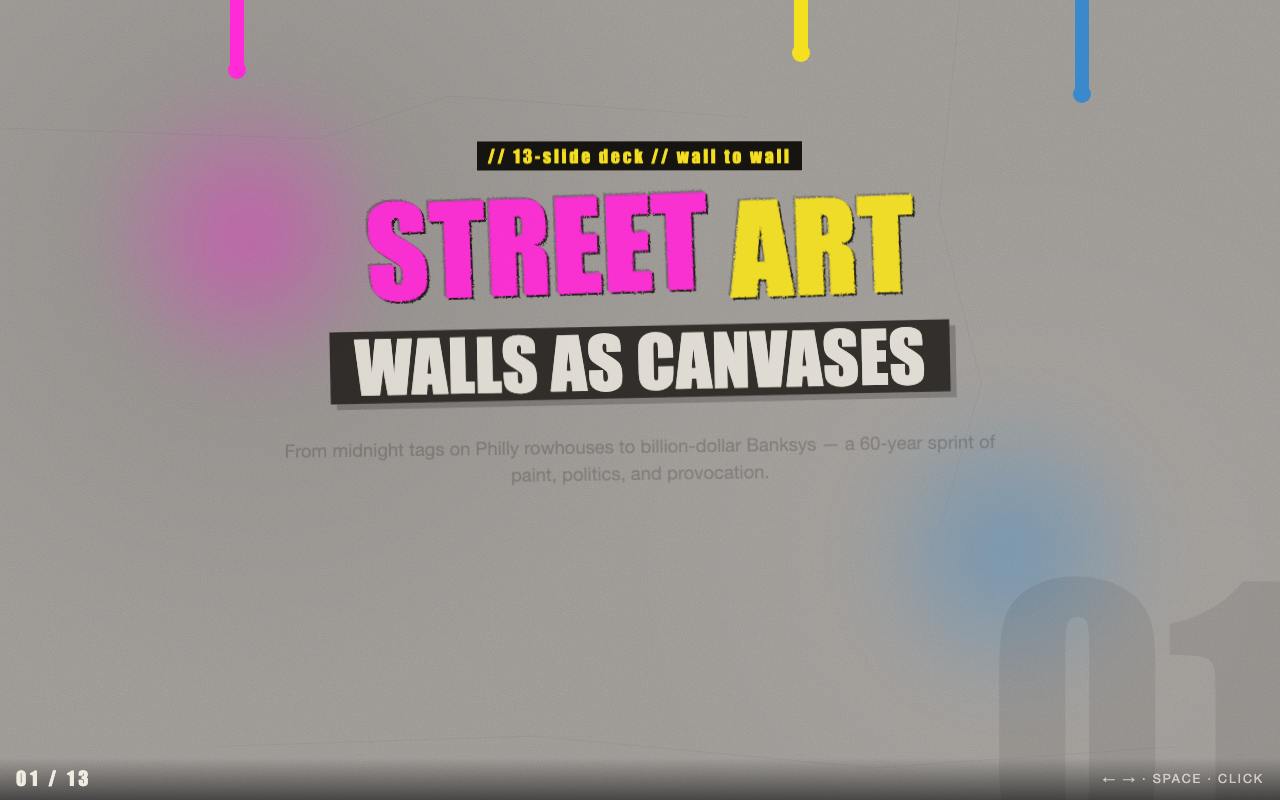
STREET
ART
- From Tags to Museums
- How unauthorized marks on public walls became one of the most contested, celebrated, and commercially valuable art forms of the 21st century.
- GraffitiMuralismStencilPublic SpaceSubculture
- 1 / 30
Slide 02
What Is Street Art?
- Defining the Indefinable
- Street art is visual art created in public locations without institutional permission, ranging from quick spray-paint tags to massive commissioned murals. The term is contested — graffiti writers often reject "street art" as a gallery-friendly rebranding that strips out the culture. But both traditions share a claim: that public space is a legitimate canvas for unauthorized self-expression.
- Graffiti
- Writing-based, name-focused, subcultural. Internal audience: fellow writers who recognize styles, skill levels, and territorial claims.
- Street Art
- Image-based, often message-driven. External audience: passers-by, media, art world. Conscious of broader reception.
- 2 / 30
Slide 03
Before Graffiti: Ancient Walls
- Roots
- Humans have marked public surfaces since the Palaeolithic. The impulse is not new — only the context, law, and media attention are.
- 40,000 BCHand stencils and animal paintings in caves — Chauvet, Lascaux. Unauthorized marks in shared space.
- 79 ADPompeii preserved 11,000+ wall inscriptions: political slogans, insults, love notes, advertisements — the graffiti of Rome.
- 1930sMexican muralists Diego Rivera, José Orozco, David Siqueiros paint public walls as revolutionary political medium.
- 1960sPhiladelphia and New York see early name-writing on walls and subway trains — Cornbread, Cool Earl in Philly. Urban tagging culture beginning.
- 3 / 30
Slide 04
The Subway as Canvas
- New York City · 1971–1989
- New York's fiscal crisis of the 1970s left the subway neglected and covered in graffiti. Far from vandalism, writers like TAKI 183, Phase 2, and Dondi developed a sophisticated visual language: tags evolved into throw-ups and then into wildstyle "pieces" covering entire cars.
- The subway was the writers' exhibition space — work seen by millions daily, moving through every borough. Style genealogies, crew rivalries, and technical vocabularies developed within a community that produced its own stars, critics, and hierarchy.
- TAKI 183 — early tagger profiled by NYT in 1971, triggering explosion of imitation
- Phase 2 — inventor of the bubble letter, foundation of graffiti typography
- Dondi — whole-car masterpieces using cinematic technique
- Lee Quiñones — transformed entire train sets into social commentary
- Lady Pink — one of the first major female writers, active since 1979
- Futura 2000 — abstract style breaking from letter-based tradition
- 4 / 30
Slide 05
Graffiti Style Elements
- The Vocabulary
- Tag
- A writer's signature — the most fundamental form. Speed and legibility to other writers are paramount. The proof of presence.
- Throw-Up
- Two-color outline letters, executed fast. More visible than a tag, less labor-intensive than a piece. The workhorse of subway coverage.
- Piece
- Short for "masterpiece" — complex multi-color work with fills, outlines, shadows, highlights, and background. Can take hours.
- Wildstyle
- Interlocking, connected letters with arrows and extensions — deliberately illegible to outsiders. Insider knowledge required to decode.
- Fill & Outline
- The interior color and surrounding stroke. Technical control of the border between fill and outline defines quality — clean lines signal mastery.
- 3D Shadow
- Illusionistic depth added to letter forms — a direct lineage from Renaissance perspective applied to aerosol typography.
- 5 / 30
Slide 06
Four Elements of Hip-Hop
- Cultural Matrix
- Graffiti was one of four pillars of hip-hop culture emerging from the South Bronx in the early 1970s. DJ Kool Herc's block parties (1973) gave the music; breakdancers gave movement; rappers gave the voice; writers gave the visual. Together they formed an integrated Bronx youth culture responding to urban disinvestment.
- 1DJing
- 2MCing / Rap
- 3Breakdancing
- 4Graffiti Writing
- 6 / 30
Slide 07
Jean-Michel Basquiat
- BBasquiat
- 1960 – 1988
- SAMO© to the Gallery
- Starting as SAMO© — "Same Old Shit" — Basquiat tagged downtown Manhattan walls with poetic phrases and copyright symbols. By 1980 he was invited to group gallery shows; by 1982 Andy Warhol was his collaborator.
- His paintings fused street writing, anatomical diagrams, Black history, jazz biography, and raw gestural painting. He died of a heroin overdose at 27 in 1988. His work now sells for $100M+.
- 7 / 30
Slide 08
Keith Haring
- New York Subway · 1980–1990
- Haring drew in white chalk on the blank black advertising panels of NYC subway stations — ephemeral, democratic, enormously visible. His vocabulary of radiant babies, barking dogs, and interlocking figures was instantly legible across languages and contexts.
- He opened the Pop Shop (1986) to make his work affordable. His art addressed AIDS, apartheid, and drug addiction with cheerful visual language that concealed urgent moral content. He died of AIDS in 1990, age 31.
- HHaring
- 1958 – 1990
- 8 / 30
Slide 09
BANKSY
- Identity Unknown · Bristol, England
- Banksy is the most famous street artist alive and the most famous anonymous artist in history. Beginning in Bristol in the 1990s with spray-stencil work, his pieces use satirical juxtaposition to critique capitalism, war, surveillance, and celebrity.
- His identity remains officially unknown despite decades of journalism. In 2018, a Banksy painting shredded itself at auction the moment the hammer fell — an act that doubled the work's value. The market he mocks finances him.
- Balloon Girl — stencil of child releasing heart-shaped balloon
- Kissing Coppers — two police officers kissing, Brighton
- Israeli West Bank Barrier murals — 2005, globally covered
- Exit Through the Gift Shop — Oscar-nominated documentary, 2010
- Dismaland — dystopian Disneyland theme park, 2015
- Self-shredding painting at Sotheby's — 2018
- 9 / 30
Slide 10
The Stencil Revolution
- Tools of the Trade
- Stenciling — cutting a design into card or acetate and spraying paint through it — allows complex images to be applied in seconds. Unlike freehand spray painting, stencil work can be planned, refined, and executed with precision independent of real-time skill. It democratized image-making on walls.
- Speed
- A multi-layer stencil can be applied in under 60 seconds. In illegal contexts, speed determines whether you're caught.
- Reproducibility
- The same stencil can be reused hundreds of times — enabling campaigns across an entire city simultaneously.
- Multi-Layer Color
- Separate stencils for each color, registered precisely, build up photorealistic images from simple geometric cuts.
- 10 / 30
Slide 11
LA: Chicano Muralism Meets Graffiti
- West Coast · 1980s–Present
- Los Angeles brought together two traditions: the Chicano mural movement (rooted in Mexican muralism and barrio identity) and New York-influenced graffiti writing. The combination produced a distinct West Coast visual culture that dominated neighborhoods like East LA and Boyle Heights.
- Artists like Shepard Fairey (OBEY) and the Seventh Letter crew emerged from LA's scene. The city's sprawl and car culture created a different relationship to public space than NYC's pedestrian density — billboards and freeway walls replaced subway cars.
- Key LA Artists
- Chaz Bojórquez — "godfather" of Chicano graffiti, Old English lettering tradition
- Shepard Fairey — OBEY Giant campaign; later Obama Hope poster
- Mr. Cartoon — tattoo-influenced black-and-grey spray work
- Retna — invented personal script language fusing Mayan, Arabic, Hebrew forms
- Cryptik — large-scale figurative murals on Buddhist themes
- 11 / 30
Slide 12
OBEY Giant:
Propaganda About Propaganda
- Mass Repetition as Strategy
- In 1989, Shepard Fairey started wheat-pasting stickers of wrestler André the Giant's face — 7'4", 520 lbs — with the word OBEY. The campaign spread globally with no product to sell. The point was to make people aware of their own obedience to images.
- Manufactured Dissent
- Fairey's campaign used the logic of advertising to critique advertising — a paradox that became the work's content.
- Obama Hope (2008)
- Fairey's four-color stencil portrait became the defining image of the Obama campaign — and triggered a copyright lawsuit over the AP photograph it was based on.
- 12 / 30
Slide 13
São Paulo: Pixação
- Brazil · 1985–Present
- Brazil's São Paulo developed its own graffiti tradition — pixação — that looks unlike any other in the world. Tall, angular, rectilinear letters derived from heavy metal typography climb skyscrapers 30 stories high. Pixadores risk their lives to paint where no one can paint — and no one can remove it.
- The Style
- Not wildstyle or bubble letters — a completely indigenous script system, immediately recognizable, incomprehensible to outsiders. Rooftopping as competitive sport.
- Social Context
- São Paulo's inequality is among the world's most extreme. Pixação explicitly occupies elite space — luxury towers, corporate buildings — as a form of class assertion.
- 13 / 30
Slide 14
Street Art in the Museum
- Institutionalization
- MoMA's 1980 "Post Graffiti" show signaled the art world's interest. Basquiat, Haring, and Kenny Scharf crossed from walls to galleries within years. The tension has never resolved: does gallery legitimacy validate or betray the street tradition?
- Critics argue that museum acquisition strips out the illegality and ephemerality — the elements that gave the work its power. Others counter that closing off the gallery to street artists is itself a form of class gatekeeping.
- Works removed from walls and auctioned — sometimes without artists' consent
- Hotels commission murals; neighborhoods gentrify around them
- Commissioned "street art" loses the transgression that defined it
- Christie's and Sotheby's now hold dedicated urban art sales
- Banksy's Balloon Girl: anonymous wall stencil to £16M auction record
- 14 / 30
Slide 15
Art as Gentrification Engine
- Urban Dynamics
- Murals attract photographers; photographers attract Instagram; Instagram attracts coffee shops; coffee shops attract developers. The cycle is well-documented in neighborhoods from Bushwick, Brooklyn to Wynwood, Miami to Shoreditch, London. Artists who painted cheap industrial walls now live in cities priced out of their own work.
- 350%Wynwood rent increase 2010–2020
- 2012Wynwood Walls established
- 5MAnnual visitors, Wynwood
- 15 / 30
Slide 16
Women in the Street
- Representation
- Street art has historically been male-dominated — the physical danger of illegal work, social barriers to nocturnal public activity, and gatekeeping within crews all excluded women. But women have always been present, and in the past decade have gained visibility at scale.
- Lady Pink
- Active since 1979, one of the most respected writers of the NYC subway era. Appeared in the film Wild Style (1983).
- SWOON
- New York artist known for large wheat-paste prints of human figures. First female street artist acquired by MoMA.
- Hyuro
- Argentine muralist whose spare, sequential figures explored female experience and social conformity. Her work still covers walls in Valencia, Spain.
- 16 / 30
Slide 17
Slide 17
- "The thing I hate the most about advertising is that it attracts all the bright, creative and ambitious young people, leaving us mainly with the slow and self-obsessed to become politicians."— Banksy, Wall and Piece
- 17 / 30
Slide 18
Street Art Around the World
- World Cities
- Berlin
- Post-Wall explosion of public art. The East Side Gallery — 1.3 km of Berlin Wall murals by international artists — is the world's largest open-air gallery.
- Melbourne
- Hosier Lane is legally protected laneway art. Melbourne combines tolerance for legal street art with active prosecution of non-sanctioned work — an uneasy compromise.
- Tehran
- State-commissioned murals dominate — war martyrs, revolutionary images. Unauthorized work is politically risky. Underground artists use code and ambiguity.
- Buenos Aires
- Argentina's 2001 economic collapse triggered an explosion of political stenciling. BA has become one of the world's most photogenic street art cities.
- Lagos
- A new generation of Nigerian muralists — Laolu Senbanjo, Emmanuel Ekpeyong — blend Yoruba pattern traditions with urban scale.
- Valparaíso
- Chile's port city has made street art central to its post-Pinochet identity — hills covered in murals, the city itself a museum without walls.
- 18 / 30
Slide 19
The Legal Landscape
- Crime and Punishment
- New York's 1972 anti-graffiti ordinance made it illegal to possess a spray can in a subway with intent to write. The MTA spent $300M+ on anti-graffiti programs 1984–89, including a "Clean Train" policy that removed tagged cars before they ran.
- Legal outcomes vary wildly: a Berlin street artist gets a commission; a Melbourne writer gets a fine; a São Paulo pixador can get six months in prison. The same act — unauthorized mark on a wall — receives completely different treatment across jurisdictions.
- 5Pointz Demolition (2013)
- Developer Jerry Wolkoff whitewashed 49 works of art from a famous Queens mural complex overnight before demolition. A federal court awarded 21 artists $6.75M under the Visual Artists Rights Act — the first major street art intellectual property victory.
- 19 / 30
Slide 20
Wheat-Paste: Paper Art in Public
- Paper and Glue
- Wheat-paste allows large-format printed or hand-drawn work to be installed quickly. Flour paste, paper, and a brush — the same technology as antique handbill posting. Artists like SWOON, JR, and Shepard Fairey built careers around it.
- JR: The Largest Gallery
- French artist JR wheat-pastes monumental photographs of unknown people — favela residents, Middle Eastern faces — on public walls globally. His "Inside Out" project distributed printing kits to participants in 130 countries.
- Ephemeral by Design
- Paste-up dissolves in rain, peels in sun, is painted over by authorities. Some artists embrace this — the street is not a museum, and durability was never the point.
- 20 / 30
Slide 21
Instagram and the Wall Economy
- After the Internet
- Instagram transformed street art's audience and economics. Before smartphones, a wall piece was seen by passers-by and perhaps documented by a handful of photographers. After 2010, a striking mural could reach millions within hours of completion.
- This created the "Instagram wall" phenomenon — murals designed as photo backdrops, optimized for selfie engagement rather than street meaning. Critics call it the sanitization of dissent; practitioners note it funds large-scale ambitious work that would otherwise be impossible.
- Brands pay for murals featuring their logos as "authentic" marketing
- Cities fund mural festivals to attract tourism and social media coverage
- Artists gain international careers without leaving their cities
- Street art aggregator accounts command millions of followers
- NFTs extended the digital-native street art economy into tokens
- 21 / 30
Slide 22
Art as Political Statement
- Walls Speak
- 1968Paris student uprising — stenciled slogans and situationist texts paper the Latin Quarter. "Sous les pavés, la plage" (Under the paving stones, the beach).
- 1989Berlin Wall murals document Cold War; their disappearance documents its end. The Wall itself becomes the world's most famous graffiti surface.
- 2005Banksy paints nine images on the Israeli West Bank separation barrier — a Palestinian child with balloons ascending, a dove in a bullet-proof vest.
- 2020Black Lives Matter murals — including "Black Lives Matter" painted in Washington D.C. by city order — make street art a governmental as well as insurgent medium.
- 22 / 30
Slide 23
The Street Art Market
- Money Changes Everything
- The same week Banksy lampooned the auction world, a Banksy sold for a record price at auction. Urban art has become a mainstream investment category, with dedicated sales at Christie's and Sotheby's generating hundreds of millions annually.
- $18.6MBanksy's "Love is in the Bin," 2021
- $110MBasquiat's "Untitled," 2017
- $5B+Global street art market estimate
- 23 / 30
Slide 24
OS GÊMEOS: Yellow Giants
- São Paulo · Brazil
- Otávio and Gustavo Pandolfo — twin brothers born in São Paulo in 1974 — began writing graffiti in the 1980s and developed a completely unique visual language: elongated yellow-skinned characters with closed or distant eyes, floating in dream logic.
- Their imagery draws on Brazilian folklore, their own shared dreams, and the psychedelic aesthetic of São Paulo's funk and hip-hop scenes. They have painted entire aircraft, museum atriums, and Olympic venues — without losing their street roots.
- Boston Ink Block warehouse — entire building, 2012
- TAM Airlines Boeing 737 — custom painted aircraft
- Tate Modern, London — indoor installation, 2008
- São Paulo subway cars — roots of the tradition
- Montreal Museum of Fine Arts retrospective, 2015
- 24 / 30
Slide 25
The New Muralism
- Large Scale
- Contemporary muralism has reached architectural scale — entire building facades, 20 stories tall, painted with lifts and sophisticated projections. Festival circuits — Upfest (Bristol), Art Basel Miami, POW! WOW! (Hawaii/global) — bring international artists to cities worldwide.
- Guido van Helten
- Australian muralist known for hyperrealistic large-scale portraits of community members — residents of the towns he paints in, 10 stories tall.
- Rone
- Melbourne-based portraitist of melancholy women in abandoned interiors — his work documents urban decay by inhabiting it.
- Eduardo Kobra
- Brazilian muralist whose Guinness-record mural covered 3,000 square meters with kaleidoscopic indigenous portraits. Scale as artistic statement.
- 25 / 30
Slide 26
Major Street Art Festivals
- The Festival Circuit
- POW! WOW!
- Founded in Honolulu, 2010. Now active in 12 cities globally. Brings 100+ artists annually; defines the contemporary mural festival model.
- Upfest (Bristol)
- Europe's largest street art festival, in Banksy's home city. 300+ artists, 30,000 live spectators. Street and gallery worlds coexist uneasily.
- Art Basel Miami
- Wynwood's murals serve as the fair's unofficial outdoor exhibition — the street art economy tied directly to the world's most important art market week.
- 26 / 30
Slide 27
Copyright on the Street
- Who Owns the Wall?
- Can illegal art be copyrighted? In most jurisdictions, yes — copyright vests in the creator at the moment of creation, regardless of whether the act was itself legal. This creates a paradox: the artist owns rights in work that the property owner can lawfully paint over.
- The 5Pointz case (2018) confirmed that the Visual Artists Rights Act can protect street art at the point of destruction — even unauthorized work. Courts are still working out the boundaries of this protection.
- The Tattoo Problem
- When a boxer's tattooed face appears in a video game, does the tattoo artist get royalties? Courts said yes in Solid Oak Sketches v. 2K Games (2020). Street artists have begun asserting similar rights when their walls appear in films, games, and advertisements.
- 27 / 30
Slide 28
Virtual Walls: AR and NFTs
- Next Frontier
- Augmented reality allows artists to "paint" walls that only appear through phone screens — invisible to the naked eye, visible to anyone with the app. This creates a new form of public art with no physical trace and no legal exposure. Artists like KAWS have used AR to place monumental sculptures in public parks globally.
- AR Street Art
- Zero risk of arrest, infinite scale, global reach. But loses the physical presence and social claim of real paint on real walls — the stakes that gave the tradition meaning.
- NFT Edition
- Pak, Beeple, and street-art-adjacent artists generated billions in NFT sales 2020–21. FEWOCIOUS, a teenager, earned $2.16M at Christie's. The street-to-gallery pipeline went digital.
- 28 / 30
Slide 29
The Enduring Legacy
- What Remains
- Street art fundamentally changed what the art world considers legitimate. It questioned who gets to make art, where art can exist, who can see it, and whether permission is a prerequisite for expression.
- These questions, once confined to subway tunnels, now animate debates about public space, intellectual property, cultural authenticity, and the relationship between dissent and spectacle. The mark on the wall turned out to be deeper than it looked.
- Democratized artistic production — anyone can spray paint
- Established public space as contested cultural terrain
- Created careers outside the gallery-school-critic system
- Generated a visual language adopted globally by advertising
- Raised legal questions about art, property, and rights
- Proved that underground culture becomes mainstream culture
- 29 / 30
Slide 30
THE
WALL
WINS
- "The art world is the biggest joke going. It's a rest home for the over-privileged, the pretentious, and the weak. And modern art is a disgrace — never have so many people used so much effort to say so little."— Banksy
- UnauthorizedPublicEphemeralGlobal
- 30 / 30