shipslides
Business20 slides0 views

Startups — Pitch Deck

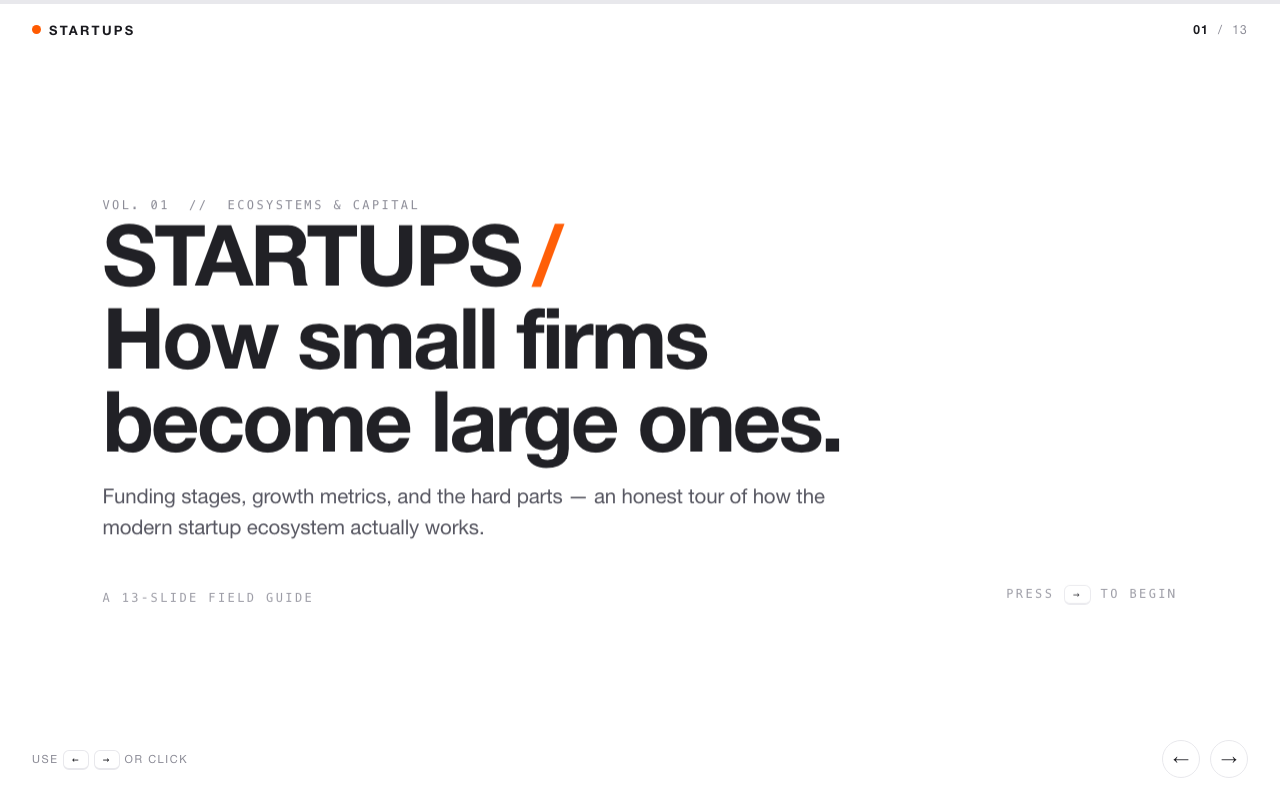
From Paul Graham's garage to the unicorn parade — what venture capital actually looks for, why most fail, and the few patterns that recur.

StandaloneDownload
Sandboxed deck
Open raw

About this HTML presentation

This Shipslides page presents Startups — Pitch Deck as an interactive HTML presentation deck in the Business catalog with 20 slides. The share page keeps the uploaded deck sandboxed while exposing readable context, topics, and a slide outline for viewers and search engines.

From Paul Graham's garage to the unicorn parade — what venture capital actually looks for, why most fail, and the few patterns that recur. Key sections include: Startups.; What is a startup?; The accelerator model; Lean Startup; Product–Market Fit; The funding ladder; The unit economics that matter; The founding team; Airbnb · 2007–2011; Stripe · 2010–today.

Key sections

  • 01Startups.
  • 02What is a startup?
  • 03The accelerator model
  • 04Lean Startup
  • 05Product–Market Fit
  • 06The funding ladder
  • 07The unit economics that matter
  • 08The founding team
  • 09Airbnb · 2007–2011
  • 10Stripe · 2010–today
  • 11Quibi · 2018–2020
  • 12The pitch deck
  • 13Why startups die
  • 14Term sheet, demystified
  • 15How startups end
  • 16The startup funnel
  • 17The seven sins of seed-stage founders
  • 18Where to learn more
  • 19The only thing that matters.
  • 20Thank you.

Topics covered

Slide outline
  1. 01Startups.
  2. 02What is a startup?
  3. 03The accelerator model
  4. 04Lean Startup
  5. 05Product–Market Fit
  6. 06The funding ladder
  7. 07The unit economics that matter
  8. 08The founding team
  9. 09Airbnb · 2007–2011
  10. 10Stripe · 2010–today
  11. 11Quibi · 2018–2020
  12. 12The pitch deck
  13. 13Why startups die
  14. 14Term sheet, demystified
  15. 15How startups end
  16. 16The startup funnel
  17. 17The seven sins of seed-stage founders
  18. 18Where to learn more
  19. 19The only thing that matters.
  20. 20Thank you.
Page data
Canonical
https://shipslides.com/d/business-startups
Category
Business
Size
29.9 KB
Updated
2026-05-17
LLM text
https://shipslides.com/d/business-startups/llms.txt

Presentation Transcript

Detailed slide-by-slide text content extracted from this presentation.

Slide 01

Startups.

  • A Pitch Deck About Pitch Decks
  • From Paul Graham's garage to the unicorn parade — what venture capital actually looks for, why most fail, and the few patterns that recur.
  • Y CombinatorLeanPMFSeries AExits
Slide 02

What is a startup?

  • Definition
  • "A startup is a company designed to grow fast." — Paul Graham, "Startup = Growth," 2012
  • Not just new. A laundromat is new but doesn't scale. Three traits define it:
  • Big market. Total addressable market in the billions, not the millions.
  • Repeatable model. Each unit sold makes future units cheaper or easier.
  • Speed before scale. Find the model first; pour fuel only when it works.
Slide 03

The accelerator model

  • Y Combinator
  • Founded 2005 by Paul Graham, Jessica Livingston, Robert Morris, Trevor Blackwell. Twice-yearly batch of ~250 startups in Mountain View / online. Investment: $500K for ~7% (current terms).
  • Demo Day at the end. ~5,000 founders have come through. Aggregate value of YC alums exceeds $600B as of 2024.
  • Notable alumni
  • Airbnb (W09) · Stripe (S09) · Dropbox (S07) · Reddit (S05) · Coinbase (S12) · Instacart (S12) · DoorDash (S13) · Twitch (W07)
  • YC Maxims
  • Make something people want.
  • Talk to users.
  • Do things that don't scale.
  • Launch ugly. Launch now.
  • Default alive, not default dead.
  • Default rate: ~5% weekly growth.
Slide 04

Lean Startup

  • Methodology
  • Eric Ries (2011), based on Steve Blank's customer development. Replace business plans with hypotheses. Replace launches with experiments.
  • Pivot = a structured course correction to test a new fundamental hypothesis. Slack pivoted from a multiplayer game (Glitch) to a chat tool. Twitter pivoted from podcasting (Odeo). Instagram pivoted from a check-in app called Burbn.
Slide 05

Product–Market Fit

  • The Holy Grail
  • "You can always feel product/market fit when it's happening. The customers are buying the product just as fast as you can make it." — Marc Andreessen
  • Sean Ellis Test
  • Survey users: "How would you feel if you could no longer use this product?" PMF benchmark: 40%+ "very disappointed."
  • Retention curves
  • The cohort retention curve must flatten above zero. Users keep coming back without paid prompting.
  • Word of mouth
  • Customers refer without being asked. The CAC drops. The sales cycle shortens. You can't make the product fast enough.
Slide 06

The funding ladder

  • Capital
  • StageTypical SizeLeadDilutionWhat you sell
  • Pre-seed$50k–$1MFriends, angels, YC5–10%A pitch deck and a working demo
  • Seed$1–4MSeed funds (FF, Initialized)15–25%Early traction, $1M ARR target
  • Series A$8–18MSequoia, A16z, Benchmark20–25%PMF, repeatable sales motion
  • Series B$25–50MTier-1 funds, growth arms15–20%Scale, $5–15M ARR, expanding ICP
  • Series C+$50–500M+Tiger, Coatue, SoftBank10–15%Market leadership, IPO proximity
  • Pre-IPO$500M–$5BCrossover, sovereign wealth5–10%Brand, IPO bookbuild
  • Rule of thumb: raise 18–24 months of runway. The next round always takes longer than you expect.
Slide 07

The unit economics that matter

  • Math
  • CACCustomer Acquisition Cost. All sales+marketing ÷ new customers in the period.
  • LTVLifetime Value. ARPU × gross margin ÷ churn rate. SaaS rule: LTV/CAC ≥ 3.
  • PBPPayback Period. Months for gross profit to cover CAC. Healthy: < 12 months.
  • NRRNet Revenue Retention. Top SaaS: 120%+. Existing customers grow faster than churn.
  • SaaS Rule of 40: Growth Rate % + Operating Margin % ≥ 40. The market will value you on this above all else once you cross $50M ARR.
Slide 08

The founding team

  • Founders
  • YC's data: solo founders fail more often than 2- or 3-person teams. 4+ team members raises coordination costs and reduces equity per founder.
  • The classic split: hacker × hustler. One ships product. One ships sales, fundraising, hiring. Sometimes a third "designer/product" sits between.
  • "Bad cofounders are a worse problem than not having a cofounder." — Paul Graham
  • Equity vesting
  • Standard: 4-year vest, 1-year cliff. After year 1, 25% vests; remainder monthly. Reverse-vesting protects everyone if a cofounder leaves in month 8.
  • Founder breakups
  • Noam Wasserman's data: 65% of high-potential startups fail because of founder conflict. Have the equity-split conversation early; revisit it.
Slide 09

Airbnb · 2007–2011

  • Case Study
  • Brian Chesky and Joe Gebbia, broke roommates in San Francisco, rent out three air mattresses during a design conference. Charge $80/night. Three guests. The seed of an idea.
  • Original site: AirBedAndBreakfast.com. They financed runway by selling election-themed cereal boxes ("Obama O's") at $40/box — made $30K.
  • Rejected by VCs 7 times. Accepted to YC W09 with PG's note: "They're like cockroaches. They will not die."
  • The unlock: photographers. NYC hosts had bad photos. The founders flew there with a camera, shot listings themselves. Bookings doubled. Lesson: do things that don't scale.
  • By the numbers, today
  • $11B revenue (2024) · 5M+ hosts · 1.5B+ guest arrivals all-time · IPO Dec 2020 at $47B valuation, popped to $100B day one.
Slide 10

Stripe · 2010–today

  • Case Study
  • Patrick & John Collison, brothers from Limerick, Ireland. Built a way to accept payments online with seven lines of code at a time when the alternatives required signing a contract with a "merchant acquirer" and waiting weeks.
  • Beachhead
  • Developers. Hard to charm, but if you do — they evangelize. Stripe's docs are still considered industry-best.
  • Expansion
  • From payments to billing, identity (Atlas, Radar), corporate cards (Issuing), tax. The "atomic concept" expanded into a financial OS.
  • Numbers
  • $1.4T processed in 2024 · ~$70B valuation · still private · profitable.
  • "We thought we were building a developer tool. Turns out we were building economic infrastructure." — Patrick Collison, 2021
Slide 11

Quibi · 2018–2020

  • Case Study
  • Jeffrey Katzenberg + Meg Whitman. Raised $1.75B from Disney, NBC, Sony, Alibaba, JPMorgan. Premium short-form video, mobile-only, $5–8/month. Star talent. Original shows.
  • Launched April 2020. Shut down October 2020. Six months.
  • What went wrong
  • Wrong moment. Mobile-only during a pandemic when everyone was home in front of a TV.
  • No social loop. Couldn't share clips. People watch short-form to send to friends.
  • Wrong target. Hollywood made shows for adults; phone-shape video lived on TikTok.
  • Capital ≠ traction. No PMF, but launched at scale anyway. Lean Startup commandment broken.
Slide 12

The pitch deck

  • Frameworks
  • Sequoia's classic 10-slide template (still 90% of seed pitches in 2026):
  • #SlideTest
  • 1Company purposeOne sentence. Could a stranger repeat it?
  • 2ProblemPain customers feel today. Quantify if you can.
  • 3SolutionYour product. Not features — the value.
  • 4Why now?What changed in tech, regulation, behavior?
  • 5Market sizeTAM / SAM / SOM. Bottoms-up beats top-down.
  • 6CompetitionDon't say "no competitors." Say where you sit.
  • 7ProductScreenshots. Demo if possible.
  • 8Business modelHow you make money. Pricing. Unit econ.
  • 9TeamWhy you. Why now. Domain credentials.
  • 10Financials & askHow much, for what milestone, runway months.
Slide 13

Why startups die

  • Survival
  • CB Insights' top reasons (post-mortem analysis of ~500 failed startups):
  • Reason%
  • Ran out of cash / failed to raise38%
  • No market need35%
  • Got outcompeted20%
  • Flawed business model19%
  • Regulatory / legal18%
  • Pricing / cost issues15%
  • Wrong team14%
  • Bad product8%
  • Default Alive vs. Default Dead
  • PG's 2015 essay. Plot expense growth vs. revenue growth at current burn. Will you reach profitability before cash runs out?
  • If yes — you can decide whether to raise. If no — your decision is forced. Most founders discover too late they're default dead.
  • "Until you're default alive, you have no permission to think about anything else." — PG
Slide 14

Term sheet, demystified

  • Frameworks
  • TermWhat it really means
  • Pre-money valuationWhat the company is worth before this check lands
  • Post-money valuationPre-money + new investment
  • Liquidation preferenceInvestor gets their money out first on exit. 1x non-participating is standard.
  • Pro-rata rightsRight to invest in future rounds to maintain ownership %
  • Anti-dilutionDown-round protection. Broad-based weighted average is fairest.
  • Board compositionWho controls the company. 2 founders / 2 investors / 1 indep is balanced.
  • Option poolSet aside for future hires. Larger pool = more dilution to founders, not investors.
  • SAFE / Convertible noteDefer valuation to next priced round. SAFE has no maturity date or interest.
Slide 15

How startups end

  • Exits
  • Acqui-hire
  • $1–25M. Talent acquisition. Common when product fails but team is strong.
  • Strategic acquisition
  • $50M–$5B. Instagram→Meta ($1B), GitHub→Microsoft ($7.5B), Slack→Salesforce ($27B).
  • IPO
  • The big one. Median age at IPO: 11 years. Only ~1% of VC-backed companies make it.
  • Direct listing
  • Spotify (2018), Slack (2019). No new shares issued; just existing ones become tradeable.
  • SPAC merger
  • 2020–21 fad. Faster than IPO but worse outcomes — most de-SPACs trade below issue.
  • Failure
  • ~75% of seed-stage VC-backed startups never return investor capital. The base rate.
Slide 16

The startup funnel

  • Diagram
Slide 17

The seven sins of seed-stage founders

  • Mistakes
  • Premature scaling. Hiring sales before you know what you're selling. Building the team you'll have at $10M ARR while you're at $1M.
  • Skipping user research. Believing your own pitch deck. Steve Blank: "No facts exist inside the building. Get out."
  • Vanity metrics. Pageviews, downloads, signups. Track activation, retention, and revenue.
  • Raising too much, too early. $10M seed at $40M post means your Series A needs to be a $200M valuation. Few companies make that jump.
  • Co-founder splits without conversation. 50/50 sounds fair until someone's working twice as hard.
  • Building features instead of solving problems. Customers want milkshakes, not blenders.
  • Confusing fundraising with success. Money is fuel. Fuel without an engine is a fire.
Slide 18

Where to learn more

  • Reading list
  • Books
  • Zero to One — Peter Thiel
  • The Lean Startup — Eric Ries
  • The Hard Thing About Hard Things — Ben Horowitz
  • Founders at Work — Jessica Livingston
  • The Mom Test — Rob Fitzpatrick
  • Hooked — Nir Eyal
  • Crossing the Chasm — Geoffrey Moore
  • YouTube
  • Y Combinator — Startup School lectures, How to Start a Startup (Stanford CS183B)
  • Stanford GSB — View From The Top, ETL series
  • a16z — Andreessen Horowitz channel
  • This Week in Startups — Jason Calacanis interviews founders
  • Essays
  • paulgraham.com/articles.html — start with "How to Start a Startup," "Do Things That Don't Scale," "Default Alive or Default Dead?"
Slide 19

The only thing that matters.

  • Last slide
  • "Make something people want." — Y Combinator motto, since 2005
  • Every framework, every term sheet, every essay reduces to that. The hard part is figuring out who the people are and what the something is. Everything else — the cap table, the demo day, the press, the IPO — is the byproduct.
  • Press → for next slide, ← for previous.
Slide 20

Thank you.

  • Index
  • Twenty slides on what makes startups grow, raise, exit, or die.
  • ← Back to The Deck Catalog
  • ← Business & Economics index
Remove this deck