shipslides
Business13 slides0 views

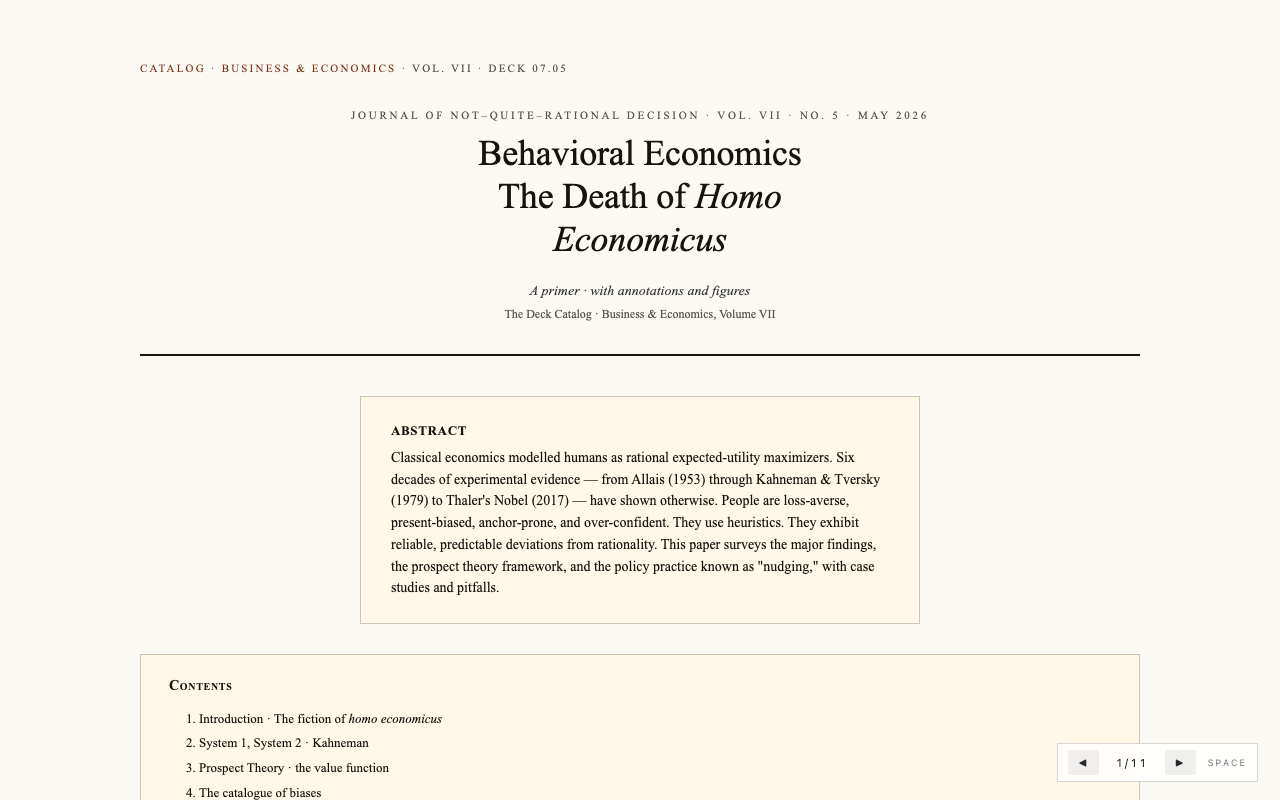
Behavioral Economics — When agents are human

A thirteen-slide synopsis of the heuristics-and-biases program, prospect theory, and the descendants of Simon, Kahneman, Tversky, and Thaler.

StandaloneDownload
Sandboxed deck
Open raw

About this HTML presentation

This Shipslides page presents Behavioral Economics — When agents are human as an interactive HTML presentation deck in the Business catalog with 13 slides. The share page keeps the uploaded deck sandboxed while exposing readable context, topics, and a slide outline for viewers and search engines.

A thirteen-slide synopsis of the heuristics-and-biases program, prospect theory, and the descendants of Simon, Kahneman, Tversky, and Thaler. Key sections include: Behavioral Economics When agents are human.; 01 The setup; 02 Bounded rationality; 03 Heuristics & biases; 04 Prospect Theory; 05 Mental accounting; 06 The endowment effect; 07 Default effects; 08 Hyperbolic discounting; 09 Nudges.

Key sections

  • 01Behavioral Economics When agents are human.
  • 0201 The setup
  • 0302 Bounded rationality
  • 0403 Heuristics & biases
  • 0504 Prospect Theory
  • 0605 Mental accounting
  • 0706 The endowment effect
  • 0807 Default effects
  • 0908 Hyperbolic discounting
  • 1009 Nudges
  • 1110 Critiques
  • 1211 Modern
  • 1312 Further reading
Slide outline
  1. 01Behavioral Economics When agents are human.
  2. 0201 The setup
  3. 0302 Bounded rationality
  4. 0403 Heuristics & biases
  5. 0504 Prospect Theory
  6. 0605 Mental accounting
  7. 0706 The endowment effect
  8. 0807 Default effects
  9. 0908 Hyperbolic discounting
  10. 1009 Nudges
  11. 1110 Critiques
  12. 1211 Modern
  13. 1312 Further reading
Page data
Canonical
https://shipslides.com/d/catalog-business-behavioral-econ
Category
Business
Size
48.7 KB
Updated
2026-05-17
LLM text
https://shipslides.com/d/catalog-business-behavioral-econ/llms.txt

Presentation Transcript

Detailed slide-by-slide text content extracted from this presentation.

Slide 01

Behavioral Economics When agents are human.

  • A Field Survey · Vol. I · Spring 2026
  • A thirteen-slide synopsis of the heuristics-and-biases program, prospect theory, and the
  • descendants of Simon, Kahneman, Tversky, and Thaler.
  • Catalog · Business & Decision Sciences
Slide 02

01The setup

  • Behavioral EconomicsI. The Departure from Rationality
  • Section I
  • Classical economics assumes a creature that does not exist.
  • For most of the twentieth century, mainstream economics modeled decision-makers as
  • homo economicus: agents with stable preferences, unlimited
  • computational power, and the discipline to maximize expected utility under uncertainty1.
  • The framework is elegant. It is also empirically wrong. Real humans systematically
  • violate its axioms — not at the margins, but at the center.
  • Working Claim
  • The deviations from rational choice are not random noise. They are structured, predictable, and exploitable.
  • Behavioral economics studies that structure — what Kahneman called the
  • "map of bounded rationality."
  • 1 Samuelson, P. (1947). Foundations of Economic Analysis. Harvard.
  • 2 Kahneman, D. (2003). "Maps of Bounded Rationality." American Economic Review 93(5).
Slide 03

02Bounded rationality

  • Behavioral EconomicsII. Bounded Rationality
  • Section II · Foundations
  • Herbert Simon (1955): we satisfice; we do not optimize.
  • Simon's central insight: cognition is a scarce resource. An agent searching for the
  • optimal apartment, spouse, or chess move would never finish. Real decision-making
  • terminates at aspiration thresholds — "good enough" beats "best."3
  • Optimizing: evaluate the full option set; select the maximum.
  • Satisficing: evaluate sequentially; stop at the first option that clears the bar.
  • Simon won the 1978 Nobel for showing that institutions and routines are not failures of
  • rationality — they are how rationality survives finite minds in infinite worlds.
  • Aspiration Dynamics
  • When a satisficer finds options easily, the threshold rises. When search drags, it falls. This adaptive thermostat resembles real consumer behavior far better than maximization does.
  • "Human rational behavior is shaped by a scissors whose blades are the structure of the environment and the computational capabilities of the actor."
  • — Simon (1990)
  • 3 Simon, H. (1955). "A Behavioral Model of Rational Choice." Quarterly Journal of Economics 69(1), 99-118.
  • 4 Simon, H. (1990). "Invariants of Human Behavior." Annual Review of Psychology 41.
Slide 04

03Heuristics & biases

  • Behavioral EconomicsIII. Heuristics & Biases
  • Section III · The Tversky-Kahneman Program
  • Tversky & Kahneman (1974): mental shortcuts, predictable failures.
  • The 1974 Science paper catalogued three master heuristics that humans deploy when
  • judging probabilities. Each is cheap, fast, and reliable in the ancestral environment — and
  • each produces characteristic errors when transplanted to modern statistical questions5.
  • Heuristic A · Availability
  • Estimate frequency by ease of recall. Plane crashes feel common; bathtub deaths do not. Cause: vivid retrieval, not base rates.
  • Heuristic B · Representativeness
  • Judge category membership by similarity. Linda the bank teller. The conjunction fallacy. Base-rate neglect.
  • Heuristic C · Anchoring
  • Adjust insufficiently from a numerical starting point — even arbitrary ones. Spinning a wheel of fortune before estimating UN African membership shifts answers in the direction of the wheel.
  • FIG. 1 Median estimates of African UN membership, by anchor (T&K, 1974)
  • 5 Tversky, A. & Kahneman, D. (1974). "Judgment under Uncertainty: Heuristics and Biases." Science 185(4157), 1124-1131.
  • 6 Gilovich, Griffin & Kahneman, eds. (2002). Heuristics and Biases: The Psychology of Intuitive Judgment.
Slide 05

04Prospect Theory

  • Behavioral EconomicsIV. Prospect Theory
  • Section IV · The Central Theorem
  • Kahneman & Tversky (1979): the descriptive replacement for expected utility.
  • The 1979 Econometrica paper has been cited over 70,000 times. Its three claims:7
  • Reference dependence. Outcomes are judged as gains or losses from a reference point, not in absolute wealth.
  • Loss aversion. Losses loom roughly 2× larger than equivalent gains (the coefficient λ ≈ 2.25).
  • Diminishing sensitivity. The value function is concave for gains, convex for losses — producing risk-aversion when winning and risk-seeking when losing.
  • Theorem
  • v(x) = x&alpha; for x &ge; 0 ; v(x) = &minus;&lambda;(&minus;x)&beta; for x < 0. With &alpha;,&beta; &asymp; 0.88, &lambda; &asymp; 2.25.
  • FIG. 2 The prospect theory value function (Kahneman & Tversky, 1979)
  • 7 Kahneman, D. & Tversky, A. (1979). "Prospect Theory: An Analysis of Decision under Risk." Econometrica 47(2), 263-291.
  • 8 Tversky & Kahneman (1992). "Advances in Prospect Theory: Cumulative Representation of Uncertainty." JRU 5.
Slide 06

05Mental accounting

  • Behavioral EconomicsV. Mental Accounting
  • Section V &middot; Thaler's Contribution
  • Money is fungible in textbooks; not in our heads.
  • Richard Thaler observed that households partition money into psychological "accounts" —
  • rent, groceries, vacation, the kids' college fund — and behave very differently across
  • them9. The same $1,000 is treated as untouchable in one account and trivially
  • spendable in another.
  • Vignette &middot; The Lost Ticket
  • You arrive at the theater and discover you've lost your $50 ticket. Most people will not buy a replacement. But if you'd lost a $50 bill on the way, most people will still buy the ticket. Same wealth loss; different mental account.
  • Mental accounting explains why people simultaneously hold credit-card debt at 22% and
  • a savings account at 4%. The accounts don't talk.
  • AccountSourceTreatment
  • SalaryEarnedSaved, careful
  • BonusWindfallSpent, indulgent
  • Tax refund"Found"Spent, often impulse
  • InheritanceSolemnHeld, untouched
  • Casino chips"House money"Risk-loving
  • The "house money effect" — people gamble more aggressively with winnings than with their
  • original stake — is a direct prediction.
  • 9 Thaler, R. (1985). "Mental Accounting and Consumer Choice." Marketing Science 4(3), 199-214.
  • 10 Thaler, R. (1999). "Mental Accounting Matters." Journal of Behavioral Decision Making 12.
Slide 07

06The endowment effect

  • Behavioral EconomicsVI. The Endowment Effect
  • Section VI &middot; Loss Aversion in the Wild
  • We value what we own roughly 2&times; what we'd pay to acquire it.
  • The classic mug experiment (Kahneman, Knetsch & Thaler, 1990): half of a class is
  • randomly given a coffee mug. Buyers are asked the maximum they'd pay for one; sellers
  • the minimum they'd accept to give theirs up.11
  • Standard theory predicts these prices should match (Coase). They do not. Sellers ask
  • about twice what buyers offer — instantly, on objects owned for under five minutes.
  • Mechanism
  • Giving up the mug is coded as a loss. Acquiring one is coded as a gain. Loss aversion (&lambda; &asymp; 2) does the rest.
  • FIG. 3 The Cornell mug experiment, median valuations
  • 11 Kahneman, D., Knetsch, J. & Thaler, R. (1990). "Experimental Tests of the Endowment Effect and the Coase Theorem." JPE 98(6).
  • 12 Knetsch, J. (1989). "The Endowment Effect and Evidence of Nonreversible Indifference Curves." AER 79(5).
Slide 08

07Default effects

  • Behavioral EconomicsVII. The Power of Defaults
  • Section VII &middot; Architecture of Inaction
  • The option pre-selected for you is, in practice, the option you choose.
  • Status-quo bias plus the cognitive cost of switching produces enormous gaps between
  • opt-in and opt-out regimes — even when the friction is one click or one form.13
  • Case &middot; Organ Donation in Europe
  • Germany (opt-in): ~12% consent rate. Austria (opt-out): ~99% consent rate. The countries are otherwise comparable. The default did the work.
  • Case &middot; 401(k) Enrollment
  • Madrian & Shea (2001): switching one US firm from opt-in to automatic enrollment raised participation from 49% to 86%. Crucially, employees did not subsequently opt out — they stayed.
  • FIG. 4 Opt-in versus opt-out enrollment, two domains
  • 13 Johnson, E. & Goldstein, D. (2003). "Do Defaults Save Lives?" Science 302(5649), 1338-1339.
  • 14 Madrian, B. & Shea, D. (2001). "The Power of Suggestion: Inertia in 401(k)..." QJE 116(4).
Slide 09

08Hyperbolic discounting

  • Behavioral EconomicsVIII. Hyperbolic Discounting
  • Section VIII &middot; Time Inconsistency
  • Tomorrow we are saints; today we are not.
  • The neoclassical model discounts the future exponentially: the trade-off between
  • today and tomorrow has the same shape as between day 100 and day 101.
  • Empirically, humans discount hyperbolically: the near future is weighted hugely
  • more than the medium future, but the medium and far futures are weighted similarly.15
  • Preference Reversal
  • Asked today: "$110 in 31 days vs. $100 in 30 days?" &rarr; most pick $110. "$110 tomorrow vs. $100 today?" &rarr; many flip and pick $100.
  • The same agent prefers patience-in-the-future and impatience-now. Hence New Year's
  • resolutions, gym memberships, retirement under-saving, and procrastination.
  • FIG. 5 Discount functions D(t): exponential vs. hyperbolic
  • 15 Laibson, D. (1997). "Golden Eggs and Hyperbolic Discounting." QJE 112(2), 443-477.
  • 16 Frederick, S., Loewenstein, G. & O'Donoghue, T. (2002). "Time Discounting..." JEL 40(2).
Slide 10

09Nudges

  • Behavioral EconomicsIX. Nudges & Choice Architecture
  • Section IX &middot; Applied Behavioral Science
  • Thaler & Sunstein (2008): designing the choice without removing it.
  • A nudge is any change in the choice architecture that alters behavior in a
  • predictable way without forbidding any option or significantly changing economic incentives.17
  • Cafeterias placing salad at eye level is a nudge; banning fries is not.
  • Libertarian Paternalism
  • People remain free to choose. But because some default must exist, a designer should pick the one that, by the chooser's own lights, makes them better off.
  • Auto-enrollment in pension plans (Save More Tomorrow).
  • Default options in health insurance and energy supply.
  • Salience: calorie counts on menus, fuel-economy stickers.
  • Social proof: "9 of 10 of your neighbors paid their taxes on time."
  • UK Behavioral Insights Team (the "Nudge Unit")
  • Founded 2010. A single sentence added to UK tax-arrears letters — citing local compliance rates — yielded an estimated &pound;200M+ in additional revenue within two years.
  • Critique
  • "Sludge" — the same architectural levers used against consumers (dark patterns, hard-to-cancel subscriptions). Thaler himself has warned about the asymmetry.
  • 17 Thaler, R. & Sunstein, C. (2008). Nudge: Improving Decisions about Health, Wealth, and Happiness. Yale.
  • 18 Behavioural Insights Team (2012). "Applying Behavioural Insights to Reduce Fraud, Error and Debt."
Slide 11

10Critiques

  • Behavioral EconomicsX. Critiques & Replication
  • Section X &middot; The Field Confronts Itself
  • Not all of the canon survived the 2010s.
  • Behavioral economics borrowed heavily from social psychology, and inherited some of its
  • problems when the replication crisis arrived.19
  • Priming effects (e.g. the "elderly walking" study) have largely failed to replicate. Kahneman publicly conceded the chapter on priming in Thinking, Fast and Slow was over-confident.
  • Ego depletion, a popular willpower model, did not survive a multi-lab pre-registered test (Hagger et al., 2016).
  • Power posing &mdash; superseded by null findings.
  • Cultural Boundedness
  • Heinrich, Heine & Norenzayan (2010) showed many "universal" findings rest on WEIRD samples (Western, Educated, Industrialized, Rich, Democratic). Loss aversion magnitudes vary across cultures; ultimatum-game offers vary by orders of magnitude across small-scale societies.
  • What Held Up
  • Loss aversion, the endowment effect, default effects, hyperbolic discounting, and base-rate neglect have all replicated robustly in pre-registered, well-powered tests. The core program is intact; the periphery is contested.
  • 19 Open Science Collaboration (2015). "Estimating the Reproducibility of Psychological Science." Science 349.
  • 20 Henrich, J., Heine, S. & Norenzayan, A. (2010). "The Weirdest People in the World?" BBS 33.
Slide 12

11Modern

  • Behavioral EconomicsXI. Modern Applications
  • Section XI &middot; Behavioral Science in Practice
  • Behavioral economics is now infrastructure.
  • Public Policy
  • Over 200 government "nudge units" worldwide. Behavioral testing of letters, forms, and defaults is routine in tax authorities, public-health agencies, and pension regulators.
  • Financial Regulation
  • The US CFPB (2011) was designed with explicit behavioral-economics premises: disclosure formats are tested, late-fee architectures are reformed, mortgage docs simplified. Auto-enrollment is now a default across OECD pension systems.
  • FinTech & Apps
  • Acorns (round-up saving), Digit and Chime (auto-saving by present-bias workaround), Robinhood (gamified trading &mdash; negative nudge), Apple Health closing rings. Behavioral architecture is now product design.
  • Environment & Health
  • Default green-energy tariffs in Germany; smoking-cessation contracts (commitment devices); social-comparison utility bills shown to reduce consumption ~2%.
  • "We are not standard-issue rational agents &mdash; and at last our institutions are starting to admit it."
  • 21 OECD (2017). Behavioural Insights and Public Policy: Lessons from Around the World.
  • 22 Allcott, H. (2011). "Social Norms and Energy Conservation." JPubE 95.
Slide 13

12Further reading

  • Behavioral EconomicsXII. Further Reading
  • Coda
  • Where to go next.
  • Books
  • Kahneman, D. &mdash; Thinking, Fast and Slow (2011)
  • Thaler, R. &mdash; Misbehaving (2015)
  • Thaler & Sunstein &mdash; Nudge (rev. ed. 2021)
  • Ariely, D. &mdash; Predictably Irrational (2008)
  • Lewis, M. &mdash; The Undoing Project (2016)
  • Mullainathan & Shafir &mdash; Scarcity (2013)
  • Foundational Papers
  • T&K (1974) &middot; Science 185 &mdash; heuristics & biases
  • K&T (1979) &middot; Econometrica 47 &mdash; prospect theory
  • Thaler (1985) &middot; Marketing Science 4 &mdash; mental accounting
  • Laibson (1997) &middot; QJE 112 &mdash; hyperbolic discounting
  • YouTube &middot; Lectures & Interviews
  • &raquo; Daniel Kahneman &mdash; Thinking, Fast and Slow
  • &raquo; Richard Thaler &mdash; Nudge & behavioral finance
  • See also: Dan Ariely TED talks, Cass Sunstein lectures on libertarian paternalism,
  • and the LSE / NYU behavioral economics lecture series.
  • A Closing Thought
  • The achievement of behavioral economics is not that it proved economists wrong. It is that it gave the discipline a more accurate subject.
  • &#9632; End of survey. Thirteen slides; ~70 years of research; one more accurate map of the human mind.
Remove this deck