Catalog Slides
A curated collection of interactive HTML presentation decks, slide outlines, and topics covering Catalog.
Popular presentations about Catalog
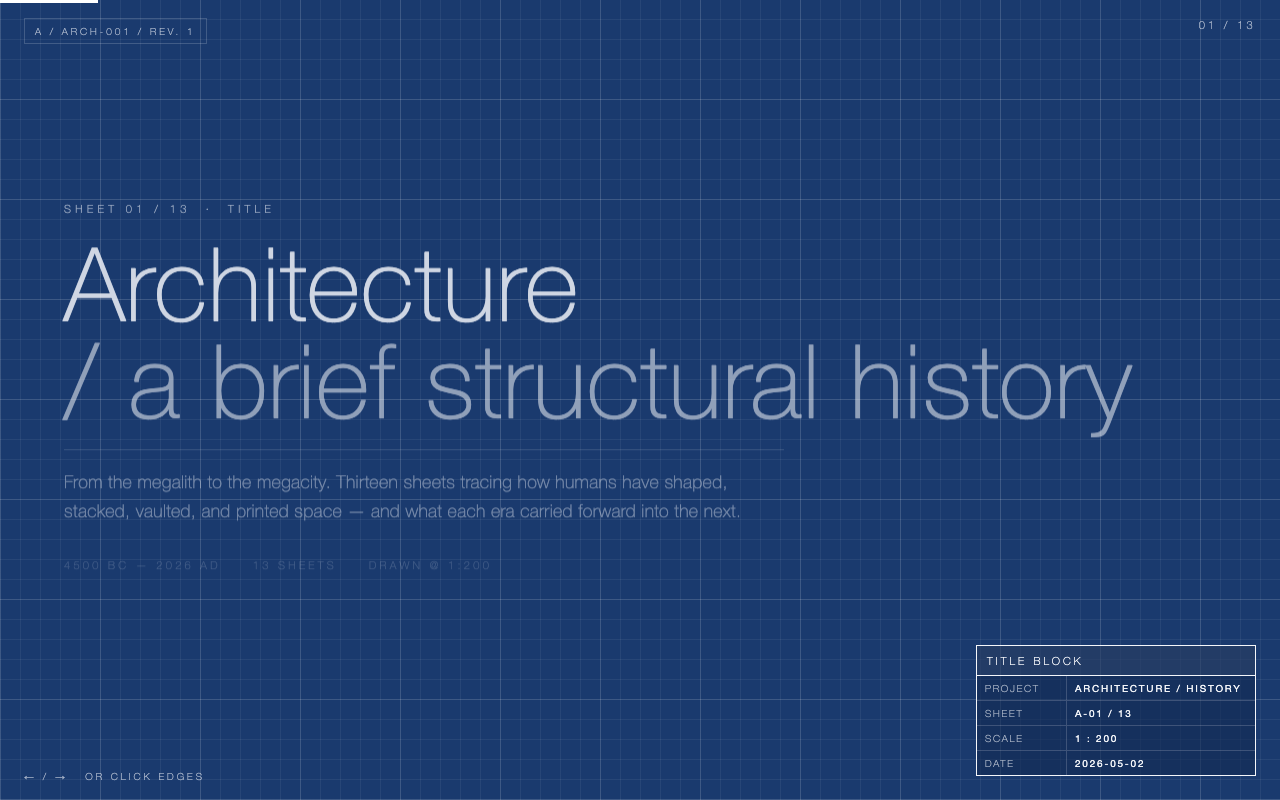
Architecture / a brief structural history
From the megalith to the megacity. Thirteen sheets tracing how humans have shaped, stacked, vaulted, and printed space — and what each era carried forward into the next.
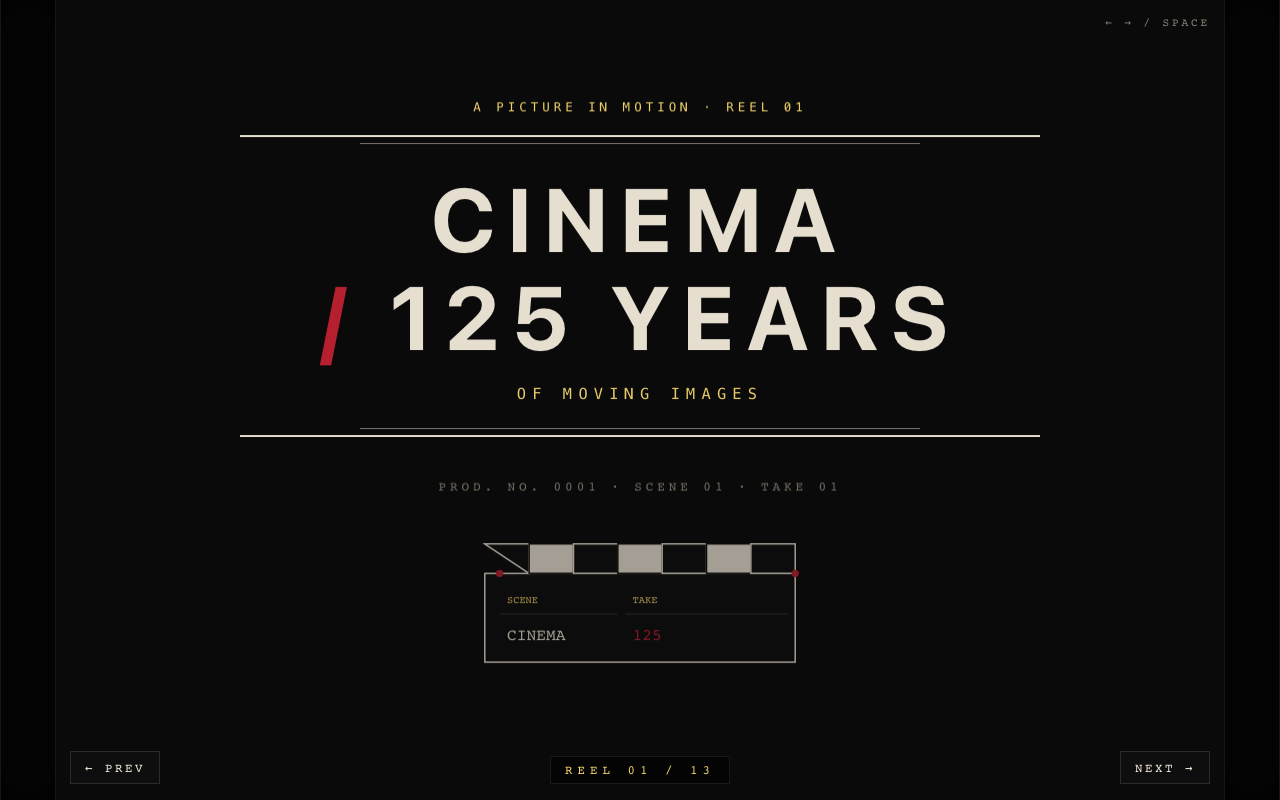
CINEMA — 125 Years of Moving Images
SCENE TAKE CINEMA 125 Reel 02 · 1895 The First Audiences Lumière, Paris December 28, 1895. The Lumière brothers project ten short films at the Salon Indien du Grand Café. L'Arrivée d'un train en gare de La Ciotat reportedly sends viewers diving from their seats. Cinema is born as a public, communal event — a shared startle.
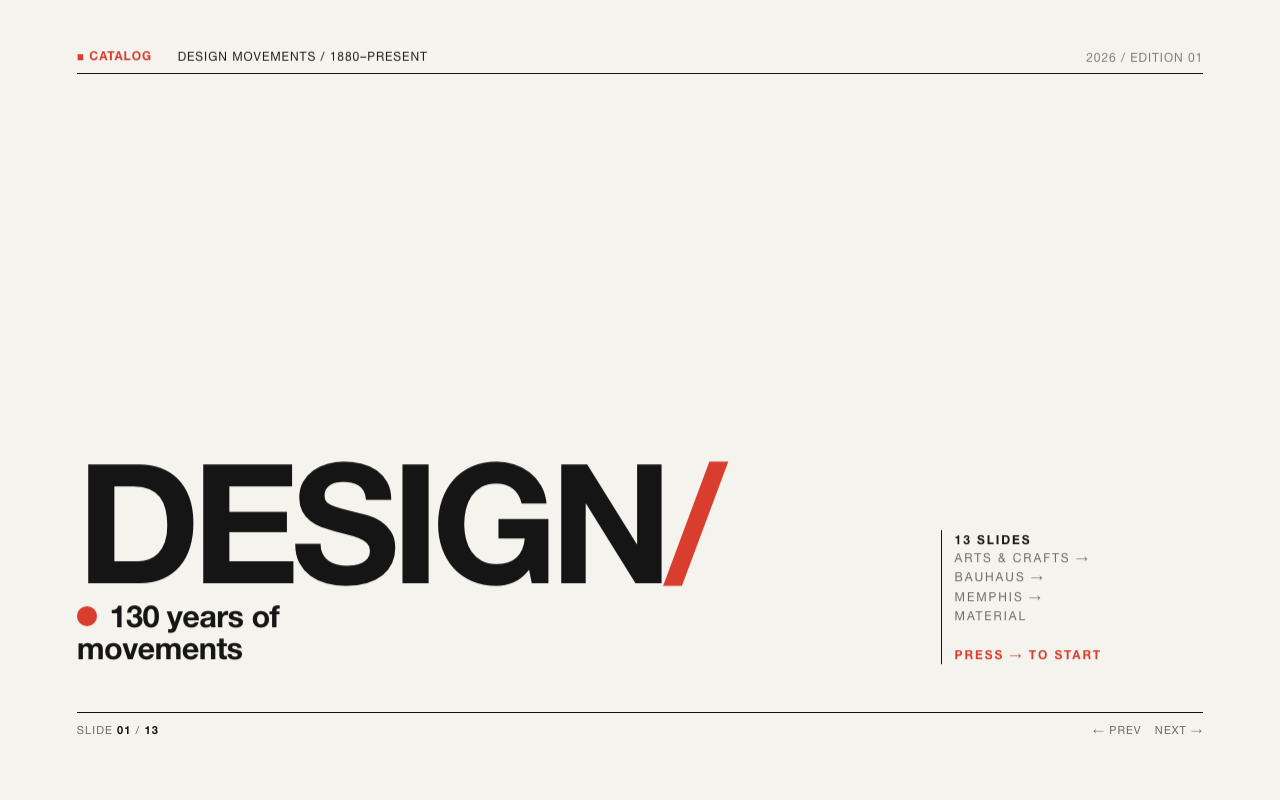
Design / 130 Years of Movements
A 19th–century revolt against industrial ugliness. William Morris and John Ruskin held that beauty lived in the maker’s hand — in honest materials, visible joinery, and patterns drawn from nature.
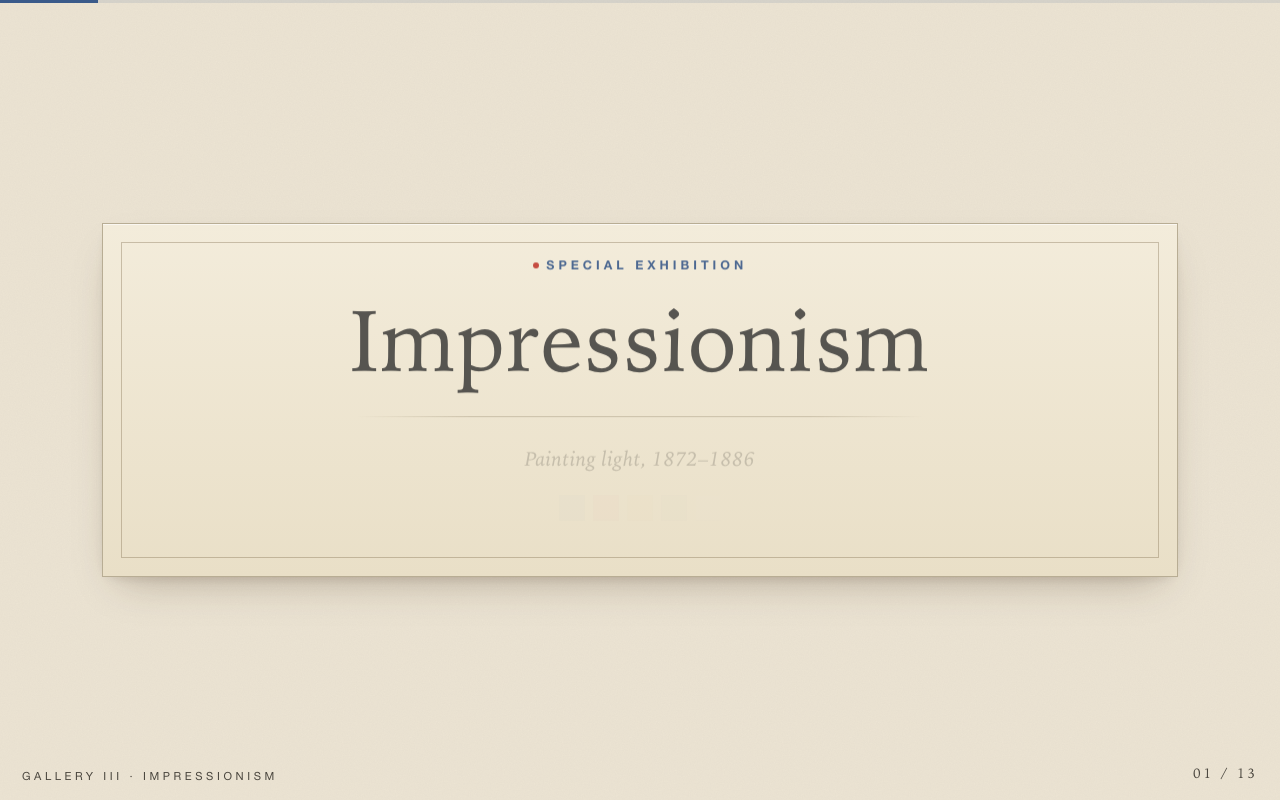
Impressionism — A Gallery Deck
Painting light, 1872–1886
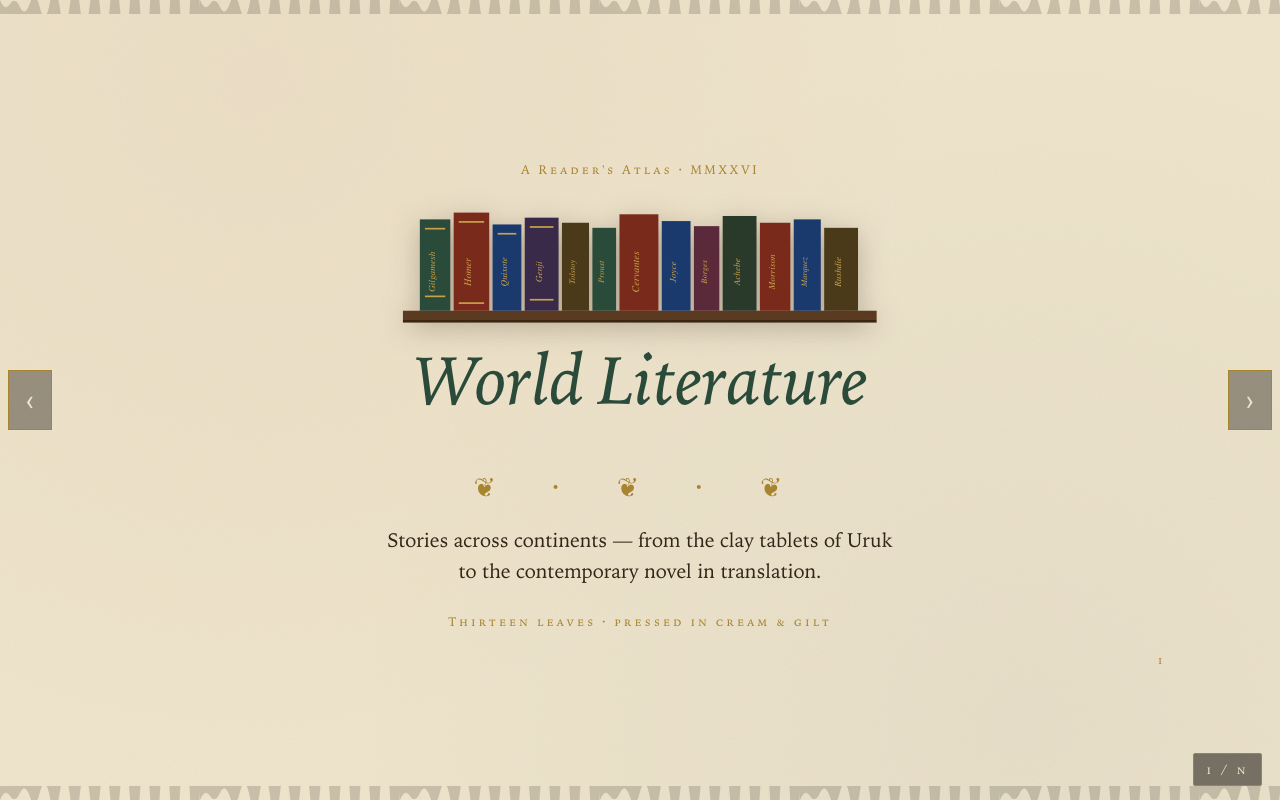
World Literature — Stories Across Continents
Stories across continents — from the clay tablets of Uruk to the contemporary novel in translation.
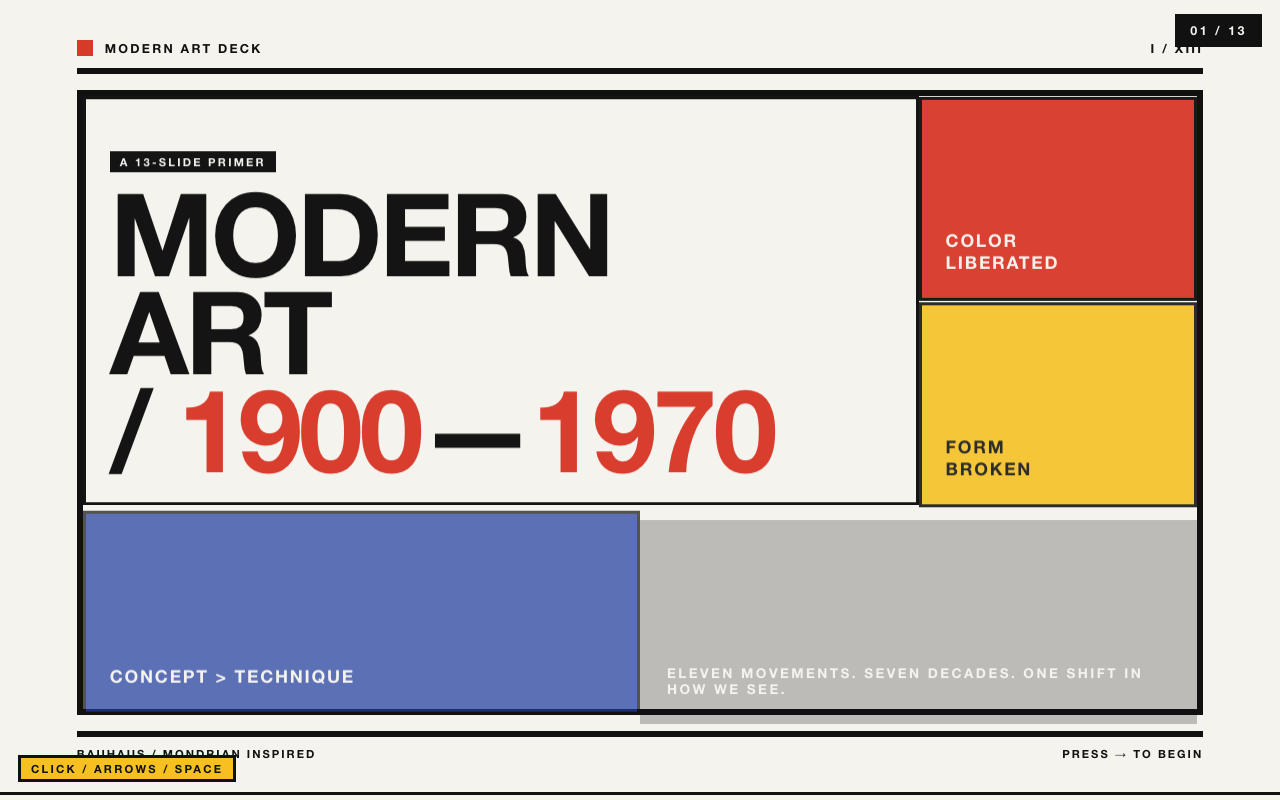
Modern Art / 1900-1970
Henri Matisse, André Derain, Maurice de Vlaminck. They paint a face green, a sky pink, a tree red — not to describe the world, but to express it.

MUSIC — A Brief History (Concert Program)
❦ ❦ ❦ Conducted in thirteen movements — use → or click
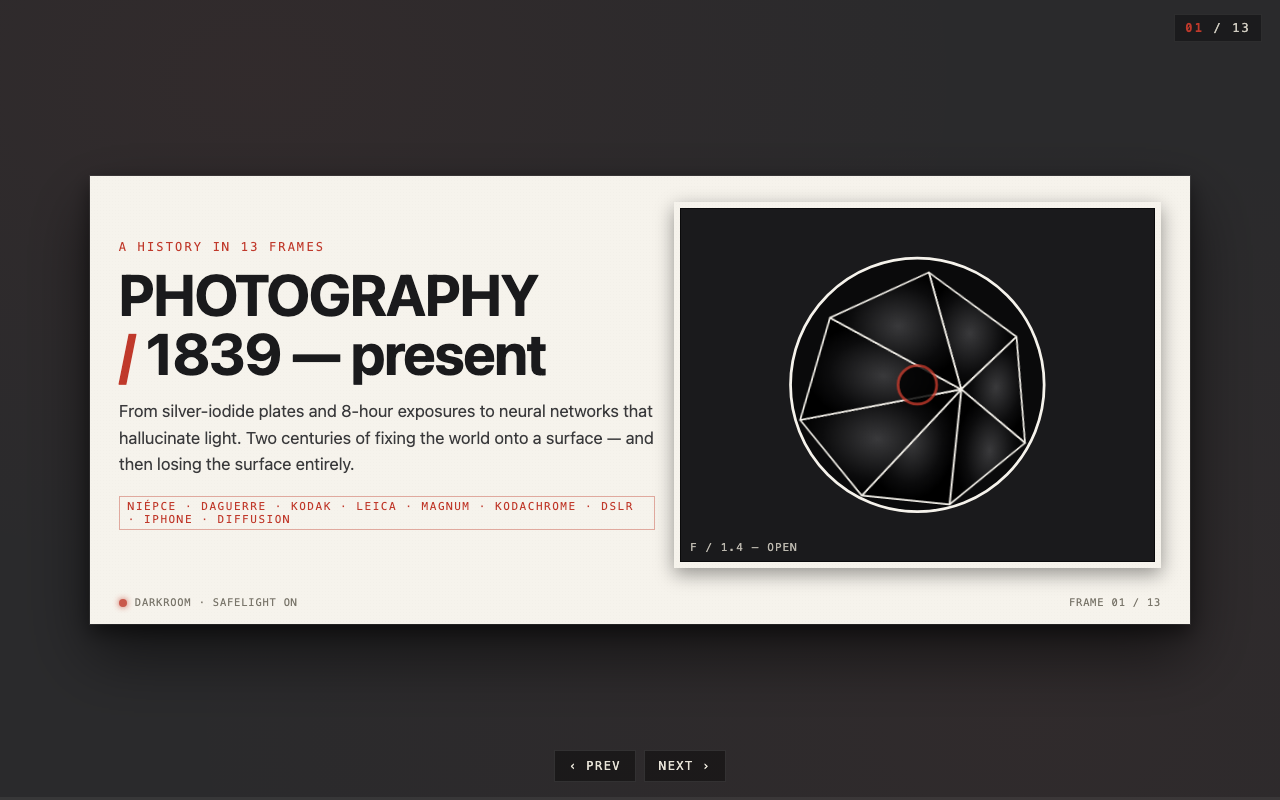
PHOTOGRAPHY / 1839 — present
From silver-iodide plates and 8-hour exposures to neural networks that hallucinate light. Two centuries of fixing the world onto a surface — and then losing the surface entirely.
Renaissance Art — A Frescoed Gallery Deck
Florence rediscovers seeing — the eye, the line, the human form.
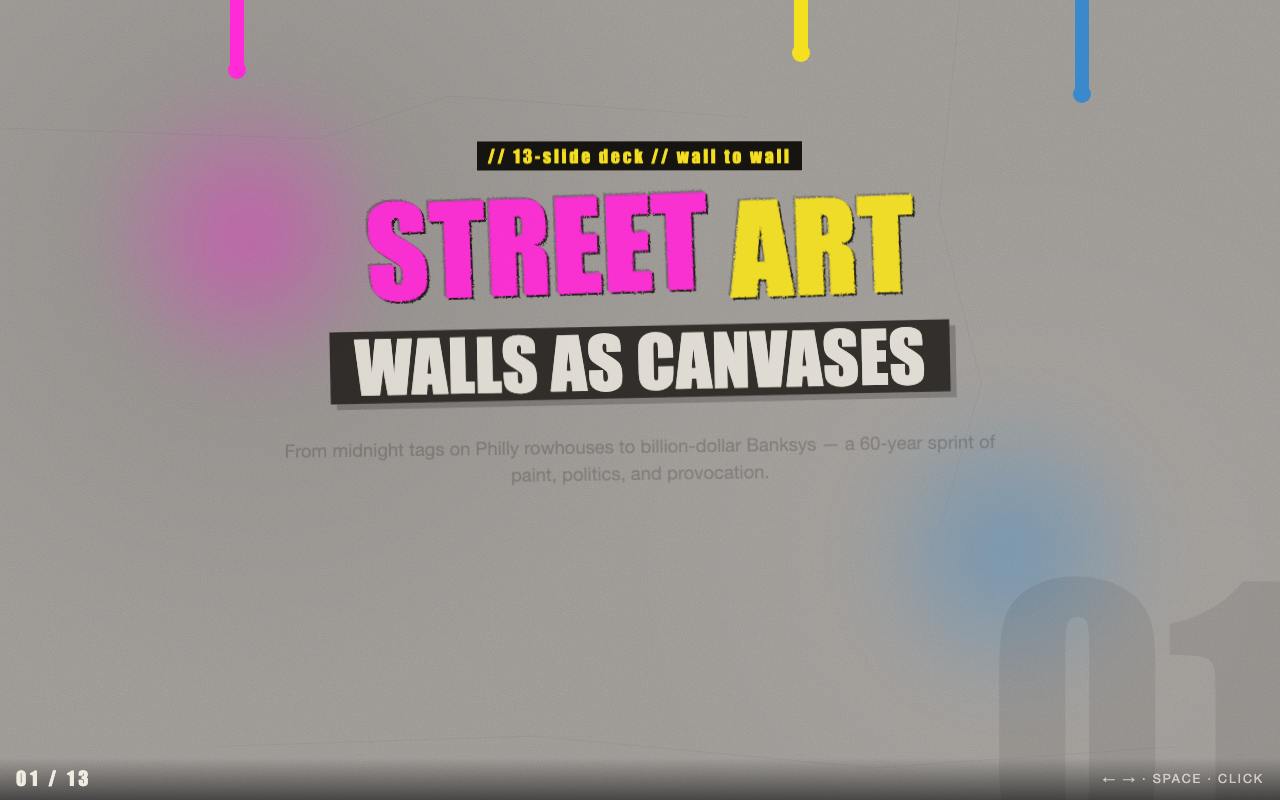
STREET ART // Walls as Canvases
"); background-size:cover;background-repeat:no-repeat;mix-blend-mode:multiply;opacity:.5; } h1,h2,h3{text-transform:uppercase;line-height:.92;font-weight:400;} h1{font-size:clamp(3rem,9.5vw,9rem);} h2{font-size:clamp(2.2rem,5.5vw,5rem);} h3{font-size:clamp(1.4rem,2.6vw,2.4rem);} p,li{font-family:"Helvetica Neue",Arial,sans-serif;font-size:clamp(1rem,1.6vw,1.35rem);line-height:1.45;letter-spacing:0;}...
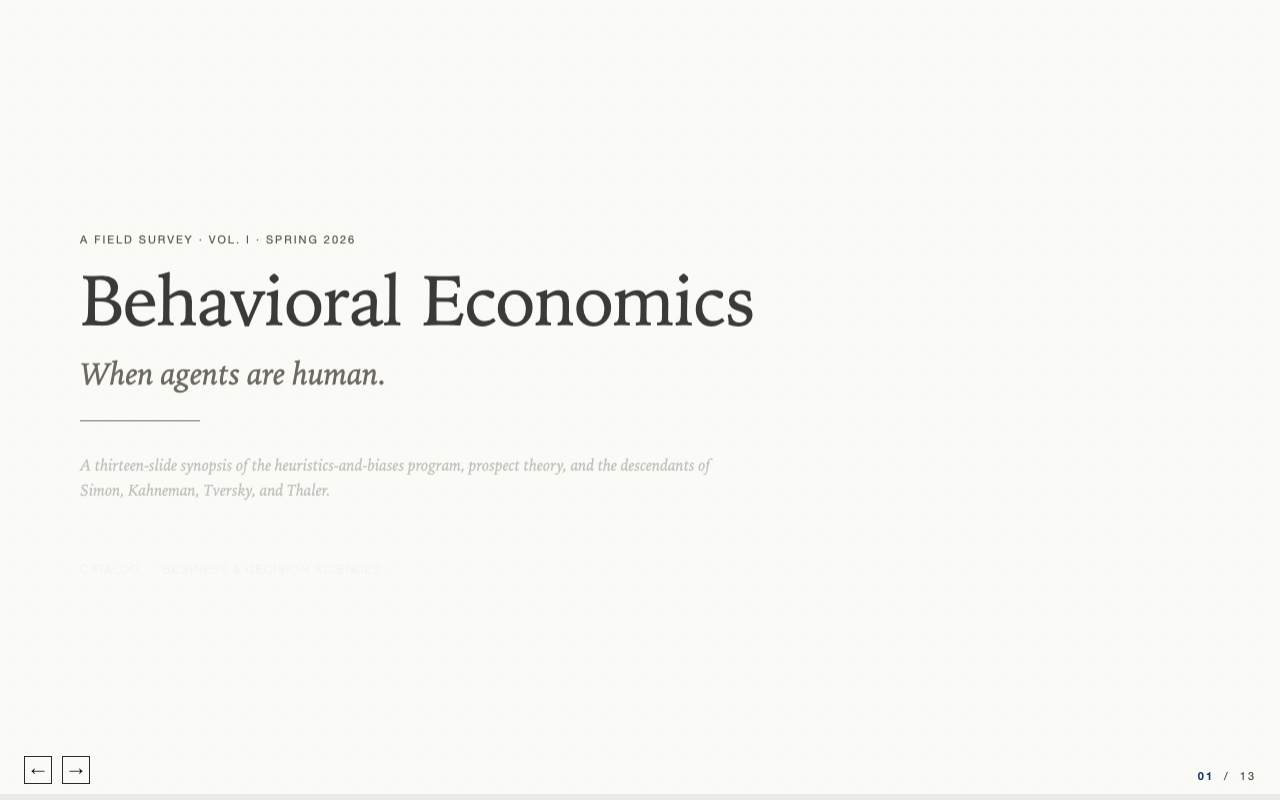
Behavioral Economics — When agents are human
A thirteen-slide synopsis of the heuristics-and-biases program, prospect theory, and the descendants of Simon, Kahneman, Tversky, and Thaler.
BRAND / How meaning gets attached to things
/ How meaning gets attached to things /
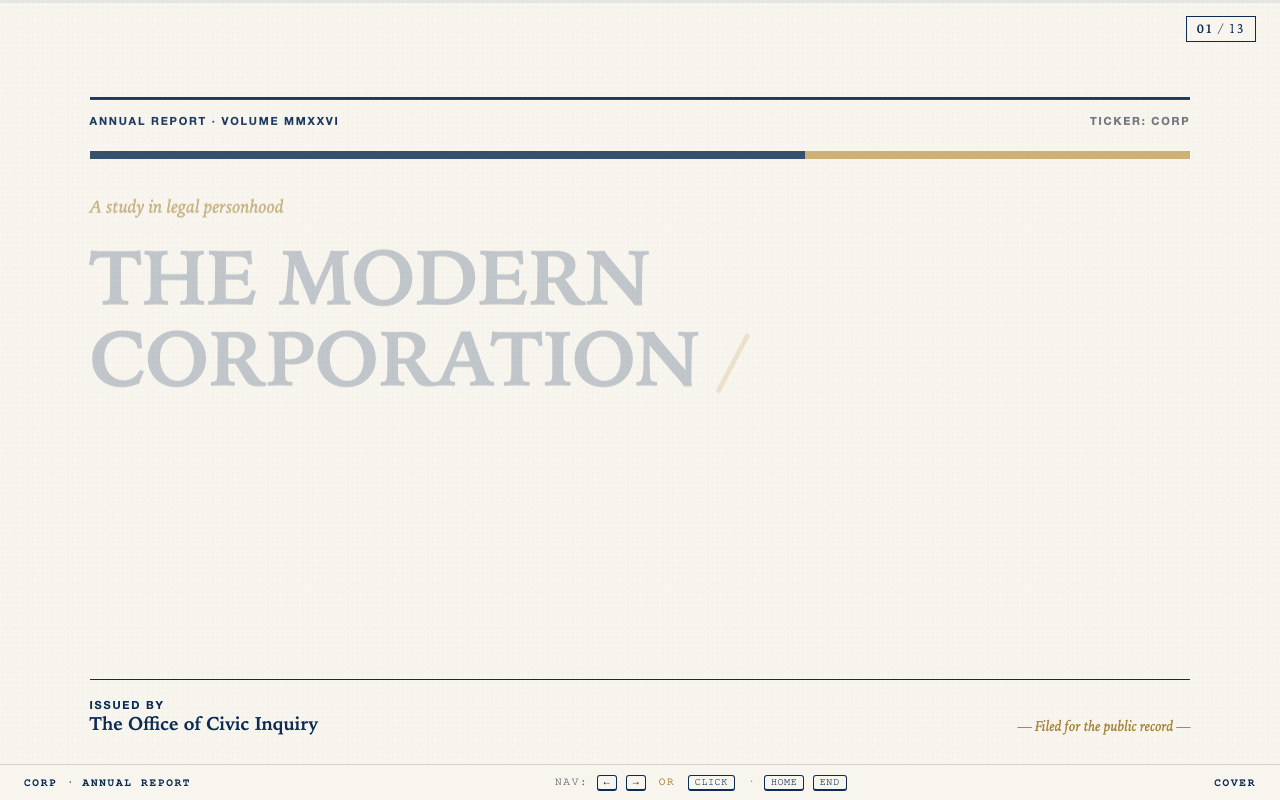
The Modern Corporation — Annual Report
Before there were corporations, there were chartered companies — sovereign-blessed monopolies pooling private capital for ventures too risky and too long-tailed for any one merchant to bankroll alone.
Disruption / Why incumbents lose
A working brief on Clayton Christensen's theory of disruptive innovation — the patterns by which dominant firms, doing everything textbooks recommend, lose their markets to upstarts they could have crushed.

Globalization — How the world got tangled together
Long before steam, three trade systems wove distant continents together. Each carried not just goods, but ideas, diseases, and — in one case — millions of human beings.
Industrial Capitalism — A Ledger
Common fields are fenced; English peasants are dispossessed of customary use-rights. Land becomes a tradable asset and a wage-labour force is freed for the towns.
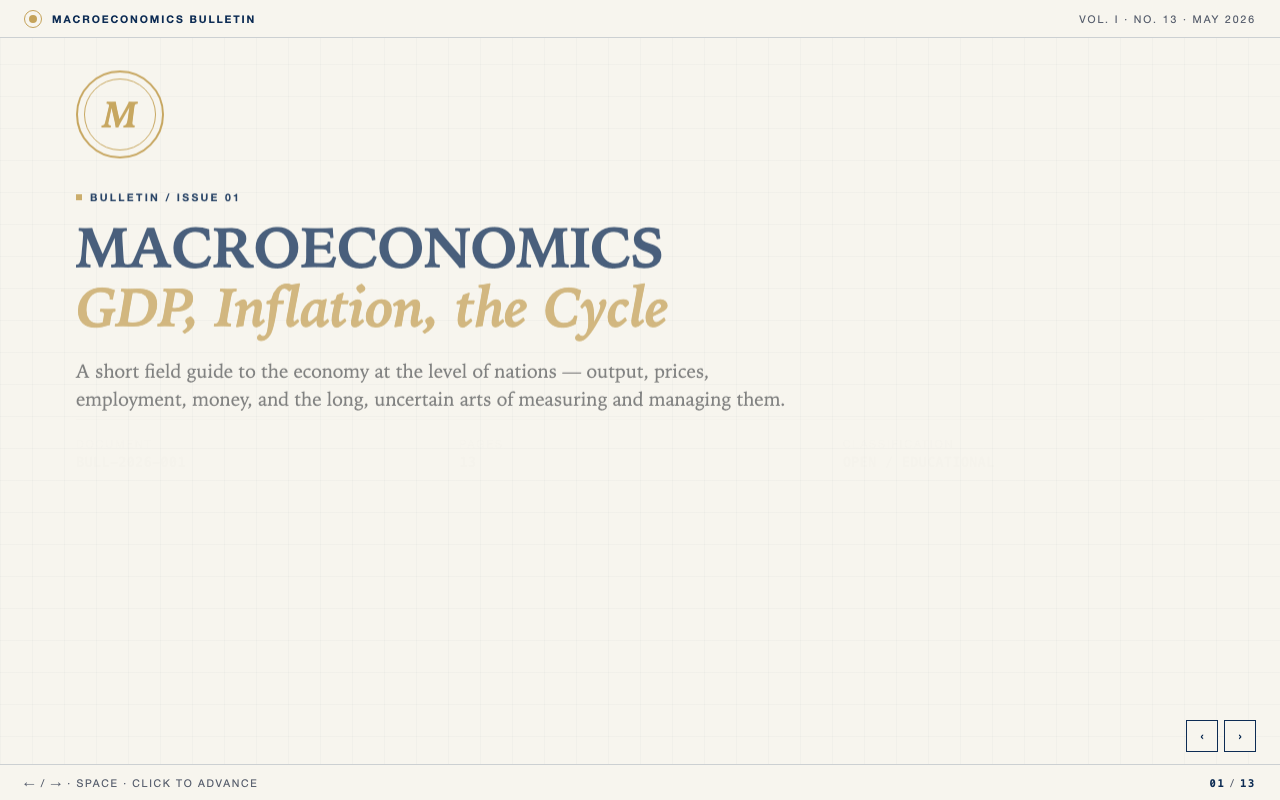
Macroeconomics — GDP, Inflation, the Cycle
A short field guide to the economy at the level of nations — output, prices, employment, money, and the long, uncertain arts of measuring and managing them.
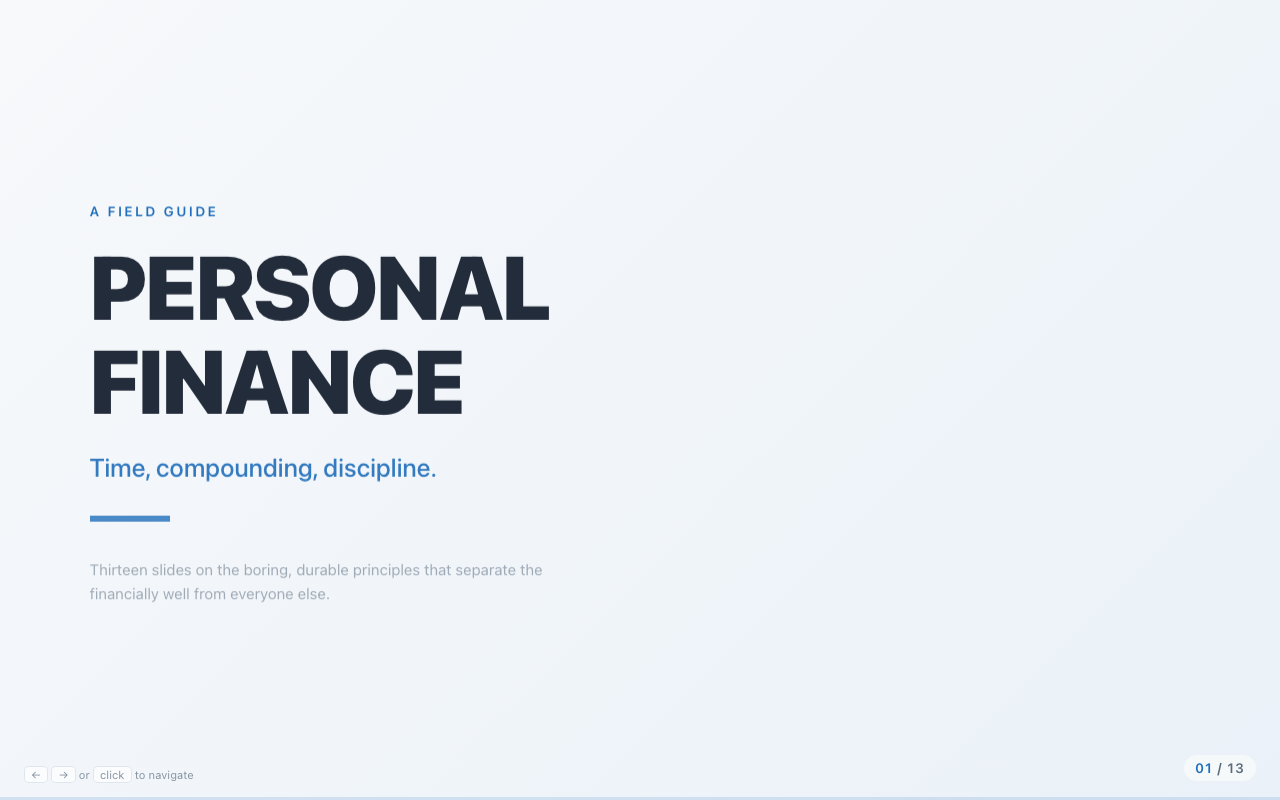
Personal Finance — Time, Compounding, Discipline
Thirteen slides on the boring, durable principles that separate the financially well from everyone else.
Startups / How small firms become large ones
Funding stages, growth metrics, and the hard parts — an honest tour of how the modern startup ecosystem actually works.
MARKETS / 400 YEARS
FROM 1602 // TO PRESENT // 13 SLIDES
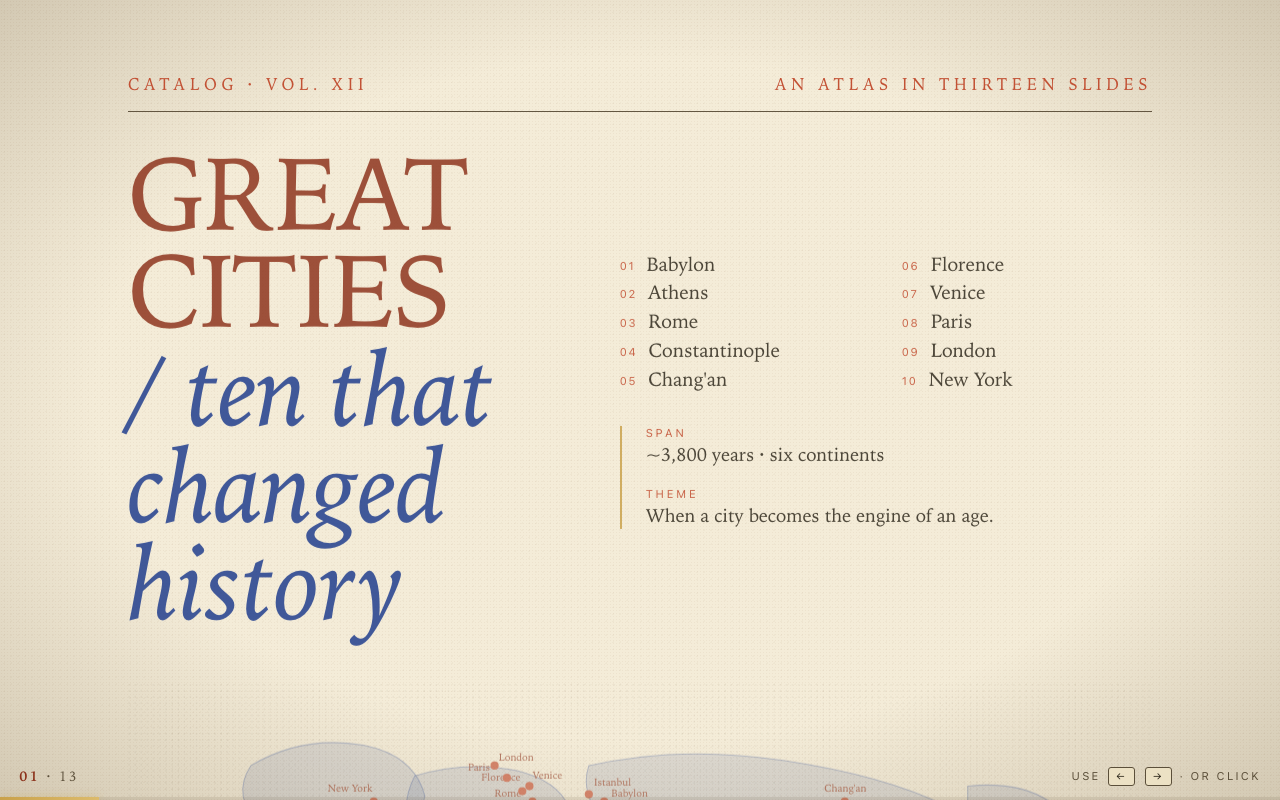
GREAT CITIES / Ten that changed history
A city of brick and clay rising from the floodplain — where civilization first learned to scale.
FASHION / Garments and what they say
A t Versailles, Louis XIV understood that silk and stitching could be statecraft. His regulated luxury — silver brocade, towering wigs, red-heeled shoes — marked rank as plainly as a coat of arms.
FOOD / a global history
THIRTEEN COURSES · PRESS → TO BEGIN No. 02 ~ origins ~ course one The Seven Hearths around 10,000 BC, agriculture begins — independently — in many places at once For 200,000 years humans foraged. Then, almost simultaneously, scattered groups began to plant, weed, and wait.
INTERNET CULTURE / forums, memes, attention
A 13-slide tour from BBS dial-tones to algorithmic feeds . Best viewed in 800x600 with a Pentium II and a fresh bowl of Bagel Bites.
Language / 7,000 voices
An atlas of the human capacity to mean — its sounds, its scripts, its families, its futures.
Migration — A Species on the Move
A species on the move

Mythology — The stars we tell ourselves by
We are pattern-seekers. Where there is a sky, we read constellations into it; where there is a death, we tell a story about what comes after.

Pop Music — A Century of Recorded Sound
Before microphones, before radio stardom — pop was a printed medium. A cluster of music publishers on West 28th Street churned out sheet music by the ream, with songpluggers banging upright pianos to sell the next hit to vaudeville singers and parlors across America.
World Religions / The Major Answers
A comparative survey of how humanity has answered the oldest questions: who are we, why are we here, and how should we live.
SPORTS — Play turned into spectacle
A 13-chapter almanac of human contest — from the agora to the algorithm.
AGI // The Most Consequential Question
Systems matching or exceeding human cognitive performance across most economically valuable tasks .
BCI // Reading and Writing to the Brain
Bypass eyes and ears. Read intent from cortex, write signals back. Once medical-only — now an arms race.
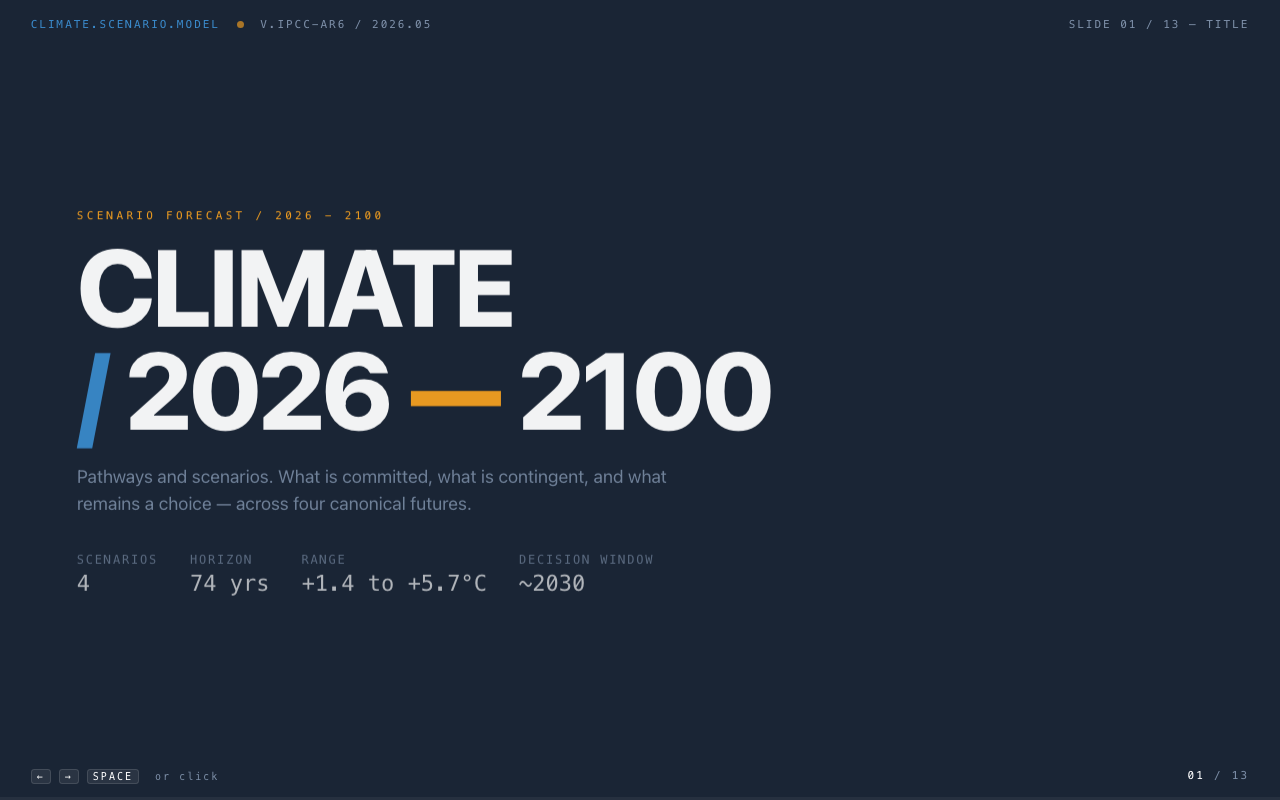
CLIMATE / 2026 - 2100
Pathways and scenarios. What is committed, what is contingent, and what remains a choice — across four canonical futures.
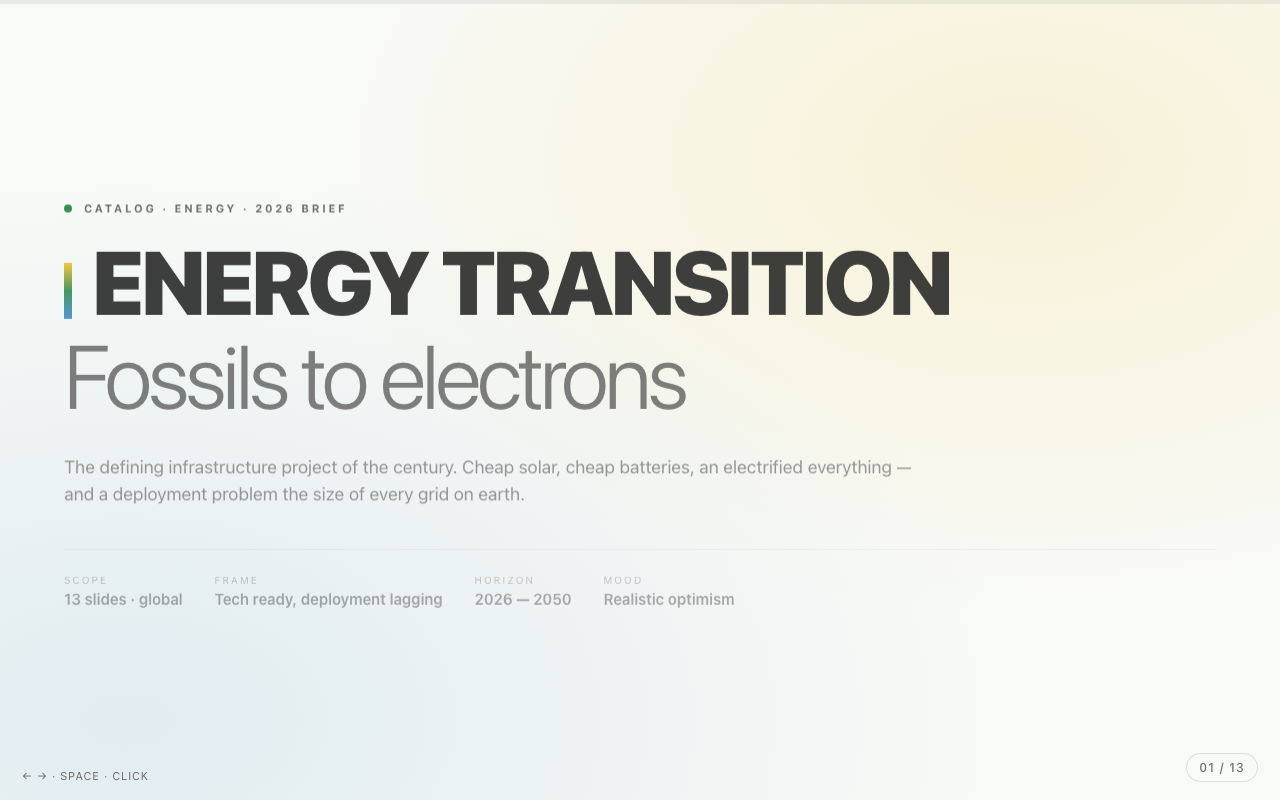
Energy Transition / Fossils to Electrons
The defining infrastructure project of the century. Cheap solar, cheap batteries, an electrified everything — and a deployment problem the size of every grid on earth.
FUSION / a star, in a bottle
13 SLIDES · THE SCIENCE · THE PROJECTS · THE TIMELINE
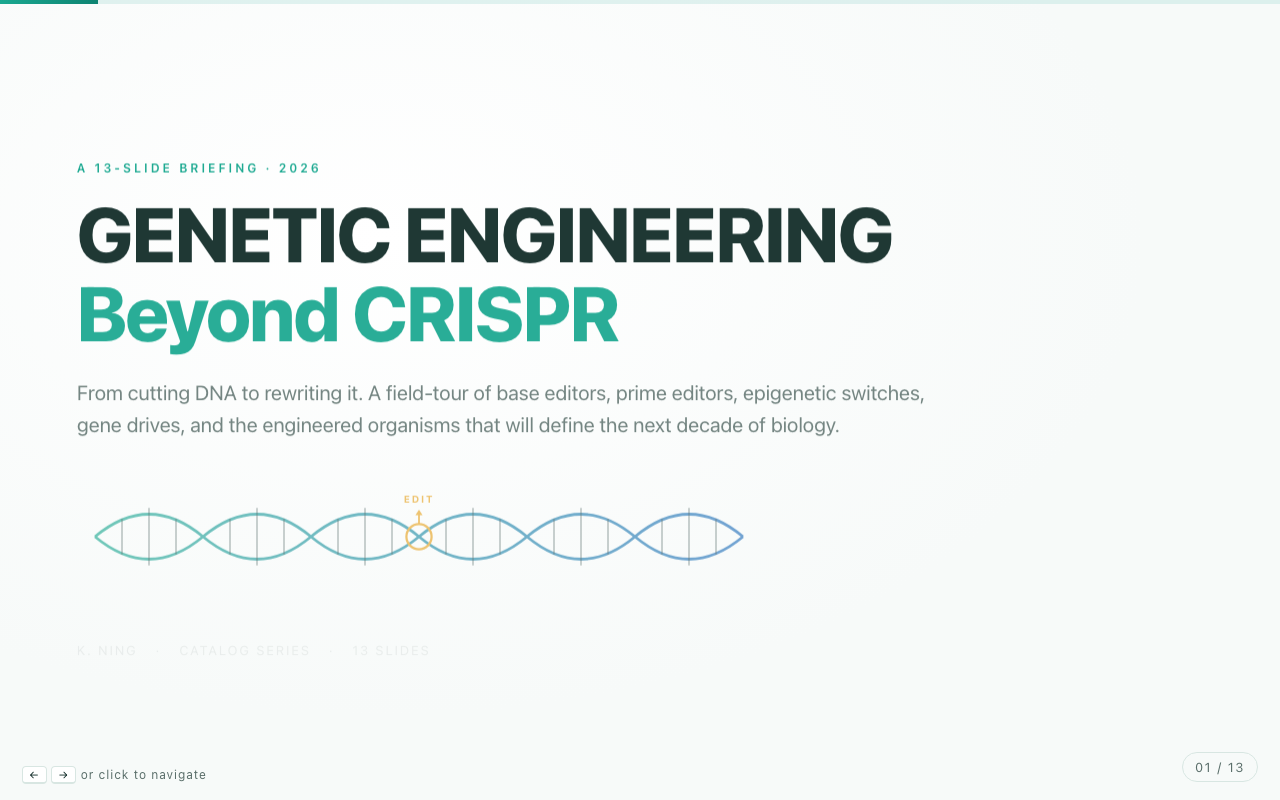
Genetic Engineering / Beyond CRISPR
From cutting DNA to rewriting it. A field-tour of base editors, prime editors, epigenetic switches, gene drives, and the engineered organisms that will define the next decade of biology.
LONGEVITY / What we know about extending healthspan
A clinical-trial style tour of the hallmarks of aging, the interventions actually being tested in humans, and the honest limits of what biology will allow.
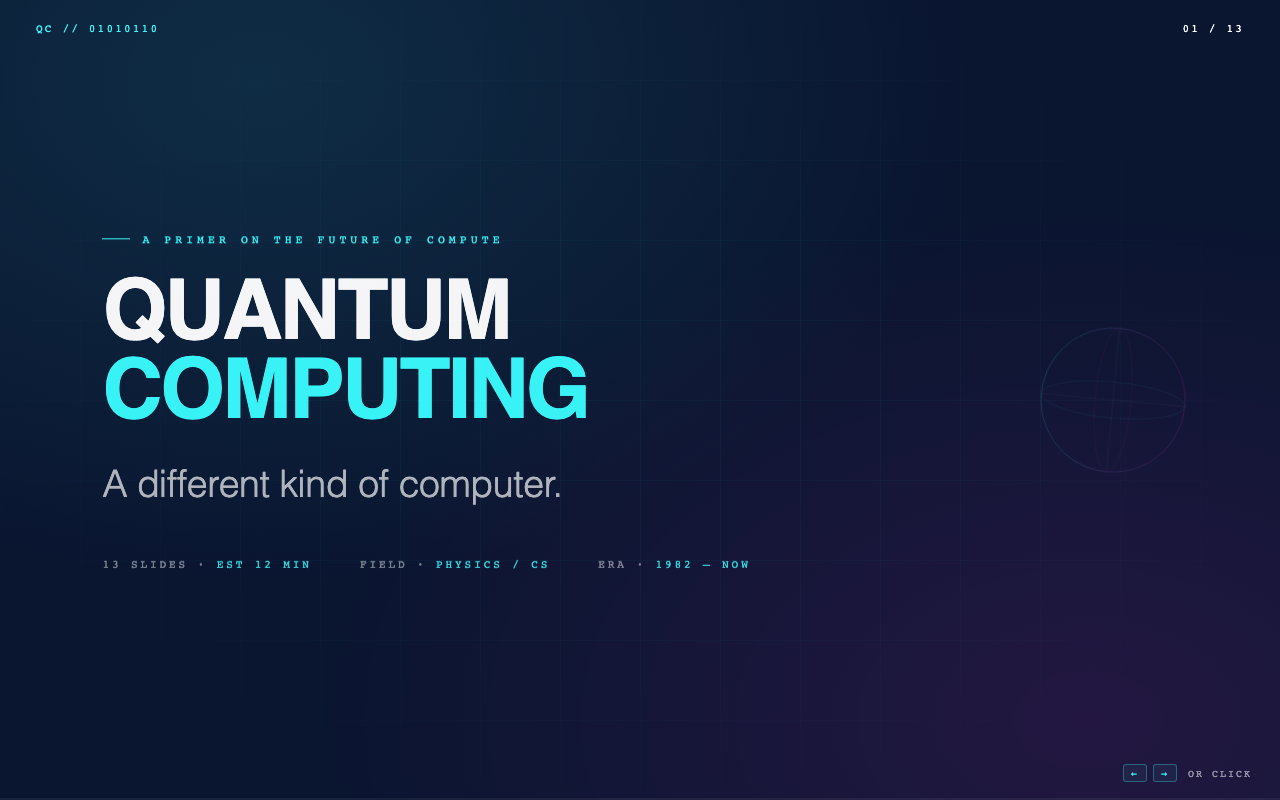
Quantum Computing — A Different Kind of Computer
Classical bits are switches: 0 or 1, definite at every instant. A qubit is a quantum object whose state is a continuous combination — a superposition — of 0 and 1, collapsing only when measured.
ROBOTICS FUTURE / Humanoids in every warehouse
A 13-slide field briefing on the next decade of physical AI: humanoid platforms, autonomous agriculture, and robotic surgery.
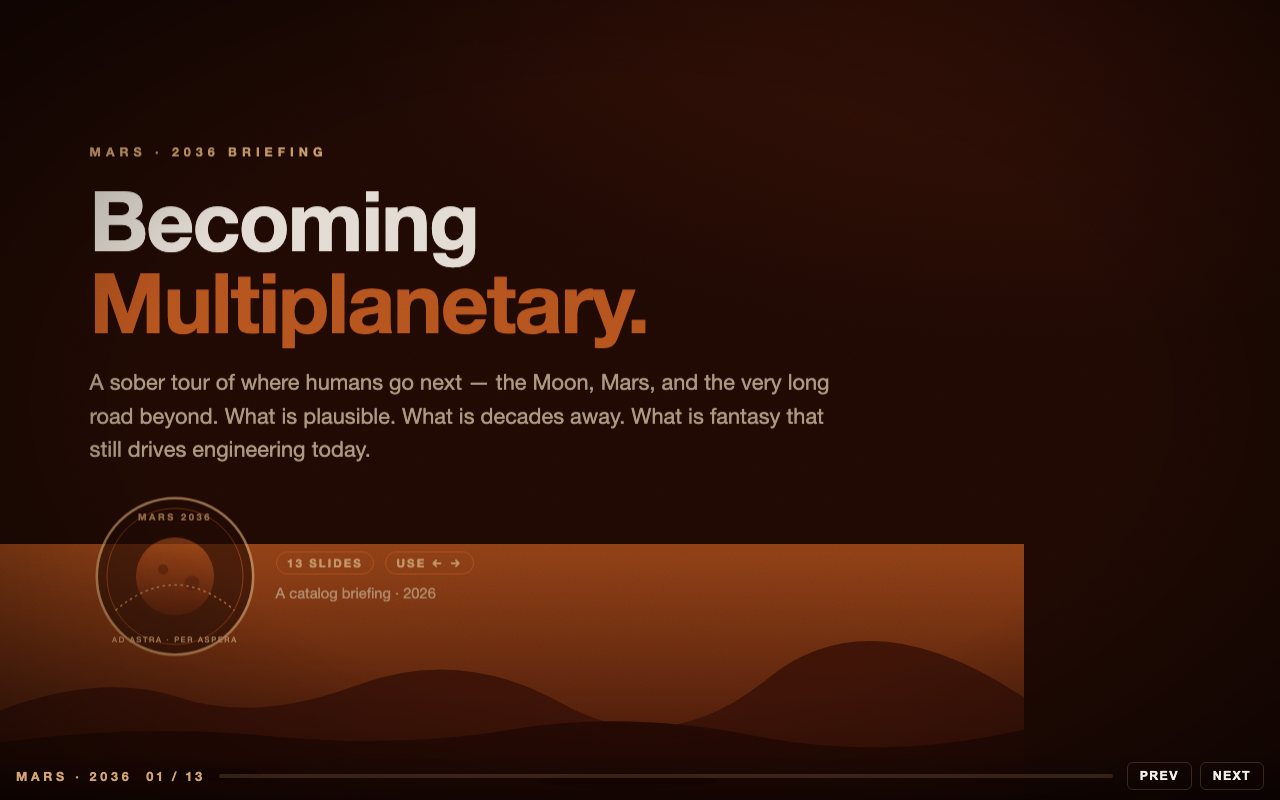
Becoming Multiplanetary — Space Colonization
Mars · 2036 Briefing Becoming Multiplanetary. A sober tour of where humans go next — the Moon, Mars, and the very long road beyond. What is plausible. What is decades away. What is fantasy that still drives engineering today.
Aging — The Mechanics of Getting Older
Average life expectancy in 1900 hovered around the mid-40s. Today it sits near 79 in high-income countries — but the gain came mostly from preventing infants and young adults from dying, not from extending old age.
Anatomia humana — a guided tour
Of the systems of the human body — twelve plates & a colophon Ex Officina · Anno MMXXVI Plate II — Numerus Corporis The body in numbers Corpus humanum — an inventory of the parts Before naming the systems, consider the magnitude. The human body is a city of cells, a refinery of chemistry, a cartography of vessels — reckoned here in round figures, as the old anatomists were fond of doing.
Medical Breakthroughs — The Big Steps That Saved Lives
The big steps that saved lives — from cowpox lymph in a country doctor's hand to messenger RNA folded by an algorithm. Two centuries of pushing back against death.
Major Diseases — the big four of chronic illness
Cardiovascular disease — ischemic heart disease, stroke, hypertensive complications — claims roughly 17 million lives every year, more than any other cause of death worldwide.
EXERCISE / The most underused medicine
A 13-slide field guide to what we know — and what we keep getting wrong — about training, adaptation, and the body's response to movement.
Mental Health — The Mind Under Pressure
Disorders, treatments, and the evolving understanding of how brain, mind, and circumstance intertwine.
NUTRITION / What we know, what we don't
Field Notes / 13 slides NUTRITION What we know, what we don't. A honest survey of dietary science: macros, micros, the metabolic narrative, ultra-processed foods, the Mediterranean diet, the gut microbiome — and where the evidence runs thin.
PANDEMICS / A SHORT HISTORY OF DISEASE
From Justinian's plague to the COVID-19 era — thirteen panels of contagion, catastrophe, and the slow accumulation of public-health wisdom.

Pharmacology / How drugs find their targets
Small molecules and large biologics navigating a body of 10 13 cells, looking for the one protein they were designed to bind.
Sleep — A Third of Life, Finally Examined
a third of life, finally examined
REVOLUTIONS // The 20th Century
01 / 13 ← → / SPACE / CLICK A 13-PART AGITPROP DECK · 1900 — 2000 REVOLUTIONS The 20th Century RUSSIA · CHINA · CUBA · IRAN · THE COLONIES 02 PETROGRAD · 1917 1917 Russia — Two Revolutions in One Year From Autocracy to October The setting: Romanov dynasty, three centuries of tsarist autocracy, devastated by World War I — mass casualties, food...
Age of Exploration — Caravels and Conquest 1400–1600
N S W E Anno Domini MCDXCII · A Cartographer's Account AGE OF EXPLORATION Caravels & Conquest · 1400 — 1600 Drawn upon parchment · with rhumb & rose
Aegyptus — Three Thousand Years on the Nile
From the unification of the Two Lands to the death of Cleopatra — a civilization that watched empires rise and fall, and outlasted them all.
COLD WAR / 1945-1991
SUBJECT: ORIGIN 1945 FILE 002/13 // SECTION 02 — POSTWAR CONFIDENTIAL THE BREAK CODENAME // YALTA-POTSDAM May 1945 — the swastika falls in Berlin. By August, Tokyo Bay surrenders. The victors meet, smile for photographers, and divide the world.
Industrial Revolution — Steam, Steel, Smoke
"); } .page::after { bottom: 8px; right: 8px; transform: rotate(180deg); background-image: url("data:image/svg+xml;utf8, "); } /* Stamps and rules */ h1, h2, h3 { font-family: "Rockwell", "Rockwell Nova", "Roboto Slab", Georgia, serif; font-weight: 900; letter-spacing: 0.02em; color: var(--ink); } .eyebrow { display: inline-block; font-family: "Rockwell", Georgia, serif; font-size: clamp(10px, 1.1vw, 13px)...
Medievalia / Europe 500-1500
Medievalia EUROPE · 500 – 1500
The Renaissance — An Illuminated Codex
"); } .page::after { bottom: 6px; right: 6px; transform: scale(-1, -1); background-image: url("data:image/svg+xml;utf8, "); } .corner-tr, .corner-bl { position: absolute; width: 80px; height: 80px; pointer-events: none; } .corner-tr { top: 6px; right: 6px; transform: scaleX(-1); } .corner-bl { bottom: 6px; left: 6px; transform: scaleY(-1); } /* Title typography */ h1.title { font-size: clamp(2.2rem, 6vw, 4.6rem)...
Roma — Imperium
ROMA Imperium ❖ S P Q R Senātus Populusque Rōmānus — The Senate and People of Rome A thousand years, in thirteen acts. 753 BC — 476 AD.
The Silk Road — Caravans across Eurasia
N The Silk Road Caravans across Eurasia ~ 200 BC · 1450 AD A history in thirteen panels I. Origins — A Han Envoy Heads West In 138 BC , Emperor Wu of the Han dispatched the diplomat Zhang Qian to find allies against the Xiongnu. He was captured for a decade, escaped, and returned with reports of vast civilizations beyond the Pamirs — Bactria, Parthia, Ferghana.
WORLD WAR II / 1939-1945 — Broadsheet Edition
Causes · Course · Consequences
Calculus — The Mathematics of Change
Newton + Leibniz, ~1665–1684
Mathematical Cryptography
A substitution cipher maps each plaintext letter to a fixed ciphertext letter. Caesar's shift is a special case: c ≡ p + k (mod 26) .
Game Theory — Strategy when others strategize too
A 13-slide tour of payoffs, equilibria, and the mathematics of mutual anticipation — from von Neumann's chessboard to the FCC spectrum auction.
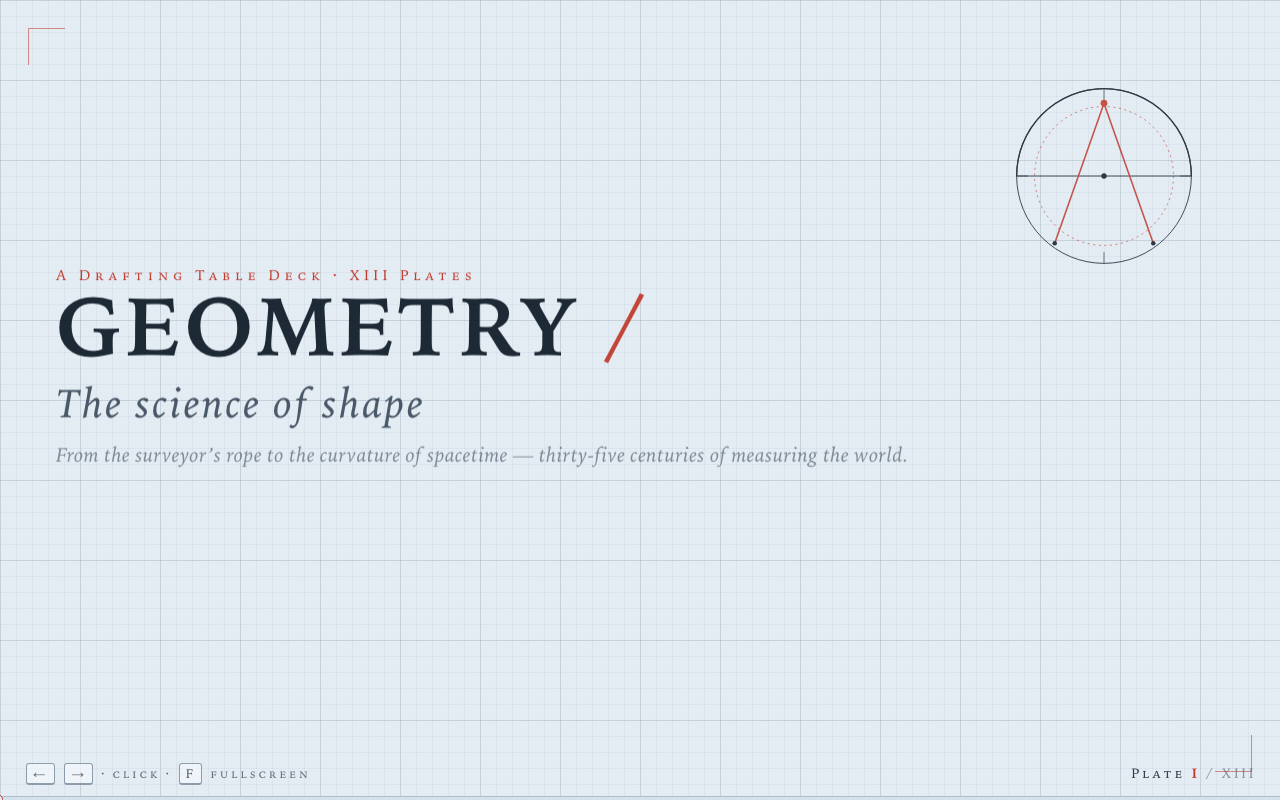
Geometry — A Drafting Table Deck
A Drafting Table Deck · XIII Plates Geometry / The science of shape From the surveyor’s rope to the curvature of spacetime — thirty-five centuries of measuring the world.
Linear Algebra — Vectors, Matrices, Transformations
Vectors, matrices, transformations.
Mathematicians — Lives behind the theorems
Eleven figures, twenty-five centuries. From a Greek cult leader who heard the world as ratios to a wandering Hungarian who slept on his colleagues' couches — the people who invented the language we count, calculate, and reason in.
Number Theory — The Queen of Mathematics
2 3 “Mathematics is the queen of the sciences, and number theory is the queen of mathematics.” — C. F. Gauss ❦ ❦ Chapter I The Integers §1. The playing field The Integers The integers ℤ = { … , −3, −2, −1, 0, 1, 2, 3, … } form the bedrock of arithmetic — discrete, unbounded, equipped with addition and multiplication.
Probability — A Grammar for Uncertainty
a grammar for uncertainty
Topology — Shape without Measurement
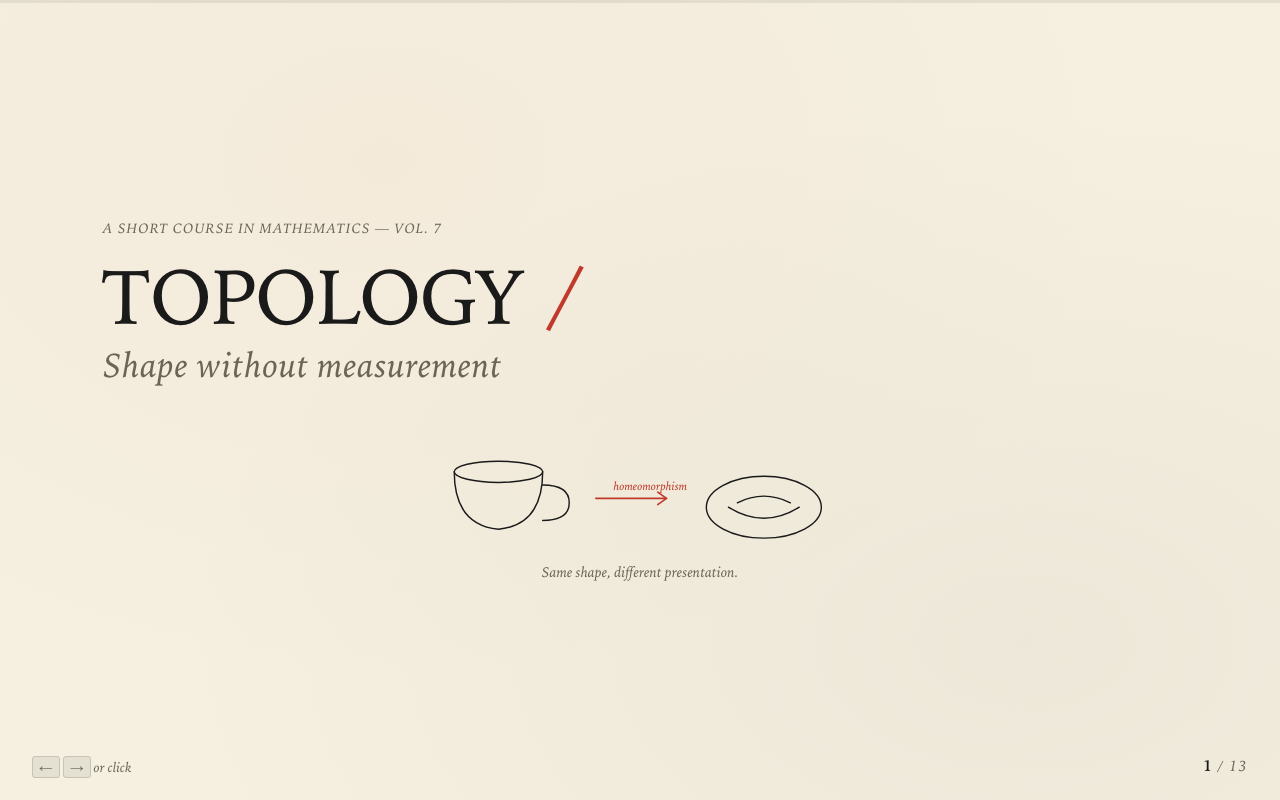
homeomorphism Same shape, different presentation. The puzzle To a topologist, a coffee cup is a donut. Stretch, bend, twist — but never cut, never glue. Under such deformations the cup with one handle and the torus with one hole are indistinguishable. Both are surfaces of genus one.
Unsolved — Open Problems in Mathematics
Some questions sit on the board for centuries. They look simple. They aren't.
Aesthetics — What Makes a Thing Beautiful?
What makes a thing beautiful?
Greek Philosophy — from Thales to the Stoics
Athens — Aegean — Ionia Greek Philosophy from Thales to the Stoics
Eastern Philosophy — The Long Traditions
Eastern Philosophy the long traditions

The Enlightenment — Reason against Tradition
Of the Age of Lights — A Discourse in XIII Plates
Epistemology — What can be known?
From Plato's Theaetetus to the replication crisis — a brief survey of the theory of knowledge: its objects, its sources, and the limits of what we may justifiably claim to know.
Ethics — How should one live?
Five frameworks. One trolley. A persistent question. The brief atlas of moral philosophy.
Existentialism — A Brief Introduction
Not “what is the world?”
Logic — The Form of Valid Inference
From the syllogism to incompleteness: twenty-three centuries of trying to mechanize reasoning, and the discovery that reason itself has limits.
Philosophy of Mind — The puzzle of the inner life
What is consciousness, why does it feel like anything, and could a machine ever have it? A short tour through the puzzles, positions, and thought experiments that won't sit still.

Political Philosophy — Justice, Power, the State
Being a brief inquiry into the foundations of authority, the just distribution of goods, and the legitimate use of force among free persons.
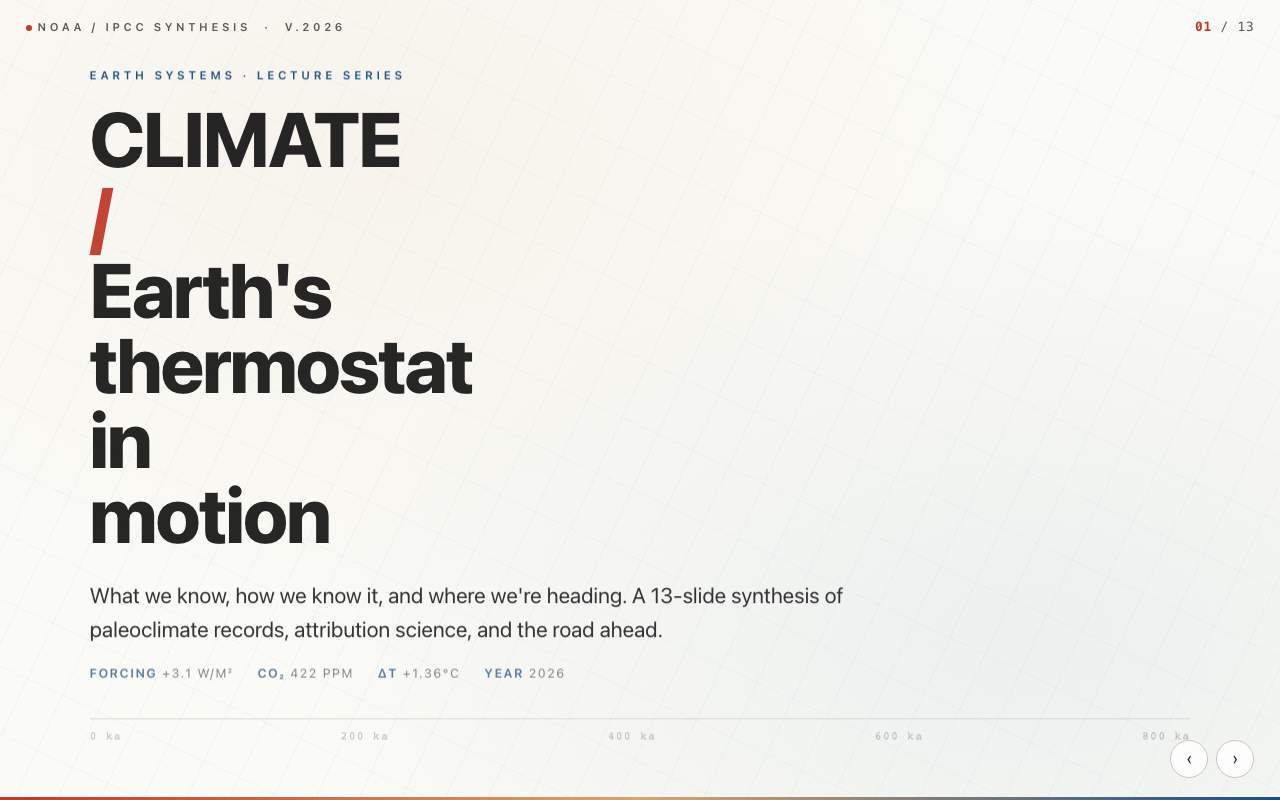
CLIMATE / Earth's thermostat in motion
What we know, how we know it, and where we're heading. A 13-slide synthesis of paleoclimate records, attribution science, and the road ahead.
Cosmology / 13.8 billion years, briefly
A short tour of everything that has ever happened — from a singularity smaller than a proton to a thin, cold sea of photons drifting through eternity.
Ecology / Webs of Dependence
— A FIELD GUIDE, PLATE I — ECOLOGY Webs of Dependence Thirteen Plates · on Living Systems Plate II Levels of Organization from a single being to the living Earth organism A single living individual — one oak, one robin, one hyphal strand of fungus. population All members of one species inhabiting a defined place at a defined time. community All populations interacting in the same locality — predators, prey...
On the Origin of Species — A Field Notebook
evolution by natural selection
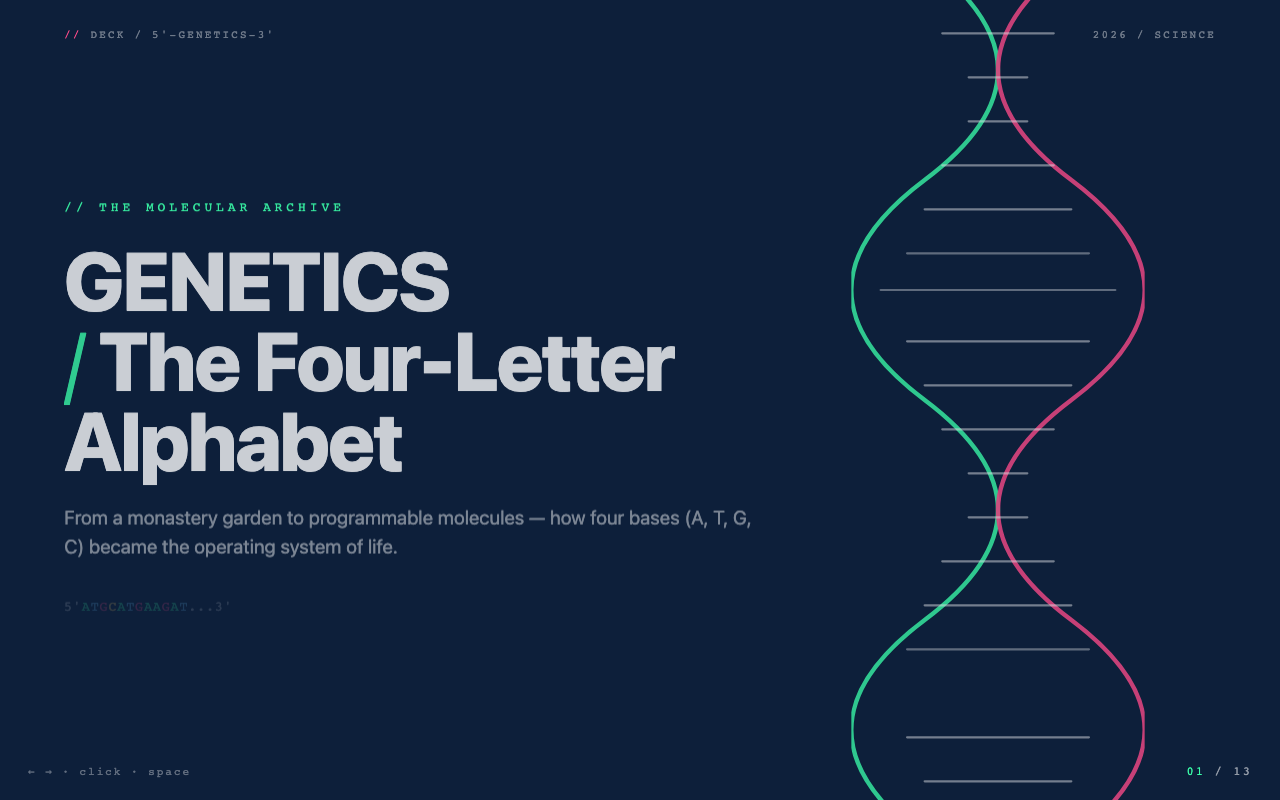
Genetics & DNA — Mendel to CRISPR
DECK / 5'-GENETICS-3' 2026 / SCIENCE // THE MOLECULAR ARCHIVE GENETICS / The Four-Letter Alphabet From a monastery garden to programmable molecules — how four bases (A, T, G, C) became the operating system of life.
Neuroscience / 86 billion cells, talking
Brain, mind, cognition — a clinical tour of the most complex object known to science.
Particle Physics — The Zoo of Fundamental Things
CERN · A Field Guide · No. 13 Particle Physics / The zoo of fundamental things From Thomson's electron to the Higgs — a hundred and twenty-five years of finding pieces of matter that refused to break further.
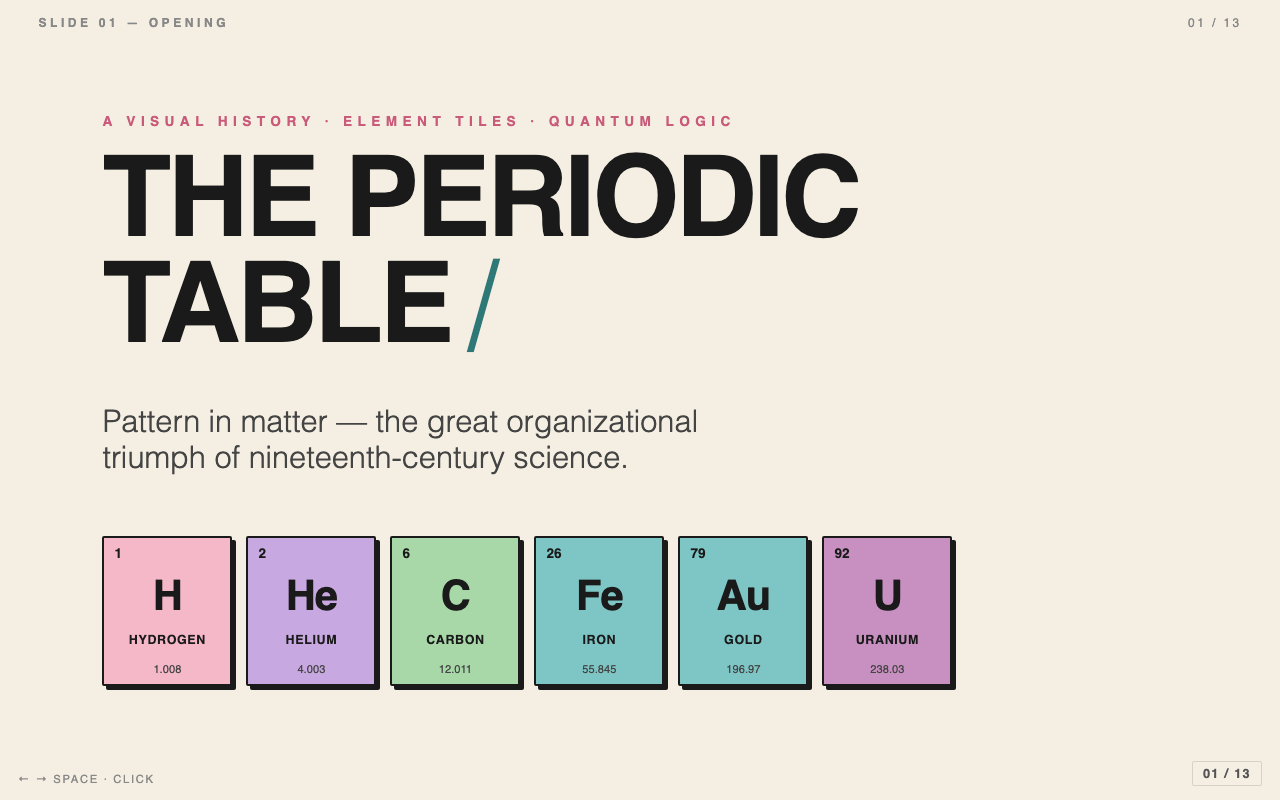
The Periodic Table — Pattern in Matter
For most of history, "elements" meant earth, water, fire, air. The chemical revolution gave that scheme a final shove — and three thinkers laid the groundwork.
Plate Tectonics — Field Guide
Alfred Wegener, a German meteorologist, noticed that the coastlines of South America and Africa fit like puzzle pieces. Matching fossils, glacial deposits, and rock formations on opposite Atlantic shores convinced him: continents move .
Quantum Physics — A Notebook
Quantum Physics — A Notebook — from Planck (1900) to Entanglement
AI — The Road to General Intelligence
From the first artificial neuron sketched in 1943 to large language models trained on most of the public internet — eight decades of one idea, scaled.
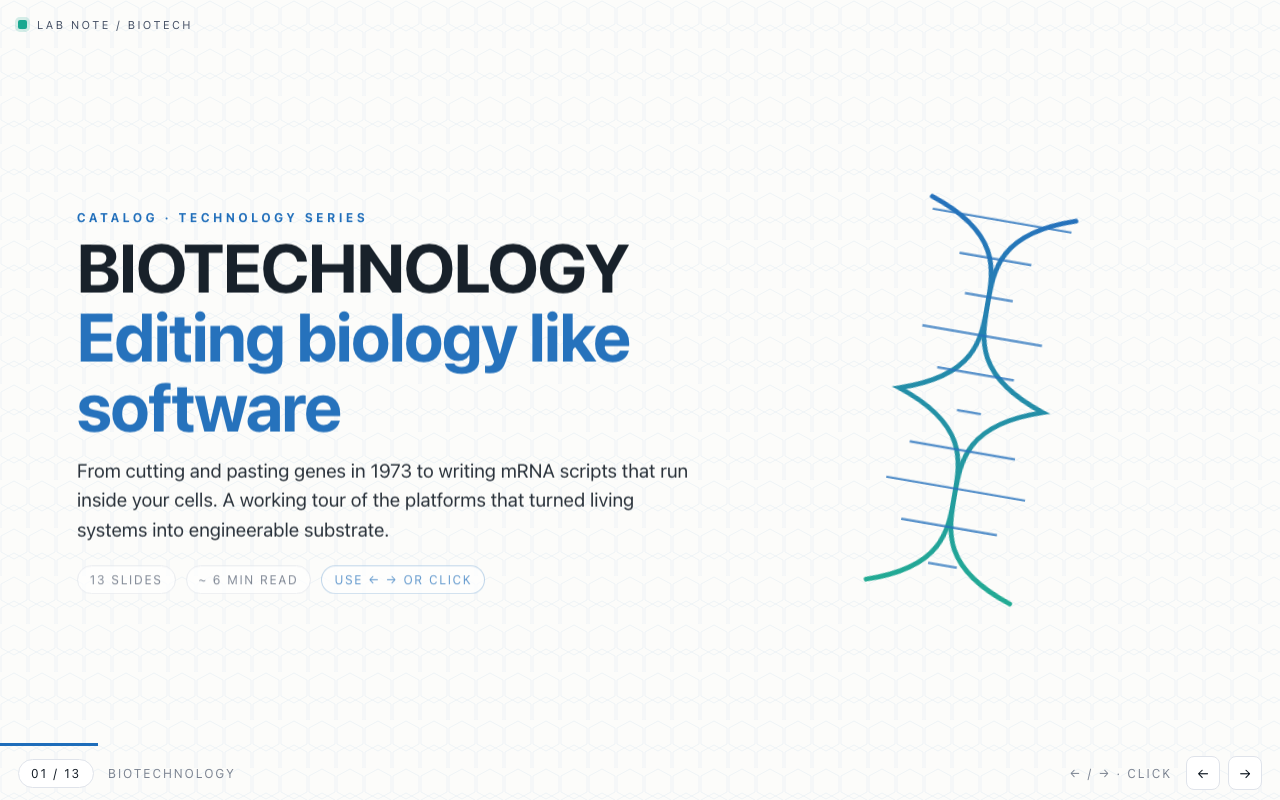
Biotechnology — Editing biology like software
From cutting and pasting genes in 1973 to writing mRNA scripts that run inside your cells. A working tour of the platforms that turned living systems into engineerable substrate.
COMPUTING / a brief history
Charles Babbage designed a mechanical, general-purpose computer with a "mill" (CPU), "store" (memory), and punched-card input — over a century before the electronic computer.
Cryptography / Declassified
Julius Caesar protected military dispatches with a substitution so simple a soldier could memorize it: shift every letter of the plaintext forward by three positions in the alphabet.
THE INTERNET // A FIFTY-YEAR HISTORY
┌──────────────────────────────────────────────────────────────┐ │ │ │ │ │ │ └──────────────────────────────────────────────────────────────┘ THE INTERNET ━━━━━━━━━━━━━━━━━━━━━━━━━━━━━━━━━━━━━ A FIFTY-YEAR HISTORY BOOTING ARCHIVE
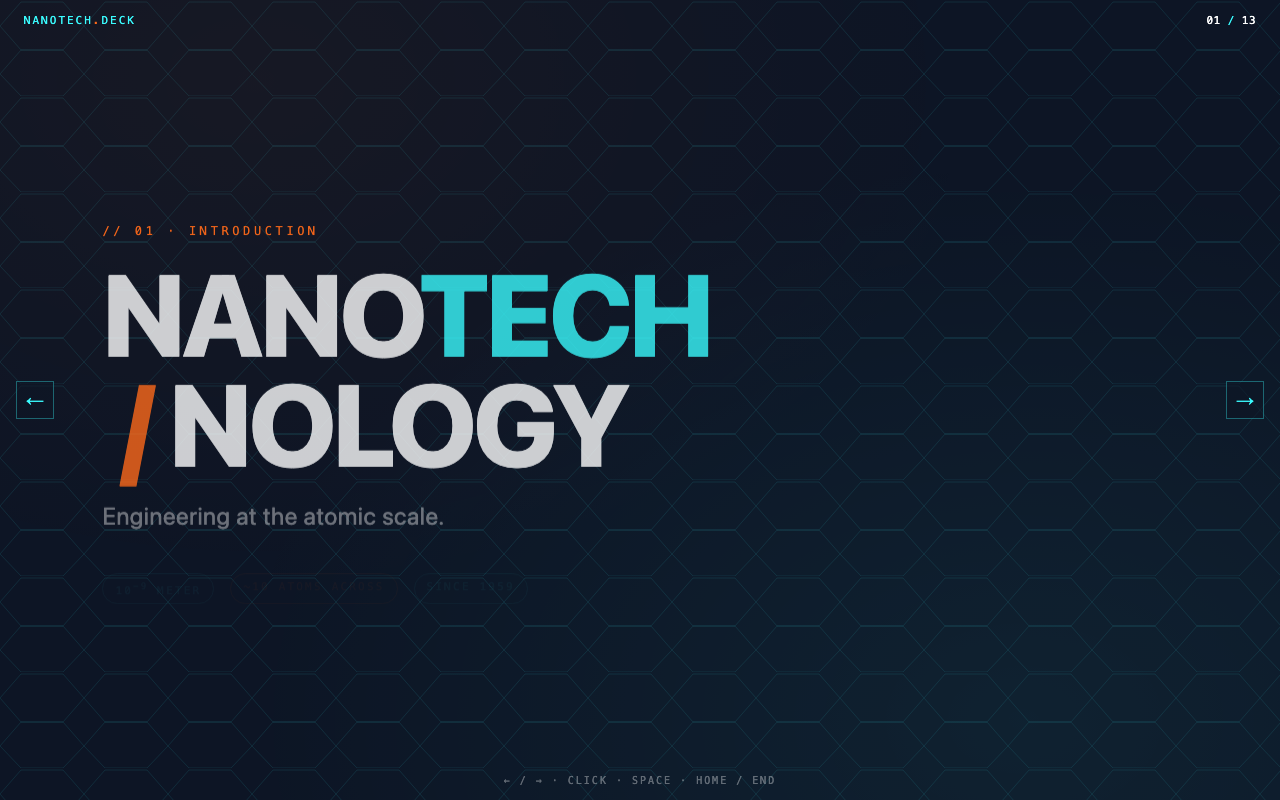
Nanotechnology / Engineering at the atomic scale
Caltech, December 29, 1959 . Richard Feynman delivers the founding lecture of nanotechnology before the field exists.
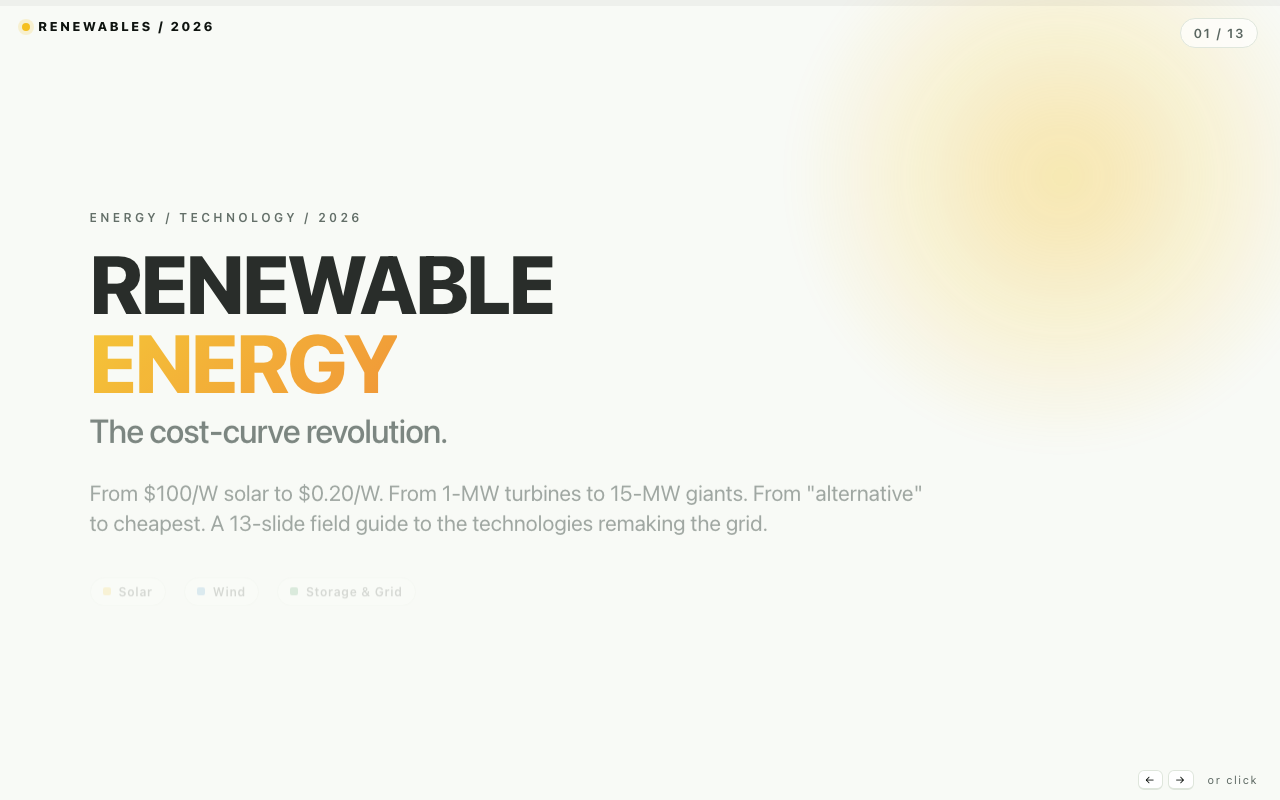
Renewable Energy / The cost-curve revolution
Every doubling of cumulative solar capacity has knocked roughly 20-25% off price. The curve has held for four decades.
ROBOTICS / Machines that move
FROM INDUSTRIAL ARMS → HUMANOIDS
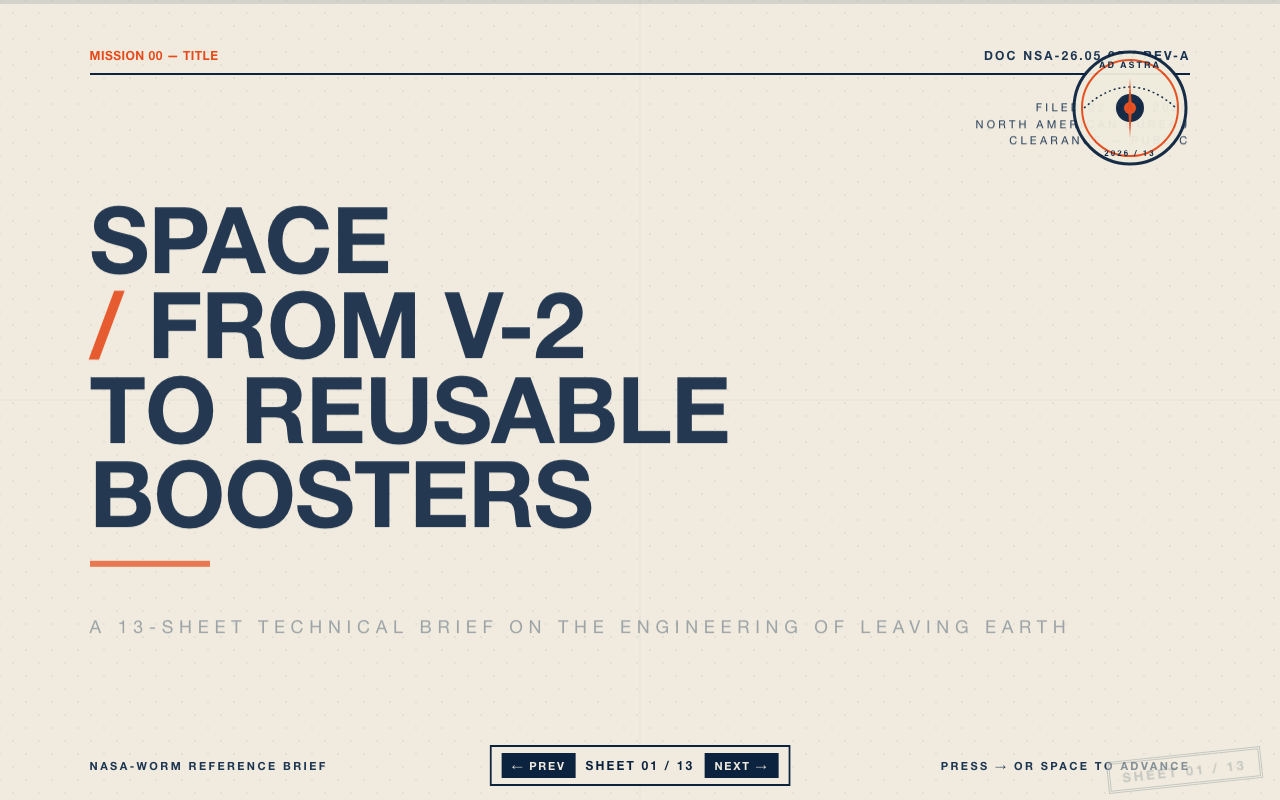
SPACE / from V-2 to reusable boosters
AD ASTRA 2026 / 13 FILED 02 MAY 2026 NORTH AMERICAN BUREAU CLEARANCE — PUBLIC SPACE / from V-2 to reusable boosters A 13-sheet technical brief on the engineering of leaving Earth NASA-WORM REFERENCE BRIEF PRESS → OR SPACE TO ADVANCE MISSION 01 — V-2 / PEENEMÜNDE EVENT 1942 1942 First vehicle to touch space On 3 October 1942 , an A-4 rocket — soon known to the world as the V-2 — lifted from Test Stand VII at...
VR / AR — Worlds rendered, worlds overlaid
From Sutherland's Sword of Damocles to Apple Vision Pro — six decades of strapping screens to faces, and learning what the eyes will tolerate.