shipslides
History13 slides0 views

Industrial Revolution — Steam, Steel, Smoke

"); } .page::after { bottom: 8px; right: 8px; transform: rotate(180deg); background-image: url("data:image/svg+xml;utf8, "); } /* Stamps and rules */ h1...

StandaloneDownload
Sandboxed deck
Open raw

About this HTML presentation

This Shipslides page presents Industrial Revolution — Steam, Steel, Smoke as an interactive HTML presentation deck in the History catalog with 13 slides. The share page keeps the uploaded deck sandboxed while exposing readable context, topics, and a slide outline for viewers and search engines.

"); } .page::after { bottom: 8px; right: 8px; transform: rotate(180deg); background-image: url("data:image/svg+xml;utf8, "); } /* Stamps and rules */ h1, h2, h3 { font-family: "Rockwell", "Rockwell Nova", "Roboto Slab", Georgia, serif; font-weight: 900; letter-spacing: 0.02em; color: var(--ink); } .eyebrow { display: inline-block; font-family: "Rockwell", Georgia, serif; font-size: clamp(10px, 1.1vw, 13px)... Key sections include: Industrial Revolution Steam · Steel · Smoke; Why Britain, Why Then; Textiles First; The Engine Comes of Age; The Black Country; Canals, Rails, Iron Hulls; Discipline of the Clock; Children, Hours, Reform; Britain → The World; Electricity, Chemicals, Wires & Engines.

Key sections

  • 01Industrial Revolution Steam · Steel · Smoke
  • 02Why Britain, Why Then
  • 03Textiles First
  • 04The Engine Comes of Age
  • 05The Black Country
  • 06Canals, Rails, Iron Hulls
  • 07Discipline of the Clock
  • 08Children, Hours, Reform
  • 09Britain → The World
  • 10Electricity, Chemicals, Wires & Engines
  • 11Smoke & Bread
  • 12Every Modern Problem & Possibility
  • 13References & the Reel
Slide outline
  1. 01Industrial Revolution Steam · Steel · Smoke
  2. 02Why Britain, Why Then
  3. 03Textiles First
  4. 04The Engine Comes of Age
  5. 05The Black Country
  6. 06Canals, Rails, Iron Hulls
  7. 07Discipline of the Clock
  8. 08Children, Hours, Reform
  9. 09Britain → The World
  10. 10Electricity, Chemicals, Wires & Engines
  11. 11Smoke & Bread
  12. 12Every Modern Problem & Possibility
  13. 13References & the Reel
Page data
Canonical
https://shipslides.com/d/catalog-history-industrial-revolution
Category
History
Size
53.8 KB
Updated
2026-05-17
LLM text
https://shipslides.com/d/catalog-history-industrial-revolution/llms.txt

Presentation Transcript

Detailed slide-by-slide text content extracted from this presentation.

Slide 01

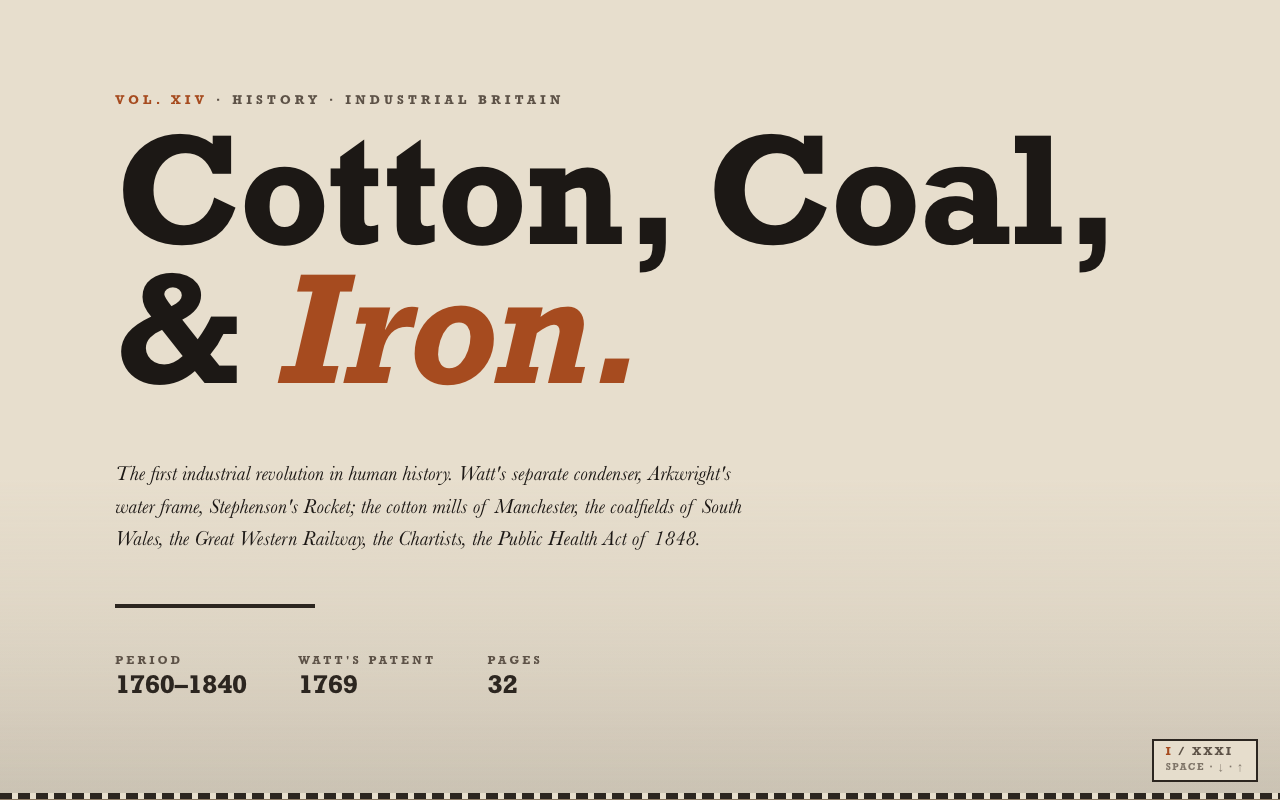
Industrial Revolution Steam · Steel · Smoke

  • A Mechanical Codex · 1760 — 1840+
  • How a damp island of looms and coal taught the world to mass-produce
  • the modern condition — for better and very much for worse.
  • Manchester
  • Coalbrookdale
  • Birmingham
  • Glasgow
  • Lancashire
Slide 02

Why Britain, Why Then

  • Chapter I · Pre-Conditions
  • A peculiar concentration of land, money, fuel, empire & ideas.
  • Enclosure Acts — common land privatised; smallholders pushed into wage labour.
  • Capital & banks — Bank of England (1694), country banks, joint-stock companies, low interest.
  • Coal beneath the feet — vast Newcastle & Welsh seams; cheap, high-density energy.
  • Colonies & Atlantic trade — raw cotton, sugar, captive markets; profits from slavery flow into mills.
  • Scientific Revolution — Newton, Boyle, Royal Society; engineering as respectable practice.
  • Stable institutions — Glorious Revolution (1688), property law, patents (e.g. Watt's 1769).
  • YearPre-condition Marker
  • 1623Statute of Monopolies — modern patent law
  • 1688Glorious Revolution — constitutional limits
  • 1694Bank of England founded
  • 1709Darby smelts iron with coke at Coalbrookdale
  • 1730sEnclosure accelerates; rural exodus
  • 1750sAtlantic trade peak; cotton imports rise
  • The Industrial Revolution did not begin with one machine. It began with a country
  • arranged, by accident and by violence, to reward whoever could build one.
Slide 03

Textiles First

  • Chapter II · Cotton & Wool
  • The thread that pulled an economy through a sieve.
  • Cotton was the test-bed: an imported fibre, an export market, a labour-intensive bottleneck.
  • Each invention solved one stage and broke the next.
  • Flying shuttle (Kay, 1733) — weavers outpace spinners.
  • Spinning Jenny (Hargreaves, 1764) — one worker, eight spindles.
  • Water frame (Arkwright, 1769) — water-powered, factory-scale.
  • Spinning mule (Crompton, 1779) — finer, stronger thread.
  • Power loom (Cartwright, 1785) — weaving mechanised.
  • Cotton gin (Whitney, 1793, US) — expands slavery to feed mills.
  • Plate I — Multi-spindle frame, water-driven
Slide 04

The Engine Comes of Age

  • Chapter III · Steam
  • Newcomen pumped the mines. Watt liberated the factory.
  • Plate II — Watt's separate-condenser engine
  • 1712 · Newcomen — atmospheric beam engine; ~0.5% efficient; pumps tin and coal mines.
  • 1769 / 1776 · Watt — separate condenser ends the wasteful re-heating of the cylinder; partnership with Boulton at Soho Manufactory.
  • Rotary motion (sun-and-planet gear, 1781) — engines now turn shafts, not just pumps.
  • High-pressure (Trevithick, 1800s) — small, mobile engines → the locomotive becomes possible.
  • “I sell here, sir, what all the world desires to have — POWER.”
  • Matthew Boulton to James Boswell, 1776
Slide 05

The Black Country

  • Chapter IV · Iron & Coal
  • Coke smelting, puddled iron, then cheap steel.
  • Wood charcoal had limits; coal contained sulphur that ruined iron. Abraham Darby I
  • (Coalbrookdale, 1709) used coke — coal baked of impurities — opening cheap pig iron.
  • 1709 · Darby smelts iron with coke.
  • 1779 · Iron Bridge over the Severn — the material announces itself.
  • 1784 · Cort's puddling & rolling — mass wrought iron.
  • 1856 · Bessemer process — air through molten pig iron drops carbon; steel becomes a commodity.
  • 1860s+ · Siemens-Martin open hearth — reliable steel for rails, ships, skyscrapers.
  • Coal fed the engines; iron was the engines, the rails, the bridges, the boilers.
  • Each cheap ton lowered the cost of every other ton.
  • YearUK Pig Iron Output (tons)
  • 1740~17,000
  • 1788~68,000
  • 1806~250,000
  • 1830~700,000
  • 1860~3,800,000
  • 1900~9,000,000
  • ~500×
  • UK pig iron, 1740 → 1900
  • ~75%
  • drop in steel cost, 1860–1900
Slide 06

Canals, Rails, Iron Hulls

  • Chapter V · Transport
  • Distance was a tax on everything; the engineers cut it.
  • 1761 · Bridgewater Canal — coal to Manchester, freight cost halves.
  • 1804 · Trevithick's locomotive runs on rails at Penydarren.
  • 1825 · Stockton & Darlington — first public steam railway.
  • 1829 · Stephenson's Rocket wins the Rainhill Trials.
  • 1830 · Liverpool & Manchester opens — the modern railway.
  • 1838 · SS Great Western crosses the Atlantic on steam.
  • 1869 · Suez Canal · US transcontinental rail completed.
  • Travel times collapsed by an order of magnitude in a single lifetime.
  • For the first time, perishables, news, and people moved at industrial speed.
  • Plate III — Stephenson's Rocket, 1829
Slide 07

Discipline of the Clock

  • Chapter VI · The Factory
  • Manchester — “Cottonopolis” — invents the modern workplace.
  • Production left the cottage and entered the works: a single roof, a single shaft of power,
  • a single rhythm. Time, once measured in tasks (“a milking”, “a brewing”), became measured in minutes.
  • Concentration — thousands of workers under one steam shaft.
  • Division of labour — Adam Smith's pin factory writ enormous.
  • Time discipline — the factory bell, the gate, the foreman, fines for lateness.
  • Urbanisation — Manchester's population: 25,000 in 1772 → 300,000+ by 1850.
  • Standardisation — interchangeable parts (Whitney, Brunel) presage assembly lines.
  • “From this foul drain the greatest stream of human industry flows out to fertilise the whole world.
  • From this filthy sewer pure gold flows.”
  • Tocqueville on Manchester, 1835
  • YearManchester Population
  • 1772~25,000
  • 1801~75,000
  • 1821~126,000
  • 1851~303,000
  • 1901~544,000
  • ~12×
  • Manchester pop. growth, 1772–1851
  • 50%
  • UK urban share by 1851 — a world first
Slide 08

Children, Hours, Reform

  • Chapter VII · The Human Cost
  • The price was paid in lungs and small fingers.
  • Child labour — 6–7 year-olds tending machines; pauper apprentices bonded for years.
  • Hours — 12 to 16-hour shifts; standard mill day was 14h · six days a week.
  • Mines — women and children pulled wagons in tunnels too low for adults.
  • Air, water, disease — cholera in slums; cotton-dust lung; black-lung in pits.
  • Wages & truck — paid sometimes in tokens redeemable only at the company shop.
  • Reform came late, in fragments, mostly after riot, strike, and journalism.
  • YearReform Milestones (UK)
  • 1802Health & Morals of Apprentices Act
  • 1819Cotton Mills Act — min. age 9
  • 1833Factory Act — under-13s: 9h limit, inspectors
  • 1842Mines Act &mdash; women, <10s out of pits
  • 1847Ten Hours Act &mdash; women & youths
  • 1867Factory Acts extended to all factories
  • 1880Compulsory schooling to age 10
  • &ldquo;You may walk through the streets and not see a single child of poor parents that does not bear
  • on its body the marks of premature toil.&rdquo;
  • Sadler Committee testimony, 1832
Slide 09

Britain &rarr; The World

  • Chapter VIII &middot; Diffusion
  • Patents leak. Engineers travel. Coalfields decide.
  • Belgium &middot; 1820s
  • The first continental industrialiser. Walloon coal & iron at Li&egrave;ge and Charleroi; British engineer
  • William Cockerill sets up textile machinery at Verviers and Seraing.
  • France &middot; 1830s
  • Slower, regional &mdash; Alsace textiles, Le Creusot ironworks. Disrupted by political upheaval; rail & banking
  • spurt under the Second Empire.
  • Germany &middot; 1850s+
  • Zollverein customs union (1834) unifies the market. Ruhr coal, Krupp steel, state railways, technical
  • universities &mdash; by 1900 Germany leads chemicals and electricity.
  • United States &middot; 1820s+
  • Slater smuggles textile know-how to Rhode Island (1790). Lowell, MA; Erie Canal (1825);
  • rails surge after 1840; post-Civil-War steel makes the US the largest economy.
  • Japan &middot; 1868+
  • The Meiji Restoration imports railways, telegraphs, factories, conscription, banks &mdash; a state-led
  • industrialisation in a single generation.
  • Russia & the Rest
  • Witte's railways and tariffs from the 1890s. India and China are forcibly de-industrialised under
  • empire &mdash; their textile crafts crushed by Manchester's prices.
Slide 10

Electricity, Chemicals, Wires & Engines

  • Chapter IX &middot; The Second Industrial Revolution
  • 1870 &mdash; 1914 &middot; the modern world snaps into focus.
  • Cheap steel (Bessemer 1856 &middot; open hearth) &rarr; rails, ships, skyscrapers.
  • Electric power &mdash; Faraday's induction (1831); Edison's Pearl St. station (1882); Tesla & Westinghouse AC; the grid arrives.
  • Chemicals &mdash; synthetic dyes (Perkin 1856), fertilisers, dynamite (Nobel 1867), Haber-Bosch (1909).
  • Telegraph & telephone &mdash; transatlantic cable 1866; Bell 1876; the world becomes simultaneous.
  • Internal combustion &mdash; Otto (1876), Daimler & Benz (1885&ndash;86), Ford Model T (1908).
  • Mass production &mdash; Taylorism, the moving assembly line (Highland Park, 1913).
  • YearStep-change
  • 1856Bessemer steel &middot; Perkin's mauveine dye
  • 1866Transatlantic telegraph cable
  • 1876Bell's telephone &middot; Otto 4-stroke engine
  • 1879Edison incandescent lamp
  • 1885Benz Patent-Motorwagen
  • 1903Wright Flyer at Kitty Hawk
  • 1909Haber-Bosch synthesises ammonia
  • 1913Ford moving assembly line
  • Where the First IR was steam & iron & cotton, the Second was electrons, molecules,
  • and signals &mdash; and the corporate laboratory that produced them on demand.
Slide 11

Smoke & Bread

  • Chapter X &middot; The Reckoning
  • Pollution, inequality, critique &mdash; against an explosion in living standards.
  • The Costs
  • Pollution &mdash; Pea-soup London fogs; rivers run with dye and acid; coal soot blackens cathedrals.
  • Inequality &mdash; capitalists accumulate; real wages stagnate for early generations of millhands (the &ldquo;Engels' pause&rdquo; ~1790&ndash;1840).
  • Marx & Engels &mdash; Condition of the Working Class (1845), Capital (1867): industrial capitalism produces wealth and alienation in the same motion.
  • Empire & slavery &mdash; cotton mills powered by enslaved labour in the US South; deindustrialisation of India.
  • Carbon &mdash; the era's hidden bequest: a CO2 curve that begins, faintly, in 1750.
  • The Benefits
  • Living standards &mdash; from ~1850 onward, real wages, life expectancy, literacy all climb steeply.
  • Famines retreat &mdash; cheap grain, refrigeration, rail; calories per person rise across Europe.
  • Goods democratise &mdash; cotton clothes, steel cutlery, glass windows, soap, sugar &mdash; once luxuries, now common.
  • Public health &mdash; sewers, vaccination, anaesthesia, antiseptics &mdash; all industrial-age inventions.
  • Mobility & literacy &mdash; rail, mass print, schooling: the rise of the modern citizen.
  • ~10&times;
  • global GDP/person, 1800 &rarr; 2000
  • +40 yrs
  • life expectancy gain, 1800 &rarr; 2000
Slide 12

Every Modern Problem & Possibility

  • Chapter XI &middot; Legacy
  • If you live in 2026, you live downstream of a Lancashire cotton mill.
  • The Industrial Revolution is not a chapter that closed; it is the operating system we still run.
  • Almost every contemporary debate is a continuation of arguments first staged in mill-towns.
  • Climate &mdash; the carbon budget we are spending was opened in 1750.
  • Work &mdash; gig labour, automation anxiety, the 40-hour week &mdash; all are descendants of the factory bell.
  • Cities &mdash; megacities, suburbs, slums &mdash; the urban form remains industrial.
  • Globalisation &mdash; cotton, opium, container ships, semiconductors: same logic, finer mesh.
  • Inequality &mdash; the &ldquo;capital vs. labour&rdquo; split structures politics still.
  • Possibility &mdash; mass education, public health, electricity, abundance: also industrial gifts.
  • &ldquo;The bourgeoisie, during its rule of scarce one hundred years, has created more massive and more
  • colossal productive forces than have all preceding generations together.&rdquo;
  • Marx & Engels, Communist Manifesto, 1848
  • &ldquo;The only way to discover the limits of the possible is to go beyond them into the impossible.&rdquo;
  • Arthur C. Clarke &mdash; an industrial-age sentence
  • Anthropocene
  • Capitalism
  • Modernity
  • Mass Politics
  • Globalised Trade
Slide 13

References & the Reel

  • Coda &middot; Further Reading & Viewing
  • Books to read by gaslight; videos to watch by LED.
  • Selected Books
  • E. P. Thompson, The Making of the English Working Class (1963)
  • Friedrich Engels, The Condition of the Working Class in England (1845)
  • Eric Hobsbawm, The Age of Revolution / Capital / Empire (trilogy)
  • David Landes, The Unbound Prometheus (1969)
  • Robert Allen, The British Industrial Revolution in Global Perspective (2009)
  • Sven Beckert, Empire of Cotton (2014)
  • Joel Mokyr, The Enlightened Economy (2009)
  • Watch on YouTube
  • &raquo; Industrial Revolution &mdash; documentaries & lectures
  • &raquo; Steam Engine &mdash; Watt's separate condenser explained
  • &ldquo;The future entered into us, in order to transform itself in us, long before it happened.&rdquo;
  • Rilke &mdash; a fitting epigraph for an industrial age
  • &mdash; FIN &mdash;
Remove this deck