shipslides
Philosophy13 slides0 views

Philosophy of Mind — The puzzle of the inner life

What is consciousness, why does it feel like anything, and could a machine ever have it? A short tour through the puzzles, positions, and thought...

StandaloneDownload
Sandboxed deck
Open raw

About this HTML presentation

This Shipslides page presents Philosophy of Mind — The puzzle of the inner life as an interactive HTML presentation deck in the Philosophy catalog with 13 slides. The share page keeps the uploaded deck sandboxed while exposing readable context, topics, and a slide outline for viewers and search engines.

What is consciousness, why does it feel like anything, and could a machine ever have it? A short tour through the puzzles, positions, and thought experiments that won't sit still. Key sections include: PHILOSOPHY OF MIND The puzzle of the inner life.; Why does any of this feel like anything?; Descartes: two substances , body and mind.; The mind as a set of dispositions.; Mental states are brain states.; Mind as functional organization.; Silicon, slime, or neurons.; The redness of red , the painfulness of pain.; Does Mary learn something new ?; Searle: syntax without semantics..

Key sections

  • 01PHILOSOPHY OF MIND The puzzle of the inner life.
  • 02Why does any of this feel like anything?
  • 03Descartes: two substances , body and mind.
  • 04The mind as a set of dispositions.
  • 05Mental states are brain states.
  • 06Mind as functional organization.
  • 07Silicon, slime, or neurons.
  • 08The redness of red , the painfulness of pain.
  • 09Does Mary learn something new ?
  • 10Searle: syntax without semantics.
  • 11Consciousness as Φ (phi).
  • 12When (if ever) does a system have an inside?
  • 13Where to read & watch.

Topics covered

Slide outline
  1. 01PHILOSOPHY OF MIND The puzzle of the inner life.
  2. 02Why does any of this feel like anything?
  3. 03Descartes: two substances , body and mind.
  4. 04The mind as a set of dispositions.
  5. 05Mental states are brain states.
  6. 06Mind as functional organization.
  7. 07Silicon, slime, or neurons.
  8. 08The redness of red , the painfulness of pain.
  9. 09Does Mary learn something new ?
  10. 10Searle: syntax without semantics.
  11. 11Consciousness as Φ (phi).
  12. 12When (if ever) does a system have an inside?
  13. 13Where to read & watch.
Page data
Canonical
https://shipslides.com/d/catalog-philosophy-mind
Category
Philosophy
Size
41.7 KB
Updated
2026-05-17
LLM text
https://shipslides.com/d/catalog-philosophy-mind/llms.txt

Presentation Transcript

Detailed slide-by-slide text content extracted from this presentation.

Slide 01

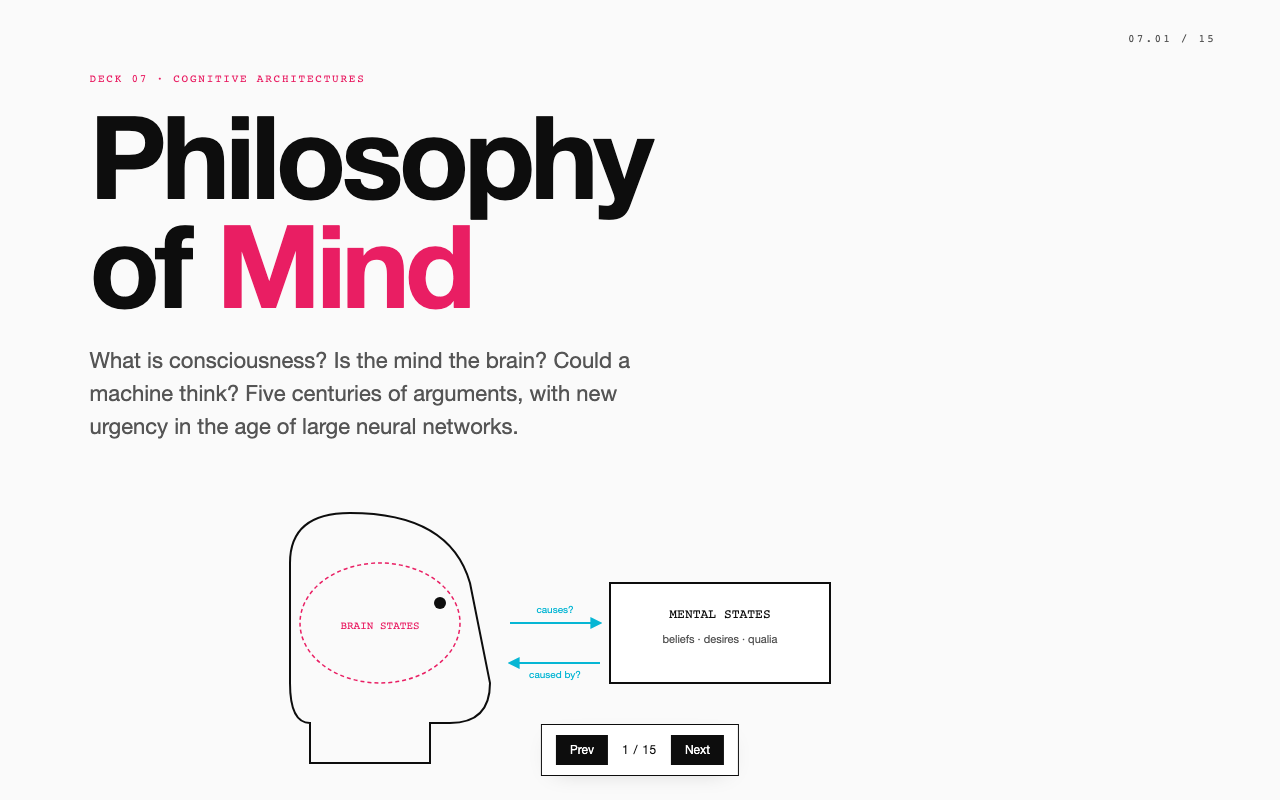
PHILOSOPHY OF MIND The puzzle of the inner life.

  • A COGNITIVE-SCIENCE NOTEBOOK · 13 SLIDES
  • What is consciousness, why does it feel like anything, and could a machine ever have it? A short tour through the puzzles, positions, and thought experiments that won't sit still.
  • I. CONSCIOUSNESS
  • II. THE HARD PROBLEM
  • III. AI & INNER EXPERIENCE
Slide 02

Why does any of this feel like anything?

  • 02 · THE HARD PROBLEM
  • David Chalmers (1995) split the science of mind in two. The easy problems — attention, memory, discrimination, report — are tractable in principle: explain the function, you've explained the phenomenon.
  • The hard problem is different. Even after we've fully described the neural and computational processes, a question remains: why is there something it is like to undergo them? Why is there an inside?
  • Easy: how does the brain integrate information?
  • Easy: how does it produce verbal report?
  • Hard: why is any of it experienced?
  • "There is something it is like to be a conscious organism. That subjective character of experience is what the hard problem is about."
  • — D. Chalmers, Facing Up to the Problem of Consciousness, 1995
  • KEY MOVE
  • The explanatory gap
  • No matter how fine-grained the physical story, it seems we can always ask: but why does it feel like this? Function alone doesn't appear to entail phenomenology.
Slide 03

Descartes: two substances, body and mind.

  • 03 · DUALISM
  • In the Meditations (1641), Descartes argued he could doubt the existence of his body but not of his thinking. Mind (res cogitans) and matter (res extensa) must therefore be distinct kinds of stuff.
  • Modern philosophy of mind largely begins with this picture — and largely as an attempt to escape it. The trouble: if mind and body are utterly different, how do they interact? Descartes' guess (the pineal gland) satisfied no one.
  • Substance dualism — two basic kinds of stuff
  • Property dualism — one stuff, two kinds of properties
  • Interaction problem — the recurring objection
  • FIG. 1 — Cartesian dualism & the interaction problem
Slide 04

The mind as a set of dispositions.

  • 04 · BEHAVIORISM
  • Tired of Cartesian ghosts, mid-20th-century thinkers proposed: drop the inner theater. To have a mental state just is to behave (or be disposed to behave) in characteristic ways.
  • Gilbert Ryle called Descartes' picture "the dogma of the ghost in the machine." B.F. Skinner pushed the program empirically: predict and shape behavior; the rest is folklore.
  • Pain = a disposition to wince, withdraw, complain
  • Belief = a disposition to assent and to act accordingly
  • Inner states are bracketed as scientifically unusable
  • OBJECTION
  • The super-actor
  • Surely a brilliant actor could mimic every pain-behavior without feeling anything. And surely a stoic could feel pain without showing it. Behavior under-determines experience.
  • LEGACY
  • A useful scaffold
  • Behaviorism failed as a complete theory of mind, but its insistence on operational tests and observable evidence shaped cognitive science and (later) AI evaluation.
  • Ryle 1949
  • Skinner 1953
Slide 05

Mental states are brain states.

  • 05 · IDENTITY THEORY
  • Place (1956) and Smart (1959) proposed a clean materialism: the relation between mind and brain is identity, just as water = H2O or lightning = electrical discharge.
  • Pain isn't merely correlated with C-fiber firing — pain is C-fiber firing, full stop. Inner life is preserved (no behaviorist dodge), but it lives entirely in the head.
  • Type identity: every kind of mental state = some kind of brain state
  • Token identity: every instance = some neural instance
  • Reductive but ontologically tidy
  • "Sensations are nothing over and above brain processes."
  • — J. J. C. Smart, 1959
  • PROBLEM AHEAD
  • What about an octopus?
  • If pain just is C-fiber firing, then a creature without C-fibers can't feel pain. That seems wrong — and it sets the stage for functionalism.
Slide 06

Mind as functional organization.

  • 06 · FUNCTIONALISM
  • Hilary Putnam's move (1967): a mental state is defined by its causal role — what causes it, what it tends to cause, and how it interacts with other states — not by its physical realizer.
  • A clock is a clock whether it ticks with gears, quartz, or atomic transitions. A belief is a belief whether it's stored in neurons, transistors, or, in principle, anything that plays the right role.
  • Inputs → internal state transitions → outputs
  • Software/hardware analogy: mind ≈ program
  • Opens the door to AI as candidate mind
  • FIG. 2 — A mental state, defined by its role
Slide 07

Silicon, slime, or neurons.

  • 07 · MULTIPLE REALIZABILITY
  • If functionalism is right, the same mental state could be implemented by radically different physical systems — as long as the causal organization is preserved.
  • This is the core argument against identity theory. Pain in a human, an octopus, and (perhaps) a Martian with hydraulic neurons may all count as pain, despite sharing nothing chemically.
  • Same function, many substrates
  • Why mind is not identical to any one physical kind
  • Foundational assumption of much AI optimism
  • Putnam 1967
  • Fodor 1974
  • SUBSTRATE A — CARBON
  • ~86 billion neurons
  • Action potentials, neurotransmitters, glia. The only kind of mind we know to exist, so far.
  • SUBSTRATE B — SILICON
  • Logic gates & tensors
  • Could the right software running on this hardware play the same causal role? Functionalists: yes, in principle.
  • SUBSTRATE C — SLIME?
  • A philosopher's hypothetical
  • If a hydraulic Martian behaves like you, believes like you, suffers like you — on what grounds do we deny it has a mind?
Slide 08

The redness of red, the painfulness of pain.

  • 08 · QUALIA
  • Qualia (singular: quale) are the felt qualities of experience — the warm orange of a sunset, the sharp ache of a stubbed toe, the strange tang of cilantro to some palates.
  • They are the part of mind that seems to slip out of every functional description. You can fully describe what red does; the worry is that you've still left out what red is like.
  • Intrinsic — properties of the experience itself
  • Ineffable — hard to convey by description alone
  • Subjective — accessible only "from the inside"
  • FIG. 3 — From neural firing to felt redness: the gap
Slide 09

Does Mary learn something new?

  • 09 · THOUGHT EXPERIMENT · MARY'S ROOM
  • Frank Jackson (1982): imagine Mary, a brilliant scientist who knows every physical fact about color vision but has lived her entire life inside a black-and-white room.
  • One day she steps outside and sees a ripe tomato. Does she learn anything new? Most people say yes — she now knows what red looks like. If so, there are facts about experience that escape the physical story.
  • Intended as a knock-down case for property dualism
  • Physicalist replies: she gains an ability, not a fact
  • Or: she gains an old fact under a new mode of presentation
  • "It seems just obvious that she will learn something about the world and our visual experience of it."
  • — F. Jackson, Epiphenomenal Qualia, 1982
  • UPSHOT
  • The knowledge argument
  • If complete physical knowledge isn't complete knowledge, then physicalism — the view that everything is physical — leaves something out. The "something" looks suspiciously like qualia.
Slide 10

Searle: syntax without semantics.

  • 10 · THOUGHT EXPERIMENT · CHINESE ROOM
  • John Searle (1980): a man who speaks no Chinese sits in a room with a vast rulebook. Slips of Chinese characters come in; he looks them up, copies the prescribed responses, and slides them back out.
  • From outside, the room appears to converse fluently in Chinese. But the man inside understands nothing. By analogy, says Searle, a digital computer manipulating symbols can never have understanding — only the appearance of it.
  • Aimed at "strong AI": that the right program just is a mind
  • Implementation matters: brains do something computers don't
  • Replies: the system understands; or, the robot reply; or, brain simulator reply
  • FIG. 4 — Searle's Chinese Room (1980)
Slide 11

Consciousness as Φ (phi).

  • 11 · INTEGRATED INFORMATION THEORY
  • Giulio Tononi (2004–) takes a different tack. Rather than asking which physical things produce consciousness, IIT starts from the felt structure of experience and asks what kind of system could realize it.
  • The answer: a system whose parts are causally bound together so tightly that the whole carries information no decomposition into parts can capture. That irreducible, integrated information is measured as Φ.
  • Consciousness is identical to integrated information
  • Φ > 0 ⇒ some inner life; higher Φ ⇒ richer experience
  • Predictions about anesthesia, sleep, split brains
  • PROVOCATION
  • A surprising verdict on AI
  • On IIT, a feed-forward network — even one that perfectly imitates a conscious system's behavior — has Φ ≈ 0. So a digital model of a brain might produce all the right outputs while being, in itself, dark inside.
  • CONTROVERSY
  • Open empirical questions
  • Critics point out that exact Φ is intractable to compute and that IIT may license panpsychism. Defenders see it as the most principled bridge yet between phenomenology and physics.
Slide 12

When (if ever) does a system have an inside?

  • 12 · AI & INNER EXPERIENCE
  • Large language models can converse, reason, even claim to feel. None of this settles the question. Behavior alone never has — that was the lesson of behaviorism's failure.
  • The same theories that divided us about brains now divide us about machines. Functionalists are open to silicon minds. IIT theorists worry that the wrong architecture is dark. Searle insists syntax never reaches semantics. Dualists may say the question is malformed.
  • The other-minds problem, sharpened by novel substrates
  • Moral stakes: if systems can suffer, we owe them something
  • Methodological stakes: how would we even test for it?
  • Open · perhaps the most consequential open question of the century
  • "We do not know how anything physical could be conscious. Nobody has the slightest idea."
  • — J. Fodor, 1992
Slide 13

Where to read & watch.

  • 13 · REFERENCES & FURTHER VIEWING
  • A few starting points. The literature is vast; these are the doors most people walk through first.
  • Chalmers · The Conscious Mind (1996)
  • Dennett · Consciousness Explained (1991)
  • Nagel · "What Is It Like to Be a Bat?" (1974)
  • Jackson · "Epiphenomenal Qualia" (1982)
  • Searle · "Minds, Brains, Programs" (1980)
  • Putnam · "Psychological Predicates" (1967)
  • Ryle · The Concept of Mind (1949)
  • Tononi · Phi (2012)
  • SEP · plato.stanford.edu/entries/consciousness/
  • Block · "On a Confusion about a Function of Consciousness"
  • YOUTUBE · SEARCH
  • The hard problem of consciousness
  • youtube.com/results?search_query=hard+problem+of+consciousness
  • YOUTUBE · SEARCH
  • Searle's Chinese Room
  • youtube.com/results?search_query=chinese+room+searle
  • END · 13/13
  • A NOTEBOOK ON MIND
Remove this deck