shipslides
Philosophy13 slides0 views

Eastern Philosophy — The Long Traditions

Eastern Philosophy the long traditions

StandaloneDownload
Sandboxed deck
Open raw

About this HTML presentation

This Shipslides page presents Eastern Philosophy — The Long Traditions as an interactive HTML presentation deck in the Philosophy catalog with 13 slides. The share page keeps the uploaded deck sandboxed while exposing readable context, topics, and a slide outline for viewers and search engines.

Eastern Philosophy the long traditions Key sections include: Eastern Philosophy; Atman is Brahman; Act, but do not cling.; The Four Noble Truths; Eight steady disciplines; Schools of the Buddha; The rectified society; Is human nature good, or bad?; Wu-wei; The butterfly's dream.

Key sections

  • 01Eastern Philosophy
  • 02Atman is Brahman
  • 03Act, but do not cling.
  • 04The Four Noble Truths
  • 05Eight steady disciplines
  • 06Schools of the Buddha
  • 07The rectified society
  • 08Is human nature good, or bad?
  • 09Wu-wei
  • 10The butterfly's dream
  • 11Buddhism + Daoism = Chan / Zen
  • 12Living traditions
  • 13Where to go from here
Slide outline
  1. 01Eastern Philosophy
  2. 02Atman is Brahman
  3. 03Act, but do not cling.
  4. 04The Four Noble Truths
  5. 05Eight steady disciplines
  6. 06Schools of the Buddha
  7. 07The rectified society
  8. 08Is human nature good, or bad?
  9. 09Wu-wei
  10. 10The butterfly's dream
  11. 11Buddhism + Daoism = Chan / Zen
  12. 12Living traditions
  13. 13Where to go from here
Page data
Canonical
https://shipslides.com/d/catalog-philosophy-eastern
Category
Philosophy
Size
24.7 KB
Updated
2026-05-17
LLM text
https://shipslides.com/d/catalog-philosophy-eastern/llms.txt

Presentation Transcript

Detailed slide-by-slide text content extracted from this presentation.

Slide 01

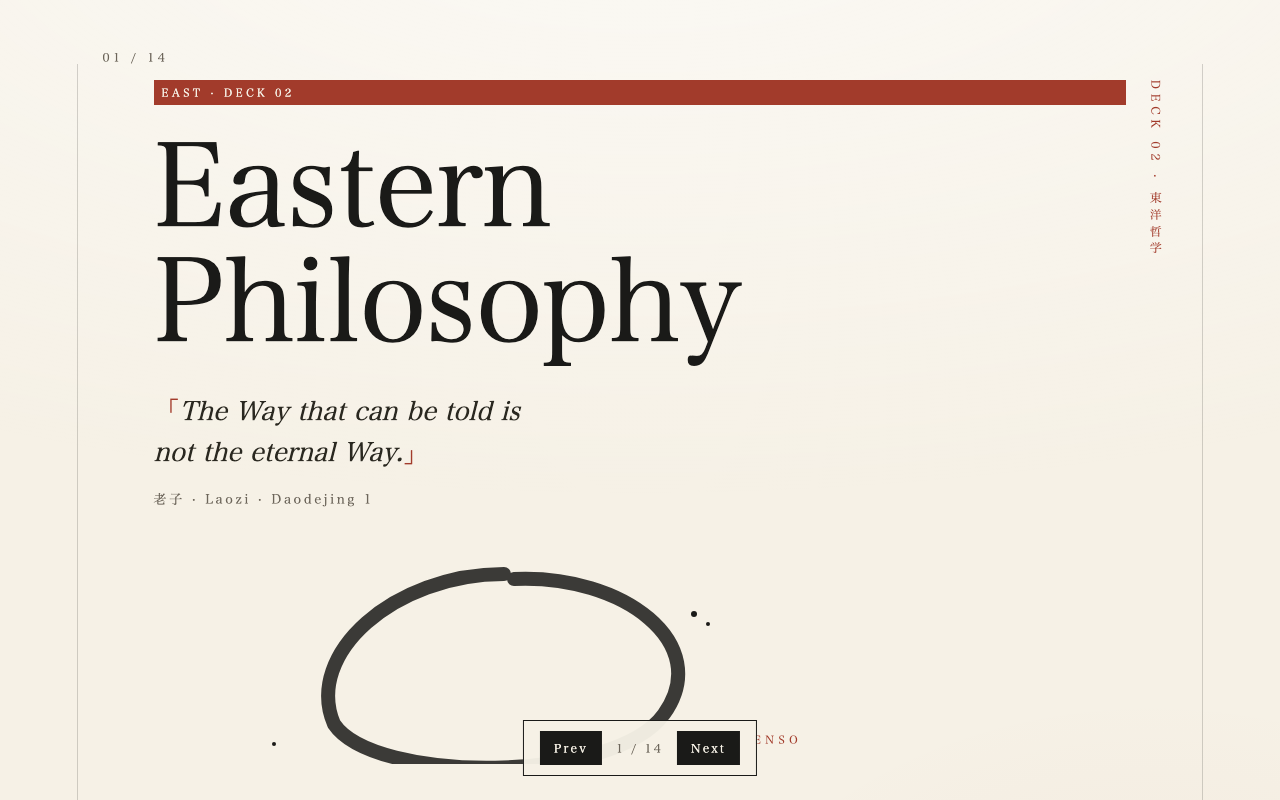
Eastern Philosophy

  • the long traditions
Slide 02

Atman is Brahman

  • Two — Hindu Thought
  • The oldest living philosophical tradition. Texts spanning three millennia ask one question: what is the self, really?
  • Vedas — hymns, ritual, cosmic order
  • Upanishads — inward turn, the self examined
  • Atman = Brahman — the inner self is the universe
  • Karma — action and consequence across lives
  • Moksha — release; the dissolution of separateness
Slide 03

Act, but do not cling.

  • Three — The Bhagavad Gita
  • You have a right to your action, never to its fruits. Let not the fruits of action be your motive — nor cling to inaction.
  • — KRISHNA TO ARJUNA, 2.47
  • On a battlefield, the warrior Arjuna freezes. His charioteer Krishna teaches him a strange ethic: do your duty fully, but release the outcome.
  • It is the seed of a remarkable idea — that effort and detachment are not opposites. The doer must do, but quietly, without grasping.
Slide 04

The Four Noble Truths

  • Four — The Buddha, ~500 BC
  • Dukkha — there is suffering
  • Samudaya — its cause is craving
  • Nirodha — there is a cessation
  • Magga — there is a path that leads to it
  • A diagnosis, an etiology, a prognosis, a treatment. The Buddha framed himself as a physician of the mind.
Slide 05

Eight steady disciplines

  • Five — The Eightfold Path
  • Right view
  • Right intention
  • Right speech
  • Right action
  • Right livelihood
  • Right effort
  • Right mindfulness
  • Right concentration
  • The path is sometimes drawn as a wheel — eight spokes turning together. Each one is incomplete without the others. It is wisdom, ethics, and meditation, woven.
Slide 06

Schools of the Buddha

  • Six — Many Vehicles
  • Theravada
  • "The way of the elders." Conservative, monastic, southern. Sri Lanka, Thailand, Burma.
  • Mahayana
  • "The great vehicle." The bodhisattva — one who delays nirvana to free all beings. China, Korea, Japan.
  • Vajrayana
  • "The diamond vehicle." Tantric ritual, mantra, the swift path. Tibet, Mongolia.
  • Chan / Zen
  • Direct seeing. The koan, the cushion, the snap of awakening. China, Japan.
Slide 07

The rectified society

  • Seven — Confucius, ~500 BC
  • Born into a fragmenting feudal China, Confucius asked: how do we live together well?
  • Ren (仁) — benevolence; the humane impulse
  • Li (禮) — ritual, propriety, the choreography of respect
  • Xiao (孝) — filial devotion as the root of order
  • Junzi — the cultivated person, made not born
  • "To rule by virtue is like the pole star — it stays still, and the others turn around it."
Slide 08

Is human nature good, or bad?

  • Eight — The Inheritors
  • MENCIUS
  • Human nature is good.
  • A child by a well — anyone would lunge to save it. The seed of compassion is already planted. Cultivation lets it grow.
  • XUNZI
  • Human nature is crooked.
  • Wood must be steamed and bent into a wheel. Without ritual and teaching, we follow appetite into chaos. Civilization is artifice — and that is its glory.
  • Two Confucian heirs, both right, both lasting.
Slide 09

Wu-wei

  • Nine — Laozi & the Dao De Jing
  • The Way that can be named is not the eternal Way.
  • Where Confucius saw order, Laozi saw flow. The sage acts by not-acting — not laziness, but the deep effort of not forcing things.
  • Water finds its way around the rock. The empty cup is useful. The hub of the wheel is the still point that lets it turn.
Slide 10

The butterfly's dream

  • Ten — Zhuangzi
  • Once Zhuangzi dreamt he was a butterfly, fluttering and free, knowing nothing of Zhuangzi. Suddenly he woke. Now he does not know — was he a man dreaming of a butterfly, or is he now a butterfly dreaming of a man?
  • Zhuangzi laughs where Laozi murmurs. He picks up the categories — useful, useless, self, other — and rotates them in the light.
  • Spontaneity (ziran) over striving. Perspective is plural. The cook cuts the ox by following the grain — never blunting his blade.
Slide 11

Buddhism + Daoism = Chan / Zen

  • Eleven — When Streams Meet
  • When Indian Buddhism arrived in China around the first century, it found a culture already steeped in Daoist intuition.
  • The two streams blended. Buddhist meditation met Daoist spontaneity. Out came Chan — and centuries later, in Japan, Zen.
  • No scripture above experience. The koan as a crowbar for the conceptual mind. The garden, the tea, the empty room — each a teaching.
Slide 12

Living traditions

  • Twelve — Why It Matters Now
  • Mindfulness in psychology
  • MBSR, MBCT, ACT — clinical Western therapy is now built atop Buddhist attention practices.
  • Stoic-Buddhist parallels
  • Two ancient traditions, separated by continents, both teach: distinguish what you control from what you don't.
  • Complexity over duality
  • Yin and yang are not opposites — they generate one another. A useful posture for systems, ecology, design.
  • A different self
  • The non-self of Buddhism, the porous self of Daoism — quiet correctives to a culture obsessed with the brand of "I."
Slide 13

Where to go from here

  • Thirteen — Further Wandering
  • READING
  • The Upanishads — Eknath Easwaran, tr.
  • The Bhagavad Gita — Stephen Mitchell, tr.
  • What the Buddha Taught — Walpola Rahula
  • The Analects — Confucius, Slingerland tr.
  • Tao Te Ching — Laozi, Ursula K. Le Guin tr.
  • Zhuangzi — Burton Watson, tr.
  • WATCHING
  • The Four Noble Truths →
  • Daoism & Laozi →
  • "Before enlightenment: chop wood, carry water.
  • After enlightenment: chop wood, carry water."
Remove this deck