shipslides
Philosophy13 slides0 views

Greek Philosophy — from Thales to the Stoics

Athens — Aegean — Ionia Greek Philosophy from Thales to the Stoics

StandaloneDownload
Sandboxed deck
Open raw

About this HTML presentation

This Shipslides page presents Greek Philosophy — from Thales to the Stoics as an interactive HTML presentation deck in the Philosophy catalog with 13 slides. The share page keeps the uploaded deck sandboxed while exposing readable context, topics, and a slide outline for viewers and search engines.

Athens — Aegean — Ionia Greek Philosophy from Thales to the Stoics Key sections include: Greek Philosophy; The Pre-Socratics; Pythagoras; Socrates; Plato; Aristotle, the Systematizer; The Cynics; Epicureanism; Stoicism; Skepticism.

Key sections

  • 01Greek Philosophy
  • 02The Pre-Socratics
  • 03Pythagoras
  • 04Socrates
  • 05Plato
  • 06Aristotle, the Systematizer
  • 07The Cynics
  • 08Epicureanism
  • 09Stoicism
  • 10Skepticism
  • 11From Athens to Everywhere
  • 12Why It Still Matters
  • 13Further Reading & Watching
Slide outline
  1. 01Greek Philosophy
  2. 02The Pre-Socratics
  3. 03Pythagoras
  4. 04Socrates
  5. 05Plato
  6. 06Aristotle, the Systematizer
  7. 07The Cynics
  8. 08Epicureanism
  9. 09Stoicism
  10. 10Skepticism
  11. 11From Athens to Everywhere
  12. 12Why It Still Matters
  13. 13Further Reading & Watching
Page data
Canonical
https://shipslides.com/d/catalog-philosophy-ancient-greek
Category
Philosophy
Size
35.0 KB
Updated
2026-05-17
LLM text
https://shipslides.com/d/catalog-philosophy-ancient-greek/llms.txt

Presentation Transcript

Detailed slide-by-slide text content extracted from this presentation.

Slide 01

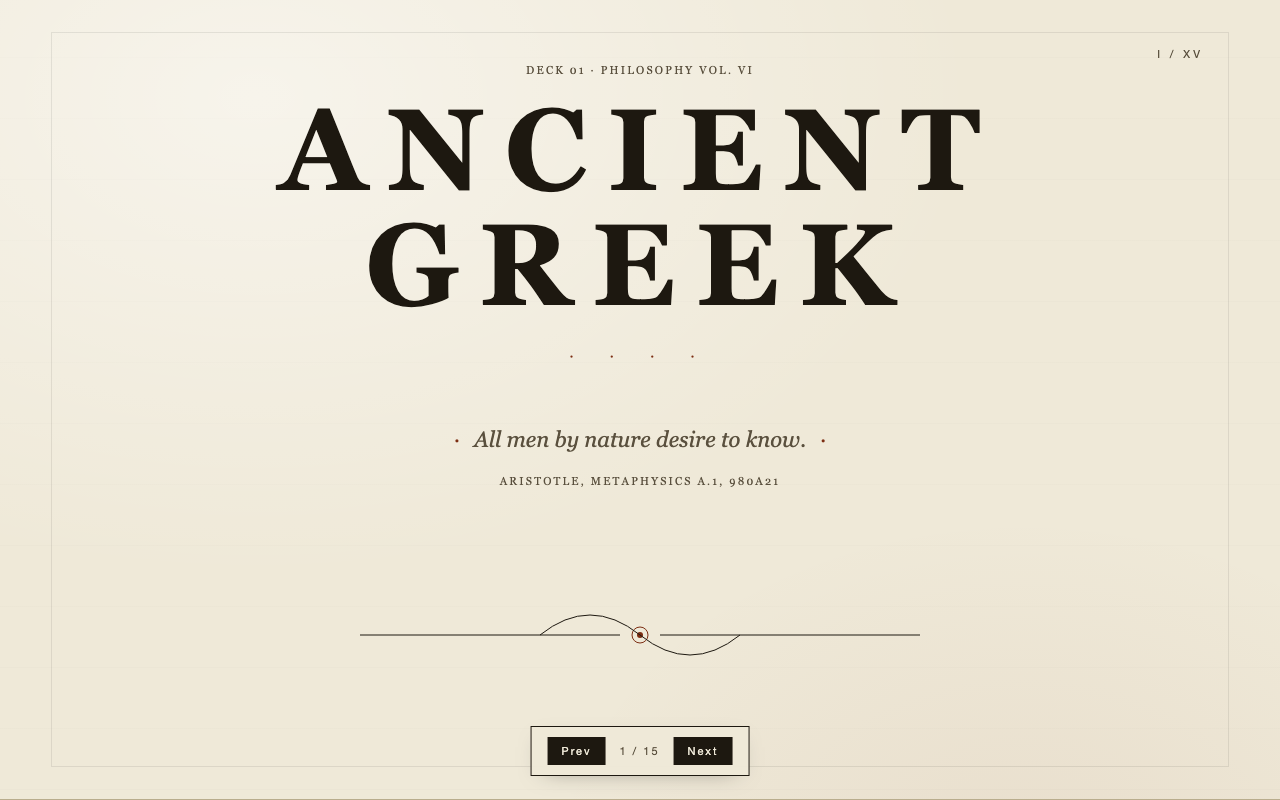
Athens — Aegean — Ionia

  • Greek Philosophy
  • from Thales to the Stoics
  • c. 600 BC — c. 200 AD
Slide 02

Before Socrates

  • The Pre-Socratics
  • What is the world made of? What stays the same beneath all change?
  • Thales of Miletus
  • All is water — the first known cosmologist.
  • Anaximander
  • The apeiron — the boundless, indefinite source.
  • Heraclitus
  • "Everything flows." You cannot step in the same river twice.
  • Parmenides
  • "Nothing changes." Being is one, eternal, and unmoving.
Slide 03

c. 570 — 495 BC

  • Pythagoras
  • Reality is number. Geometry reveals the harmonics of the cosmos — the same ratios that make a lyre sing govern the orbits of the stars.
  • A secretive brotherhood, vegetarianism, and a doctrine of the transmigration of the soul. Math became sacred.
Slide 04

470 — 399 BC

  • Socrates
  • "I know that I know nothing."
  • He wrote nothing. He walked the agora asking questions until certainty crumbled — the elenchus, the method of refutation.
  • Tried for impiety and corrupting the youth. He drank the hemlock rather than flee.
Slide 05

428 — 348 BC

  • Plato
  • Behind every fleeting thing stands an eternal Form — the perfect Triangle, the Good itself. The world we see is shadow.
  • In The Republic: justice, the philosopher-king, the allegory of the cave.
  • Founded the Academy — the West's first university.
Slide 06

384 — 322 BC — tutor to Alexander

  • Aristotle, the Systematizer
  • Plato's brightest student broke with him: knowledge begins not in the Forms but in observation. He cataloged everything.
  • Logic
  • The syllogism — rules of valid inference, unchanged for 2,000 years.
  • Ethics
  • Eudaimonia: flourishing through the virtues, the golden mean.
  • Biology
  • Dissected hundreds of species. The first true zoologist.
  • Politics
  • "Man is by nature a political animal." Constitutions compared.
Slide 07

4th century BC

  • The Cynics
  • Convention is a cage. Wealth, status, and shame are illusions invented by the polis to make you obedient.
  • "Stand a little out of my sun." — Diogenes, to Alexander the Great
  • Diogenes of Sinope lived in a wine jar, owned nothing, and barked at hypocrites in the marketplace. Virtue, he taught, comes through asceticism — living in radical accord with nature.
Slide 08

Epicurus — 341 to 270 BC

  • Epicureanism
  • The highest good is pleasure — not indulgence, but ataraxia: the tranquil absence of pain and fear.
  • All matter is atoms in the void. Atoms occasionally swerve — this small randomness rescues human freedom.
  • Don't fear death: "When I am, death is not. When death is, I am not."
Slide 09

Stoa Poikile — "the painted porch"

  • Stoicism
  • Live according to nature and reason. Keep firm hold of the only thing you truly own: your judgment.
  • "Some things are in our control, and others not." — Epictetus
  • Zeno of Citium
  • Founder — taught at the Stoa around 300 BC.
  • Epictetus
  • A freed slave whose lectures became the Discourses.
  • Seneca
  • Roman senator and tragedian; on the brevity of life.
  • Marcus Aurelius
  • Emperor and philosopher — the Meditations.
Slide 10

c. 360 — 270 BC

  • Skepticism
  • Pyrrho of Elis traveled with Alexander to India, and returned convinced that for every argument an equally good counter-argument exists.
  • The way out is epoché — suspension of judgment. Stop insisting reality is one way or the other.
  • From this suspension flows ataraxia: an unexpected, hard-won peace.
Slide 11

How the words survived

  • From Athens to Everywhere
  • c. 200 BC
  • Greek thought reaches Rome — Cicero, Seneca, Marcus Aurelius.
  • →
  • 8th — 12th c.
  • Preserved & extended by Islamic scholars — Al-Kindi, Avicenna, Averroes.
  • →
  • 12th — 16th c.
  • Translated back into Latin — ignites the Renaissance.
  • →
  • today
  • Read in classrooms, dorms, prisons, and cockpits the world over.
Slide 12

The long shadow

  • Why It Still Matters
  • "The safest general characterization of the European philosophical tradition is that it consists of a series of footnotes to Plato."
  • — Alfred North Whitehead
  • Logic, ethics, science, politics, education, the very idea of argument itself — the Greeks invented the categories we still think inside.
  • Every time you ask "but what does that really mean?", you are doing what Socrates did in the agora 2,400 years ago.
Slide 13

Where to go next

  • Further Reading & Watching
  • Books
  • Plato — Republic, Symposium, Apology
  • Aristotle — Nicomachean Ethics
  • Marcus Aurelius — Meditations
  • Epictetus — Enchiridion
  • Bertrand Russell — A History of Western Philosophy
  • Lectures on YouTube
  • Plato — Republic (lectures)
  • Stoicism — Marcus Aurelius
  • — ΤΕΛΟΣ —
Remove this deck