shipslides
Science13 slides0 views

CLIMATE / Earth's thermostat in motion

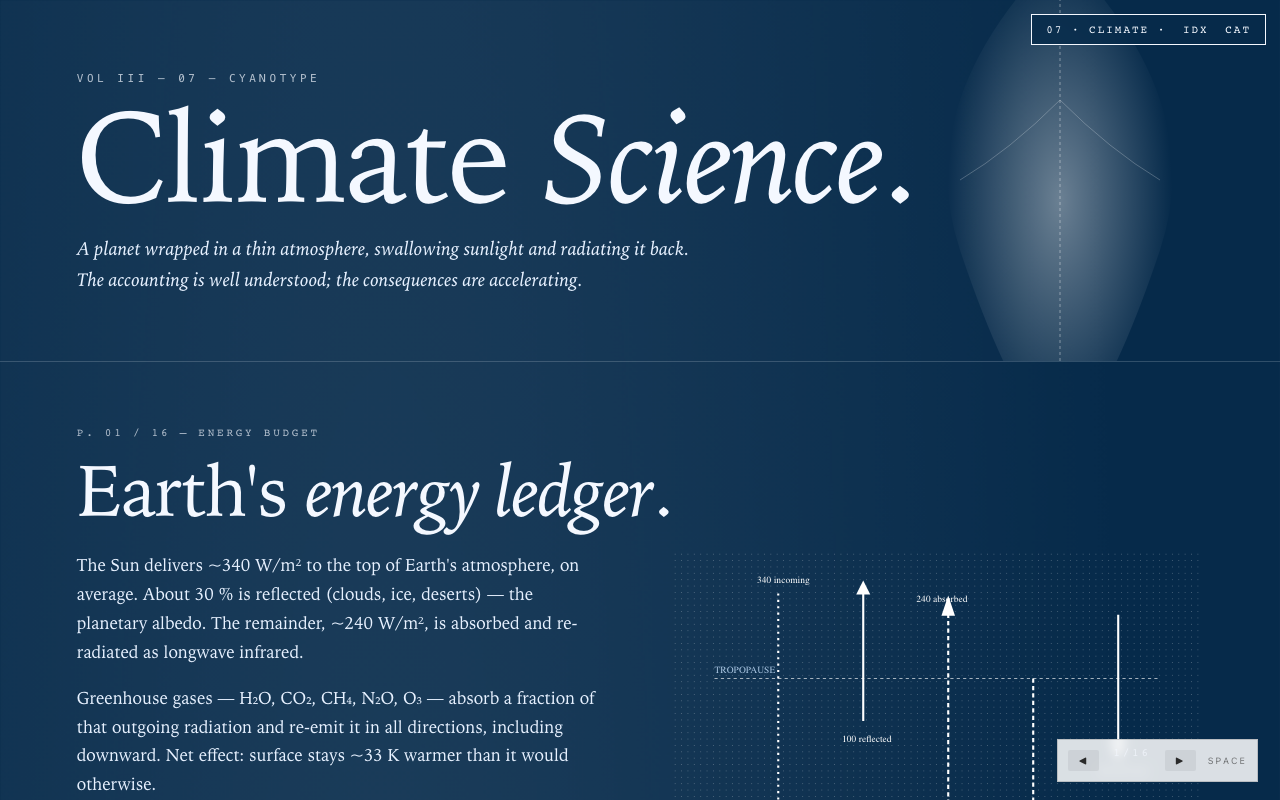
What we know, how we know it, and where we're heading. A 13-slide synthesis of paleoclimate records, attribution science, and the road ahead.

StandaloneDownload
Sandboxed deck
Open raw

About this HTML presentation

This Shipslides page presents CLIMATE / Earth's thermostat in motion as an interactive HTML presentation deck in the Science catalog with 13 slides. The share page keeps the uploaded deck sandboxed while exposing readable context, topics, and a slide outline for viewers and search engines.

What we know, how we know it, and where we're heading. A 13-slide synthesis of paleoclimate records, attribution science, and the road ahead. Key sections include: CLIMATE / Earth's thermostat in motion; The greenhouse effect: certain molecules trap outgoing IR.; The records reach back 800,000 years.; The hockey stick: unmistakable since 1850.; Mauna Loa, since 1958: 280 → 422 ppm.; It's us. The fingerprints are unambiguous.; Doubling CO₂ buys us roughly 3°C of warming.; Tipping points: irreversible on human timescales.; Heat. Sea level. Drought + flood. Ecosystems under stress.; The cost curves already won the technical argument..

Key sections

  • 01CLIMATE / Earth's thermostat in motion
  • 02The greenhouse effect: certain molecules trap outgoing IR.
  • 03The records reach back 800,000 years.
  • 04The hockey stick: unmistakable since 1850.
  • 05Mauna Loa, since 1958: 280 → 422 ppm.
  • 06It's us. The fingerprints are unambiguous.
  • 07Doubling CO₂ buys us roughly 3°C of warming.
  • 08Tipping points: irreversible on human timescales.
  • 09Heat. Sea level. Drought + flood. Ecosystems under stress.
  • 10The cost curves already won the technical argument.
  • 11Some warming is already locked in.
  • 121.5°C is nearly out of reach . 2°C is still defensible.
  • 13Go deeper. Trust the data, follow the work.
Topics covered

Slide outline
  1. 01CLIMATE / Earth's thermostat in motion
  2. 02The greenhouse effect: certain molecules trap outgoing IR.
  3. 03The records reach back 800,000 years.
  4. 04The hockey stick: unmistakable since 1850.
  5. 05Mauna Loa, since 1958: 280 → 422 ppm.
  6. 06It's us. The fingerprints are unambiguous.
  7. 07Doubling CO₂ buys us roughly 3°C of warming.
  8. 08Tipping points: irreversible on human timescales.
  9. 09Heat. Sea level. Drought + flood. Ecosystems under stress.
  10. 10The cost curves already won the technical argument.
  11. 11Some warming is already locked in.
  12. 121.5°C is nearly out of reach . 2°C is still defensible.
  13. 13Go deeper. Trust the data, follow the work.

Page data
Canonical
https://shipslides.com/d/catalog-science-climate
Category
Science
Size
42.9 KB
Updated
2026-05-17
LLM text
https://shipslides.com/d/catalog-science-climate/llms.txt

Presentation Transcript

Detailed slide-by-slide text content extracted from this presentation.

Slide 01

CLIMATE / Earth's thermostat in motion

  • Earth Systems · Lecture Series
  • What we know, how we know it, and where we're heading. A 13-slide synthesis of paleoclimate records, attribution science, and the road ahead.
  • FORCING +3.1 W/m²
  • CO₂ 422 ppm
  • ΔT +1.36°C
  • YEAR 2026
  • 0 ka200 ka400 ka600 ka800 ka
Slide 02

The greenhouse effect: certain molecules trap outgoing IR.

  • 02 · Mechanism
  • Sunlight arrives mostly as visible light. Earth re-radiates heat as long-wave infrared. CO₂, CH₄, water vapor, and N₂O have molecular bond resonances that absorb that IR — and re-emit it in all directions, including back down.
  • CO₂ — long-lived (centuries), fossil-fuel dominated
  • CH₄ — ~80× CO₂'s warming over 20 years, ~12-year lifetime
  • H₂O — feedback amplifier, not a forcing (responds to T)
  • N₂O — agriculture; ~120-year lifetime
  • FIG. 2.1 — Radiative balance
Slide 03

The records reach back 800,000 years.

  • 03 · Paleoclimate
  • We don't need a thermometer. Every glacial cycle is preserved in air bubbles, isotopes, and growth rings — independent archives that converge on the same story.
  • Ice Cores
  • EPICA Dome C (Antarctica) drilled to bedrock — 800 ka of trapped air. Vostok confirms. δ¹⁸O gives temperature; bubbles give CO₂ directly.
  • Tree Rings
  • Dendrochronology resolves year-by-year temperature back ~12,000 years for some regions. Width and density encode growing-season warmth.
  • Ocean Sediment
  • Foraminifera shells in seafloor cores extend the record to tens of millions of years. Mg/Ca and δ¹⁸O reconstruct deep ocean T.
  • ArchiveReachResolutionProxy
  • Ice cores800 kaannual–decadalδD, δ¹⁸O, CO₂
  • Tree rings~12 kaannualwidth, density
  • Speleothems~500 kaannual–decadalδ¹⁸O, U/Th dating
  • Foraminifera~70 Macentennial+δ¹⁸O, Mg/Ca
Slide 04

The hockey stick: unmistakable since 1850.

  • 04 · Instrumental Record
  • Reconstructions disagree on tenths of a degree before 1850. They all agree on what came after: a sharp, sustained departure from any prior 2,000-year baseline.
  • 10 hottest years on record: all since 2014
  • 2024 ΔT vs 1850–1900: +1.55°C
  • Land warms ~2× ocean; Arctic ~4× global
  • Independent datasets (HadCRUT, GISS, Berkeley, NOAA, JMA) all agree
  • FIG. 4.1 — Global Temperature Anomaly (°C, 1850–2025)
Slide 05

Mauna Loa, since 1958: 280 → 422 ppm.

  • 05 · The Keeling Curve
  • Charles David Keeling started measuring atmospheric CO₂ in 1958. Same instrument site, same calibration. The curve has not stopped rising for a single year.
  • Pre-industrial: ~280 ppm (stable for 10,000 years)
  • 1958 (Keeling start): 315 ppm
  • 2026: ~422 ppm — 50% above natural baseline
  • Annual oscillation: ~6 ppm — Northern Hemisphere "breathing"
  • No paleoclimate record shows CO₂ rising this fast. Even at the PETM (56 Mya), the increase took thousands of years.
  • FIG. 5.1 — Atmospheric CO₂ at Mauna Loa (ppm)
Slide 06

It's us. The fingerprints are unambiguous.

  • 06 · Attribution
  • A warming Sun would heat the whole atmosphere. Greenhouse warming has a specific signature: it warms the lower atmosphere while cooling the stratosphere. That's exactly what we observe.
  • Stratospheric Cooling
  • The stratosphere has cooled ~1°C since 1980. A brighter Sun would warm it. Only enhanced GHG greenhouse forcing produces this pattern — and the magnitude matches models.
  • Polar Amplification
  • Arctic warming is ~4× global average. Predicted by physics (ice-albedo feedback, Planck term) decades before measurement. Antarctica lags due to deep ocean heat sink.
  • Isotopic Signature
  • Fossil-fuel CO₂ is depleted in ¹⁴C (it's ancient) and ¹³C. Atmospheric ¹³C/¹²C ratio has dropped exactly as expected. The new CO₂ is provably from coal, oil, gas.
  • Nights & Winters Warm Faster
  • If the Sun were the cause, days would warm more than nights. They don't. Nights warm faster because GHG insulation acts strongest when there's no incoming sunlight.
Slide 07

Doubling CO₂ buys us roughly 3°C of warming.

  • 07 · Equilibrium Climate Sensitivity
  • "Climate sensitivity" is the field's central number: how much does Earth warm at equilibrium for each doubling of atmospheric CO₂? After 50 years of refinement across paleo, models, and observations, the answer has stayed remarkably stable.
  • IPCC AR6 best estimate: 3°C per CO₂ doubling
  • Likely range: 2.5–4°C (66% confidence)
  • Bare CO₂ effect (no feedbacks): only ~1.1°C
  • The other ~2°C: water vapor, ice, clouds, lapse rate
  • 3.0°C / 2×CO₂
  • Scenario2100 CO₂ΔT
  • SSP1-1.9 (best)~400 ppm+1.4°C
  • SSP2-4.5 (mid)~600 ppm+2.7°C
  • SSP3-7.0~800 ppm+3.6°C
  • SSP5-8.5 (worst)~1100 ppm+4.4°C
Slide 08

Tipping points: irreversible on human timescales.

  • 08 · Nonlinearity
  • Most warming is gradual and reversible. Some is not. Several Earth subsystems can flip into a new state and stay there for centuries — millennia — even if we eventually pull CO₂ back down.
  • Greenland Ice
  • Threshold: ~1.5–3°C. Once crossed, melt becomes self-sustaining via altitude feedback. Commit: ~7m sea level rise.
  • West Antarctic
  • Marine ice-sheet instability may already be triggered for parts of WAIS. Commit: ~3m sea level over centuries.
  • AMOC
  • Atlantic overturning has slowed ~15% since 1950. Full collapse would freeze NW Europe, shift monsoons, raise NE-US sea level.
  • Amazon Dieback
  • ~17% deforested, ~3.5°C local warming → savannification cascade. Forest becomes net carbon source.
  • Permafrost C
  • ~1,500 Gt carbon frozen — 2× atmosphere. Warming releases CO₂ + CH₄ as a self-amplifying loop.
  • Boreal Forests
  • Northern shift; insect outbreaks; megafires. Carbon sink → carbon source already in some regions.
  • Coral Reefs
  • ~99% loss expected at 2°C. Mostly gone already at 1.5°C. Functional collapse this century.
  • Monsoons
  • West African and South Asian systems sensitive to aerosol/GHG balance. Shifts disrupt billions.
Slide 09

Heat. Sea level. Drought + flood. Ecosystems under stress.

  • 09 · Impacts (Observed + Projected)
  • A warmer atmosphere holds more water (~7% per °C — Clausius-Clapeyron). Wets gets wetter, dries get drier, and the swing between them sharpens. Heat waves that used to occur once a decade now occur three to five times.
  • Sea level: +22 cm since 1900; accelerating to ~5 mm/yr
  • Heat days {`>`}35°C: 2–3× more frequent at +1.5°C
  • Wildfire season: longer by ~20% globally since 1979
  • Climate-displaced people 2024: ~32 million (IDMC)
  • HEAT
  • Marine heatwaves doubled since 1980
  • SEA
  • +22cm; +5mm/yr now
  • FLOOD
  • Precip extremes +13% / °C
  • DROUGHT
  • SW US, Med, Sahel intensifying
  • FIRE
  • Burned area Western US 4× vs 1980s
  • REEFS
  • ~50% lost since 1950
  • CROPS
  • Maize yields −5% per °C tropics
  • HEALTH
  • Heat mortality, vector range shifts
Slide 10

The cost curves already won the technical argument.

  • 10 · Mitigation
  • In 2010, solar PV cost $0.30/kWh. In 2026, it's under $0.03/kWh — a 90% drop, ahead of every forecast. Battery storage followed. Wind too. The remaining problem is deployment speed and grid integration, not invention.
  • Technology2010 LCOE2026 LCOEΔ
  • Utility solar PV$0.378/kWh$0.029/kWh−92%
  • Onshore wind$0.099/kWh$0.033/kWh−67%
  • Offshore wind$0.188/kWh$0.075/kWh−60%
  • Li-ion storage$1191/kWh pack$95/kWh pack−92%
  • EV battery~$1100/kWh~$110/kWh−90%
  • Electrify Everything
  • Heat, transport, industry. ~50% of fossil use disappears as electricity decarbonizes.
  • Hard Sectors
  • Cement, steel, aviation, shipping — need H₂, biofuels, CCS, or substitutes. Solvable, expensive.
  • Carbon Removal
  • DAC + bio + enhanced weathering. Currently ~Mt scale; needs Gt by 2050. Expensive insurance, not a substitute.
Slide 11

Some warming is already locked in.

  • 11 · Adaptation
  • Even on the most aggressive mitigation path, ~1.5°C is essentially baked in by inertia. The question for cities, water systems, agriculture, and insurers is no longer "if" but "how fast."
  • Cities
  • Cool roofs, urban canopy, permeable surfaces, district cooling. Phoenix, Singapore, Medellín are showing the playbook. Heat-island effect can add another +5°C locally.
  • Water
  • Storage diversification, leak reduction, desalination where viable, water-trading markets. Cape Town's Day Zero a preview, not an exception.
  • Crops + Land
  • Drought-tolerant cultivars, shifting plant zones north + uphill, regenerative practices, irrigation efficiency. Yield gaps still large in many regions.
  • Insurance
  • Markets retreating from FL, CA wildfire zones, Gulf Coast. Repricing forces relocation faster than policy. Watch this space — it's the leading indicator.
  • Adaptation does not substitute for mitigation. It buys time and reduces suffering at any given level of warming — but the cost rises non-linearly with each fraction of a degree.
Slide 12

1.5°C is nearly out of reach. 2°C is still defensible.

  • 12 · The Honest Assessment
  • Pretending 1.5°C is still alive doesn't help. The carbon budget at 50% probability was ~500 GtCO₂ in 2020. We've spent over half. At ~40 Gt/yr emissions, the math is unforgiving.
  • The Bad News
  • Without dramatic acceleration, we'll cross 1.5°C in the early 2030s. Overshoot is now the planning baseline for most credible scenarios. Some impacts (coral, low atolls, glaciers) are committed.
  • The Good News
  • Emissions per dollar of GDP are falling. China's emissions may have peaked. Coal is in structural decline. EVs are eating ICE share. Renewables now dominate new generation. The slope is bending — just not fast enough yet.
  • Outcome2100 ΔTPlausibility 2026
  • 1.5°C, no overshoot+1.5°Cvery unlikely
  • 1.5°C with overshoot+1.6–1.8°C peakplausible w/ CDR
  • 2°C+1.9–2.1°Cdefensible
  • Current policies+2.5–3.0°Ctracking here
Slide 13

Go deeper. Trust the data, follow the work.

  • 13 · Further Reading
  • The science is mature, the data is open, and the explanations are abundant. Below: primary sources, syntheses, and accessible explainers.
  • Primary
  • Synthesis
  • Video
  • IPCC · AR6 SynthesisThe full assessment, every working group
  • NOAA · Mauna Loa CO₂Live Keeling Curve data
  • NASA · Global Climate ChangeVital signs, indicators, evidence
  • Berkeley EarthIndependent temperature reconstruction
  • Carbon BriefBest in-depth climate journalism
  • Our World in DataEmissions, energy, every dataset
  • YouTube · SearchClimate change explained — IPCC
  • YouTube · SearchThe Keeling Curve — CO₂ history
  • "The stone age didn't end because we ran out of stones." — Sheikh Yamani.
  • The fossil age won't end because we run out of fossils, either.
  • END 13 / 13
  • SOURCES IPCC AR6 · NOAA · NASA · Berkeley · IEA · IRENA
Remove this deck