Science Slides
A curated collection of interactive HTML presentation decks, slide outlines, and topics covering Science.
Popular presentations about Science
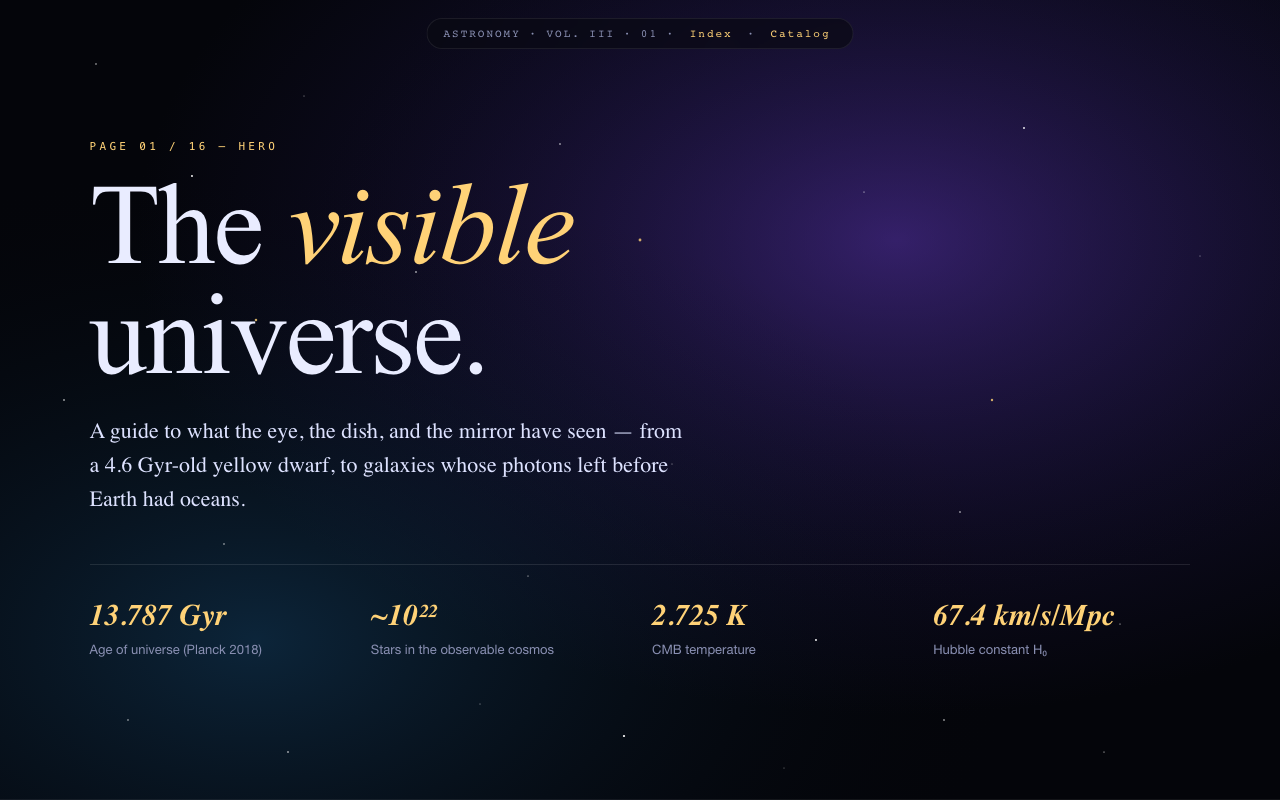
Astronomy
A guide to what the eye, the dish, and the mirror have seen — from a 4.6 Gyr-old yellow dwarf, to galaxies whose photons left before Earth had oceans.
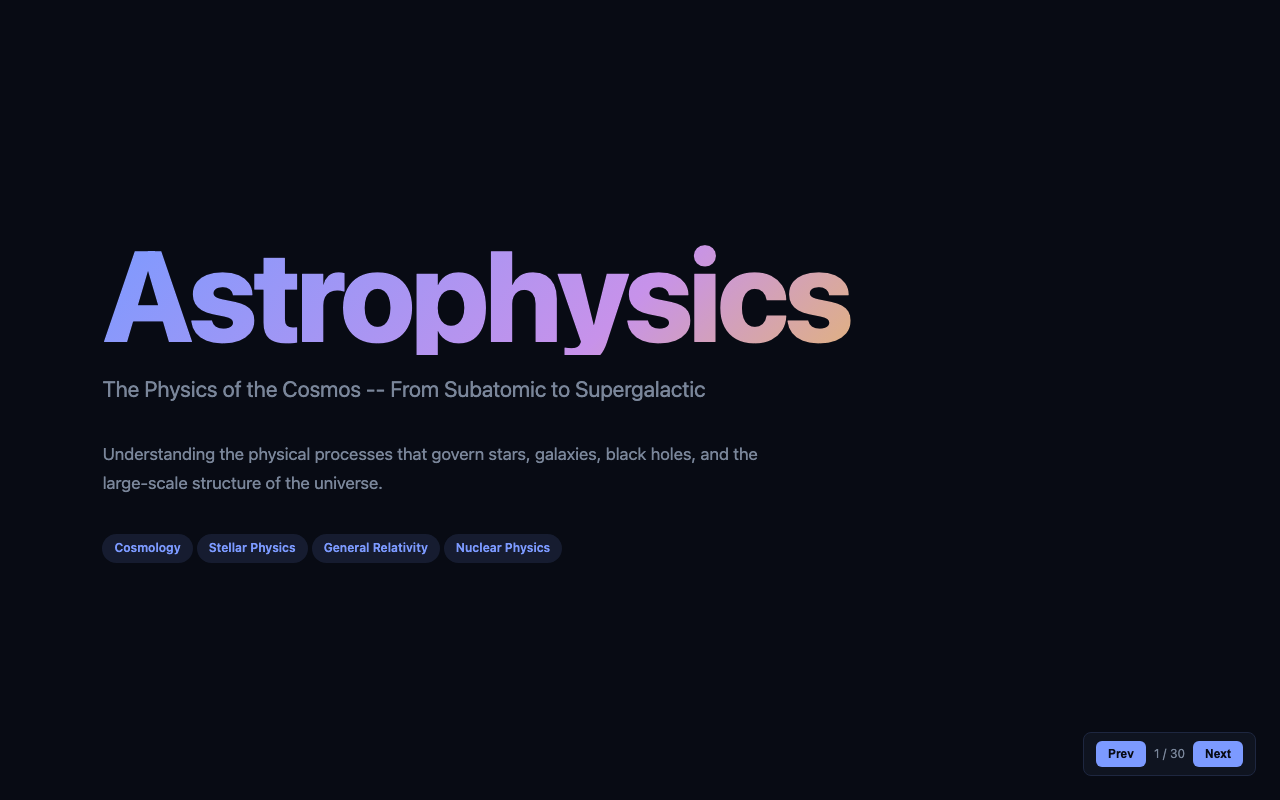
Astrophysics
The Physics of the Cosmos -- From Subatomic to Supergalactic
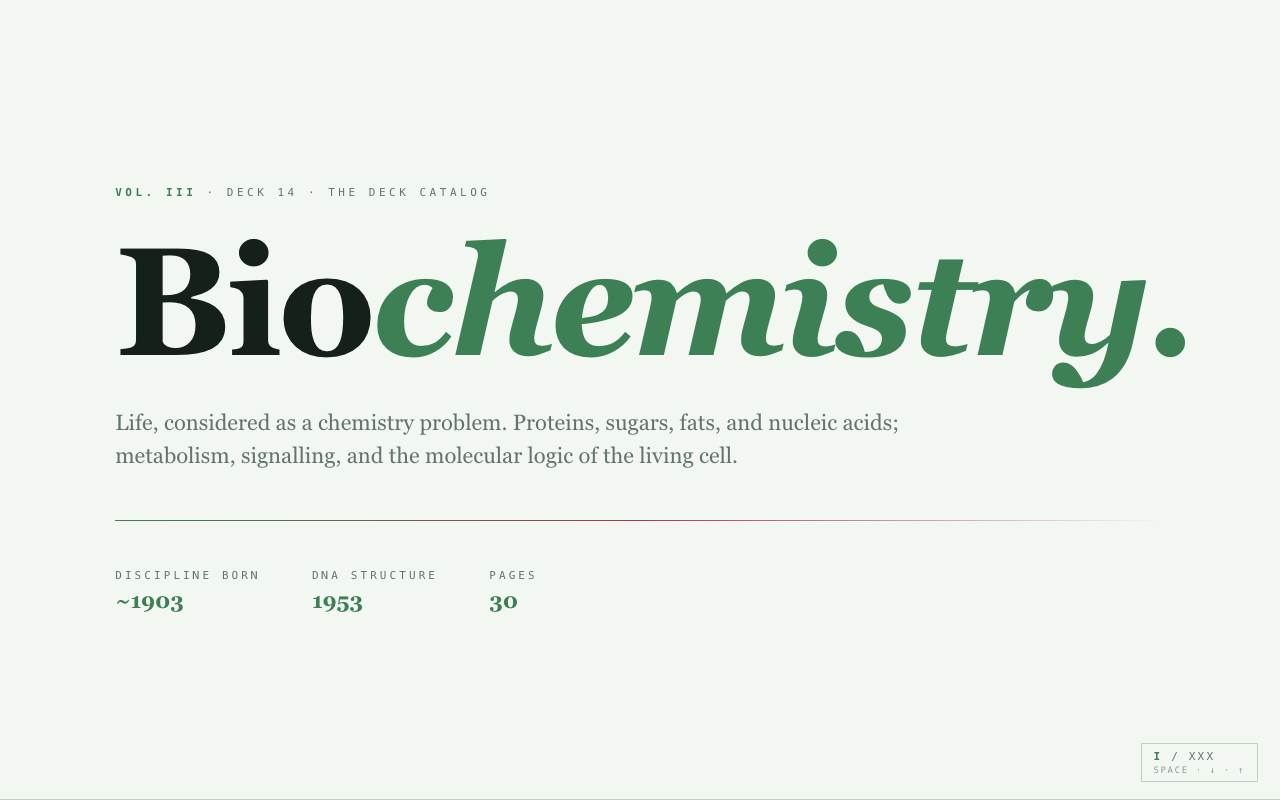
Biochemistry
Cells are wet bags of organic chemistry. Biochemistry is the study of those reactions — what molecules, organised how, doing what. Reductive in method; vast in subject matter.
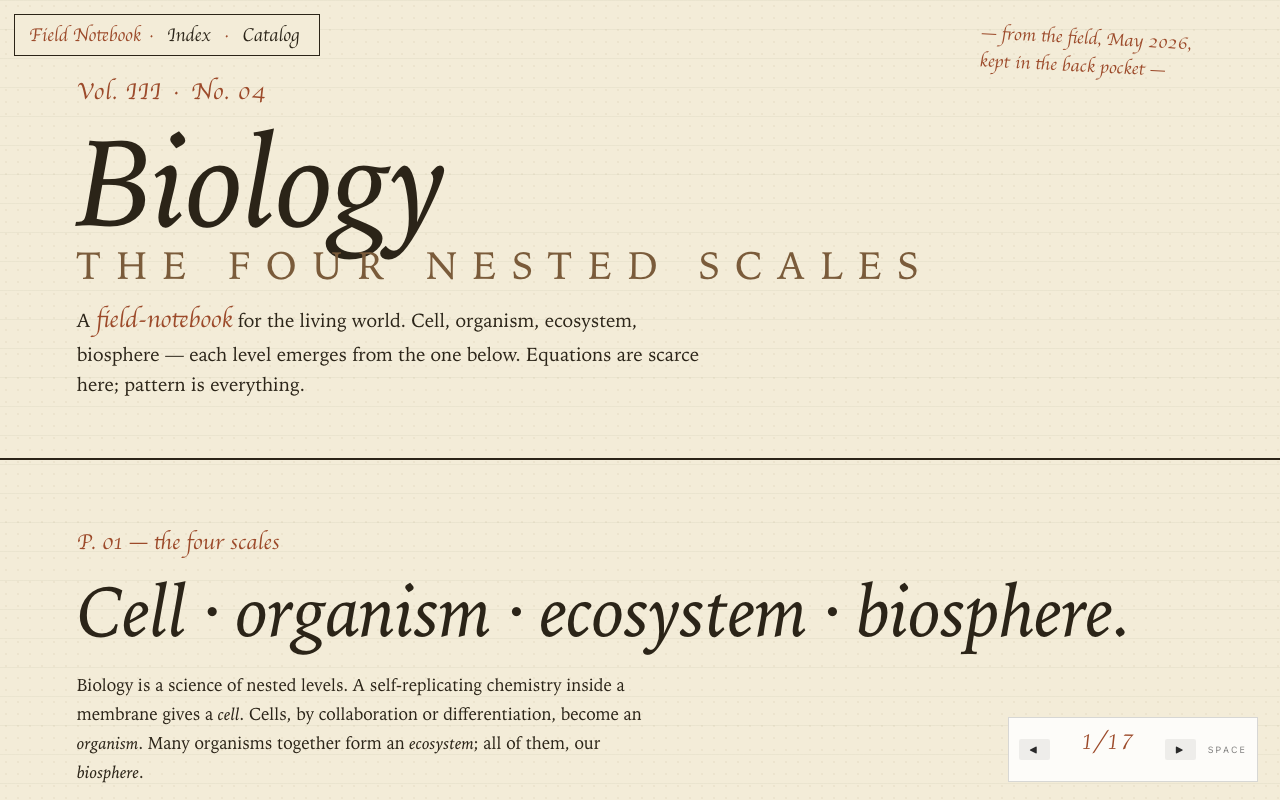
Biology
A field-notebook for the living world. Cell, organism, ecosystem, biosphere — each level emerges from the one below. Equations are scarce here; pattern is everything.
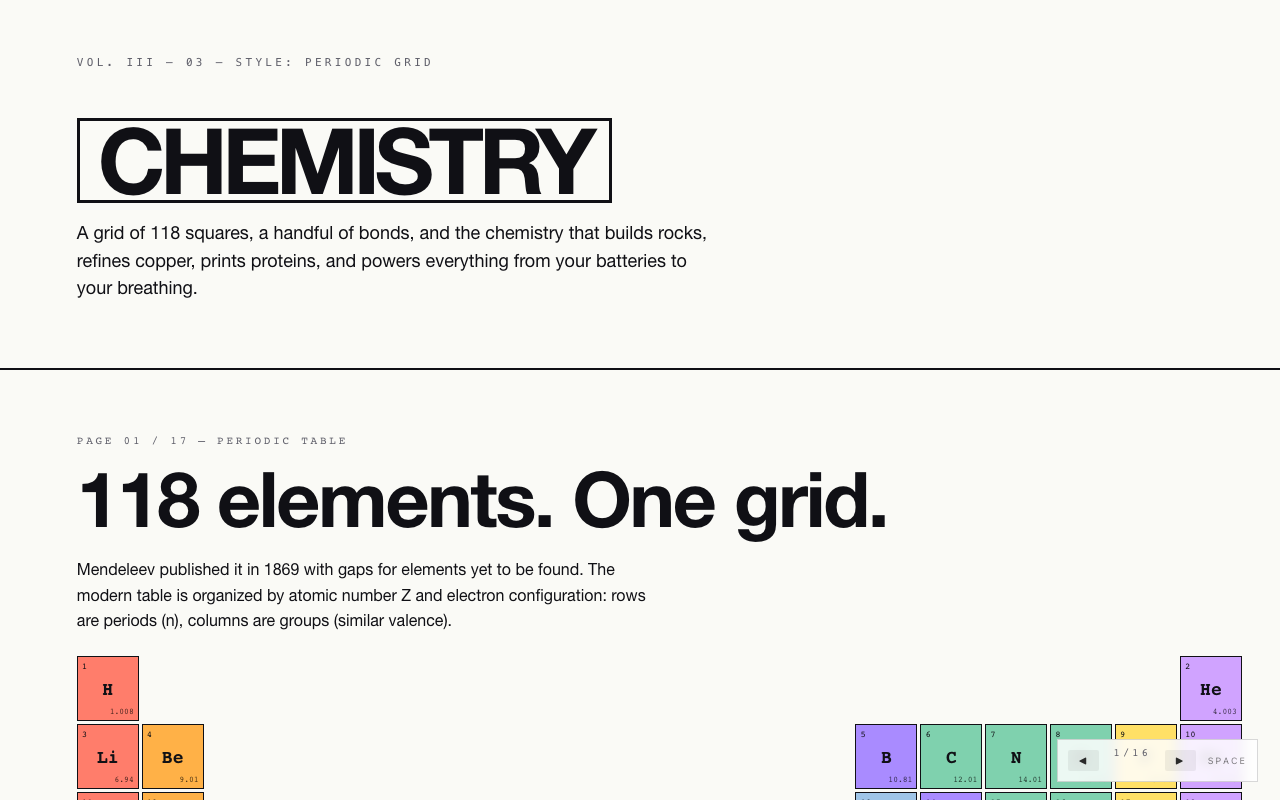
Chemistry
A grid of 118 squares, a handful of bonds, and the chemistry that builds rocks, refines copper, prints proteins, and powers everything from your batteries to your breathing.
Exercise Science
Strength. Endurance. Recovery. Periodization. The physiology and the practice of training a human body to do more than it could yesterday.
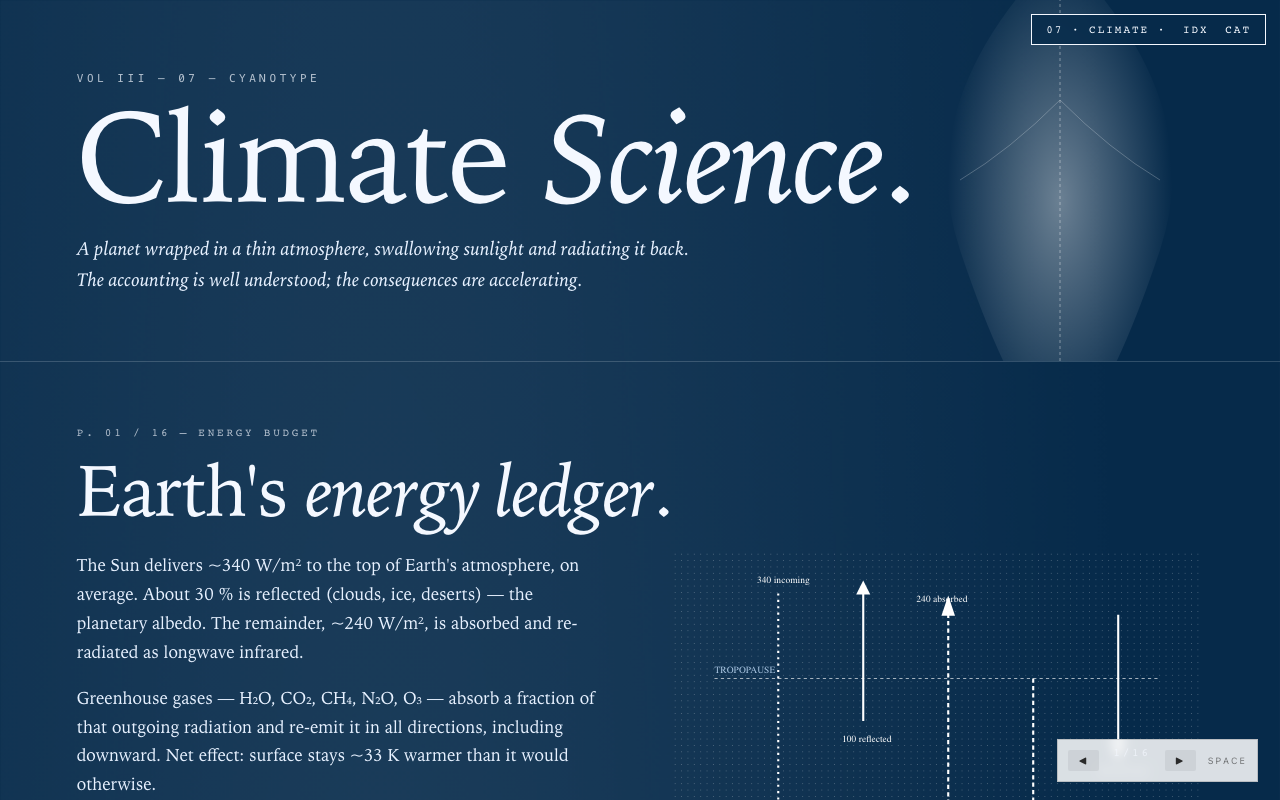
Climate Science
A planet wrapped in a thin atmosphere, swallowing sunlight and radiating it back. The accounting is well understood; the consequences are accelerating.
Ecology
The study of relationships — between organisms, between organisms and their environment, between species and the abiotic conditions that make life possible.
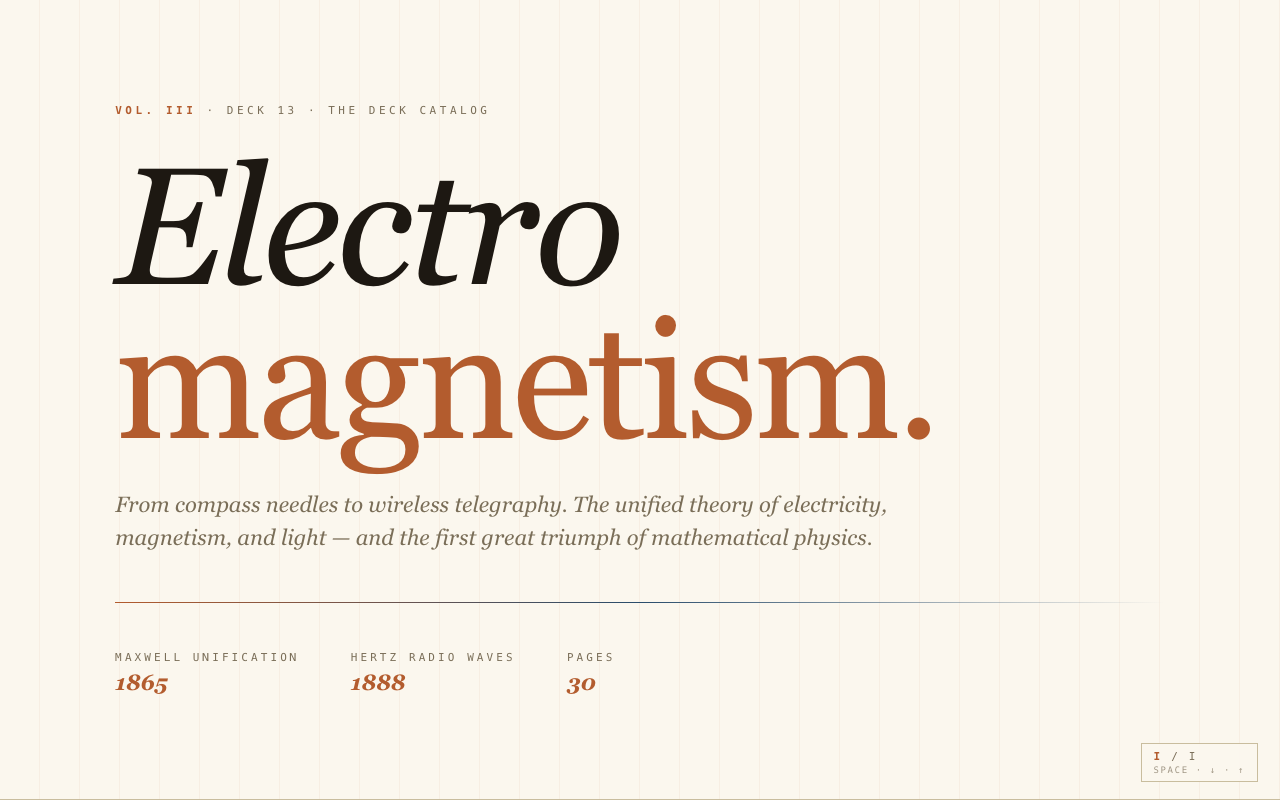
Electromagnetism
Electricity and magnetism look like separate phenomena. They are not. Maxwell's 1865 paper showed they are aspects of one field — and that field's waves travel at exactly the speed of light. Light, then, is electromagnetism.
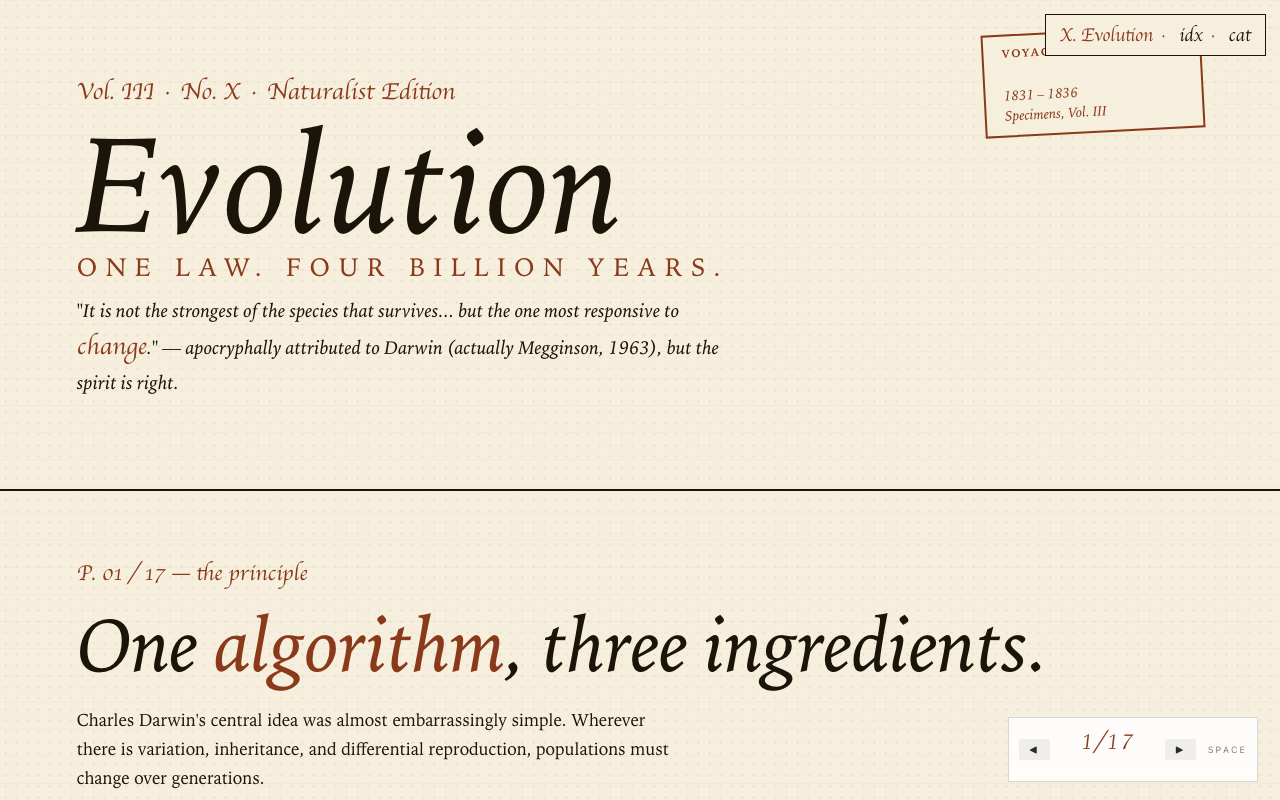
Evolution
"It is not the strongest of the species that survives... but the one most responsive to change ." — apocryphally attributed to Darwin (actually Megginson, 1963), but the spirit is right.
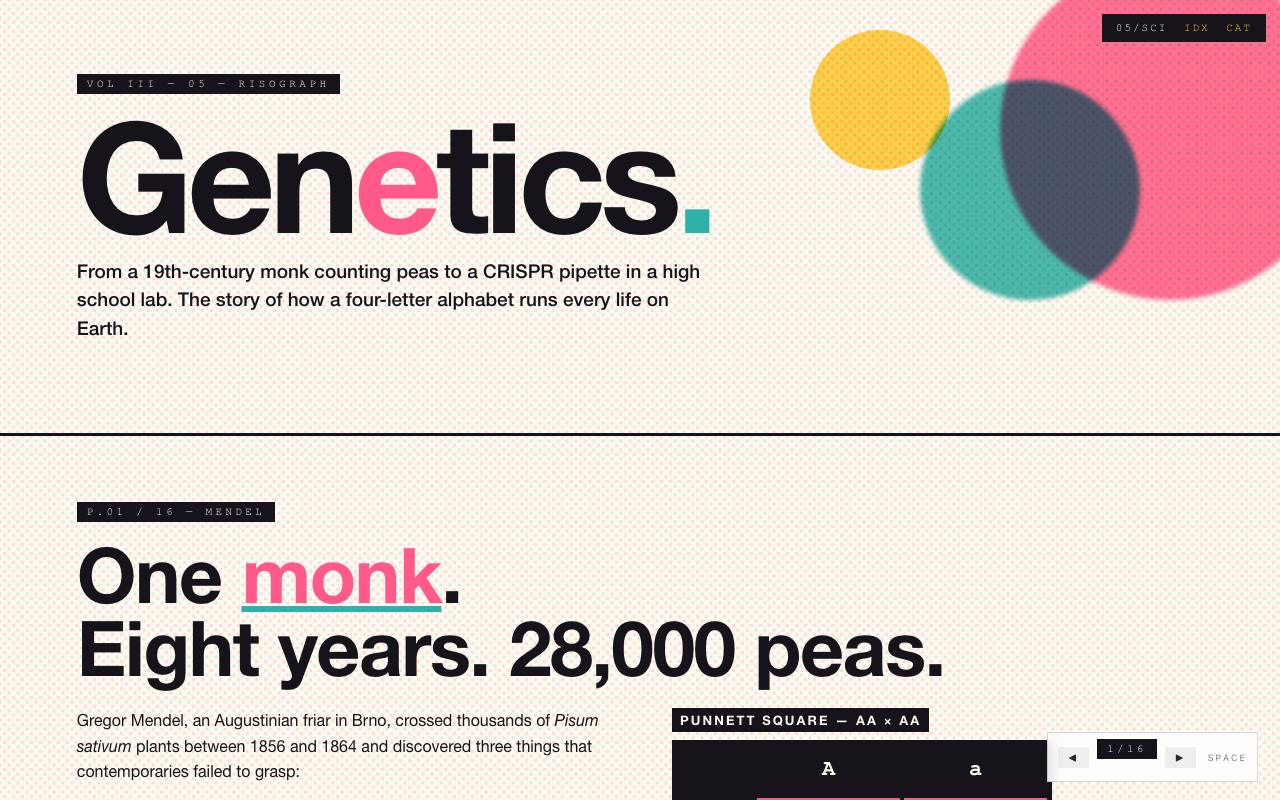
Genetics
From a 19th-century monk counting peas to a CRISPR pipette in a high school lab. The story of how a four-letter alphabet runs every life on Earth.
Genetics and Genomics
From Mendel's Peas to CRISPR -- The Code of Life
Geology
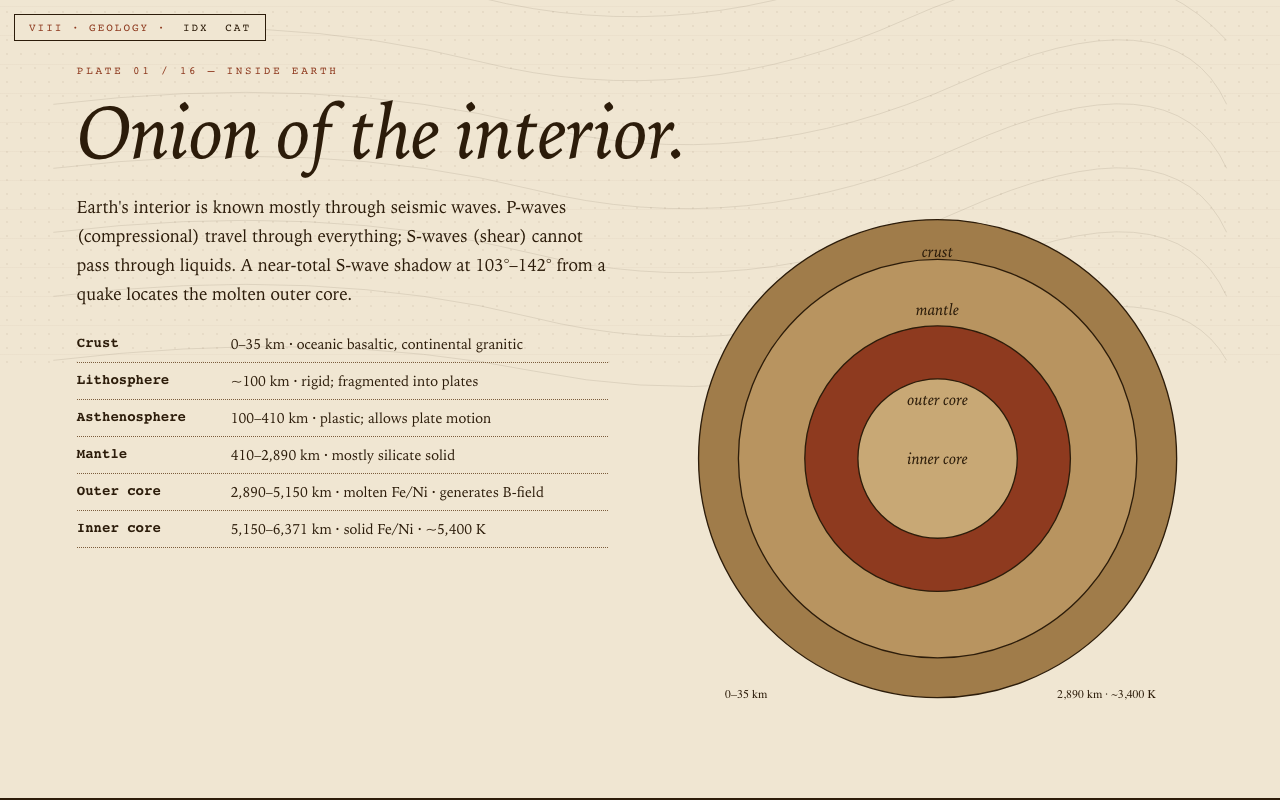
Earth is a layered, slow-cooking heat engine, and the stones at our feet are its receipts. This atlas traces the science of rocks, time, and the moving plates beneath us.
Materials Science
From Ancient Alloys to Metamaterials: The Engineering of Matter
Mathematics
"The mathematician does not study pure mathematics because it is useful; he studies it because he delights in it..." — Henri Poincaré, 1908
Philosophy of Science
A second-order discipline. Philosophy of science does not do science; it studies what scientists do, what they should do, and why we are entitled to believe them.
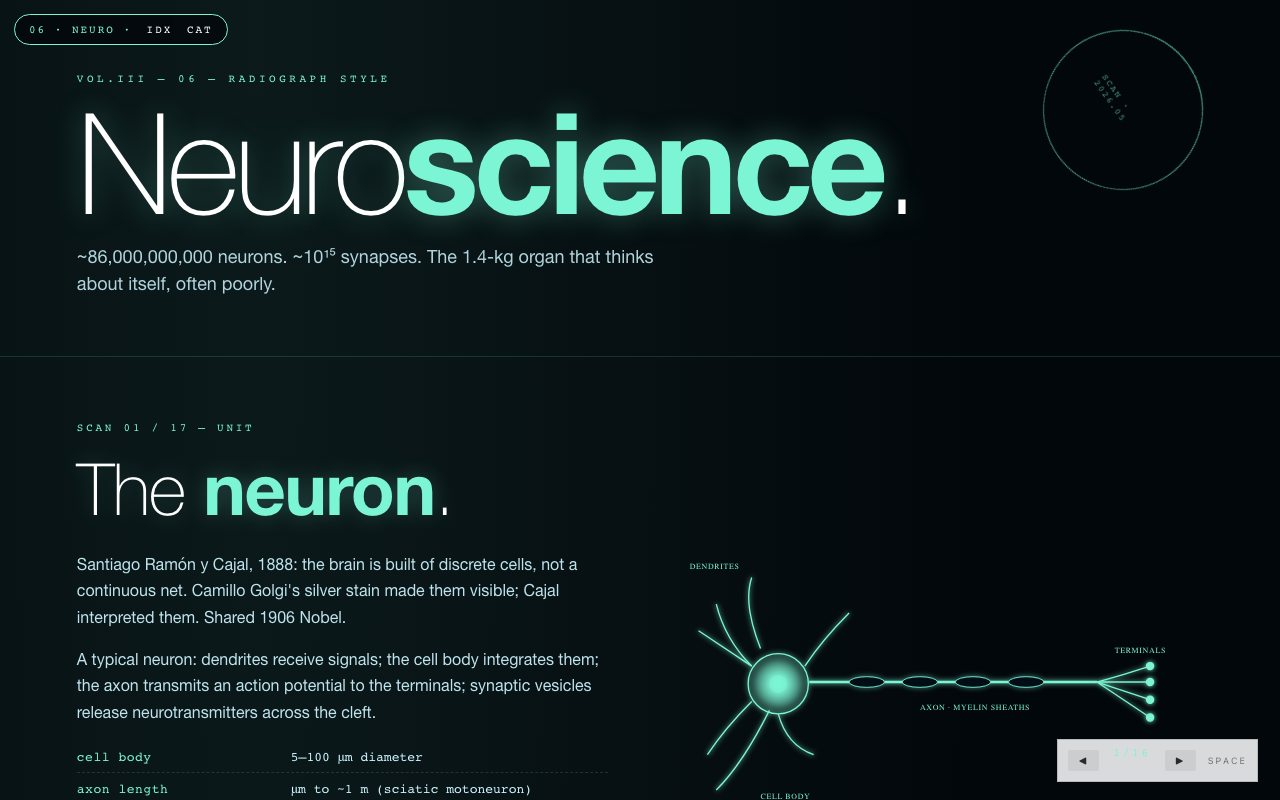
Neuroscience
~86,000,000,000 neurons. ~10¹⁵ synapses. The 1.4-kg organ that thinks about itself, often poorly.
Nutrition Science: Fueling the Human Body
From macronutrients to microbiome, from ancient dietary wisdom to modern metabolomics -- the science of how food sustains, heals, and transforms the human body.
Oceanography
Exploring Earth's Last Frontier: The Science of Our Oceans
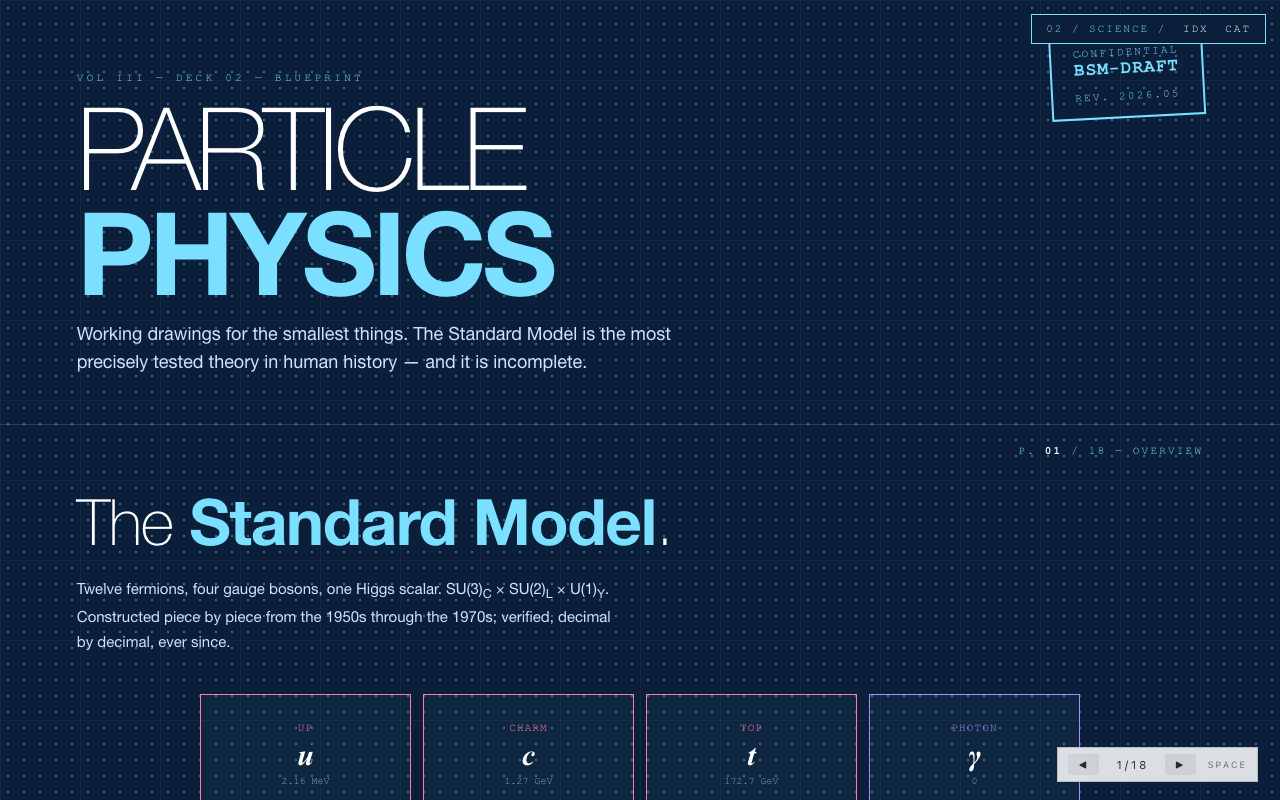
Particle Physics
The Standard Model and the Fundamental Building Blocks of the Universe
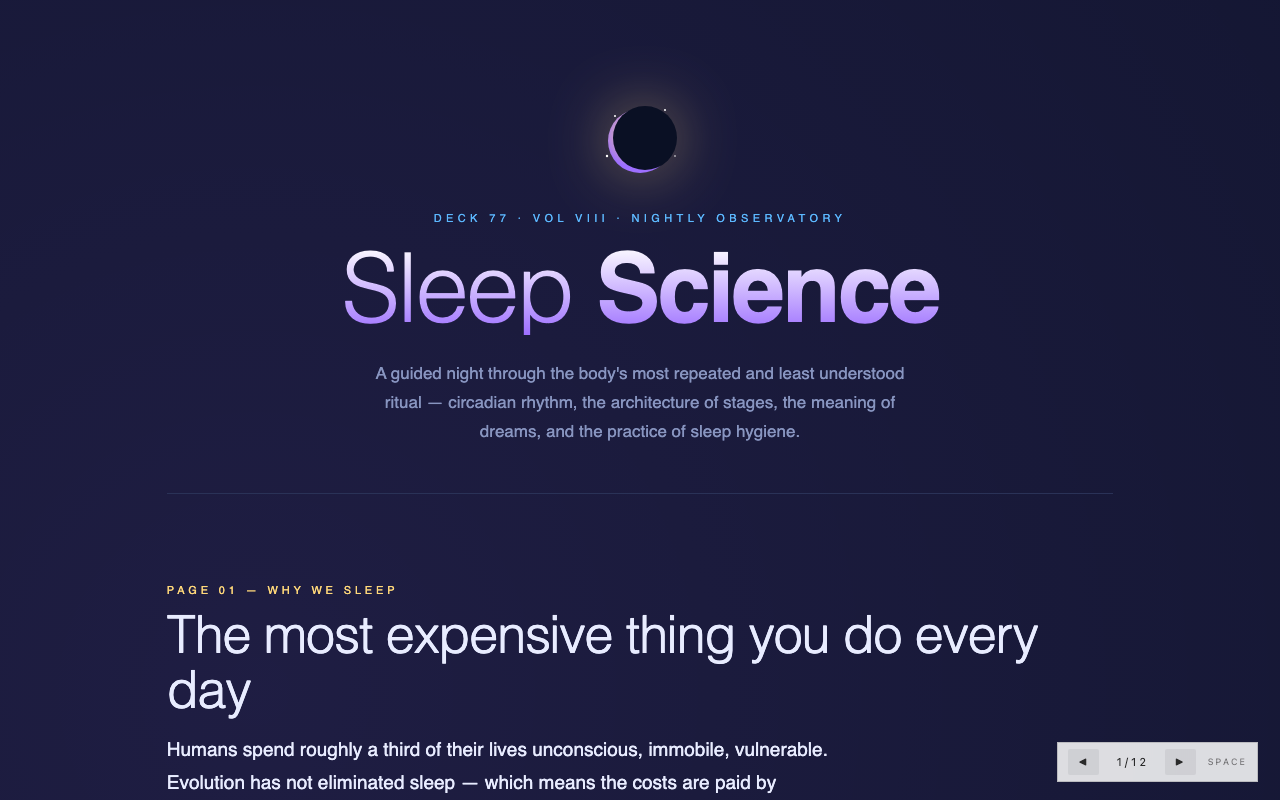
The Science of Sleep
We spend one-third of our lives asleep. Far from passive, sleep is a dynamic, critical biological process that consolidates memory, repairs tissue, regulates hormones, and defends against disease.
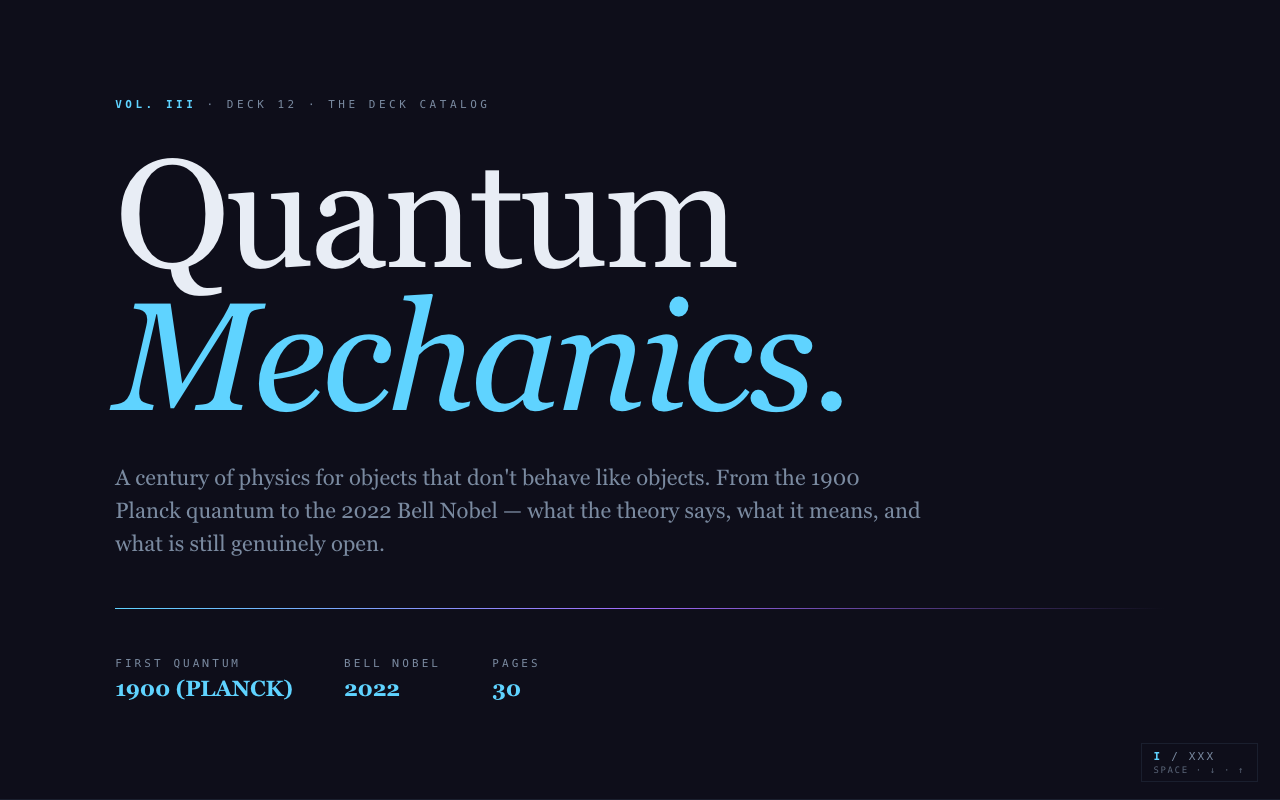
Quantum Mechanics
The Theory of the Very Small -- Where Intuition Fails and Mathematics Prevails
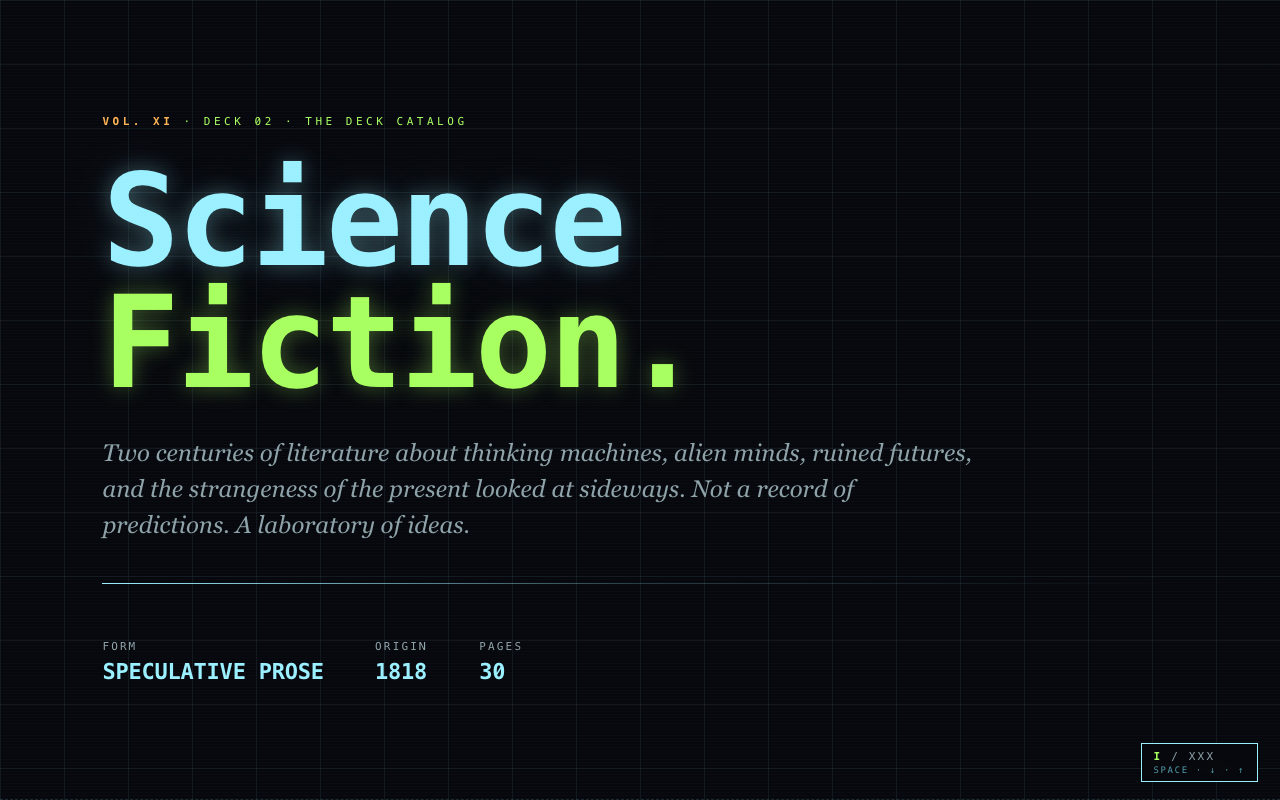
Science Fiction
Science fiction is the literature that takes one premise its world does not allow — a different physics, a different history, a different species — and follows the consequences with a straight face.
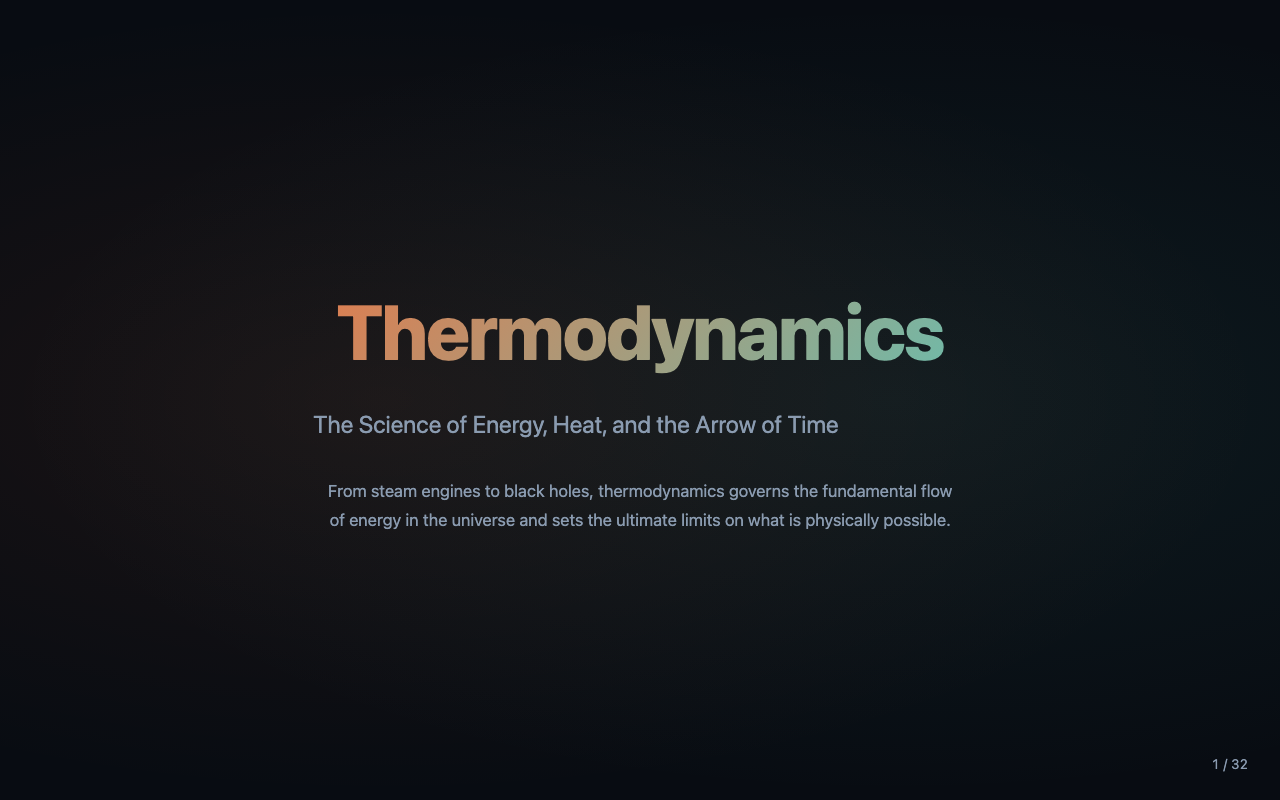
Thermodynamics
The Science of Energy, Heat, and the Arrow of Time
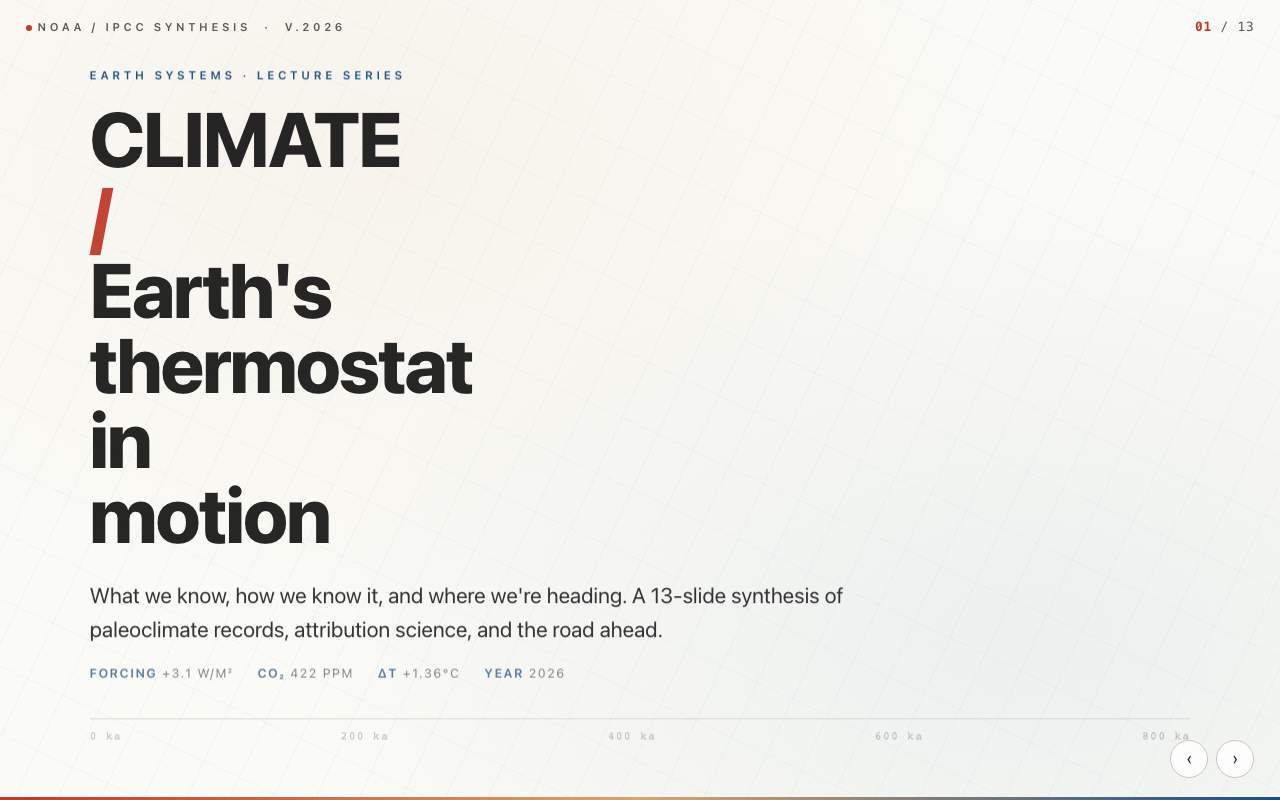
CLIMATE / Earth's thermostat in motion
What we know, how we know it, and where we're heading. A 13-slide synthesis of paleoclimate records, attribution science, and the road ahead.
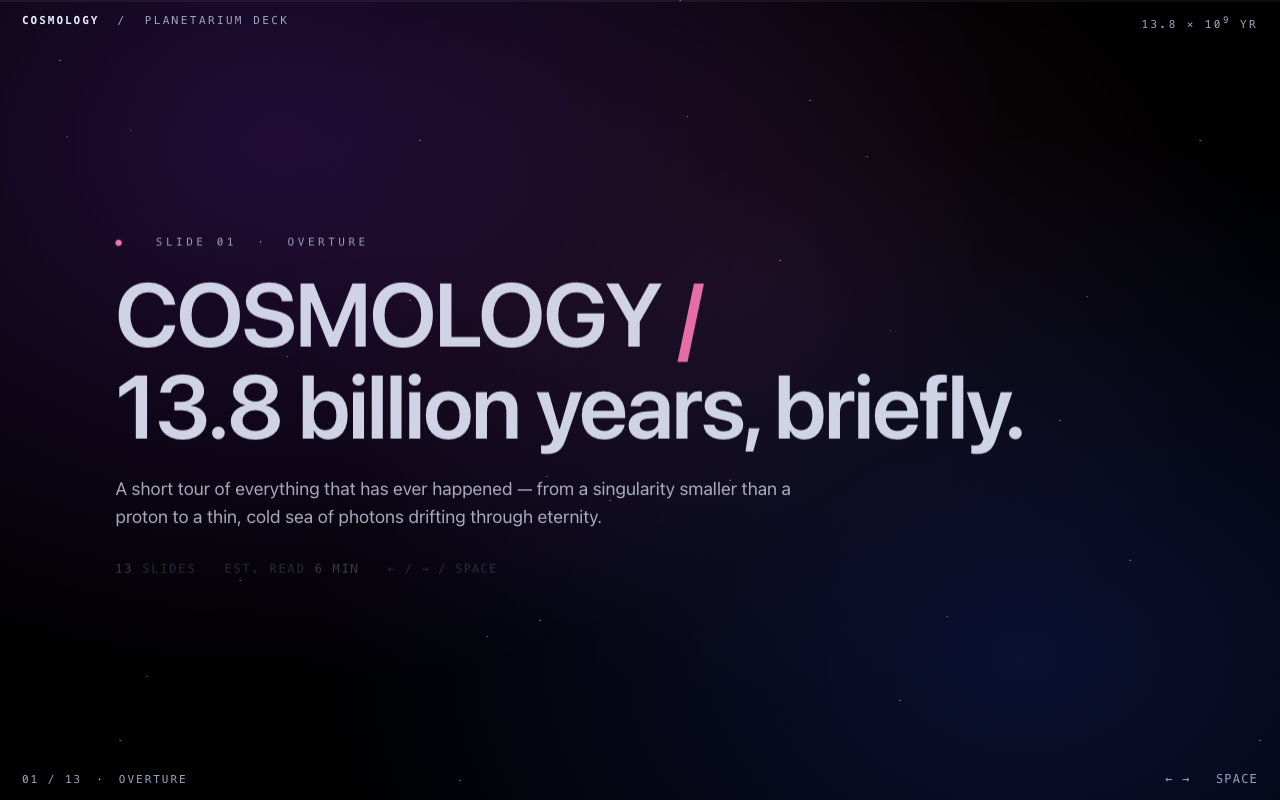
Cosmology / 13.8 billion years, briefly
A short tour of everything that has ever happened — from a singularity smaller than a proton to a thin, cold sea of photons drifting through eternity.
Ecology / Webs of Dependence
— A FIELD GUIDE, PLATE I — ECOLOGY Webs of Dependence Thirteen Plates · on Living Systems Plate II Levels of Organization from a single being to the living Earth organism A single living individual — one oak, one robin, one hyphal strand of fungus. population All members of one species inhabiting a defined place at a defined time. community All populations interacting in the same locality — predators, prey...
On the Origin of Species — A Field Notebook
evolution by natural selection
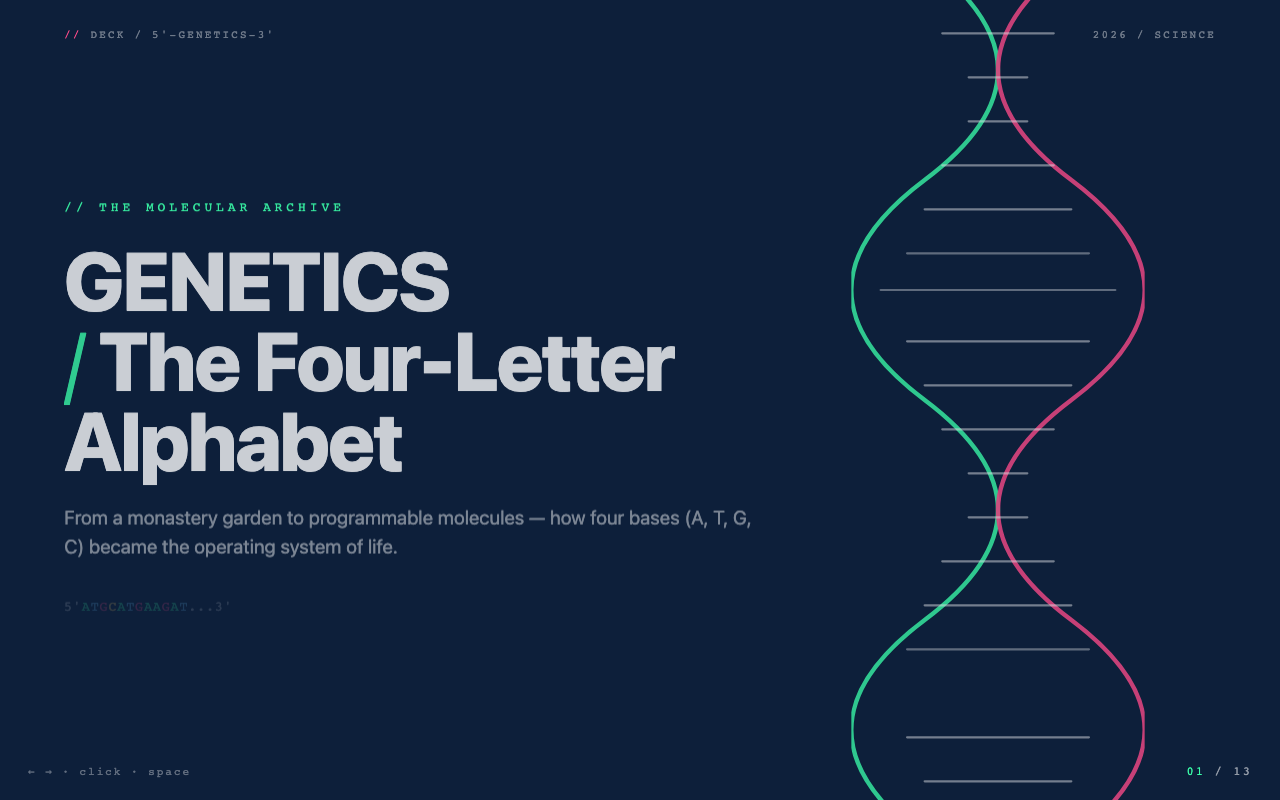
Genetics & DNA — Mendel to CRISPR
DECK / 5'-GENETICS-3' 2026 / SCIENCE // THE MOLECULAR ARCHIVE GENETICS / The Four-Letter Alphabet From a monastery garden to programmable molecules — how four bases (A, T, G, C) became the operating system of life.
Neuroscience / 86 billion cells, talking
Brain, mind, cognition — a clinical tour of the most complex object known to science.
Particle Physics — The Zoo of Fundamental Things
CERN · A Field Guide · No. 13 Particle Physics / The zoo of fundamental things From Thomson's electron to the Higgs — a hundred and twenty-five years of finding pieces of matter that refused to break further.
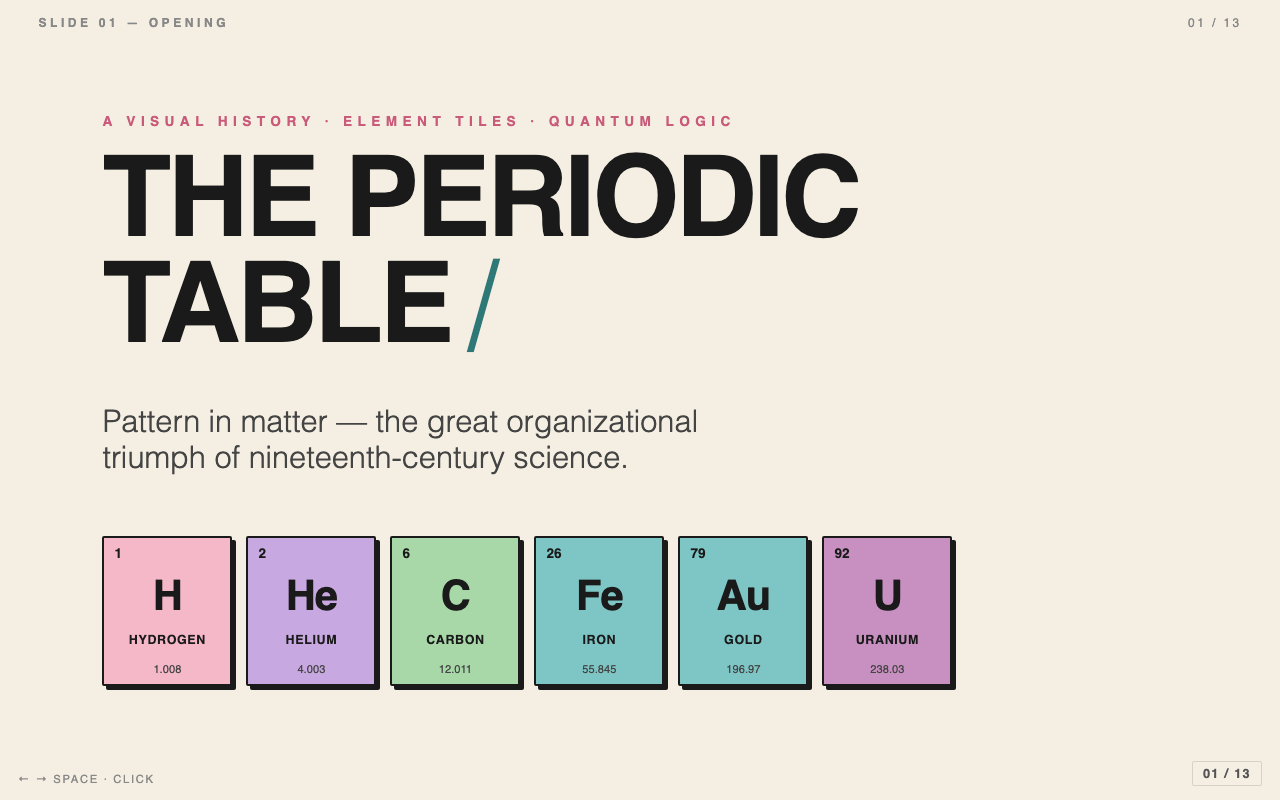
The Periodic Table — Pattern in Matter
For most of history, "elements" meant earth, water, fire, air. The chemical revolution gave that scheme a final shove — and three thinkers laid the groundwork.
Plate Tectonics — Field Guide
Alfred Wegener, a German meteorologist, noticed that the coastlines of South America and Africa fit like puzzle pieces. Matching fossils, glacial deposits, and rock formations on opposite Atlantic shores convinced him: continents move .
Quantum Physics — A Notebook
Quantum Physics — A Notebook — from Planck (1900) to Entanglement