shipslides
Science14 slides0 views

Particle Physics — The Zoo of Fundamental Things

CERN · A Field Guide · No. 13 Particle Physics / The zoo of fundamental things From Thomson's electron to the Higgs — a hundred and twenty-five years of...

StandaloneDownload
Sandboxed deck
Open raw

About this HTML presentation

This Shipslides page presents Particle Physics — The Zoo of Fundamental Things as an interactive HTML presentation deck in the Science catalog with 14 slides. The share page keeps the uploaded deck sandboxed while exposing readable context, topics, and a slide outline for viewers and search engines.

CERN · A Field Guide · No. 13 Particle Physics / The zoo of fundamental things From Thomson's electron to the Higgs — a hundred and twenty-five years of finding pieces of matter that refused to break further. Key sections include: Particle Physics /; The zoo of fundamental things; Before the Standard Model; Four ways things push; Fermions vs Bosons; The quark model; The other half of matter; The Standard Model; W and Z bosons; The Higgs boson.

Key sections

  • 01Particle Physics /
  • 02The zoo of fundamental things
  • 03Before the Standard Model
  • 04Four ways things push
  • 05Fermions vs Bosons
  • 06The quark model
  • 07The other half of matter
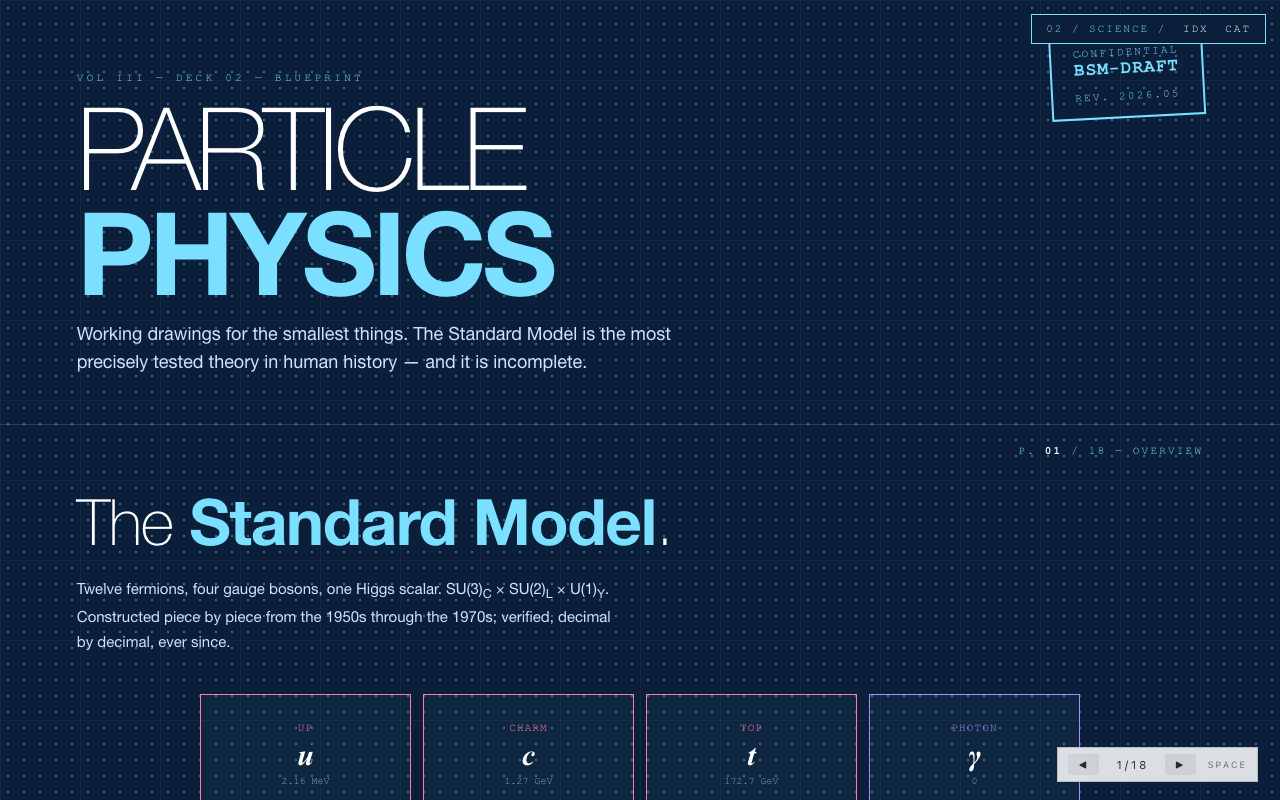
  • 08The Standard Model
  • 09W and Z bosons
  • 10The Higgs boson
  • 11What the Standard Model doesn't explain
  • 12Where the work happens
  • 13Unresolved · 2026
  • 14Read further · watch further
Slide outline
  1. 01Particle Physics /
  2. 02The zoo of fundamental things
  3. 03Before the Standard Model
  4. 04Four ways things push
  5. 05Fermions vs Bosons
  6. 06The quark model
  7. 07The other half of matter
  8. 08The Standard Model
  9. 09W and Z bosons
  10. 10The Higgs boson
  11. 11What the Standard Model doesn't explain
  12. 12Where the work happens
  13. 13Unresolved · 2026
  14. 14Read further · watch further
Page data
Canonical
https://shipslides.com/d/catalog-science-particle-physics
Category
Science
Size
36.8 KB
Updated
2026-05-17
LLM text
https://shipslides.com/d/catalog-science-particle-physics/llms.txt

Presentation Transcript

Detailed slide-by-slide text content extracted from this presentation.

Slide 01

Particle Physics /

  • CERN · A Field Guide · No. 13
  • The zoo of fundamental things
  • From Thomson's electron to the Higgs — a hundred and twenty-five years of finding pieces of matter that refused to break further.
  • A 13-slide deck · 2026
Slide 02

02 · Pre-history

  • Before the Standard Model
  • 1897
  • J. J. Thomson
  • Cathode-ray experiments at Cambridge reveal a particle ~1/1836 the mass of hydrogen — the electron. The atom is no longer indivisible.
  • 1911
  • Ernest Rutherford
  • Alpha particles fired at gold foil bounce backward. Atoms are mostly empty space with a tiny dense nucleus. Plum-pudding is dead.
  • 1932
  • Chadwick · Anderson
  • The neutron is found. The positron arrives — Dirac's prediction of antimatter is real.
  • 1930s–50s
  • The particle zoo
  • Cosmic-ray cloud chambers and early accelerators produce muons, pions, kaons, lambdas. Dozens of "elementary" particles. Nobody is happy about this.
Slide 03

03 · Forces

  • Four ways things push
  • Strong
  • Gluons bind quarks into protons, neutrons. Confined to ~10-15 m. Strongest, shortest range.
  • Photons. Infinite range. Light, chemistry, electricity, magnetism — all one thing since Maxwell.
  • Weak
  • W±, Z bosons. Beta decay. Massive carriers — that's why it's "weak" and short-range (~10-18 m).
  • Gravity
  • Hypothetical graviton. Infinite range, absurdly weak (10-39 of EM). Not in the Standard Model.
  • The Standard Model unifies the first three. The fourth still refuses to join.
Slide 04

04 · Cast

  • Fermions vs Bosons
  • FERMIONS · spin ½
  • Matter
  • The stuff that makes things. Obey Pauli exclusion — no two in the same quantum state. That's why atoms have shells, why solids are solid.
  • Quarks (build hadrons)
  • Leptons (electrons, neutrinos, ...)
  • BOSONS · integer spin
  • Force-carriers
  • Mediators. Pile up freely in the same state — that's why lasers and superconductors work. They exchange between fermions to make forces happen.
  • Gauge bosons (γ, g, W, Z)
  • Higgs (scalar, spin 0)
Slide 05

05 · 1964

  • The quark model
  • Murray Gell-Mann (and George Zweig, independently) propose: the particle zoo isn't a zoo of elementaries. The hadrons are composite, built from a small set of fractionally-charged constituents.
  • Three flavors at first — u, d, s — later expanded to six. Combinations:
  • Mesons: q q̄ — quark + antiquark (pion, kaon)
  • Baryons: q q q — three quarks (proton, neutron)
  • "Three quarks for Muster Mark." — Joyce, via Gell-Mann.
Slide 06

06 · Leptons

  • The other half of matter
  • Leptons don't feel the strong force. Three charged leptons, three neutrinos — arranged in three generations, each heavier than the last.
  • GENERATION I
  • electron · e⁻
  • Mass 0.511 MeV. Stable. Builds every atom.
  • νe — electron neutrino. Nearly massless.
  • GENERATION II
  • muon · μ⁻
  • Mass 106 MeV. Lifetime 2.2 μs.
  • νμ — muon neutrino.
  • GENERATION III
  • tau · τ⁻
  • Mass 1.78 GeV. Heavier than a proton.
  • ντ — tau neutrino.
  • Rabi on the muon's discovery: "Who ordered that?"
Slide 07

07 · The chart

  • The Standard Model
  • 2.2 MeV
  • CHARM
  • 1.27 GeV
  • TOP
  • 173 GeV
  • PHOTON
  • DOWN
  • 4.7 MeV
  • STRANGE
  • 95 MeV
  • BOTTOM
  • 4.18 GeV
  • GLUON
  • ELECTRON
  • 0.511 MeV
  • MUON
  • 106 MeV
  • TAU
  • 1.78 GeV
  • Z BOSON
  • 91.2 GeV
  • e-NEUTRINO
  • < eV
  • μ-NEUTRINO
  • < eV
  • τ-NEUTRINO
  • < eV
  • HIGGS
  • 125 GeV
  • Quarks (6)
  • Leptons (6)
  • Gauge bosons (4)
  • Higgs (1)
Slide 08

08 · 1983

  • W and Z bosons
  • 1968. Glashow, Weinberg, Salam unify electromagnetism and the weak force into electroweak theory. The theory predicts three new heavy bosons: W⁺, W⁻, Z⁰.
  • 1983. Carlo Rubbia and Simon van der Meer at CERN's Super Proton Synchrotron see them at exactly the predicted masses.
  • W± : 80.4 GeV — charged-current weak decays
  • Z⁰ : 91.2 GeV — neutral-current weak decays
  • Nobel Prize, 1984
  • A theory makes a number. A machine measures the number. They agree to four decimals. That's the Standard Model working.
Slide 09

09 · 2012

  • The Higgs boson
  • The problem
  • Gauge symmetry says W, Z, and fermions should be massless. They aren't. W weighs as much as a silver atom.
  • The 1964 fix
  • Englert · Brout · Higgs propose a scalar field filling all space. Particles drag through it; the drag is mass. The field's quantum is a new boson.
  • The 2012 find
  • ATLAS and CMS at the LHC see a bump at 125 GeV, decaying as the theory predicted. 5σ announced 4 July 2012.
  • What it does
  • Gives mass to W, Z via electroweak symmetry breaking
  • Gives mass to fermions via Yukawa couplings
  • Last missing Standard Model particle
  • Nobel: Englert & Higgs, 2013.
Slide 10

10 · Beyond

  • What the Standard Model doesn't explain
  • Dark matter
  • Galaxies rotate as if there's ~5× more matter than we see. Standard Model has no candidate. WIMPs, axions, sterile neutrinos — none confirmed.
  • Neutrino mass
  • Neutrinos oscillate between flavors — therefore have mass. The Standard Model says they shouldn't. Where does the mass come from? Majorana? See-saw?
  • Hierarchy
  • Why is the Higgs 125 GeV and not 1019 GeV (the Planck scale)? Quantum corrections should drag it up. They don't. Why?
  • Matter–antimatter
  • The Big Bang should have made equal amounts. We see a universe of matter. CP violation in the SM is ~10⁹ too small to explain it.
  • Dark energy
  • The expansion is accelerating. About 68% of the universe is some unknown vacuum-energy-like thing. The SM offers nothing.
  • Gravity
  • Just absent. General relativity is classical; the SM is quantum. They don't combine without infinities.
Slide 11

11 · Machines

  • Where the work happens
  • LHC · CERN
  • 27 km ring under France/Switzerland. Proton-proton at 13.6 TeV. Found the Higgs. Currently Run 3.
  • ATLAS
  • General-purpose detector at LHC. 7000 tonnes, 100M readout channels. One of two that found the Higgs.
  • CMS
  • Compact Muon Solenoid. The other Higgs-discovery detector. Different design, same answer — that's how you cross-check.
  • Fermilab
  • Illinois. Tevatron found the top quark (1995). Now hosts g-2 muon experiments — possible hints of new physics.
  • IceCube
  • A cubic kilometer of Antarctic ice instrumented for neutrinos. First detection of astrophysical neutrinos, 2013.
  • KATRIN · Super-K · DUNE
  • Neutrino mass and oscillation experiments. Patient, precise, low-background. The opposite of a hadron collider in style.
Slide 12

12 · Open

  • Unresolved · 2026
  • Quantum gravity
  • String theory and loop quantum gravity remain mathematically rich, experimentally untested. Energies of 1019 GeV are roughly 1015× beyond the LHC.
  • Supersymmetry
  • Predicted superpartners would solve the hierarchy problem and offer a dark-matter candidate. The LHC has not found them at expected masses. Minimal SUSY is in trouble; weaker variants survive.
  • The next collider
  • Three serious proposals: FCC-ee/hh (CERN, 91 km), CEPC (China, ~100 km), muon collider (Fermilab concept). Decades and tens of billions either way.
  • Anomalies to chase
  • Muon g-2 tension, lepton-flavor universality hints in B mesons, the W-mass measurement controversy. Each is small. Each could be the crack.
Slide 13

13 · End

  • Read further · watch further
  • References
  • Griffiths · Introduction to Elementary Particles (2nd ed.)
  • Peskin & Schroeder · An Introduction to QFT
  • Frank Close · The Infinity Puzzle
  • Sean Carroll · The Particle at the End of the Universe
  • home.cern · CERN public site
  • particleadventure.org · LBNL primer
  • pdg.lbl.gov · Particle Data Group
  • YouTube
  • SEARCH ▶
  • Standard Model · particle physics
  • Lectures, animations, overviews
  • SEARCH ▶
  • Higgs boson · discovery
  • 2012 announcement, ATLAS/CMS, the science
  • "The history of physics is a history of finding the next layer down. There is no reason to think we're near the bottom."
Remove this deck