shipslides
Science13 slides0 views

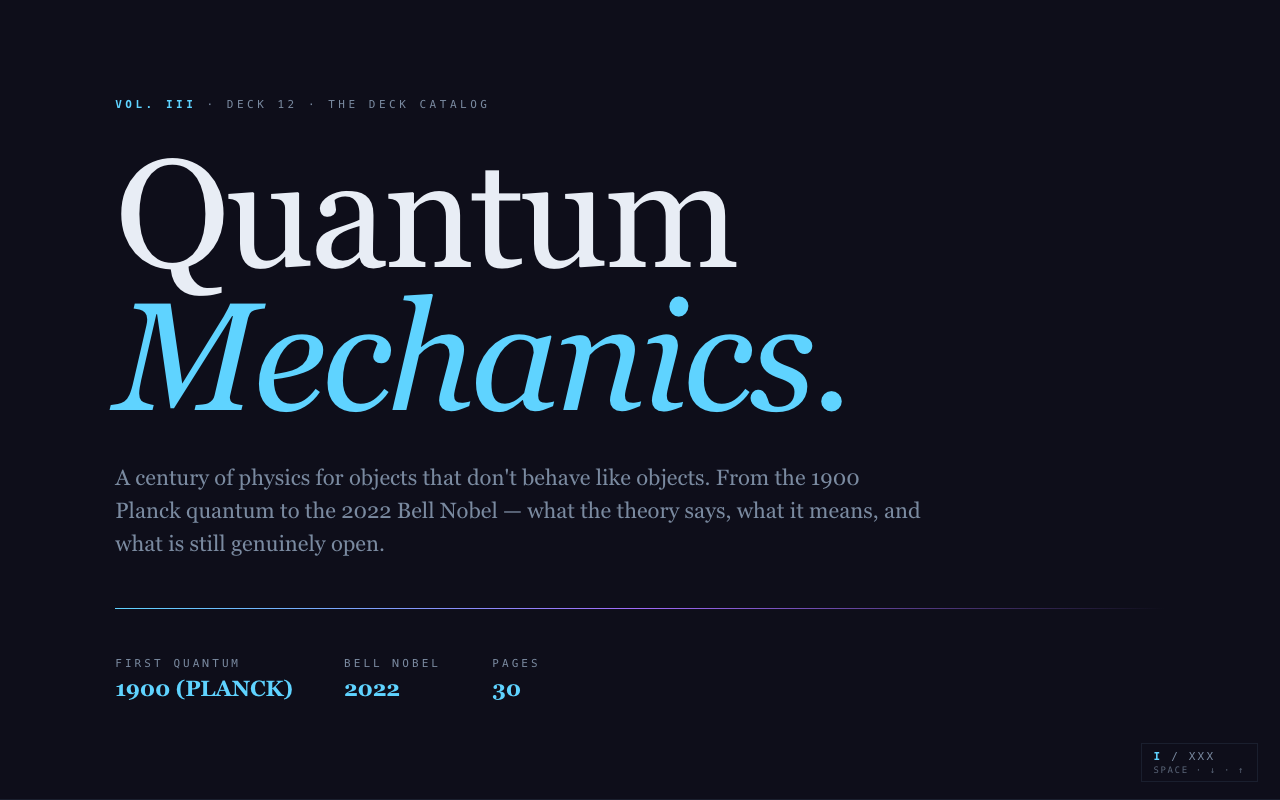
Quantum Physics — A Notebook

Quantum Physics — A Notebook — from Planck (1900) to Entanglement

StandaloneDownload
Sandboxed deck
Open raw

About this HTML presentation

This Shipslides page presents Quantum Physics — A Notebook as an interactive HTML presentation deck in the Science catalog with 13 slides. The share page keeps the uploaded deck sandboxed while exposing readable context, topics, and a slide outline for viewers and search engines.

Quantum Physics — A Notebook — from Planck (1900) to Entanglement Key sections include: Quantum Physics; 1900 · Planck; 1905 · Einstein; 1913 · Bohr; 1924 · de Broglie; 1926–27 · Schrödinger & Heisenberg; The Double-Slit Experiment; 1935 · EPR; 1964 · Bell's Theorem; Decoherence & Measurement.

Key sections

  • 01Quantum Physics
  • 021900 · Planck
  • 031905 · Einstein
  • 041913 · Bohr
  • 051924 · de Broglie
  • 061926–27 · Schrödinger & Heisenberg
  • 07The Double-Slit Experiment
  • 081935 · EPR
  • 091964 · Bell's Theorem
  • 10Decoherence & Measurement
  • 11Quantum, in Your Pocket
  • 12What IS the Wavefunction?
  • 13Further Reading
Slide outline
  1. 01Quantum Physics
  2. 021900 · Planck
  3. 031905 · Einstein
  4. 041913 · Bohr
  5. 051924 · de Broglie
  6. 061926–27 · Schrödinger & Heisenberg
  7. 07The Double-Slit Experiment
  8. 081935 · EPR
  9. 091964 · Bell's Theorem
  10. 10Decoherence & Measurement
  11. 11Quantum, in Your Pocket
  12. 12What IS the Wavefunction?
  13. 13Further Reading
Page data
Canonical
https://shipslides.com/d/catalog-science-quantum-physics
Category
Science
Size
29.1 KB
Updated
2026-05-17
LLM text
https://shipslides.com/d/catalog-science-quantum-physics/llms.txt

Presentation Transcript

Detailed slide-by-slide text content extracted from this presentation.

Slide 01

Quantum Physics

  • — A Notebook —
  • from Planck (1900) to Entanglement
  • Lab notebook of K. Ning · vol. III
  • May 2026
Slide 02

1900 · Planck

  • Energy comes in lumps.
  • Studying blackbody radiation, Max Planck made a desperate ad-hoc fix: assume oscillators
  • can only emit/absorb energy in discrete chunks —
  • quanta
  • E = h·ν
  • h = 6.626 × 10⁻³⁴ J·s tiny!
  • Planck himself thought it was just a math trick.
  • It wasn't. The classical world cracked open.
  • "An act of desperation," he later called it.
  • slide 2 / 13
Slide 03

1905 · Einstein

  • The photoelectric effect — light is granular too.
  • Shine light on metal → electrons pop out.
  • Classical theory predicted: brighter light = more energetic electrons.
  • Wrong. What matters is frequency, not intensity.
  • Below a threshold ν₀, nothing happens — no matter how bright.
  • KE = hν − φ
  • Light arrives in discrete packets — photons
  • Won Einstein the 1921 Nobel (not relativity!).
  • Wave-particle duality is now real.
  • slide 3 / 13
Slide 04

1913 · Bohr

  • Electrons live on discrete orbits.
  • Hydrogen's spectrum had specific colors — not a smear.
  • Bohr postulated electrons orbit only at quantized angular momentum:
  • L = n·ℏ (n = 1, 2, 3, ...)
  • Photons emitted when electrons jump down.
  • Explained the Rydberg formula.
  • Crude model — but a huge step.
  • Sketch: Bohr atom (hydrogen)
  • slide 4 / 13
Slide 05

1924 · de Broglie

  • Matter has wave nature.
  • Louis de Broglie (in his PhD thesis!): if light waves act like particles,
  • why shouldn't particles act like waves?
  • λ = h / p
  • Every electron is also a wave
  • Confirmed by Davisson–Germer (1927): electrons diffract through crystals.
  • Even buckyballs (C₆₀) show interference. Even molecules of 2000+ atoms.
  • slide 5 / 13
Slide 06

1926–27 · Schrödinger & Heisenberg

  • The wavefunction. The uncertainty principle.
  • Schrödinger wrote the equation that governs the wavefunction Ψ:
  • iℏ ∂Ψ/∂t = Ĥ Ψ
  • Almost simultaneously, Heisenberg showed you cannot pin down both position and momentum:
  • Δx · Δp ≥ ℏ/2
  • Not a measurement clumsiness — it's fundamental.
  • |Ψ|² gives the probability of finding the particle (Born rule).
  • The same physics, two formalisms — wave mechanics & matrix mechanics.
  • slide 6 / 13
Slide 07

The Double-Slit Experiment

  • "All of quantum mechanics in one experiment." — Feynman
  • Send one electron at a time → fringes still build up.
  • Each particle goes through both slits
  • as a wave — but lands as a single point.
  • Try to peek at which slit, and the fringes vanish.
  • slide 7 / 13
Slide 08

1935 · EPR

  • "Spooky action at a distance."
  • Einstein, Podolsky & Rosen wrote a paper attacking QM as incomplete.
  • Their target: entanglement.
  • Pair two particles so their spins are correlated. Send them light-years apart.
  • Measure one — instantly the other's outcome is fixed.
  • How? They must have carried the answer all along, said EPR.
  • Reality must be locally pre-determined by hidden variables.
  • Schrödinger coined "Verschränkung" — entanglement — that year.
  • Einstein: "God does not play dice."
  • Bohr: it's fine, you just can't talk about properties before measurement.
  • For 30 years the debate seemed philosophical. Then Bell took up the pen.
  • slide 8 / 13
Slide 09

1964 · Bell's Theorem

  • Hidden variables — ruled out.
  • John Bell derived an inequality that any local-hidden-variable theory must obey:
  • |S| ≤ 2 (local realism)
  • Quantum mechanics predicts |S| = 2√2 ≈ 2.83.
  • Aspect (1982), Zeilinger, Clauser — experiment after experiment violates Bell.
  • 2015: loophole-free tests in Delft, Vienna, NIST.
  • 2022 Nobel Prize.
  • Conclusion: no local hidden variables. Reality is non-local or non-real.
  • Pick your poison.
  • slide 9 / 13
Slide 10

Decoherence & Measurement

  • Why doesn't my coffee cup superpose?
  • Quantum systems don't sit in a vacuum — they entangle with their environment
  • (photons, air molecules, phonons) at femtosecond speed.
  • This decoherence rapidly washes out interference for
  • macroscopic objects. The cat is dead OR alive, in our local "branch."
  • Decoherence ≠ collapse. It explains the appearance of classicality.
  • Why we never see Schrödinger's cat suspended in superposition.
  • Why quantum computers need millikelvin shielding.
  • Schrödinger's cat — a thought experiment, not a how-to
  • slide 10 / 13
Slide 11

Quantum, in Your Pocket

  • Modern applications.
  • Lasers — stimulated emission (Einstein, 1917).
  • From DVD players to LIDAR.
  • Semiconductors — band theory is quantum mechanics.
  • Every transistor in your phone.
  • MRI — nuclear-spin precession, a direct quantum effect.
  • GPS — atomic clocks tuned to a Cs hyperfine transition.
  • Solar cells, LEDs — photoelectric effect & bandgaps.
  • Quantum computers — superposition + entanglement as compute resources.
  • Shor's algorithm, error-corrected qubits, NISQ era → fault tolerance.
  • ~30% of US GDP touches quantum tech.
  • slide 11 / 13
Slide 12

What IS the Wavefunction?

  • The unresolved question.
  • The math works. But what is Ψ made of?
  • Copenhagen (Bohr, Heisenberg) — Ψ is a tool for predicting
  • measurements. Don't ask more. "Shut up and calculate."
  • Many-Worlds (Everett, 1957) — Ψ never collapses; the universe
  • branches. Every outcome happens, somewhere.
  • QBism (Fuchs, Caves) — Ψ is an agent's belief, a
  • subjective Bayesian wager.
  • Pilot-wave (de Broglie–Bohm) — particles do have positions, guided
  • by a non-local wave.
  • Objective collapse (GRW, Penrose) — collapse is real and physical.
  • All make the same predictions today. The pen, here, hesitates.
  • pick one ☺
  • slide 12 / 13
Slide 13

Further Reading

  • R. Feynman — QED: The Strange Theory of Light & Matter
  • D. Griffiths — Introduction to Quantum Mechanics
  • A. Becker — What Is Real? (interpretations & history)
  • J.S. Bell — Speakable & Unspeakable in Quantum Mechanics
  • S. Carroll — Something Deeply Hidden (Many-Worlds)
  • YouTube
  • Double-slit experiment — search
  • Feynman quantum lectures — search
  • — end of notebook —
  • "I think I can safely say that nobody understands quantum mechanics." — R. Feynman
  • slide 13 / 13
Remove this deck