shipslides
Health20 slides1 view

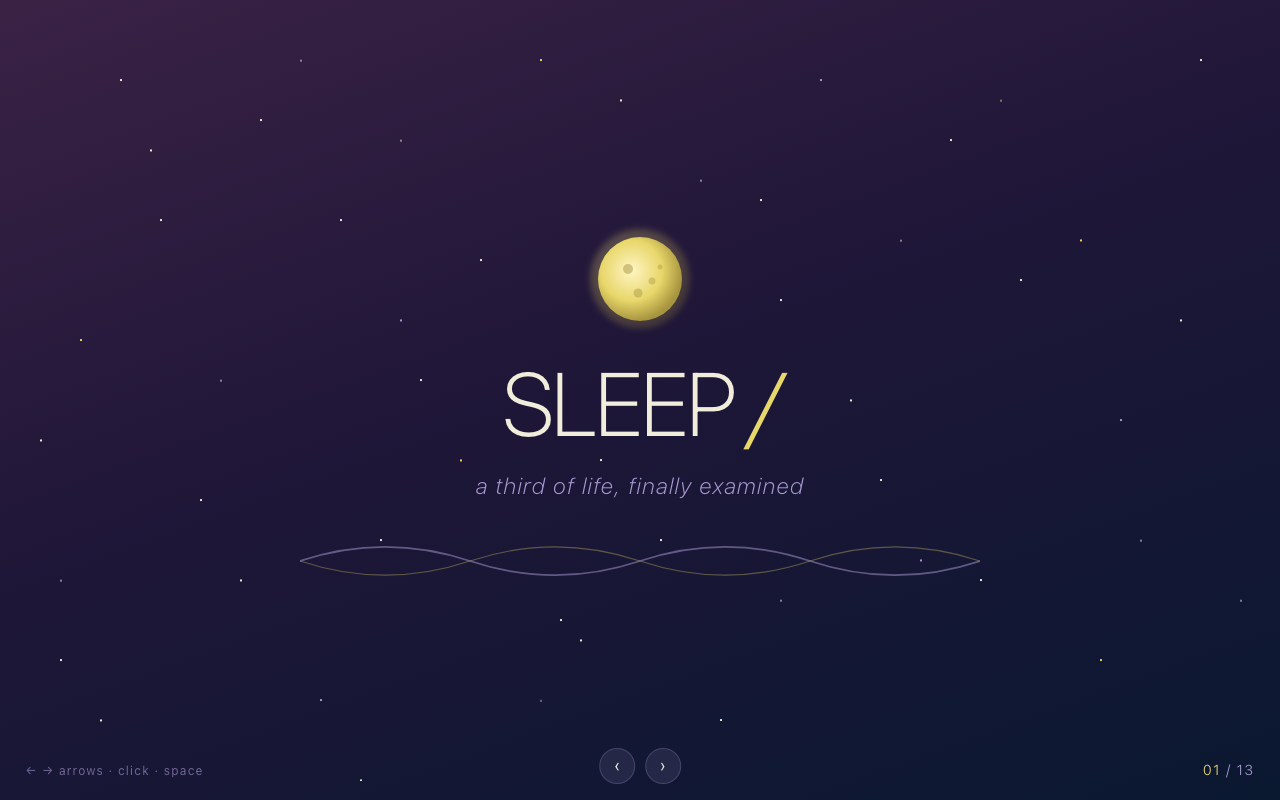
The Science of Sleep

We spend one-third of our lives asleep. Far from passive, sleep is a dynamic, critical biological process that consolidates memory, repairs tissue...

StandaloneDownload
Sandboxed deck
Open raw

About this HTML presentation

This Shipslides page presents The Science of Sleep as an interactive HTML presentation deck in the Health catalog with 20 slides. The share page keeps the uploaded deck sandboxed while exposing readable context, topics, and a slide outline for viewers and search engines.

We spend one-third of our lives asleep. Far from passive, sleep is a dynamic, critical biological process that consolidates memory, repairs tissue, regulates hormones, and defends against disease. Key sections include: The Science of Sleep; Why Do We Sleep?; Sleep Architecture; The Circadian Clock; The Two-Process Model; Sleep and Memory; Dreaming; Sleep Disorders; Sleep and Physical Health; Sleep Across the Lifespan.

Key sections

  • 01The Science of Sleep
  • 02Why Do We Sleep?
  • 03Sleep Architecture
  • 04The Circadian Clock
  • 05The Two-Process Model
  • 06Sleep and Memory
  • 07Dreaming
  • 08Sleep Disorders
  • 09Sleep and Physical Health
  • 10Sleep Across the Lifespan
  • 11The Glymphatic System
  • 12Light, Screens, and Modern Sleep
  • 13Caffeine and Sleep
  • 14Sleep and Performance
  • 15Napping: The Science
  • 16Sleep Hygiene: Evidence-Based Strategies
  • 17Sleep in the Animal Kingdom
  • 18The Future of Sleep Science
  • 19Key Takeaways

Topics covered

Slide outline
  1. 01The Science of Sleep
  2. 02Why Do We Sleep?
  3. 03Sleep Architecture
  4. 04The Circadian Clock
  5. 05The Two-Process Model
  6. 06Sleep and Memory
  7. 07Dreaming
  8. 08Sleep Disorders
  9. 09Sleep and Physical Health
  10. 10Sleep Across the Lifespan
  11. 11The Glymphatic System
  12. 12Light, Screens, and Modern Sleep
  13. 13Caffeine and Sleep
  14. 14Sleep and Performance
  15. 15Napping: The Science
  16. 16Sleep Hygiene: Evidence-Based Strategies
  17. 17Sleep in the Animal Kingdom
  18. 18The Future of Sleep Science
  19. 19Key Takeaways
Page data
Canonical
https://shipslides.com/d/health-sleep-science
Category
Health
Size
22.6 KB
Updated
2026-05-17
LLM text
https://shipslides.com/d/health-sleep-science/llms.txt

Presentation Transcript

Detailed slide-by-slide text content extracted from this presentation.

Slide 01

The Science of Sleep

  • Health • Sleep
  • We spend one-third of our lives asleep. Far from passive, sleep is a dynamic, critical biological process that consolidates memory, repairs tissue, regulates hormones, and defends against disease.
  • NeuroscienceCircadian BiologyHealthDreams
Slide 02

Why Do We Sleep?

  • Sleep is universal across the animal kingdom -- every species studied sleeps. This evolutionary persistence despite the vulnerability it creates suggests sleep serves essential functions that outweigh its dangers.
  • Five Functions of Sleep
  • Memory consolidation: Transfer from hippocampus to neocortex during slow-wave sleep
  • Metabolic clearance: Glymphatic system removes toxic waste (including amyloid-beta) 10x more actively during sleep
  • Immune function: Production of cytokines, T-cell activation, inflammation regulation
  • Emotional processing: REM sleep strips emotional tone from memories
  • Tissue repair: Growth hormone peaks during deep sleep (70% of daily secretion)
  • "Sleep is the single most effective thing we can do to reset our brain and body health each day."-- Matthew Walker, "Why We Sleep" (2017)
  • The Cost of Sleep Deprivation
  • 24 hrs without sleep = legally drunk (BAC 0.10%)
  • Losing 1.5 hours reduces daytime alertness by 32%
  • Chronic sleep debt linked to 7 of 15 leading causes of death
  • 17 hours awake impairs performance equal to BAC 0.05%
Slide 03

Sleep Architecture

  • A typical night cycles through stages approximately every 90 minutes, with 4-6 complete cycles. The proportion of each stage shifts across the night.
  • NREM Stage 1 (N1)
  • Light sleep, 1-5 minutes. Theta waves (4-7 Hz). Hypnagogic hallucinations, hypnic jerks. Easy to wake. Transition from wakefulness.
  • NREM Stage 2 (N2)
  • 45-55% of total sleep. Sleep spindles (12-15 Hz bursts) and K-complexes. Body temperature drops. Heart rate slows. Memory consolidation begins here.
  • NREM Stage 3 (N3 / Deep Sleep)
  • Delta waves (0.5-4 Hz). 15-25% of sleep. Most restorative stage. Growth hormone release, immune function, tissue repair. Hardest to wake from. Declines with age (60-70% less by age 60).
  • REM Sleep
  • 20-25% of sleep. Discovered by Aserinsky and Kleitman (1953). Brain activity resembles wakefulness. Rapid eye movements, muscle atonia (paralysis), vivid dreams. Increases in later cycles (final cycle: 60 min of REM).
  • Cycle Architecture
  • First half of night: Dominated by deep NREM (N3). Critical for physical restoration.
  • Second half of night: Dominated by REM. Critical for emotional processing and memory.
  • Implication: Cutting sleep short preferentially eliminates REM. Sleeping late preferentially eliminates deep sleep.
  • "No aspect of our biology is left unscathed by sleep deprivation."-- Matthew Walker, UC Berkeley sleep researcher
Slide 04

The Circadian Clock

  • The suprachiasmatic nucleus (SCN) -- a cluster of ~20,000 neurons in the hypothalamus -- serves as the master biological clock. It runs on a ~24.2 hour cycle, synchronized daily by light.
  • How It Works
  • Molecular mechanism: Transcription-translation feedback loops. CLOCK and BMAL1 proteins activate PER and CRY genes, whose proteins then inhibit CLOCK/BMAL1. Cycle takes ~24 hours. Nobel Prize 2017 (Hall, Rosbash, Young).
  • Light as zeitgeber: Intrinsically photosensitive retinal ganglion cells (ipRGCs) detect blue light (480nm) via melanopsin. Signal travels to SCN via retinohypothalamic tract. Morning light advances clock; evening light delays it.
  • Chronotypes
  • Early chronotype ("Lark"): ~25% of population. Peak alertness 9-11am. Prefer early bedtime.
  • Late chronotype ("Owl"): ~25% of population. Peak alertness evening. Often misaligned with social schedules ("social jet lag").
  • Intermediate: ~50%. Moderate flexibility.
  • Genetic basis: PER3 gene variants strongly predict chronotype. Also influenced by age (teens shift late, elderly shift early).
  • Social jet lag: Mismatch between biological clock and social obligations. Average: 1-2 hours. Each hour associated with 11% increased risk of heart disease (Roenneberg, 2012).
Slide 05

The Two-Process Model

  • Alexander Borbely (1982) proposed that sleep is regulated by two independent processes:
  • Process S: Sleep Pressure (Homeostatic)
  • Adenosine accumulates during wakefulness as a byproduct of ATP metabolism. The longer you're awake, the more adenosine builds up, increasing sleep drive. Caffeine works by blocking adenosine receptors (A1 and A2A).
  • Process C: Circadian Alerting Signal
  • The SCN generates a roughly sinusoidal alerting signal that opposes sleep pressure during the day and withdraws in the evening. This explains why you feel most sleepy ~4am and ~2pm (post-lunch dip is partly circadian, not just food).
  • Key Molecules
  • Melatonin: "Hormone of darkness." Released by pineal gland 2-3 hours before habitual bedtime. Does not induce sleep -- signals timing. Suppressed by light (especially blue, 460-480nm).
  • Adenosine: Sleep pressure molecule. Half-life: 10 minutes. Cleared during sleep. Caffeine blocks receptors for 5-7 hours (half-life).
  • Cortisol: Peaks 30-45 min after waking (cortisol awakening response). Lowest at midnight. Provides morning alertness.
  • Orexin/Hypocretin: Wakefulness promoter. Loss causes narcolepsy. Discovery (1998) led to new sleeping pill class (suvorexant, 2014).
  • "The two-process model elegantly explains why shift workers feel worst at 4am -- maximal sleep pressure meets minimal circadian alerting."-- Alexander Borbely, University of Zurich
Slide 06

Sleep and Memory

  • Memory Consolidation During Sleep
  • Slow-wave sleep: Hippocampal "replay" -- neurons that fired during learning reactivate in the same sequence but 5-20x faster. Memories transfer from hippocampus (short-term) to neocortex (long-term).
  • Sleep spindles: Burst activity in thalamocortical circuits during N2. Number of spindles predicts learning capacity. Can be enhanced with auditory stimulation (pink noise timed to slow oscillations).
  • REM sleep: Integrates new memories with existing knowledge. Supports creative problem-solving (Mendeleev dreamed the periodic table; Kekule dreamed benzene's ring structure).
  • Experimental Evidence
  • Students sleeping after studying retain 20-40% more than those who don't (Jenkins & Dallenbach, 1924; replicated extensively)
  • A 60-90 minute nap containing both N3 and REM consolidates motor skills as well as a full night's sleep
  • Targeted memory reactivation: playing sounds associated with learning during sleep enhances retention 20%
  • Sleep deprivation reduces hippocampal activity 40%, impairing new memory formation (Walker, 2007)
  • "Sleep is the price we pay for plasticity."-- Giulio Tononi, University of Wisconsin, Synaptic Homeostasis Hypothesis
  • Synaptic homeostasis: Tononi's theory proposes sleep globally downscales synaptic strength that builds during waking. This "prunes" unimportant connections and resets capacity for next day's learning.
Slide 07

Dreaming

  • Humans spend approximately 6 years of their lives dreaming. While dreams occur in all sleep stages, they are most vivid, narrative-rich, and emotionally intense during REM sleep.
  • Scientific Theories of Dreaming
  • Activation-synthesis (Hobson & McCarley, 1977): Random brainstem signals during REM are interpreted by the cortex into narratives. Dreams are the brain making sense of noise.
  • Threat simulation theory (Revonsuo, 2000): Dreams rehearse threatening scenarios, conferring evolutionary advantage. 65-70% of dream content involves threat.
  • Emotional processing (Walker, 2009): REM sleep provides "overnight therapy." Dreams replay emotional events in a neurochemically safe environment (no norepinephrine), stripping emotional charge from memories.
  • Dream Facts
  • Average: 4-6 dream episodes per night
  • Dream amnesia: 95% of dreams forgotten within 5 minutes of waking
  • Lucid dreaming: awareness during dreaming (55% have experienced it; 23% regularly)
  • Dream content: day residue (recent experiences) appears in 65% of dreams
  • Blind from birth: dream in other senses (no visual imagery)
  • Universal themes: falling, being chased, teeth falling out, being unprepared for exam
  • "Dreams are the royal road to the unconscious."-- Sigmund Freud, "The Interpretation of Dreams" (1900)
  • "Dreaming permits each and every one of us to be quietly and safely insane every night of our lives."-- William Dement, pioneer of sleep medicine
Slide 08

Sleep Disorders

  • Insomnia
  • Most common: affects 30-35% (symptoms) / 10% (chronic disorder). Difficulty falling/staying asleep despite adequate opportunity. CBT-I is first-line treatment (superior to pills long-term). Hyperarousal model: overactive wake-promoting systems.
  • Sleep Apnea
  • Affects 936 million people worldwide. Repeated airway collapse during sleep. 5+ apneas/hour = diagnosis. 80% undiagnosed. Doubles cardiovascular risk. Treatment: CPAP, oral appliances, weight loss.
  • Narcolepsy
  • Loss of orexin-producing neurons (autoimmune). Affects 1 in 2,000. Excessive daytime sleepiness, cataplexy, sleep paralysis, hypnagogic hallucinations. Average 7-year diagnostic delay.
  • Restless Legs Syndrome
  • Affects 5-10% of adults. Irresistible urge to move legs, worse at rest/evening. Iron-dopamine connection. Treatment: iron supplementation, dopamine agonists, alpha-2-delta ligands.
  • Parasomnias
  • Abnormal behaviors during sleep. Sleepwalking (N3, 1-15%), sleep terrors (N3), REM behavior disorder (acting out dreams -- 80% develop Parkinson's within 15 years).
  • Circadian Rhythm Disorders
  • Delayed sleep phase (common in teens, 7-16%), advanced sleep phase (elderly), shift work disorder (10-38% of shift workers), jet lag. Light therapy and melatonin timing primary treatments.
Slide 09

Sleep and Physical Health

  • Cardiovascular System
  • Sleeping less than 6 hours increases coronary heart disease risk by 48%, stroke by 15%, and hypertension by 21%. The spring daylight saving transition (1 hour sleep loss) increases heart attacks 24% the next day.
  • Immune System
  • After 4 hours sleep for one night, natural killer cell activity drops 72%. Sleeping less than 7 hours makes you 3x more likely to develop a cold when exposed to rhinovirus (Cohen, 2009).
  • Metabolism and Weight
  • Sleep restriction increases ghrelin (hunger hormone) 28% and decreases leptin (satiety hormone) 18%. Short sleepers consume 300-500 extra calories/day. Sleeping 5 hours/night associated with 50% higher obesity risk.
  • Cancer
  • WHO classified night shift work as "probably carcinogenic" (Group 2A, 2007). Nurses working rotating night shifts 30+ years have 36% higher breast cancer risk. Melatonin suppression and circadian disruption are proposed mechanisms.
  • Longevity
  • U-shaped mortality curve: both short (9h) sleep associated with increased mortality. Optimal: 7-8 hours. Each hour below 7 increases all-cause mortality 6%.
  • Pain
  • Sleep deprivation lowers pain threshold by 15-30%. Creates a vicious cycle: pain disrupts sleep, poor sleep amplifies pain. Adequate sleep enhances opioid analgesic effects.
Slide 10

Sleep Across the Lifespan

  • Changing Sleep Needs
  • Newborns (0-3 months): 14-17 hours. 50% REM (vs. 20-25% adult). Polyphasic. No circadian rhythm until 3-4 months.
  • Children (6-13): 9-11 hours. High proportion of deep sleep (N3). Critical for growth hormone release and brain development.
  • Teenagers (14-17): Need 8-10 hours but average 6.5-7.5. Biological clock shifts 2-3 hours later (delayed circadian phase). Early school start times create chronic sleep debt.
  • Older adults (65+): Need 7-8 hours but ability to generate deep sleep declines 60-70%. More fragmented. Earlier circadian timing. 50%+ have insomnia symptoms.
  • Adolescent Sleep Crisis
  • 73%
  • of US high school students get insufficient sleep (CDC, 2023)
  • Biological phase delay + early school + screens + social pressure = perfect storm
  • Sleep-deprived teens: 3x more likely to experience depression
  • Drowsy driving causes 100,000 crashes/year in US (majority involve drivers under 25)
  • California law (2022): no public middle school before 8:00am, high school before 8:30am
  • "Asking a teenager to function at 7am is like asking an adult to function at 4am."-- Mary Carskadon, Brown University, adolescent sleep researcher
Slide 11

The Glymphatic System

  • Discovered in 2012 by Maiken Nedergaard (University of Rochester), the glymphatic system is the brain's waste-clearance mechanism -- and it operates primarily during sleep.
  • How It Works
  • Cerebrospinal fluid (CSF) flows along para-arterial channels into brain tissue via aquaporin-4 water channels on astrocyte endfeet. It flushes interstitial fluid and waste products out along paravenous routes.
  • Sleep activation: Glial cells shrink 60% during sleep, expanding the interstitial space and increasing CSF flow 10-20x. This allows efficient clearance of metabolic waste accumulated during waking.
  • Implications for Neurodegeneration
  • Alzheimer's disease: Amyloid-beta is cleared by the glymphatic system. Poor sleep increases Abeta deposition. One night of sleep deprivation increases Abeta by 5% in healthy humans (Shokri-Kojori, 2018).
  • Parkinson's disease: Alpha-synuclein also cleared during sleep. REM behavior disorder predicts Parkinson's with 80-90% conversion rate within 15 years.
  • Sleep position: Lateral (side) sleeping enhances glymphatic clearance compared to supine or prone positions in animal models (Lee, 2015).
  • "The restorative function of sleep may be a consequence of the enhanced removal of potentially neurotoxic waste products that accumulate in the awake central nervous system."-- Lulu Xie et al., Science, 2013
Slide 12

Light, Screens, and Modern Sleep

  • The Blue Light Problem
  • Melanopsin-containing retinal cells are maximally sensitive to blue-enriched light (~480nm). LEDs and screens emit substantial blue light, suppressing melatonin and delaying circadian phase.
  • iPad study (Harvard, 2014): Reading an iPad for 4 hours before bed vs. printed book: melatonin suppressed 55%, onset delayed 1.5 hours, REM sleep reduced, morning alertness impaired.
  • Light exposure evolution: Pre-electric humans got 10-100x more light during the day and experienced true darkness at night. Modern indoor living: too dim during day (500 lux vs. 10,000+ outdoors), too bright at night.
  • Solutions
  • Morning bright light: 10,000 lux for 20-30 minutes anchors circadian rhythm. Even cloudy outdoor light vastly exceeds indoor lighting.
  • Evening dim light: Switch to warm/amber lighting 2-3 hours before bed. Below 10 lux is ideal.
  • Blue-blocking glasses: Amber-tinted lenses in evening preserve melatonin timing.
  • Night mode/f.lux: Reduces blue emission. Helpful but does not eliminate arousal from screen content.
  • Smart lighting: Programmable LEDs that shift from blue-rich (5000K) morning to warm (2700K) evening.
  • "We are a dark-deprived society."-- Charles Czeisler, Harvard Medical School, Division of Sleep Medicine
Slide 13

Caffeine and Sleep

  • Caffeine is the world's most widely consumed psychoactive substance. 85% of American adults consume it daily. Its mechanism directly opposes sleep biology.
  • Pharmacology
  • Mechanism: Competitive antagonist at adenosine A1 and A2A receptors. Blocks sleep pressure signal without removing adenosine itself. When caffeine wears off, accumulated adenosine floods receptors ("crash").
  • Pharmacokinetics: Half-life: 5-7 hours (range: 3-9 based on CYP1A2 genetics). A coffee at 3pm still has 50% of caffeine in your system at 9pm.
  • Tolerance: Develops within 7-12 days. Receptors upregulate. Withdrawal peaks 24-48 hours after cessation. WHO recognizes caffeine dependence.
  • Effects on Sleep
  • Reduces total sleep time by 30-60 minutes (even when subjectively unnoticed)
  • Reduces deep sleep (N3) by 20% -- even when consumed 6 hours before bed
  • Delays circadian clock by 40 minutes per standard dose consumed 3 hours before bed
  • Creates a vicious cycle: poor sleep -> more caffeine -> poorer sleep
  • Genetic slow metabolizers: more pronounced sleep disruption
  • "Caffeine does not give you energy. It blocks the signal that tells you you're tired. The debt remains, hidden but accruing."-- Adapted from Matthew Walker, UC Berkeley
Slide 14

Sleep and Performance

  • Cognitive Performance
  • 400%
  • increase in microsleeps after just one night of 4 hours sleep
  • Attention: After 2 weeks of 6 hours/night, cognitive impairment equals 24 hours total sleep deprivation -- but subjects don't realize it.
  • Decision-making: Sleep deprivation preferentially impairs divergent thinking, moral reasoning, and innovation while preserving routine tasks.
  • Athletic Performance
  • NBA study: Stanford players sleeping 10 hours: free throw accuracy +9%, sprint times faster
  • Injury risk: Athletes sleeping Testosterone: Men sleeping 5 hours/night have testosterone levels of someone 10 years older
  • Reaction time: Sleep extension improves by 15-20ms
  • Economic Impact
  • RAND Corporation (2016): Insufficient sleep costs the US economy $411 billion/year (2.28% of GDP). 1.2 million working days lost annually.
Slide 15

Napping: The Science

  • Many cultures historically included afternoon naps. Modern research validates their benefits -- with caveats about timing and duration.
  • Nap Types by Duration
  • Power nap (10-20 min): Stage N1-N2 only. Immediate alertness boost lasting 1-3 hours. No sleep inertia. NASA study: 26-minute nap improved performance 34% and alertness 54%.
  • Full-cycle nap (90 min): Complete sleep cycle including deep sleep and REM. Best for memory consolidation and creativity.
  • Danger zone (30-60 min): Entry into deep sleep without completing the cycle. Causes sleep inertia: grogginess lasting 30+ minutes after waking.
  • Key Findings
  • Timing: Early afternoon (1-3pm) aligns with circadian dip. After 3pm may impair nighttime sleep.
  • Frequency: 1-2 naps/week associated with 48% lower cardiovascular events vs. non-nappers (Swiss study, 2019).
  • Coffee nap: Drink coffee immediately before a 20-minute nap. Caffeine takes 20 minutes to activate. Wake with both cleared adenosine and caffeine blockade.
  • "No day is so bad it can't be fixed with a nap."-- Carrie Snow
  • "Think what a better world it would be if we all took cookies and milk at 3 and then lay down for a nap."-- Robert Fulghum
Slide 16

Sleep Hygiene: Evidence-Based Strategies

  • Environment
  • Temperature: 65-68F (18-20C) -- core body temp must drop 2-3F to initiate sleep
  • Darkness: blackout curtains, cover LEDs
  • Quiet: earplugs, white noise if needed
  • Comfortable mattress and pillow
  • Reserve bed for sleep and sex only
  • Timing
  • Consistent wake time (most important)
  • Regular bed time within 30-min window
  • Morning sunlight within 30 min of waking
  • No caffeine after noon
  • No alcohol 3+ hours before bed
  • Dim lights 2 hours before bed
  • Behavior
  • Wind-down routine: 30-60 min
  • If not asleep in 20 min, get up
  • Regular exercise (not within 2-3 hrs of bed)
  • Hot bath 1-2 hrs before bed (paradoxical cooling)
  • Manage worry: journal, scheduled worry time
  • Avoid clock-watching
  • "Sleep hygiene alone rarely cures insomnia -- but violating it reliably causes sleep problems."-- Michael Perlis, University of Pennsylvania, Behavioral Sleep Medicine
Slide 17

Sleep in the Animal Kingdom

  • Extreme Sleepers
  • Koalas: 22 hours/day (low-calorie eucalyptus diet)
  • Brown bats: 20 hours/day
  • Giraffes: 30 minutes/day (shortest of any mammal)
  • Elephants: 2-4 hours (in the wild)
  • Dolphins: Unihemispheric sleep -- one brain half sleeps while the other stays awake
  • Alpine swifts: 200 days continuous flight (sleep on the wing)
  • Bullfrogs: May not sleep at all (debated)
  • Evolutionary Insights
  • Predator-prey: Predators sleep more than prey. Herbivores sleep less. Social animals share vigilance, enabling longer individual sleep.
  • Brain size: Animals with larger brains relative to body size generally have more REM sleep. Suggests REM's role in neural development.
  • Fatal familial insomnia: Prion disease causing progressive inability to sleep. Uniformly fatal within 6-36 months. Only ~40 families carry the mutation. Proves sleep is essential for life.
  • "If sleep does not serve an absolutely vital function, then it is the biggest mistake the evolutionary process has ever made."-- Allan Rechtschaffen, University of Chicago
Slide 18

The Future of Sleep Science

  • Emerging Technologies
  • Closed-loop stimulation: Auditory tones delivered in sync with slow oscillations to enhance deep sleep and memory consolidation. PhilipsSmartSleep headband was early commercial attempt.
  • Targeted memory reactivation: Replaying learning-associated cues during sleep to selectively strengthen specific memories. Moving from lab to consumer products.
  • Orexin-based treatments: New class of sleep medications (DORAs) that work with natural sleep architecture rather than sedating the brain. Suvorexant (2014), lemborexant (2019).
  • Open Questions
  • Can we compress sleep into fewer hours without health consequences?
  • Why do we lose deep sleep with age -- and can we restore it?
  • What is the precise function of dreaming?
  • Can sleep optimization prevent neurodegenerative disease?
  • Will personalized sleep schedules based on genetics become standard?
  • How will AI-driven sleep coaching transform insomnia treatment?
  • "Sleep is the Swiss Army knife of health. When sleep is deficient, there is sickness and disease. And when sleep is abundant, there is vitality and health."-- Matthew Walker, "Why We Sleep"
Slide 19

Key Takeaways

  • Non-Negotiable
  • 7-9 hours for adults (not optional)
  • Consistency trumps duration
  • No technology can replace natural sleep
  • Sleep debt is real and cumulative
  • Both deep sleep AND REM are essential
  • Priority Actions
  • Anchor wake time (most powerful fix)
  • Morning light, evening darkness
  • Cool, dark, quiet bedroom
  • Caffeine curfew (noon)
  • Wind-down routine (screens off)
  • The Big Picture
  • Sleep is not a luxury -- biological necessity
  • Societies that devalue sleep pay in health and lives
  • Sleep is the foundation for all other health
  • If struggling, CBT-I works
  • "The best bridge between despair and hope is a good night's sleep."-- E. Joseph Cossman
Slide 20

The Science of Sleep

  • End
  • Understanding the third of our lives that makes the other two-thirds possible.
  • 30 slides • Health • 2024
Remove this deck