shipslides
Health13 slides0 views

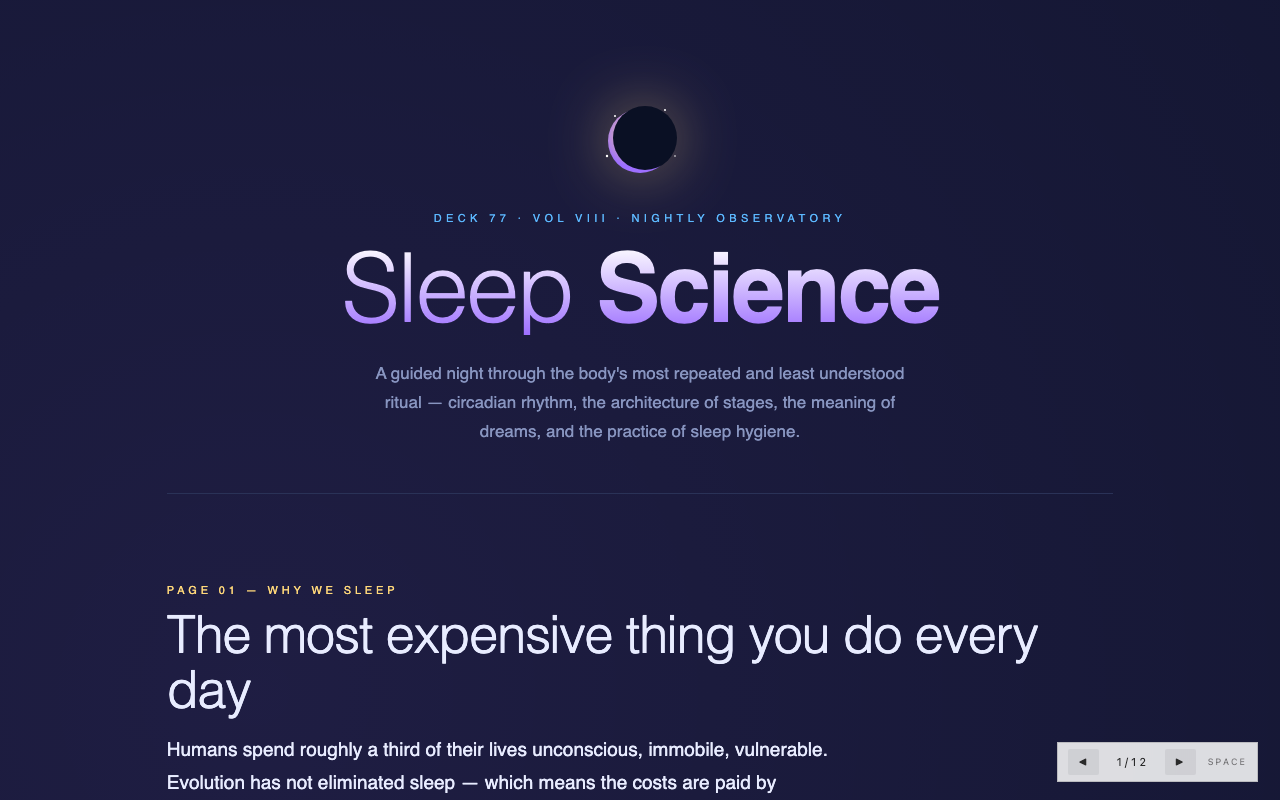
Sleep — A Third of Life, Finally Examined

a third of life, finally examined

StandaloneDownload
Sandboxed deck
Open raw

About this HTML presentation

This Shipslides page presents Sleep — A Third of Life, Finally Examined as an interactive HTML presentation deck in the Health catalog with 13 slides. The share page keeps the uploaded deck sandboxed while exposing readable context, topics, and a slide outline for viewers and search engines.

a third of life, finally examined Key sections include: SLEEP /; Sleep is universal; Two forces, one night: C + S; Stages of the night; What sleep does; How much do you need?; Architecture: deep vs. dreaming; The dream; Modern dysfunction; Insomnia & CBT-I.

Key sections

  • 01SLEEP /
  • 02Sleep is universal
  • 03Two forces, one night: C + S
  • 04Stages of the night
  • 05What sleep does
  • 06How much do you need?
  • 07Architecture: deep vs. dreaming
  • 08The dream
  • 09Modern dysfunction
  • 10Insomnia & CBT-I
  • 11Sleep apnea
  • 12Practical advice
  • 13Further reading

Topics covered

Slide outline
  1. 01SLEEP /
  2. 02Sleep is universal
  3. 03Two forces, one night: C + S
  4. 04Stages of the night
  5. 05What sleep does
  6. 06How much do you need?
  7. 07Architecture: deep vs. dreaming
  8. 08The dream
  9. 09Modern dysfunction
  10. 10Insomnia & CBT-I
  11. 11Sleep apnea
  12. 12Practical advice
  13. 13Further reading
Page data
Canonical
https://shipslides.com/d/catalog-health-sleep
Category
Health
Size
28.8 KB
Updated
2026-05-17
LLM text
https://shipslides.com/d/catalog-health-sleep/llms.txt

Presentation Transcript

Detailed slide-by-slide text content extracted from this presentation.

Slide 01

SLEEP /

  • a third of life, finally examined
Slide 02

Sleep is universal

  • Every animal we have looked closely at sleeps — or does something so close to it that the difference is academic.
  • Fruit flies, jellyfish, octopuses, fish, mice, elephants, humans.
  • Dolphins and some birds sleep one hemisphere at a time, keeping one eye open.
  • Sleep is so costly — predator-vulnerable, opportunity-blind — yet evolution has kept it for hundreds of millions of years.
  • That alone tells us: whatever sleep does, it cannot be done any other way.
Slide 03

Two forces, one night: C + S

  • Process C — Circadian
  • An internal ~24-hour clock anchored in the suprachiasmatic nucleus. Light (especially morning sun) sets it. It says when you should sleep.
  • Process S — Sleep Pressure
  • Adenosine builds up in the brain the longer you are awake. It says how badly you need sleep. Caffeine works by blocking it.
  • The two waves intersect: maximum sleepiness when both are aligned at night, brief afternoon dip ("siesta hour") when S is high but C lifts.
Slide 04

Stages of the night

  • A healthy adult cycles through sleep stages roughly every 90 minutes, four to six times a night.
  • Deep slow-wave sleep dominates the first half of the night. REM grows longer in the second half — which is why oversleeping in the morning feels dream-heavy.
Slide 05

What sleep does

  • Memory
  • consolidation
  • Glymphatic
  • brain washing
  • Immune
  • repair & defense
  • Emotion
  • regulation
  • Hippocampus → cortex transfer: the day's experiences are replayed and filed away during slow-wave sleep.
  • Glymphatic flushing: cerebrospinal fluid clears metabolic waste — including beta-amyloid linked to Alzheimer's.
  • Cytokines & T-cells rise during sleep; one bad night meaningfully blunts vaccine response.
  • Amygdala recalibration: REM dampens emotional charge of memories — "the night soothes."
Slide 06

How much do you need?

  • 7–9 hmost adults
  • 9–11 hschool-age children
  • 14–17 hnewborns
  • < 1%true short sleepers
  • Chronically running on under 6 hours is associated with measurably higher risks of cardiovascular disease, type-2 diabetes, depression, certain cancers, and early mortality. You cannot adapt — you adapt to feeling worse.
Slide 07

Architecture: deep vs. dreaming

  • Slow-wave (N3): hippocampus broadcasts the day's facts to the cortex. Sharp-wave ripples orchestrate the transfer.
  • REM: brain is as active as waking, body paralyzed (atonia). Skill consolidation, creative recombination, emotional defanging.
  • Lose deep sleep → lose declarative memory. Lose REM → lose emotional balance and procedural skill.
Slide 08

The dream

  • Most vivid in REM sleep, when the brain is paradoxically as active as waking but cut off from sensory input and motor output.
  • Memory rehearsal
  • Dreams replay and remix the day's experiences, weaving new information into existing networks.
  • Threat simulation
  • An evolutionary rehearsal space: practice predators, social danger, falls — without the cost of dying.
  • Emotional regulation
  • Noradrenaline drops to zero in REM — the brain processes painful memories without their sting.
  • Random noise?
  • Hobson's "activation-synthesis": dreams are the cortex inventing stories from random brainstem signals.
Slide 09

Modern dysfunction

  • Industrial life has assembled an almost perfect attack on sleep:
  • Blue light from screens after dusk suppresses melatonin and pushes the circadian clock later.
  • Shift work chronically misaligns Process C; classified by the WHO as a probable carcinogen.
  • Caffeine's half-life is ~6 hours — a 4pm coffee leaves a quarter still working at midnight.
  • Anxiety & rumination activate the sympathetic nervous system, the opposite of what sleep needs.
  • Alcohol sedates but fragments the night — REM is suppressed, sleep is shallower.
  • Average sleep has fallen from ~8.5h (1942) to ~6.8h today.
Slide 10

Insomnia & CBT-I

  • For chronic insomnia, cognitive-behavioral therapy for insomnia (CBT-I) is the first-line treatment recommended by sleep medicine bodies — more effective than sleeping pills long-term.
  • Stimulus control: bed is for sleep only. If you can't sleep in 20 min, get up.
  • Sleep restriction: compress time in bed to rebuild sleep efficiency, then gradually expand.
  • Cognitive restructuring: dismantle catastrophic beliefs ("I'll fail tomorrow") that drive arousal.
  • Relaxation training + consistent wake time, every day.
  • Hypnotics (Ambien, etc.) produce sedation, not natural sleep — and tolerance, dependence, and rebound insomnia are common.
Slide 11

Sleep apnea

  • Roughly ~30% of adults have some degree of obstructive sleep apnea. The majority of moderate-to-severe cases are undiagnosed.
  • The airway collapses repeatedly; the brain micro-arouses to gasp, hundreds of times a night.
  • Sleep architecture is shredded — minimal deep sleep, minimal REM.
  • Consequences: hypertension, atrial fibrillation, stroke, heart failure, cognitive decline, daytime fatigue.
  • Snoring loudly + waking unrefreshed + observed pauses → ask for a sleep study.
  • CPAP remains the gold-standard treatment; new therapies (mandibular devices, hypoglossal nerve stimulation) are expanding options.
Slide 12

Practical advice

  • Cool~65°F / 18°C
  • Darkblackout if needed
  • Quietor steady noise
  • Regularsame wake time daily
  • Morning sunlight within an hour of waking — anchors Process C.
  • No caffeine after roughly noon; honestly, earlier if you're sensitive.
  • Last meal 2–3 hours before bed; alcohol is not a sleep aid.
  • Wind-down ritual: dim lights, screens off or in night mode 60 min before bed.
  • If you can't sleep, leave the bed and read in dim light until drowsy.
  • Protect the same wake time on weekends — "social jetlag" is real.
Slide 13

Further reading

  • Sleep science is one of the youngest mature fields in biology. A few starting points:
  • Matt Walker — "Why We Sleep" lectures (YouTube)
  • Sleep stages & REM explained (YouTube)
  • "Sleep is the single most effective thing we can do to reset our brain and body health each day." — Matthew Walker
Remove this deck