shipslides
Health13 slides0 views

Anatomia humana — a guided tour

Of the systems of the human body — twelve plates & a colophon Ex Officina · Anno MMXXVI Plate II — Numerus Corporis The body in numbers Corpus humanum...

StandaloneDownload
Sandboxed deck
Open raw

About this HTML presentation

This Shipslides page presents Anatomia humana — a guided tour as an interactive HTML presentation deck in the Health catalog with 13 slides. The share page keeps the uploaded deck sandboxed while exposing readable context, topics, and a slide outline for viewers and search engines.

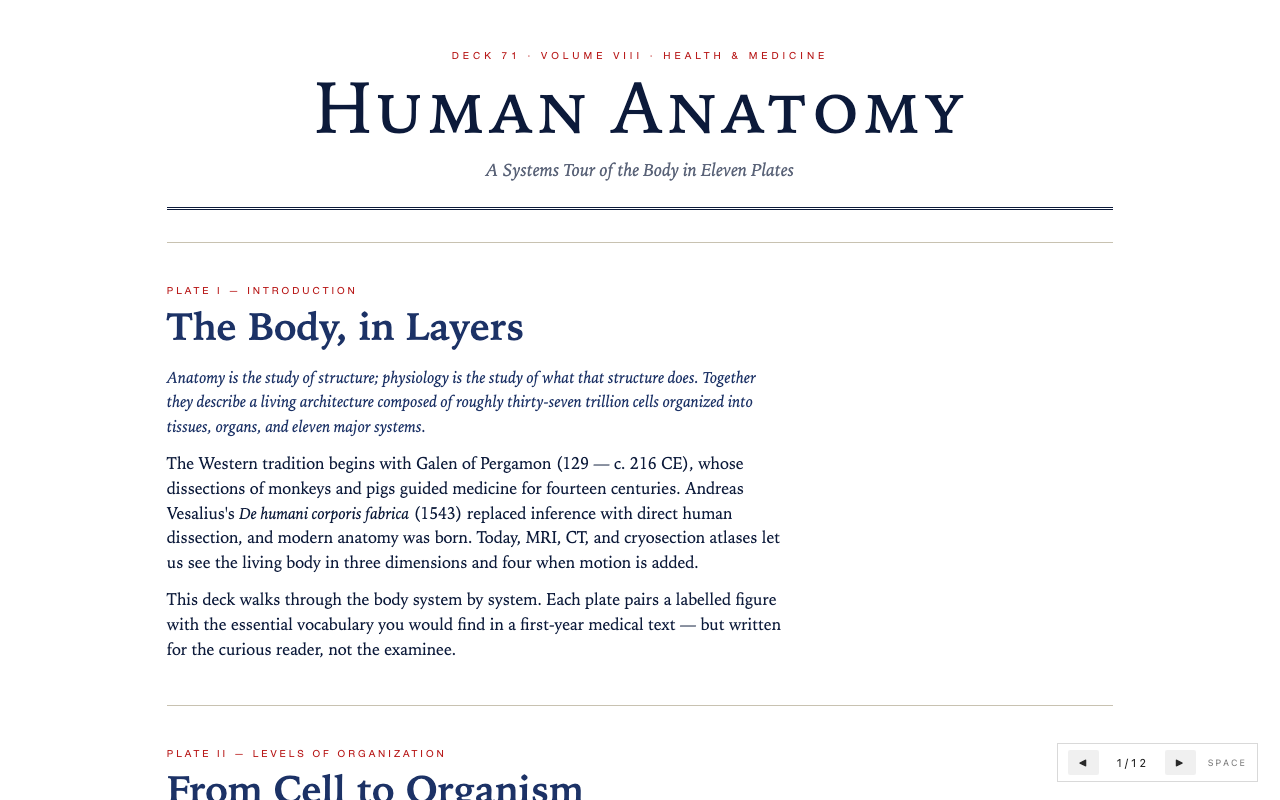
Of the systems of the human body — twelve plates & a colophon Ex Officina · Anno MMXXVI Plate II — Numerus Corporis The body in numbers Corpus humanum — an inventory of the parts Before naming the systems, consider the magnitude. The human body is a city of cells, a refinery of chemistry, a cartography of vessels — reckoned here in round figures, as the old anatomists were fond of doing. Key sections include: Anatomia humana; The body in numbers; The skeletal system; The muscular system; The cardiovascular system; The respiratory system; The digestive system; The nervous system; The endocrine system; The immune system.

Key sections

  • 01Anatomia humana
  • 02The body in numbers
  • 03The skeletal system
  • 04The muscular system
  • 05The cardiovascular system
  • 06The respiratory system
  • 07The digestive system
  • 08The nervous system
  • 09The endocrine system
  • 10The immune system
  • 11The integumentary system
  • 12No system stands alone
  • 13Further reading & viewing

Topics covered

Slide outline
  1. 01Anatomia humana
  2. 02The body in numbers
  3. 03The skeletal system
  4. 04The muscular system
  5. 05The cardiovascular system
  6. 06The respiratory system
  7. 07The digestive system
  8. 08The nervous system
  9. 09The endocrine system
  10. 10The immune system
  11. 11The integumentary system
  12. 12No system stands alone
  13. 13Further reading & viewing
Page data
Canonical
https://shipslides.com/d/catalog-health-anatomy
Category
Health
Size
63.0 KB
Updated
2026-05-17
LLM text
https://shipslides.com/d/catalog-health-anatomy/llms.txt

Presentation Transcript

Detailed slide-by-slide text content extracted from this presentation.

Slide 01

Anatomia humana

  • — Tabula Prima —
  • a guided tour
  • Of the systems of the human body — twelve plates & a colophon
  • Ex Officina · Anno MMXXVI
Slide 02

The body in numbers

  • Plate II — Numerus Corporis
  • Corpus humanum — an inventory of the parts
  • Before naming the systems, consider the magnitude. The human body is a city of cells, a refinery of chemistry, a cartography of vessels — reckoned here in round figures, as the old anatomists were fond of doing.
  • ~37 trillion
  • cellulae — living cells, of some 200 distinct kinds
  • 206
  • ossa — bones in the adult skeleton (newborns: ~270)
  • 600+
  • musculi — named skeletal muscles
  • ~100,000 mi
  • vasa — blood vessels, end to end — four times Earth's circumference
Slide 03

The skeletal system

  • Plate III — Systema Skeletale
  • Ossa — the living scaffold
  • The skeleton is conventionally divided into the axial — the skull, vertebral column, and ribcage that defend the brain, cord, and viscera — and the appendicular, the limbs and their girdles, by which the body acts upon the world.
  • Bone is not the dry chalk of memento mori. It is a living tissue, woven of collagen and mineral, threaded with vessels, populated by osteoblasts that build and osteoclasts that pare back. The adult skeleton renews itself entirely every decade.
  • Axial: 80 bones — cranium, vertebrae, ribs, sternum.
  • Appendicular: 126 bones — pectoral and pelvic girdles, arms, legs.
  • Marrow: site of haematopoiesis — the daily birth of blood cells.
  • Tab. III — sceleton humanum, prospectu anteriore
Slide 04

The muscular system

  • Plate IV — Systema Musculare
  • Musculi — the engines of motion
  • Three kinds of muscle compose the body's musculature, each with its own architecture and obedience — some willing, some unbidden.
  • Skeletal — striated, voluntary, attached to bone by tendons. The muscles of expression and labour.
  • Smooth — unstriated, involuntary, lining the gut, the vessels, the airways. The quiet workforce.
  • Cardiac — striated yet involuntary, branched and intercalated, contracting in concert at its own metronome.
  • Muscles act only by pulling. Every push is a pull elsewhere. Every step is a chorus — agonist, antagonist, synergist, and stabilizer in their counterpoised duet.
  • Tab. IV — the three kinds of muscle, ad histologiam
Slide 05

The cardiovascular system

  • Plate V — Systema Cardiovasculare
  • Cor — the unwearying engine
  • The heart is a four-chambered pump no larger than its owner's fist, contracting some 100,000 times a day, moving roughly 7,000 litres of blood through the long circuit of arteries, capillaries, and veins.
  • Two loops, intertwined:
  • Pulmonary — right ventricle to lungs and back. Spent blood reloads with oxygen.
  • Systemic — left ventricle to the body's furthest reach. Oxygen delivered, carbon dioxide collected.
  • Capillaries, where the actual commerce happens, are so fine that red cells pass through in single file.
  • Tab. V — cor humanum, sectio frontalis
Slide 06

The respiratory system

  • Plate VI — Systema Respiratorium
  • Pulmones — bellows of the spirit
  • Air enters by the nose, where it is warmed, moistened, and filtered. It descends through the trachea and divides at the carina into two bronchi; these branch and re-branch some twenty-three times into a microscopic foliage.
  • At the tips: alveoli. Some 300 to 500 million of them, gossamer sacs whose unfurled surface measures ~70 square metres — the area of a respectable parlour. There, oxygen crosses one cell's thickness into the blood and carbon dioxide departs.
  • Twelve to twenty breaths a minute. About half a billion in a long life.
  • Tab. VI — pulmones et viae respiratoriae
Slide 07

The digestive system

  • Plate VII — Systema Digestorium
  • Canalis alimentarius — the long passage
  • From mouth to anus, the digestive tract is a single tube about nine metres long, folded with great economy into the abdomen. It is, topologically, the body's outside running through its inside.
  • Mouth & oesophagus — mastication, deglutition.
  • Stomach — acid bath, churning vat (pH ~ 1.5).
  • Small intestine — ~6 m of villi and microvilli; the seat of absorption.
  • Large intestine — water reclamation, fermentation.
  • Liver, pancreas, gallbladder — the chemical works alongside.
  • And the microbiome: some 38 trillion bacterial cells — rivalling our own count — that fashion a virtual organ within us, helping digest, train the immune system, and synthesize what we cannot.
  • Tab. VII — canalis alimentarius cum visceribus
Slide 08

The nervous system

  • Plate VIII — Systema Nervosum
  • Cerebrum et nervi — the lightning network
  • About 86 billion neurons compose the brain — each averaging some 7,000 connections — plus an even larger company of glial cells that nurture and insulate them.
  • Central (CNS) — brain and spinal cord. The seat of cognition and reflex.
  • Peripheral (PNS) — cranial and spinal nerves, the wiring to every organ and limb.
  • The peripheral system itself divides:
  • Somatic — voluntary, the nerves of the will.
  • Autonomic — involuntary, splitting again into sympathetic (fight or flight) and parasympathetic (rest and digest).
  • Signals travel by electrochemical wave at up to 120 m/s — faster than the swiftest train.
  • Tab. VIII — neuronum, cum dendritis et axone
Slide 09

The endocrine system

  • Plate IX — Systema Endocrinum
  • Glandulae — the chemical orchestra
  • Where the nervous system speaks in milliseconds, the endocrine system speaks in minutes and hours, by the slower medium of hormones — molecules released into the bloodstream that find, by exquisite key-and-lock, only their intended cells.
  • The choir is conducted from the head:
  • Hypothalamus — the bridge between brain and gland; sets the tempo.
  • Pituitary — the master gland, releasing trophic hormones to direct others.
  • Thyroid & parathyroids — metabolism, calcium.
  • Adrenals — cortisol, adrenaline; stress and salt.
  • Pancreas (islets) — insulin and glucagon; sugar's regulator.
  • Gonads — the sex steroids that mark each life stage.
  • A picogram of the right hormone, in the right place, can reshape a whole organism.
Slide 10

The immune system

  • Plate X — Systema Immunitatis
  • Praesidia corporis — the body's standing army
  • The body's defence operates in two registers, both indispensable.
  • Innate — ancient, fast, unspecific. Skin and mucosae, complement proteins, neutrophils, macrophages, natural killer cells. The first responders.
  • Adaptive — slow to mount, but exquisitely specific and memorial. B cells manufacture antibodies; T cells kill infected cells and orchestrate the response.
  • The two communicate by cytokine, by direct contact, by displayed antigen. The whole network is plumbed by the lymphatic system — vessels that drain interstitial fluid, lymph nodes that filter and sample, the spleen, thymus, and tonsils that train and station the lymphocytes.
  • Its defining trick is memory. A first encounter teaches; a second is dispatched in days.
Slide 11

The integumentary system

  • Plate XI — Integumentum
  • Cutis — the wrapper that is more than wrapping
  • The skin is, by area and by mass, the body's largest organ — some 1.5 to 2 square metres, weighing several kilograms in an adult.
  • Three strata, ordered outward to in:
  • Epidermis — layered keratinocytes, melanocytes; the renewable barrier.
  • Dermis — collagen and elastin, with vessels, nerves, glands, and hair follicles.
  • Hypodermis — subcutaneous fat for insulation and ballast.
  • The skin defends, regulates temperature, synthesises vitamin D under sunlight, signals emotion (blush, pallor, gooseflesh), and reads the world by touch — some four million sensory receptors of pressure, vibration, temperature, and pain.
  • Every twenty-eight days or so, the epidermis renews itself: the body literally moults.
Slide 12

No system stands alone

  • Plate XII — Homeostasis
  • Homeostasis — the steady state
  • To divide the body into systems is a teacher's convenience, not nature's design. Every system relies on every other.
  • Lift a cup of tea and observe it: bones and joints provide the lever; muscles do the work; the nervous system commands and corrects; the heart and lungs replenish what is burned; the endocrine system tunes the pace; the skin reports temperature; the immune system guards the cut on your finger; the kidneys keep the chemistry inside its narrow ledger.
  • This dynamic equilibrium is homeostasis — the body's quiet, ceaseless project of remaining itself. Body temperature within half a degree. Blood pH within a tenth. Glucose within a band. Hour by hour, year by year, the body negotiates with the world to stay the body.
  • “The constancy of the internal environment is the condition of free life.” — Claude Bernard
Slide 13

Further reading & viewing

  • Colophon — Index Lectionum
  • Ad fontes — to the sources
  • For the curious, a small bibliography to begin a longer wandering.
  • Video — Systems overview
  • youtube.com/results?search_query=human+body+systems
  • Video — Heart, in detail
  • youtube.com/results?search_query=heart+anatomy+tour
  • Vesalius, De humani corporis fabrica (1543) — the founding atlas; figures still unsurpassed.
  • Gray's Anatomy (any modern edition) — the standard reference.
  • Bill Bryson, The Body: A Guide for Occupants — a readable companion.
  • Sherwin B. Nuland, The Wisdom of the Body — physiology as natural history.
  • — Finis —
Remove this deck