shipslides
Science13 slides0 views

Neuroscience / 86 billion cells, talking

Brain, mind, cognition — a clinical tour of the most complex object known to science.

StandaloneDownload
Sandboxed deck
Open raw

About this HTML presentation

This Shipslides page presents Neuroscience / 86 billion cells, talking as an interactive HTML presentation deck in the Science catalog with 13 slides. The share page keeps the uploaded deck sandboxed while exposing readable context, topics, and a slide outline for viewers and search engines.

Brain, mind, cognition — a clinical tour of the most complex object known to science. Key sections include: NEUROSCIENCE 86 billion cells, talking.; The neuron — an electrical wire that thinks.; The action potential — a 1 ms electrical spike.; Synapses — chemical conversation, ~100 trillion of them.; Anatomy — one brain, many regions, two halves.; Sensory & motor — the brain’s I/O bus.; Memory — how the brain holds onto time.; Broca, Wernicke, and what aphasia teaches us.; Cajal vs. Golgi — the 1906 Nobel.; The modern toolkit..

Key sections

  • 01NEUROSCIENCE 86 billion cells, talking.
  • 02The neuron — an electrical wire that thinks.
  • 03The action potential — a 1 ms electrical spike.
  • 04Synapses — chemical conversation, ~100 trillion of them.
  • 05Anatomy — one brain, many regions, two halves.
  • 06Sensory & motor — the brain’s I/O bus.
  • 07Memory — how the brain holds onto time.
  • 08Broca, Wernicke, and what aphasia teaches us.
  • 09Cajal vs. Golgi — the 1906 Nobel.
  • 10The modern toolkit.
  • 11What we still don’t know.
  • 12Brain disorders — where the work matters.
  • 13Where to go next.
Slide outline
  1. 01NEUROSCIENCE 86 billion cells, talking.
  2. 02The neuron — an electrical wire that thinks.
  3. 03The action potential — a 1 ms electrical spike.
  4. 04Synapses — chemical conversation, ~100 trillion of them.
  5. 05Anatomy — one brain, many regions, two halves.
  6. 06Sensory & motor — the brain’s I/O bus.
  7. 07Memory — how the brain holds onto time.
  8. 08Broca, Wernicke, and what aphasia teaches us.
  9. 09Cajal vs. Golgi — the 1906 Nobel.
  10. 10The modern toolkit.
  11. 11What we still don’t know.
  12. 12Brain disorders — where the work matters.
  13. 13Where to go next.
Page data
Canonical
https://shipslides.com/d/catalog-science-neuroscience
Category
Science
Size
41.1 KB
Updated
2026-05-17
LLM text
https://shipslides.com/d/catalog-science-neuroscience/llms.txt

Presentation Transcript

Detailed slide-by-slide text content extracted from this presentation.

Slide 01

NEUROSCIENCE 86 billion cells, talking.

  • Neuroscience · Lecture series
  • Brain, mind, cognition — a clinical tour of the most complex object known to science.
  • 13 slides
  • Topic The brain, the cell, the network
  • Reading time ~12 min
Slide 02

The neuron — an electrical wire that thinks.

  • 02 · The cell
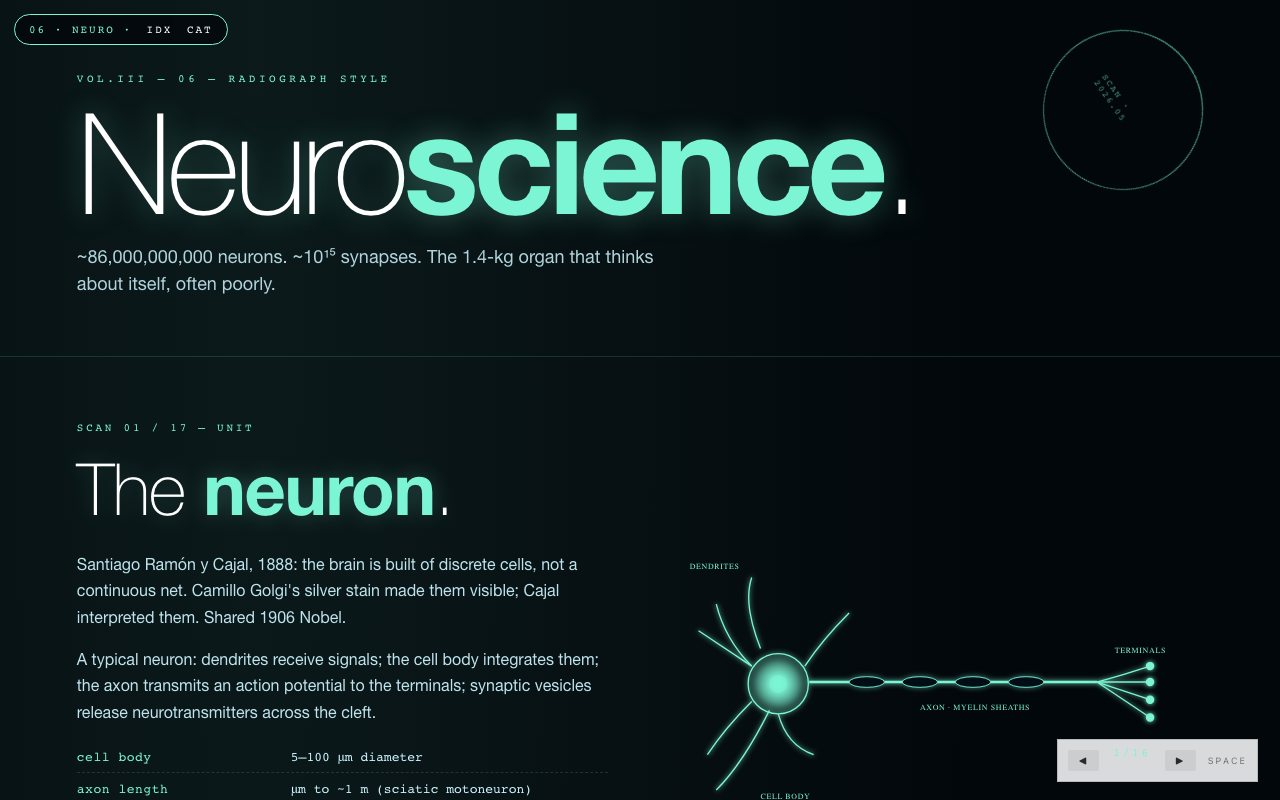
  • ~86 billion neurons in the human brain[1], each with thousands of inputs. Specialized for one job: receive a signal, decide, transmit.
  • Fig 2.1 · A typical neuron, schematic
  • Dendrites — branched receivers, sum thousands of inputs.
  • Soma — cell body; if input crosses threshold, fires.
  • Axon — wire-like output, can stretch over a meter.
  • Synapse — the gap where one neuron talks to the next.
  • Glia — support cells; roughly 1:1 with neurons[2].
  • [1] Azevedo et al., J Comp Neurol (2009) — isotropic fractionator count.
  • [2] von Bartheld et al. (2016) revised the old "10:1 glia" myth.
Slide 03

The action potential — a 1 ms electrical spike.

  • 03 · The signal
  • When inputs push the membrane past about −55 mV, voltage-gated Na⁺ channels snap open. The cell depolarizes, then K⁺ channels reset it. Repeat down the axon at up to ~100 m/s in myelinated fibres[1].
  • Fig 3.1 · Membrane voltage during a single spike (~1 ms)
  • Resting potential ~−70 mV, maintained by Na⁺/K⁺ pump.
  • Threshold ~−55 mV — an all-or-nothing decision.
  • Peak ~+40 mV — Na⁺ rushes in.
  • Refractory period — can’t fire again immediately.
  • Saltatory conduction — signal jumps between Nodes of Ranvier in myelinated axons[2].
  • [1] Hodgkin & Huxley, J Physiol (1952) — squid giant axon model. 1963 Nobel.
  • [2] Conduction velocity scales with axon diameter and myelination.
Slide 04

Synapses — chemical conversation, ~100 trillion of them.

  • 04 · The handshake
  • An action potential reaches the terminal, calcium floods in, vesicles dump neurotransmitter into a 20 nm gap. The next cell’s receptors decide what to do. The whole thing takes about half a millisecond.[1]
  • ~1014
  • Synapses
  • Roughly 100 trillion connections in an adult brain — an order of magnitude more than there are stars in our galaxy.
  • ~50
  • Neurotransmitters
  • Glutamate (excite), GABA (inhibit), dopamine, serotonin, acetylcholine, norepinephrine, and many peptides.
  • LTP
  • The cellular basis of learning
  • Long-term potentiation: repeatedly co-active synapses get stronger[2]. Hebb’s rule — "neurons that fire together, wire together."
  • 0.5 ms
  • Synaptic delay
  • Time from arriving spike to postsynaptic response — the rate-limiting step in neural circuits.
  • [1] Sakmann & Neher, patch-clamp methods — 1991 Nobel.
  • [2] Bliss & Lømo (1973), hippocampal LTP, Journal of Physiology.
Slide 05

Anatomy — one brain, many regions, two halves.

  • 05 · The map
  • Fig 5.1 · Lateral view, left hemisphere
  • Cerebrum — the wrinkled outer layer; thinking, perception, voluntary action.
  • Cerebellum — "little brain"; balance, motor timing, fine coordination.
  • Brainstem — breathing, heart rate, the things you can’t turn off.
  • Four lobes — frontal (planning), parietal (touch/space), temporal (hearing/memory), occipital (vision).
  • Two hemispheres linked by the corpus callosum; each receives the opposite side of the body.
Slide 06

Sensory & motor — the brain’s I/O bus.

  • 06 · In and out
  • Cortex is organized as topographic maps: neighbouring neurons code for neighbouring features. Discovered by carefully poking the cortex with electrodes — literally.
  • Primary visual cortex (V1)
  • Hubel & Wiesel (1959) found neurons that fire only for edges at a specific orientation[1]. The retinal image is mapped point-for-point onto V1 in the occipital lobe.
  • Primary motor cortex (M1)
  • A strip of cortex along the central sulcus where each patch controls a specific muscle group. Stimulate it, the body twitches.
  • Somatotopy · the homunculus
  • Penfield’s wartime maps showed lips, hands, and tongue claim disproportionate cortical real estate — sensitivity, not size, sets the scale[2].
  • Cross-modal plasticity
  • In congenitally blind people, "visual" cortex is recruited for Braille reading. Maps re-write themselves when the input changes.
  • [1] Hubel & Wiesel, J Physiol (1959); 1981 Nobel.
  • [2] Penfield & Boldrey, Brain (1937).
Slide 07

Memory — how the brain holds onto time.

  • 07 · The hippocampus
  • In 1953, surgeons removed both hippocampi from a young man named Henry Molaison — "Patient H.M." — to stop his seizures. They worked. But H.M. could no longer form new long-term memories.[1]
  • "Every day is alone in itself. Whatever enjoyment I’ve had, and whatever sorrow I’ve had."
  • — Henry Molaison, c. 1980
  • H.M. founded modern memory research. We learned that declarative memory (facts, events) needs the hippocampus, but procedural memory (skills) does not — he could still learn new motor tasks without remembering having practiced them.
  • Encoding — hippocampus binds together cortical activity into an episode.
  • Consolidation — over hours to years, memories migrate to neocortex[2].
  • Sleep replays the day's hippocampal activity at high speed (sharp-wave ripples).
  • Place cells — O’Keefe (1971); a hippocampal map of where you are. 2014 Nobel.
  • Forgetting — not a bug; selective decay keeps memory useful.
  • [1] Scoville & Milner, J Neurol Neurosurg Psychiatry (1957).
  • [2] Standard model: McClelland, McNaughton & O’Reilly (1995).
Slide 08

Broca, Wernicke, and what aphasia teaches us.

  • 08 · Language
  • Two 19th-century clinicians, two patients, two distinct deficits — and the first localized account of any cognitive function in the brain.
  • Broca's area · left frontal
  • Damage here produces Broca’s aphasia: speech is halting, ungrammatical, effortful — but comprehension is largely intact. The patient knows what they want to say.
  • "Walk dog. Yes... outside. Hard."
  • — A typical Broca’s aphasia utterance
  • Wernicke's area · left temporal
  • Damage here produces Wernicke’s aphasia: fluent, grammatical, melodic speech — but comprehension is impaired and the words come out as nonsense. Patients are often unaware.
  • "I called my mother on the television and did not understand the door."
  • — A typical Wernicke’s aphasia utterance
  • Modern fMRI shows language is more distributed than the classical model suggested[1] — but Broca’s and Wernicke’s patients are still where every neurology resident starts.
  • [1] Hagoort, Trends Cogn Sci (2014); Fedorenko et al. on the language network.
Slide 09

Cajal vs. Golgi — the 1906 Nobel.

  • 09 · History
  • Camillo Golgi invented the silver-nitrate stain that, mysteriously, blackens only a few neurons at random — rendering each one in exquisite detail.[1]
  • Santiago Ramón y Cajal, a Spanish histologist, used Golgi’s stain to draw thousands of neurons by hand. He concluded that the brain is made of discrete cells, not a continuous web — the neuron doctrine.
  • They shared the 1906 Nobel Prize. They disagreed bitterly in their acceptance speeches. Cajal turned out to be right.[2]
  • Pyramidal neuron, after Cajal (1899)
  • [1] Golgi (1873), la reazione nera.
  • [2] The reticular vs. neuronal theory debate — resolved by electron microscopy in the 1950s.
Slide 10

The modern toolkit.

  • 10 · Tools
  • Twenty years ago neuroscience meant electrodes and post-mortem slices. Today we can image, manipulate, and reconstruct circuits at multiple scales simultaneously.
  • fMRI
  • Functional MRI tracks blood-oxygen changes (BOLD signal) at ~1 mm resolution — the workhorse of cognitive neuroscience since the 1990s.[1]
  • Optogenetics
  • Channelrhodopsins from algae let researchers switch specific neurons on or off with millisecond pulses of blue light.[2] Causation, not just correlation.
  • Calcium imaging
  • GCaMP fluoresces when calcium rises during a spike. Two-photon microscopy can record thousands of neurons simultaneously in a behaving mouse.
  • Connectomics
  • Serial electron microscopy + deep learning reconstructs every synapse in a tissue volume. Full Drosophila brain mapped in 2024[3]; mouse cortex underway.
  • [1] Ogawa et al. (1990) discovered BOLD contrast.
  • [2] Boyden, Deisseroth et al., Nat Neurosci (2005).
  • [3] FlyWire consortium, Nature (Oct 2024) — ~140k neurons, ~50M synapses.
Slide 11

What we still don’t know.

  • 11 · Frontier
  • Despite a century of progress, the deepest questions remain genuinely open. These are the problems a young researcher could bet a career on.
  • Consciousness
  • Why does any physical process feel like something? The "hard problem"[1]. Leading frameworks: Global Workspace Theory, Integrated Information Theory — neither yet decisive.
  • YouTube · Consciousness & neuroscience →
  • The binding problem
  • Color, shape, motion, and location are processed in separate cortical regions. How are they fused into a single, unified percept of "red car moving left"?
  • What is a dream?
  • REM sleep is universal among mammals and birds. Dreams may be memory replay, threat rehearsal, noise — or essential to learning. We still don’t know.
  • The engram
  • If memory is stored physically in the brain, where? Recent work (Tonegawa lab) tags and reactivates specific memory traces in mice[2] — but the full code is still cryptic.
  • [1] Chalmers, J Conscious Stud (1995).
  • [2] Liu, Ramirez et al., Nature (2012); engram cell tagging in hippocampus.
Slide 12

Brain disorders — where the work matters.

  • 12 · Clinical
  • Roughly one in three people will be affected by a neurological or psychiatric disorder in their lifetime[1]. The clinic is where neuroscience meets the world.
  • Aβ
  • Alzheimer’s disease
  • Amyloid-β plaques and tau tangles; first hippocampal, then cortical neurodegeneration. Lecanemab (2023) is the first disease-modifying therapy — modest but real.[2]
  • Parkinson’s disease
  • Loss of dopamine neurons in the substantia nigra. L-DOPA (1968) was a miracle drug; deep-brain stimulation now helps refractory patients.
  • 5-HT
  • Depression
  • SSRIs treat symptoms imperfectly. Ketamine and psilocybin show rapid antidepressant effects via NMDA / 5-HT2A receptors — reshaping the field.[3]
  • ~1%
  • Schizophrenia
  • Lifetime prevalence around 1% globally. Heritable, dopaminergic and glutamatergic dysregulation, but cause and definitive biomarker still elusive.
  • [1] WHO, Global Burden of Disease.
  • [2] van Dyck et al., NEJM (2023) — CLARITY-AD trial.
  • [3] Krystal et al., Cell (2019); Carhart-Harris et al., NEJM (2021).
Slide 13

Where to go next.

  • 13 · Further reading
  • Books
  • Principles of Neural Science — Kandel, Schwartz et al. The standard reference.
  • The Idea of the Brain — Matthew Cobb. History of how we got here.
  • Behave — Robert Sapolsky. Neuroscience meets behavior, written for humans.
  • The Man Who Mistook His Wife for a Hat — Oliver Sacks. The case-study tradition.
  • Consciousness and the Brain — Stanislas Dehaene. The science of awareness.
  • Video
  • Neuron & action potential — YouTube search →
  • Consciousness & neuroscience — YouTube search →
  • Online
  • NIH BRAIN Initiative — current US funding map and data releases.
  • Allen Brain Atlas — high-resolution gene expression and connectivity data.
  • FlyWire.ai — the connectome of the fruit fly, free to explore.
Remove this deck