shipslides
Science14 slides0 views

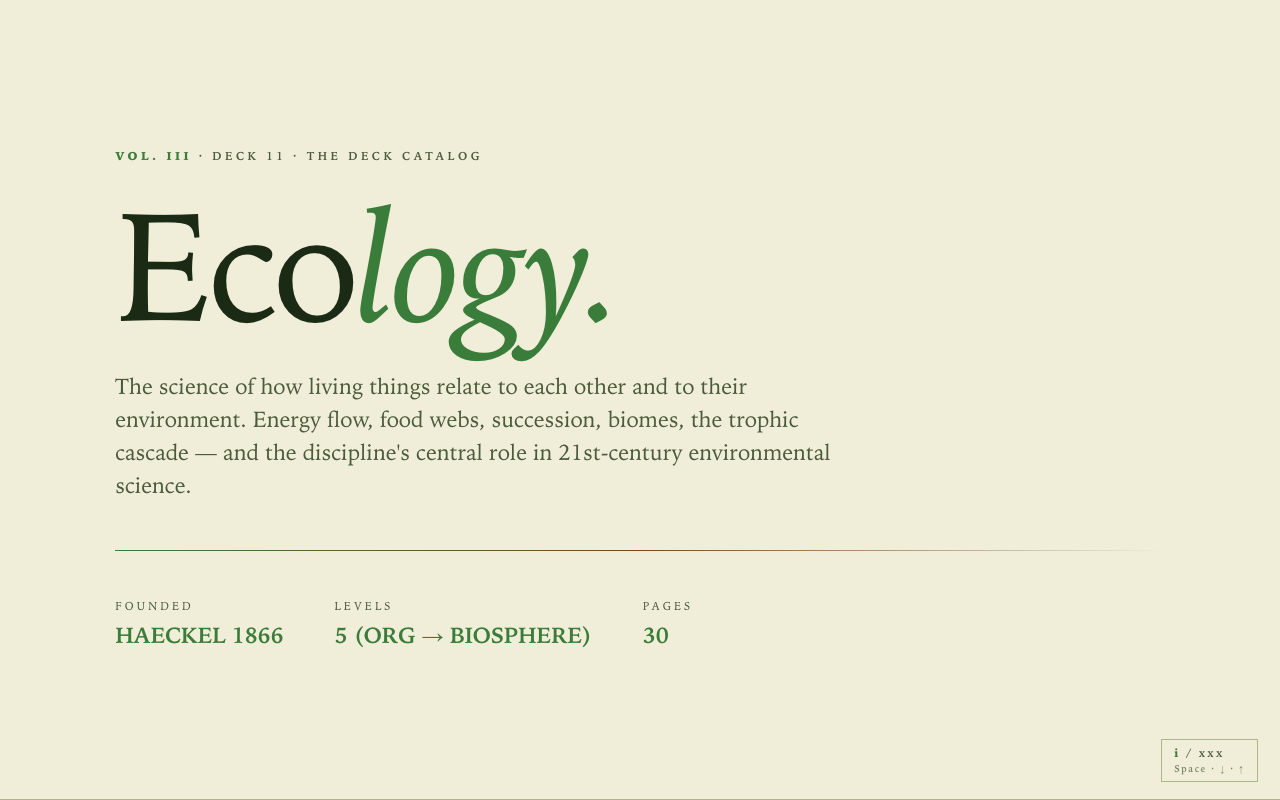
Ecology / Webs of Dependence

— A FIELD GUIDE, PLATE I — ECOLOGY Webs of Dependence Thirteen Plates · on Living Systems Plate II Levels of Organization from a single being to the...

StandaloneDownload
Sandboxed deck
Open raw

About this HTML presentation

This Shipslides page presents Ecology / Webs of Dependence as an interactive HTML presentation deck in the Science catalog with 14 slides. The share page keeps the uploaded deck sandboxed while exposing readable context, topics, and a slide outline for viewers and search engines.

— A FIELD GUIDE, PLATE I — ECOLOGY Webs of Dependence Thirteen Plates · on Living Systems Plate II Levels of Organization from a single being to the living Earth organism A single living individual — one oak, one robin, one hyphal strand of fungus. population All members of one species inhabiting a defined place at a defined time. community All populations interacting in the same locality — predators, prey... Key sections include: ECOLOGY; Webs of Dependence; Levels of Organization from a single being to the living Earth; Major Biomes of the Earth climate paints the world in distinct hands; Energy & the Ten-Percent Rule each step up the pyramid loses ninety; Nutrient Cycles matter is borrowed, not consumed; Predator & Prey Lotka & Volterra: a dance in two voices; Niches & Competition Gause's principle of exclusion; Keystone Species remove the stone, the arch falls; Biodiversity Hotspots much, in very little.

Key sections

  • 01ECOLOGY
  • 02Webs of Dependence
  • 03Levels of Organization from a single being to the living Earth
  • 04Major Biomes of the Earth climate paints the world in distinct hands
  • 05Energy & the Ten-Percent Rule each step up the pyramid loses ninety
  • 06Nutrient Cycles matter is borrowed, not consumed
  • 07Predator & Prey Lotka & Volterra: a dance in two voices
  • 08Niches & Competition Gause's principle of exclusion
  • 09Keystone Species remove the stone, the arch falls
  • 10Biodiversity Hotspots much, in very little
  • 11Trophic Cascades change at the top reaches the roots
  • 12The Anthropocene a sixth mass extinction
  • 13Conservation tools to keep the web from fraying
  • 14Further Reading & Viewing where to follow these threads onward
Topics covered

Slide outline
  1. 01ECOLOGY
  2. 02Webs of Dependence
  3. 03Levels of Organization from a single being to the living Earth
  4. 04Major Biomes of the Earth climate paints the world in distinct hands
  5. 05Energy & the Ten-Percent Rule each step up the pyramid loses ninety
  6. 06Nutrient Cycles matter is borrowed, not consumed
  7. 07Predator & Prey Lotka & Volterra: a dance in two voices
  8. 08Niches & Competition Gause's principle of exclusion
  9. 09Keystone Species remove the stone, the arch falls
  10. 10Biodiversity Hotspots much, in very little
  11. 11Trophic Cascades change at the top reaches the roots
  12. 12The Anthropocene a sixth mass extinction
  13. 13Conservation tools to keep the web from fraying
  14. 14Further Reading & Viewing where to follow these threads onward
Page data
Canonical
https://shipslides.com/d/catalog-science-ecology
Category
Science
Size
56.4 KB
Updated
2026-05-17
LLM text
https://shipslides.com/d/catalog-science-ecology/llms.txt

Presentation Transcript

Detailed slide-by-slide text content extracted from this presentation.

Slide 01

ECOLOGY

  • — A FIELD GUIDE, PLATE I —
  • Webs of Dependence
  • Thirteen Plates · on Living Systems
Slide 02

Levels of Organizationfrom a single being to the living Earth

  • Plate II
  • organism
  • A single living individual — one oak, one robin, one hyphal strand of fungus.
  • population
  • All members of one species inhabiting a defined place at a defined time.
  • community
  • All populations interacting in the same locality — predators, prey, competitors, mutualists.
  • ecosystem
  • A community plus its physical setting: soil, climate, water, sunlight, and the flow of matter and energy through them.
  • biosphere
  • The thin shell of all ecosystems, considered as one — Earth's entire envelope of life.
Slide 03

Major Biomes of the Earthclimate paints the world in distinct hands

  • Plate III
  • Tundra
  • Frozen ground, mosses & lichens, brief blooming summer.
  • Taiga
  • Boreal conifer forest — spruce, fir, pine; the green crown of the north.
  • Temperate
  • Deciduous forests & grasslands; four seasons, oak, beech, prairie.
  • Tropical
  • Year-round warmth & rain; rainforests cradle half of Earth's species.
  • Desert
  • Less than 25 cm rain a year — life adapts with succulence and silence.
  • Marine
  • Open ocean, reefs, kelp & deep — the largest biome by far, covering 71% of Earth.
Slide 04

Energy & the Ten-Percent Ruleeach step up the pyramid loses ninety

  • Plate IV
  • Energy enters ecosystems as sunlight, captured by photosynthesizing producers. From there it travels along trophic levels — and at each transfer, most of it is lost.
  • Roughly only 10% of the energy at one level is incorporated into the next. The rest is exhaled as heat, spent in respiration, or lies undigested in scat.
  • This is why apex predators are rare. A pasture supports millions of grass blades, thousands of voles, hundreds of foxes, and perhaps a single eagle nesting overhead.
  • It takes ten thousand pounds of grass to make one pound of mountain lion.
  • FIG. IV — TROPHIC PYRAMID
Slide 05

Nutrient Cyclesmatter is borrowed, not consumed

  • Plate V
  • Unlike energy, which flows through and dissipates, the elements of life are recycled — passed between living tissue, soil, water, and air across geological time.
  • Carbon
  • Photosynthesis pulls CO₂ from the air; respiration & decay return it. Reservoirs in oceans, soils, and rock release on slow rhythms — disturbed now by combustion of fossil seams.
  • Nitrogen
  • Atmospheric N₂ is fixed by lightning and bacterial root partners (legumes, cyanobacteria) into ammonia & nitrates plants can use; denitrifiers eventually return it to air.
  • Water
  • Evaporation, condensation, precipitation, transpiration — the hydrologic loop. Forests sweat the rain that falls downwind; remove the trees and rivers fail.
  • Phosphorus
  • Slow & sedimentary — has no gaseous phase. Weathered from rock, taken up by plants, returned by decomposition. Often the limiting nutrient in fresh waters.
Slide 06

Predator & PreyLotka & Volterra: a dance in two voices

  • Plate VI
  • In 1925–26, Alfred Lotka and Vito Volterra independently described how the populations of a predator and its prey can oscillate — each chasing the other in slow waves.
  • When hares are plentiful, lynx multiply. Their abundance then thins the hares; without prey the lynx starve, and the hares rebound. Decades of Hudson's Bay Company pelt records (1845–1935) show this rhythm in nature.
  • The cycle is roughly ten years long, and the predator's peak lags the prey's by a season or more — a fingerprint of coupled lives.
  • FIG. VI — POPULATION OSCILLATION
Slide 07

Niches & CompetitionGause's principle of exclusion

  • Plate VII
  • A niche is the role a species plays — its food, its shelter, its hours of activity, its tolerance for cold and damp. Every dimension of life it occupies.
  • Georgii Gause (1934) put two species of Paramecium in a single tube of broth. They could not coexist: one always drove the other extinct.
  • No two species can occupy the same ecological niche indefinitely — one wins, the other yields, splits, or disappears.
  • In the wild, species solve this by partitioning resources — different prey sizes, different perch heights, different times of day. MacArthur's warblers each forage in a distinct part of the same spruce.
  • FIG. VII — NICHE PARTITIONING
Slide 08

Keystone Speciesremove the stone, the arch falls

  • Plate VIII
  • A keystone species exerts disproportionate influence on its community — its absence reorganizes everything beneath it. Robert Paine (1969) coined the term after pulling starfish from a Washington coast and watching mussels overrun all other life.
  • Sea otters & kelp forests
  • Otters eat sea urchins. Without otters, urchins explode and graze kelp forests to bare rock — entire submarine cathedrals collapse into “urchin barrens.” Otters returning to the Pacific coast in the 20th c. brought the kelp back.
  • Wolves of Yellowstone
  • Reintroduced in 1995 after a 70-year absence. Elk could no longer browse riverbanks unmolested; willows and aspens recovered, beavers returned, river channels themselves shifted shape — a famous “trophic cascade.”
  • FIG. VIII — A FOOD WEB
Slide 09

Biodiversity Hotspotsmuch, in very little

  • Plate IX
  • Norman Myers (1988) noticed that biodiversity is wildly uneven — a few small regions hold disproportionate amounts of the world's living variety. Conservation International today recognizes 36 hotspots, defined by extreme endemism and severe loss.
  • recognized hotspots worldwide
  • ~50%
  • of all vascular plant species are endemic to them
  • 2.4%
  • of Earth's land surface — what they cover
  • FIG. IX — BIOME MAP
Slide 10

Trophic Cascadeschange at the top reaches the roots

  • Plate X
  • A trophic cascade is the rippling effect of one trophic level on the levels far beneath it. Top-down: predators shape herbivores, herbivores shape vegetation, vegetation shapes soil and rivers themselves.
  • In the kelp-otter system: more otters → fewer urchins → more kelp → more fish, sea birds, whales.
  • In Yellowstone: more wolves → wary elk → recovering willow → returning songbirds & beavers → re-meandered streams. The wolf, in this telling, is also a hydrologist.
  • Cascades reveal that ecosystems are not loose collections but tightly braided wholes; pulling on any single strand redraws the whole pattern.
  • FIG. X — A CASCADE
Slide 11

The Anthropocenea sixth mass extinction

  • Plate XI
  • Five times in Earth's deep history more than three quarters of all species have vanished within a geological eyeblink — at the close of the Ordovician, Devonian, Permian, Triassic, and Cretaceous.
  • We are now midway through a sixth. The 2019 IPBES Global Assessment estimated that around one million species face extinction in the coming decades — many within decades, not centuries.
  • The drivers are by now familiar: habitat loss, direct exploitation, climate change, pollution, and invasive species. Each amplifies the others.
  • For the first time, the geology of a single species — ours — is reshaping the biosphere of the planet.
  • FIG. XI — RATES OF LOSS
Slide 12

Conservationtools to keep the web from fraying

  • Plate XII
  • There is no single remedy, only a working repertoire — practiced across scales from the gene bank to the continent.
  • Protected areas
  • National parks, marine reserves, biosphere reserves. The 30×30 framework asks for 30% of land & sea protected by 2030 — a target adopted in Montreal, 2022.
  • Rewilding
  • Returning missing species (wolves, bison, beavers) and restoring ecological processes — letting landscapes reassemble themselves rather than be gardened.
  • Wildlife corridors
  • Stitching fragmented habitat with bridges, underpasses, and connecting strips so populations can mix, migrate, and adjust to a shifting climate.
  • Captive breeding
  • Last-resort insurance for the brink: California condors, Arabian oryx, Mauritius kestrels — pulled from extinction through breeding & reintroduction.
Slide 13

Further Reading & Viewingwhere to follow these threads onward
  • Plate XIII — Coda
  • References
  • Lotka, A. J. (1925). Elements of Physical Biology.
  • Gause, G. F. (1934). The Struggle for Existence.
  • Paine, R. T. (1969). “A Note on Trophic Complexity and Community Stability.”
  • Myers, N. et al. (2000). “Biodiversity hotspots for conservation priorities.” Nature.
  • IPBES (2019). Global Assessment Report on Biodiversity and Ecosystem Services.
  • Wilson, E. O. (2016). Half-Earth: Our Planet's Fight for Life.
  • Carson, R. (1962). Silent Spring.
  • Viewing
  • Trophic Cascade — Yellowstone
  • Biodiversity Hotspots
  • — end of plates —
Remove this deck