shipslides
Science17 slides0 views

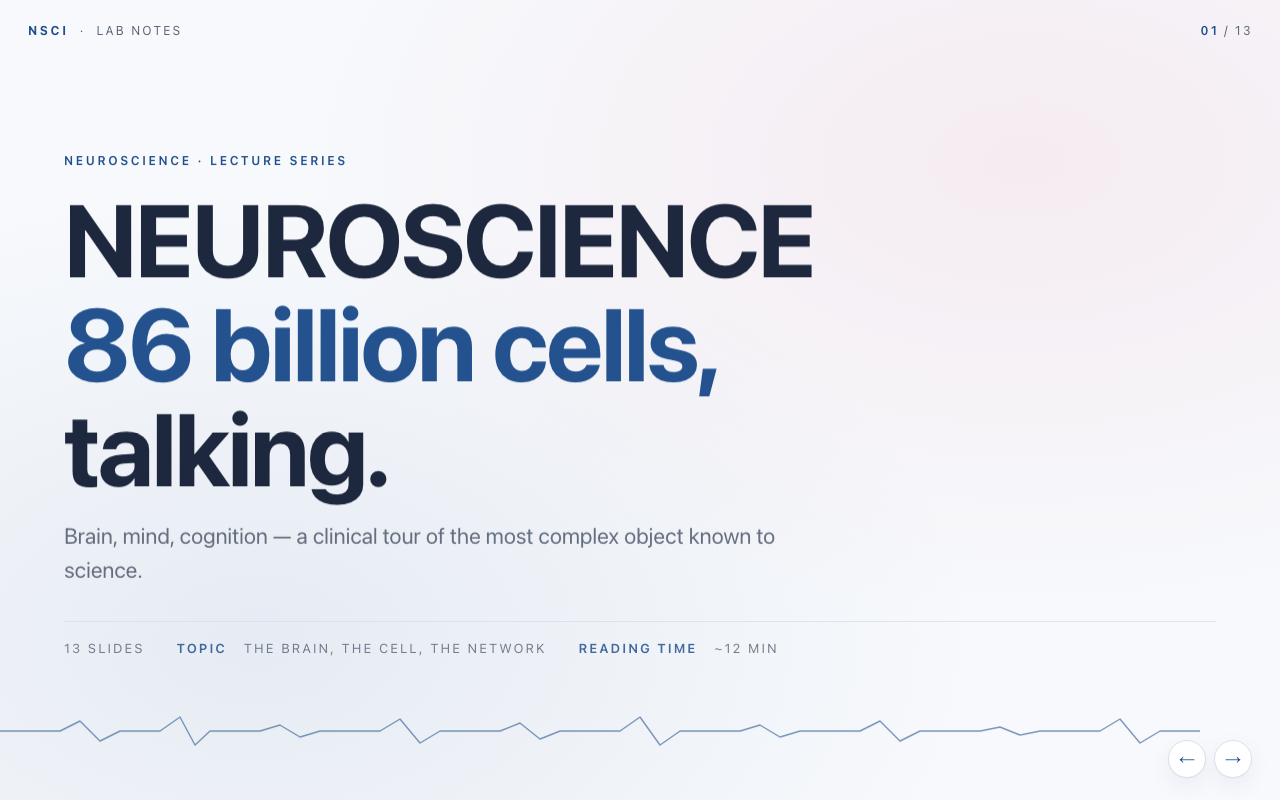
Neuroscience

~86,000,000,000 neurons. ~10¹⁵ synapses. The 1.4-kg organ that thinks about itself, often poorly.

StandaloneDownload
Sandboxed deck
Open raw

About this HTML presentation

This Shipslides page presents Neuroscience as an interactive HTML presentation deck in the Science catalog with 17 slides. The share page keeps the uploaded deck sandboxed while exposing readable context, topics, and a slide outline for viewers and search engines.

~86,000,000,000 neurons. ~10¹⁵ synapses. The 1.4-kg organ that thinks about itself, often poorly. Key sections include: Neuro science.; The neuron.; The action potential.; The synapse.; The regions.; Cells that fire together , wire together.; How the brain tastes the world.; Builders of brain science.; Two centuries of nerves.; The brain in equations..

Key sections

  • 01Neuro science.
  • 02The neuron.
  • 03The action potential.
  • 04The synapse.
  • 05The regions.
  • 06Cells that fire together , wire together.
  • 07How the brain tastes the world.
  • 08Builders of brain science.
  • 09Two centuries of nerves.
  • 10The brain in equations.
  • 11The brain's chemistry.
  • 12The hard problem.
  • 13When the network breaks.
  • 14What's active now.
  • 15The deep uncertainties.
  • 16Watch & read.

Topics covered

Slide outline
  1. 01Neuro science.
  2. 02The neuron.
  3. 03The action potential.
  4. 04The synapse.
  5. 05The regions.
  6. 06Cells that fire together , wire together.
  7. 07How the brain tastes the world.
  8. 08Builders of brain science.
  9. 09Two centuries of nerves.
  10. 10The brain in equations.
  11. 11The brain's chemistry.
  12. 12The hard problem.
  13. 13When the network breaks.
  14. 14What's active now.
  15. 15The deep uncertainties.
  16. 16Watch & read.
Page data
Canonical
https://shipslides.com/d/science-neuroscience
Category
Science
Size
459.3 KB
Updated
2026-05-17
LLM text
https://shipslides.com/d/science-neuroscience/llms.txt

Presentation Transcript

Detailed slide-by-slide text content extracted from this presentation.

Slide 01

The neuron.

  • SCAN 01 / 17 — UNIT
  • Santiago Ramón y Cajal, 1888: the brain is built of discrete cells, not a continuous net. Camillo Golgi's silver stain made them visible; Cajal interpreted them. Shared 1906 Nobel.
  • A typical neuron: dendrites receive signals; the cell body integrates them; the axon transmits an action potential to the terminals; synaptic vesicles release neurotransmitters across the cleft.
  • cell body5–100 μm diameter
  • axon lengthμm to ~1 m (sciatic motoneuron)
  • conduction speed0.5 – 120 m/s (myelinated)
  • refractory period~1–2 ms
  • synapses per neuron10³ – 10⁵
Slide 02

The action potential.

  • SCAN 02 / 17 — SIGNAL
  • Voltage-gated Na⁺ channels open at threshold (~−55 mV). Sodium rushes in; the membrane depolarizes to ~+30 mV in < 1 ms. Na⁺ channels inactivate; K⁺ channels open; potassium leaks out; the membrane repolarizes.
  • Hodgkin and Huxley quantified all of this in squid giant axons in 1952 — Nobel 1963. Their equations:
  • I = Cm dV/dt + INa + IK + IL
  • still teach computational neuroscience today.
Slide 03

The synapse.

  • SCAN 03 / 17 — JUNCTION
  • At the chemical synapse — most synapses in the human brain — depolarization of the presynaptic terminal opens voltage-gated Ca²⁺ channels; Ca²⁺ triggers vesicle fusion via SNARE proteins; neurotransmitter diffuses ~20 nm across the cleft; postsynaptic receptors open ion channels.
  • Excitatory: glutamate (~80 % of cortical synapses), AMPA & NMDA receptors. Inhibitory: GABA, GABAA (Cl⁻) and GABAB (G-protein) receptors. Modulatory: dopamine, serotonin, acetylcholine, noradrenaline.
  • cleft width~20 nm
  • vesicle diameter~40 nm
  • vesicles released1–10 per spike
  • NT molecules / vesicle~5,000
  • delay~0.5 ms
Slide 04

The regions.

  • SCAN 04 / 17 — ANATOMY
  • frontal lobeplanning, motor, executive
  • parietal lobesomatosensory, spatial
  • occipital lobevisual cortex (V1–V5)
  • temporal lobehearing, language, memory
  • cerebellummotor coordination, timing
  • brainstemautonomic, arousal
  • hippocampusepisodic memory
  • amygdalaemotion, threat detection
  • thalamussensory relay
  • basal gangliaaction selection, habits
Slide 05

SCAN 05 / 17

  • A T2-weighted analog. fMRI BOLD signals in vivo correlate ~hemodynamic delay 4–6 s after neural activity.
Slide 06

Cells that fire together, wire together.

  • SCAN 06 / 17 — PLASTICITY
  • Donald Hebb, 1949: synaptic strength changes with correlated pre- and post-synaptic activity. Cellularly demonstrated by Bliss & Lømo in 1973: long-term potentiation (LTP) of dentate gyrus synapses by tetanic stimulation, lasting hours, days, weeks.
  • The molecular machinery: NMDA receptors as coincidence detectors (require both glutamate AND postsynaptic depolarization to relieve Mg²⁺ block); Ca²⁺ entry triggers AMPA receptor insertion via CaMKII; with sustained activity, gene expression and morphological growth (spine enlargement, new spines).
  • Inverse: long-term depression (LTD), driven by lower Ca²⁺. Together: bidirectional learning rule, basis of synaptic theories of memory.
Slide 07

How the brain tastes the world.

  • SCAN 07 / 17 — SENSES
  • Vision
  • Photons → rhodopsin/opsins in rods/cones → bipolar/ganglion cells → optic nerve → LGN → V1 retinotopy.
  • Hearing
  • Pressure waves → cochlear hair cells → tonotopic organ of Corti → auditory nerve → A1.
  • Touch
  • Mechanoreceptors (Merkel, Meissner, Pacinian, Ruffini), thermoreceptors, nociceptors → dorsal columns → S1 homunculus.
  • Smell & Taste
  • ~400 olfactory receptor genes, combinatorial code; 5+ taste qualities (sweet, salty, sour, bitter, umami) via TRPM/T1R/T2R.
Slide 08

Builders of brain science.

  • SCAN 08 / 17 — FIGURES
  • Cajal
  • 1852–1934. Neuron doctrine; exquisite drawings.
  • Sherrington
  • 1857–1952. Synapse coined; reflexes.
  • Hodgkin & Huxley
  • 1952. Action potential mathematized.
  • Hubel & Wiesel
  • 1959–. Visual cortex orientation columns.
  • Patient HM
  • Henry Molaison. Bilateral hippocampectomy revealed memory systems.
  • O'Keefe, Mosers
  • Place cells, grid cells. Nobel 2014.
  • Eric Kandel
  • Aplysia LTP; molecular memory. Nobel 2000.
  • Karl Deisseroth
  • Optogenetics, CLARITY tissue clearing.
Slide 09

Two centuries of nerves.

  • SCAN 09 / 17 — TIMELINE
  • 1791Galvani: frog legs twitch on metal — animal electricity.
  • 1848Phineas Gage's iron rod; frontal lobe and personality.
  • 1861Broca's patient "Tan"; speech in left frontal cortex.
  • 1888–1906Cajal & Golgi work out neuronal architecture.
  • 1924Hans Berger records the first human EEG.
  • 1952Hodgkin–Huxley equations.
  • 1957Patient HM's bilateral medial-temporal lobectomy maps memory.
  • 1973LTP discovered.
  • 1990sfMRI BOLD signal — Kwong, Ogawa.
  • 2005Optogenetics: Boyden, Deisseroth express channelrhodopsin in neurons.
  • 2013BRAIN Initiative (US), Human Brain Project (EU).
  • 2024Janelia/Google MICrONS: ~1 mm³ of mouse cortex synapse-resolved (~ 10⁸ synapses).
Slide 10

The brain in equations.

  • SCAN 10 / 17 — MATH
  • Nernst
  • Eion = (RT/zF) ln([X]o/[X]i)
  • Equilibrium potential for an ion across a membrane. K⁺: ~−90 mV; Na⁺: +60 mV.
  • Goldman–Hodgkin–Katz
  • Vm = (RT/F) ln (Σ Pi[Xo] / Σ Pj[Xi])
  • Resting potential weighted by ion permeabilities.
  • Cable Equation
  • τ ∂V/∂t = λ² ∂²V/∂x² − V
  • Wilfred Rall, 1959. Passive signal spread along dendrites.
Slide 11

The brain's chemistry.

  • SCAN 11 / 17 — CHEMISTRY
  • Glutamate
  • Main excitatory NT. AMPA fast, NMDA slow + Ca²⁺. Excitotoxicity in stroke.
  • GABA
  • Main inhibitory NT. Benzodiazepines, alcohol, anesthetics potentiate GABAA.
  • Dopamine
  • Reward prediction error; movement (Parkinson's). VTA, substantia nigra.
  • Serotonin
  • Mood, sleep, gut. SSRIs target reuptake. Raphe nuclei.
  • Acetylcholine
  • Neuromuscular junction; cortical attention/arousal. Lost in Alzheimer's.
  • Noradrenaline
  • Locus coeruleus. Arousal, fight-or-flight, attention.
  • Endocannabinoids
  • Anandamide, 2-AG. Retrograde messengers; CB1, CB2 receptors.
  • Neuropeptides
  • Oxytocin, vasopressin, opioids, substance P. Slower, longer-lasting.
Slide 12

Slide 12

  • SCAN 12 / 17 — PULL QUOTE
  • "If our brains were simple enough for us to understand, we would be too simple to understand them."— EMERSON M. PUGH, OFTEN MISATTRIBUTED TO LYALL WATSON
Slide 13

The hard problem.

  • SCAN 13 / 17 — CONSCIOUSNESS
  • David Chalmers (1995) distinguished the "easy" problems of consciousness — explaining attention, integration, reportability — from the "hard" problem: why is there subjective experience at all? Why does any of this feel like anything?
  • Several theories compete:
  • GNWGlobal Neuronal Workspace (Baars, Dehaene). Broadcast to a frontoparietal network.
  • IITIntegrated Information Theory (Tononi). Φ measures irreducible cause-effect structure.
  • HOTHigher-order thought theories. Consciousness = representation of representations.
  • PCTPredictive coding / active inference (Friston). Brain as Bayesian model.
  • In 2023, an "adversarial collaboration" between IIT and GNW returned mixed verdicts. The hard problem itself remains unresolved.
  • Levels of Awareness
Slide 14

When the network breaks.

  • SCAN 14 / 17 — DISORDERS
  • Alzheimer's
  • Aβ plaques, tau tangles. ~55 M cases globally. Lecanemab/donanemab (2023–24) modestly slow progression.
  • Parkinson's
  • Substantia nigra dopamine loss; α-synuclein aggregates. L-DOPA, deep brain stimulation.
  • Major depression
  • ~280 M cases. SSRIs & SNRIs first-line; ketamine/esketamine for treatment-resistant.
  • Schizophrenia
  • ~24 M cases. Dopamine D2 hyperactivity (mesolimbic) and hypoactivity (prefrontal); glutamate/NMDA hypofunction theories.
  • Stroke
  • 2nd cause of death globally. Ischemic vs hemorrhagic. tPA < 4.5 h, thrombectomy < 24 h.
  • Epilepsy
  • Hypersynchronous discharges. ~50 M cases. Antiepileptic drugs, vagus nerve stim, resective surgery.
Slide 15

What's active now.

  • SCAN 15 / 17 — FRONTIER
  • Brain-computer interfaces
  • Neuralink, Synchron, BrainGate. Speech decoding from cortical electrodes; human trials underway.
  • Connectomics
  • Drosophila full-brain (FlyWire, 140k neurons, 50M synapses, 2024). Mouse cubic mm done; primate scaling.
  • Organoids
  • Cerebral organoids; assembloids; neural-network-grown wetware. Ethical questions accumulating.
  • Psychedelics
  • Psilocybin, MDMA, ketamine, LSD: serotonergic 5-HT2A modulation; clinical phase III for PTSD, depression.
  • Glymphatic system
  • Brain's waste-clearance pathway, mostly during sleep. Cerebrospinal fluid flow along perivascular spaces.
  • Aging brain
  • GLP-1 agonists, senolytics, intermittent fasting. Cognitive reserve. Klotho protein.
Slide 16

The deep uncertainties.

  • SCAN 16 / 17 — OPEN
  • Q.01What is consciousness, computationally and physically?
  • Q.02What's the neural code? Rate? Population? Phase? Sparse? All of the above?
  • Q.03How do we form, store, and recall a single memory at the synaptic / cellular level?
  • Q.04What is the basic unit of cortical computation — column? minicolumn? circuit motif?
  • Q.05Can we cure or even slow major neurodegenerative diseases?
  • Q.06What's the developmental program that wires 86 B neurons with mostly non-genetic precision?
  • Q.07How does sleep do its many jobs — memory consolidation, glymphatic clearance, synaptic homeostasis?
Slide 17

Watch & read.

  • SCAN 17 / 17 — GO DEEPER
  • Veritasium & Crash Course
  • Plus Robert Sapolsky's Stanford behavioural biology course and "2-Minute Neuroscience" by Neuroscientifically Challenged.
  • Watch ↗
  • References
  • KandelPrinciples of Neural Science 6e
  • PurvesNeuroscience 6e
  • Dayan & AbbottTheoretical Neuroscience
  • SapolskyBehave (2017)
  • DamasioThe Feeling of What Happens
  • SethBeing You (2021)
Remove this deck