shipslides
Science30 slides0 views

Astrophysics

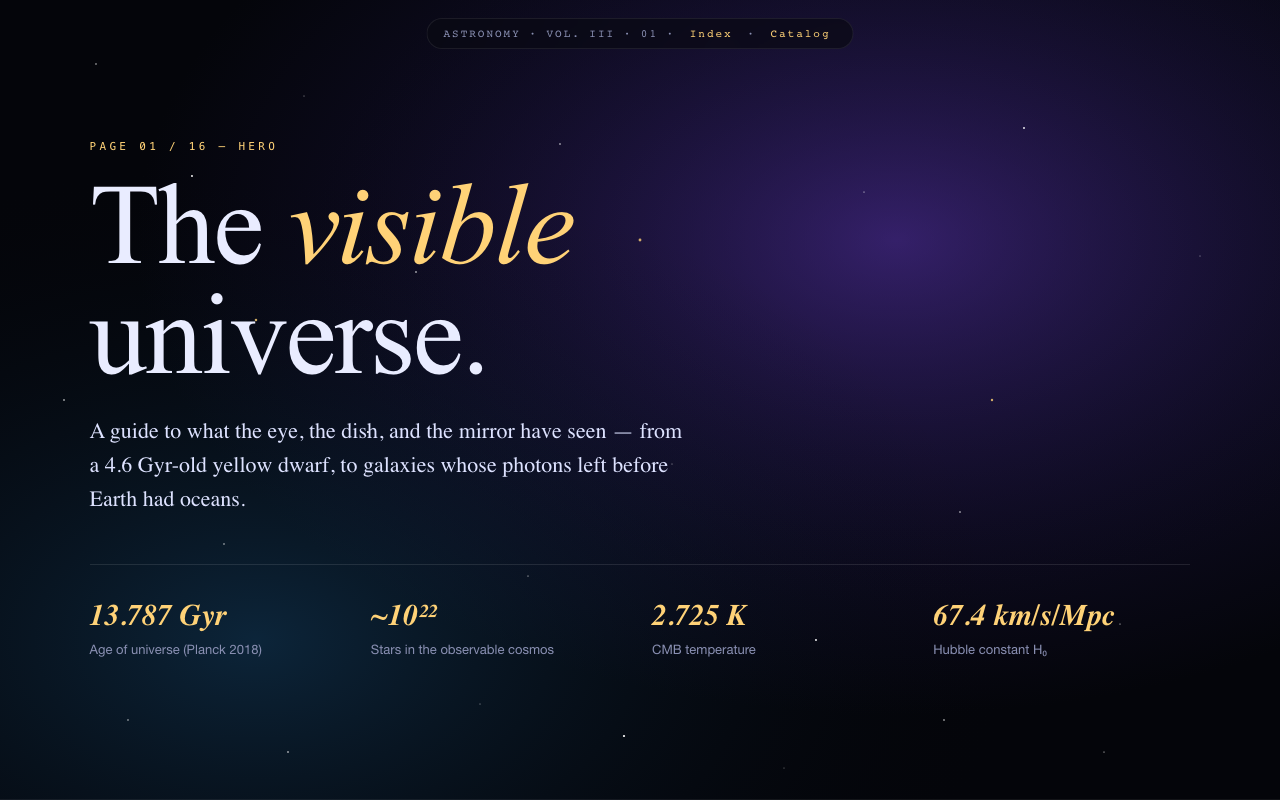
The Physics of the Cosmos -- From Subatomic to Supergalactic. Slides: Astrophysics · What is Astrophysics? · The Hertzsprung-Russell Diagram · Stellar Nucleosynthesis · Stellar Evolution · Black Holes · Neutron Stars · The Big Bang · Dark Matter · Dark Energy · General Relativity in Astrophysics.

StandaloneDownloadMarkdown
Sandboxed deck
Open raw

About this HTML presentation

This Shipslides page presents Astrophysics as an interactive HTML presentation deck in the Science catalog with 30 slides. The share page keeps the uploaded deck sandboxed while exposing readable context, topics, and a slide outline for viewers and search engines.

The Physics of the Cosmos -- From Subatomic to Supergalactic Key sections include: Astrophysics; What is Astrophysics?; The Hertzsprung-Russell Diagram; Stellar Nucleosynthesis; Stellar Evolution; Black Holes; Neutron Stars; The Big Bang; Dark Matter; Dark Energy.

Key sections

  • 01Astrophysics
  • 02What is Astrophysics?
  • 03The Hertzsprung-Russell Diagram
  • 04Stellar Nucleosynthesis
  • 05Stellar Evolution
  • 06Black Holes
  • 07Neutron Stars
  • 08The Big Bang
  • 09Dark Matter
  • 10Dark Energy
  • 11General Relativity in Astrophysics
  • 12Gravitational Waves
  • 13Galaxy Formation and Evolution
  • 14The Cosmic Microwave Background
  • 15Supernovae
  • 16Exoplanets
  • 17Active Galactic Nuclei
  • 18Cosmic Distance Ladder
  • 19The Hubble Tension
  • 20High-Energy Astrophysics
  • 21Large-Scale Structure
  • 22Star Formation
  • 23Cosmological Parameters
  • 24Multi-Messenger Astronomy

Topics covered

Slide outline
  1. 01Astrophysics
  2. 02What is Astrophysics?
  3. 03The Hertzsprung-Russell Diagram
  4. 04Stellar Nucleosynthesis
  5. 05Stellar Evolution
  6. 06Black Holes
  7. 07Neutron Stars
  8. 08The Big Bang
  9. 09Dark Matter
  10. 10Dark Energy
  11. 11General Relativity in Astrophysics
  12. 12Gravitational Waves
  13. 13Galaxy Formation and Evolution
  14. 14The Cosmic Microwave Background
  15. 15Supernovae
  16. 16Exoplanets
  17. 17Active Galactic Nuclei
  18. 18Cosmic Distance Ladder
  19. 19The Hubble Tension
  20. 20High-Energy Astrophysics
  21. 21Large-Scale Structure
  22. 22Star Formation
  23. 23Cosmological Parameters
  24. 24Multi-Messenger Astronomy
  25. 25JWST and the New Frontier
  26. 26Stellar Classification
  27. 27Planetary Science
  28. 28Radio Astronomy
  29. 29Open Questions
  30. 30Summary
Page data
Canonical
https://shipslides.com/d/science-astrophysics
Category
Science
Size
36.8 KB
Updated
2026-05-17
LLM text
https://shipslides.com/d/science-astrophysics/llms.txt

Presentation Transcript

Detailed slide-by-slide text content extracted from this presentation.

Slide 01

Astrophysics

  • The Physics of the Cosmos -- From Subatomic to Supergalactic
  • Understanding the physical processes that govern stars, galaxies, black holes, and the large-scale structure of the universe.
  • CosmologyStellar PhysicsGeneral RelativityNuclear Physics
Slide 02

What is Astrophysics?

  • Astrophysics applies the laws of physics -- mechanics, thermodynamics, electromagnetism, nuclear physics, quantum mechanics, and general relativity -- to understand celestial objects and phenomena. It seeks to explain not merely what is out there, but why it looks and behaves the way it does.
  • Core Questions
  • How do stars form, live, and die?
  • What is the nature of dark matter and dark energy?
  • How did the universe begin and how will it end?
  • What generates the most energetic events in the cosmos?
  • Are we alone in the universe?
  • Methods
  • Multi-wavelength observations (radio to gamma-ray)
  • Gravitational wave detection
  • Neutrino astronomy
  • Computational simulations
  • Theoretical modeling and analytic solutions
Slide 03

The Hertzsprung-Russell Diagram

  • The most important diagram in stellar astrophysics. Plots luminosity against surface temperature, revealing that stars cluster into distinct populations reflecting their evolutionary state.
  • Main Sequence
  • Where stars spend ~90% of their lives fusing hydrogen to helium. A tight band from hot, luminous O-stars (top-left) to cool, dim M-dwarfs (bottom-right). Mass determines position.
  • Red Giants
  • Post-main-sequence stars with exhausted core hydrogen. Expanded envelopes, cool surfaces, high luminosity. Future fate of our Sun in ~5 billion years.
  • White Dwarfs
  • Stellar remnants below the main sequence. Earth-sized but Sun-mass. Supported by electron degeneracy pressure. Slowly cooling over billions of years.
  • Instability Strip
  • Region containing pulsating variables (Cepheids, RR Lyrae). Their period-luminosity relation makes them crucial distance indicators -- Hubble's original cosmic yardstick.
Slide 04

Stellar Nucleosynthesis

  • Stars are the nuclear furnaces that forged nearly every element in the periodic table from primordial hydrogen and helium.
  • Fusion Chain
  • pp chain: H to He (Sun's primary source, T~15M K)
  • CNO cycle: H to He via C,N,O catalysts (massive stars)
  • Triple-alpha: 3 He-4 to C-12 (red giants)
  • Alpha capture: C to O to Ne to Mg to Si
  • Silicon burning: Si to Fe (core of massive stars, hours before death)
  • Beyond Iron
  • Iron is the endpoint of exothermic fusion. Heavier elements require energy input and are created by:
  • s-process: Slow neutron capture in AGB stars (Sr, Ba, Pb)
  • r-process: Rapid neutron capture in neutron star mergers and supernovae (Au, Pt, U)
  • p-process: Proton-rich isotopes via photodisintegration
Slide 05

Stellar Evolution

  • A star's fate is almost entirely determined by its birth mass. More massive stars live shorter, more violent lives.
  • Low Mass (less than 0.5 solar)
  • Red dwarfs. Fully convective, burn hydrogen for trillions of years. No red giant phase. Eventually become helium white dwarfs. None have yet died in our universe.
  • Sun-like (0.5 - 8 solar)
  • Main sequence for billions of years, then red giant, helium flash, AGB phase with thermal pulses, planetary nebula ejection, white dwarf remnant.
  • Massive (8 - 25 solar)
  • Rapid evolution through successive fusion stages. Iron core collapse triggers core-collapse supernova. Remnant: neutron star (1.4-2 solar masses).
  • Very Massive (25+ solar)
  • May lose envelopes via stellar winds (Wolf-Rayet stars). Core collapse may produce a black hole directly or via fallback. Possible pair-instability supernovae above 130 solar masses.
Slide 06

Black Holes

  • "Black holes are where God divided by zero."Popular saying (attributed to various)
  • Regions of spacetime where gravity is so extreme that nothing -- not even light -- can escape once past the event horizon. Predicted by general relativity, confirmed observationally.
  • Stellar Black Holes
  • 3-100 solar masses. Formed from massive star core collapse. Thousands in our galaxy. Detected via X-ray binaries and gravitational waves from mergers.
  • Supermassive Black Holes
  • 10^6 - 10^10 solar masses. Found at centers of most galaxies. Sagittarius A* (4 million solar) is our Milky Way's. Formation mechanism still debated.
  • Hawking Radiation
  • Quantum effects near the horizon produce thermal radiation. Black holes slowly evaporate. For stellar-mass BHs, the temperature is negligible (~10^-8 K). Micro-BHs would evaporate explosively.
  • Event Horizon Telescope
  • 2019: First image of M87* black hole shadow. 2022: Image of Sgr A*. Earth-sized virtual telescope using very long baseline interferometry at 1.3mm wavelength.
Slide 07

Neutron Stars

  • The densest observable objects in the universe. A neutron star packs 1.4-2.1 solar masses into a sphere just 20 km across -- a teaspoon weighs a billion tons.
  • Properties
  • Density: 10^17 kg/m^3 (nuclear density)
  • Surface gravity: 2 x 10^11 g
  • Magnetic fields: 10^8 - 10^15 Tesla
  • Rotation periods: milliseconds to seconds
  • Surface temperature: ~10^6 K
  • Types
  • Pulsars: Beamed radio emission sweeping like a lighthouse
  • Magnetars: Ultra-strong magnetic fields (10^15 T). Starquakes produce giant gamma-ray flares
  • Millisecond pulsars: Spun up by accretion. Rival atomic clocks in stability
  • X-ray binaries: Accreting matter from companion star
Slide 08

The Big Bang

  • The universe began 13.8 billion years ago from an extremely hot, dense state and has been expanding and cooling ever since. The evidence is overwhelming.
  • Key Evidence
  • Hubble expansion, cosmic microwave background (CMB) at 2.725 K, primordial nucleosynthesis (H:He ratio of 75:25 by mass), and large-scale structure formation matching predictions.
  • Timeline
  • Planck era (10^-43 s), inflation (10^-36 s), quark-gluon plasma (10^-6 s), nucleosynthesis (3 min), recombination (380,000 yr), first stars (200 Myr), galaxies form (1 Gyr).
  • Inflation
  • A period of exponential expansion (10^-36 to 10^-32 s) that explains the flatness, horizon, and monopole problems. Generated primordial density fluctuations that seeded all cosmic structure.
  • Open Questions
  • What drove inflation? What is the physics of the Planck era? Why is there more matter than antimatter (baryogenesis)? What happened "before" the Big Bang?
Slide 09

Dark Matter

  • Approximately 27% of the universe's mass-energy content consists of invisible matter that interacts gravitationally but not electromagnetically. Its nature remains unknown.
  • Evidence
  • Galaxy rotation curves (Vera Rubin, 1970s)
  • Gravitational lensing by galaxy clusters
  • CMB anisotropy power spectrum
  • Large-scale structure formation simulations
  • Bullet Cluster: separated dark and visible matter
  • Candidates
  • WIMPs: Weakly interacting massive particles (leading candidate for decades, but undetected)
  • Axions: Ultralight particles from QCD theory
  • Sterile neutrinos: Heavier neutrino species
  • Primordial black holes: Formed in early universe
  • Modified gravity (MOND): Alternative explanation, struggles with clusters and CMB
Slide 10

Dark Energy

  • The universe's expansion is accelerating -- discovered in 1998 via Type Ia supernovae. Dark energy (68% of mass-energy) drives this acceleration. The biggest mystery in physics.
  • Cosmological Constant
  • Einstein's "greatest blunder" may be the simplest explanation: vacuum energy with equation of state w = -1 exactly. But the predicted value from quantum field theory is 10^120 times too large.
  • Quintessence
  • A dynamical scalar field whose energy density evolves with time. Would produce w slightly different from -1. Current observations are consistent with w = -1 but cannot yet rule out evolution.
  • Observational Tests
  • DESI (baryon acoustic oscillations), Euclid (weak lensing), Nancy Grace Roman Telescope (supernovae). These aim to measure w(z) to percent-level precision by 2030.
  • The Fate of the Universe
  • If dark energy remains constant: eternal expansion, galaxies beyond our Local Group recede beyond the observable horizon, heat death in 10^100+ years.
Slide 11

General Relativity in Astrophysics

  • "Spacetime tells matter how to move; matter tells spacetime how to curve."John Archibald Wheeler
  • Einstein's theory of gravity is essential for understanding black holes, neutron stars, gravitational waves, cosmological expansion, and gravitational lensing.
  • Gravitational Waves
  • Ripples in spacetime from accelerating masses. LIGO's 2015 detection of merging black holes opened a new window on the universe. Nobel Prize 2017.
  • Gravitational Lensing
  • Mass bends light paths. Strong lensing creates multiple images and Einstein rings. Weak lensing statistically distorts background galaxy shapes, mapping dark matter distribution.
  • Frame Dragging
  • Rotating masses drag spacetime around them (Lense-Thirring effect). Measured by Gravity Probe B and in binary pulsars. Important near spinning black holes (Kerr metric).
Slide 12

Gravitational Waves

  • Detected for the first time on September 14, 2015, gravitational waves represent an entirely new way to observe the universe -- "hearing" the cosmos rather than "seeing" it.
  • LIGO/Virgo Detections
  • Over 90 confirmed events: binary black hole mergers, binary neutron star mergers (GW170817 -- with electromagnetic counterpart), and neutron star-black hole mergers.
  • How Detection Works
  • Laser interferometers with 4 km arms measure length changes of 10^-19 meters (1/10,000th of a proton diameter). The most precise measurement ever made by humans.
  • Multi-Messenger Astronomy
  • GW170817: gravitational waves + gamma-ray burst + optical/IR kilonova + X-ray + radio afterglow. Confirmed neutron star mergers produce heavy elements via r-process nucleosynthesis.
  • Future: LISA
  • Space-based detector (2030s) with million-km arms. Will detect supermassive black hole mergers, galactic binaries, and possibly signals from the very early universe.
Slide 13

Galaxy Formation and Evolution

  • Galaxies are the fundamental building blocks of cosmic structure. Understanding how they form and evolve connects cosmology to the stars and planets we observe.
  • Hierarchical Assembly
  • Small dark matter halos merge to form larger ones. Baryonic matter falls into these potential wells, cools, and forms stars. Galaxy mergers build up massive ellipticals over cosmic time.
  • JWST has revealed surprisingly massive galaxies at z>10, challenging models of early galaxy formation.
  • Galaxy Types
  • Spirals: Disk + bulge + halo. Ongoing star formation. Our Milky Way.
  • Ellipticals: Old, red, dead. Formed by major mergers. Dominant in clusters.
  • Irregulars: No clear structure. Often gas-rich and actively star-forming.
  • AGN: Active galactic nuclei powered by accreting supermassive BHs.
Slide 14

The Cosmic Microwave Background

  • The oldest light in the universe, released 380,000 years after the Big Bang when hydrogen atoms first formed and the universe became transparent.
  • Discovery (1965)
  • Penzias and Wilson detected uniform 3K microwave radiation with their horn antenna at Bell Labs. Initially thought to be pigeon droppings on the receiver. Nobel Prize 1978.
  • Anisotropies
  • Tiny temperature fluctuations (1 part in 100,000) mapped by COBE, WMAP, and Planck. These are the seeds of all cosmic structure -- density variations that grew into galaxies and clusters.
  • Power Spectrum
  • The angular power spectrum reveals cosmological parameters with exquisite precision: the universe is flat, 5% baryonic, 27% dark matter, 68% dark energy. Age: 13.8 billion years.
  • Polarization
  • CMB is weakly polarized. E-mode polarization confirms the standard model. B-mode polarization from gravitational waves would be a "smoking gun" for inflation -- searched for by BICEP, SPT, Simons Observatory.
Slide 15

Supernovae

  • The explosive deaths of stars -- among the most energetic events in the universe, briefly outshining entire galaxies and seeding the cosmos with heavy elements.
  • Type Ia
  • Thermonuclear explosion of a white dwarf reaching the Chandrasekhar limit (1.4 solar masses) via accretion or merger. Remarkably uniform luminosity makes them "standard candles" for measuring cosmic distances. Led to the discovery of dark energy.
  • Core-Collapse (Type II, Ib, Ic)
  • Iron core of a massive star (8+ solar) collapses in milliseconds. Gravitational energy (3 x 10^46 J) released, 99% as neutrinos. Shock wave ejects envelope. Creates neutron star or black hole. Synthesizes elements from oxygen through nickel.
  • 10^44 J
  • Kinetic energy of a supernova
  • 10^46 J
  • Neutrino energy released
  • ~2/century
  • Rate in Milky Way
Slide 16

Exoplanets

  • Over 5,600 exoplanets confirmed as of 2024. The discovery of planets around other stars has revolutionized our understanding of planetary systems and the potential for life.
  • Detection Methods
  • Transit (Kepler, TESS): planet crosses star, dimming it. Radial velocity: star wobbles from planet's gravity. Direct imaging: for young, massive, distant planets. Microlensing: statistical surveys.
  • Diversity
  • Hot Jupiters, super-Earths, mini-Neptunes, circumbinary planets, ultra-short period worlds. Planetary systems are far more varied than our Solar System suggested.
  • Habitable Zone
  • The range of distances where liquid water could exist on a planet's surface. JWST is now characterizing atmospheres of rocky planets in habitable zones via transit spectroscopy.
  • Atmospheric Biosignatures
  • Oxygen, ozone, methane in disequilibrium -- potential signs of life. JWST, and future missions (HWO), aim to detect these in exoplanet atmospheres within the next 1-2 decades.
Slide 17

Active Galactic Nuclei

  • When supermassive black holes actively accrete matter, they produce enormous luminosities across the entire electromagnetic spectrum -- outshining their host galaxy by factors of 100-1000.
  • Quasars
  • The most luminous AGN, visible across the observable universe. Powered by accretion rates of solar masses per year onto billion-solar-mass black holes. Discovered 1963 as "quasi-stellar radio sources."
  • Relativistic Jets
  • Collimated outflows of plasma at 99.9%+ the speed of light. Launched by magnetic fields threading the accretion disk or black hole ergosphere. Extend millions of light-years.
  • Unified Model
  • Seyfert 1/2, blazars, radio galaxies -- all the same physical system viewed at different angles. The dusty torus orientation explains the observed diversity of AGN types.
  • AGN Feedback
  • Energy from AGN heats and expels gas from galaxies, regulating star formation. Explains why the most massive galaxies are "red and dead" -- their central black holes quenched star formation.
Slide 18

Cosmic Distance Ladder

  • Measuring distances in the universe requires a chain of techniques, each calibrated against the previous step.
  • Parallax (up to ~10 kpc)Geometric method using Earth's orbital motion. Gaia satellite measures parallaxes for 2 billion stars with micro-arcsecond precision.
  • Cepheids (up to ~30 Mpc)Period-luminosity relation discovered by Henrietta Leavitt (1912). Hubble used Cepheids to prove galaxies are external systems.
  • Type Ia Supernovae (up to ~1000 Mpc)Standardizable candles after light curve corrections. Revealed dark energy. Remain the workhorse of precision cosmology.
  • BAO (any distance)Baryon acoustic oscillations: a 490 million light-year "standard ruler" imprinted on galaxy distributions from sound waves in the early universe.
  • CMB (z=1100)Angular size of sound horizon provides absolute calibration of the early universe geometry.
Slide 19

The Hubble Tension

  • The expansion rate of the universe (Hubble constant H0) measured locally disagrees with the value inferred from the early universe at high statistical significance.
  • The Measurements
  • Local (Cepheids + SNe): H0 = 73.0 +/- 1.0 km/s/Mpc (SH0ES team)
  • Early universe (CMB): H0 = 67.4 +/- 0.5 km/s/Mpc (Planck)
  • Discrepancy: ~5 sigma -- highly significant
  • Possible Explanations
  • Systematic errors in distance ladder calibration
  • Early dark energy (extra component at z > 1000)
  • New neutrino physics (extra species)
  • Decaying dark matter
  • Sign of new physics beyond standard cosmology
Slide 20

High-Energy Astrophysics

  • The most extreme phenomena in the universe -- gamma-ray bursts, cosmic rays, and neutrinos -- probe physics at energies unreachable in terrestrial laboratories.
  • Gamma-Ray Bursts
  • The brightest explosions since the Big Bang. Long GRBs: collapse of massive stars to black holes. Short GRBs: neutron star mergers. Release 10^44-10^47 J in seconds.
  • Cosmic Rays
  • Charged particles (protons, nuclei) with energies up to 10^20 eV -- far beyond any accelerator. Sources likely include supernova remnants, AGN jets, and magnetars. Composition and origin of the highest-energy particles remain debated.
  • Neutrino Astronomy
  • IceCube (South Pole) detects high-energy neutrinos from AGN, tidal disruption events, and our galaxy. Neutrinos travel undeflected, pointing back to their sources. The blazar TXS 0506+056 was the first identified cosmic neutrino source.
Slide 21

Large-Scale Structure

  • The universe is not uniformly filled with galaxies. Matter is organized into a cosmic web of filaments, clusters, walls, and voids spanning billions of light-years.
  • Structure
  • Filaments: Threads of dark matter and galaxies connecting clusters
  • Galaxy clusters: 10^14-10^15 solar masses, 1000+ galaxies
  • Voids: Underdense regions spanning 50-300 Mpc
  • Superclusters: Clusters of clusters (e.g., Laniakea)
  • Formation
  • Grown from tiny quantum fluctuations amplified by inflation and gravitational instability over 13.8 billion years. N-body simulations (Millennium, IllustrisTNG) reproduce the observed web beautifully when dark matter + dark energy are included.
  • On scales above ~300 Mpc, the universe is homogeneous and isotropic, as required by the cosmological principle.
Slide 22

Star Formation

  • Stars form when dense molecular clouds collapse under their own gravity, fragment, and accrete matter through protostellar disks.
  • Molecular Clouds
  • Giant complexes of cold (10-20 K) molecular hydrogen, 10^4-10^6 solar masses. Observed via CO emission. Internal turbulence and magnetic fields resist collapse.
  • Jeans Instability
  • Collapse occurs when gravity overcomes thermal pressure. The Jeans mass sets the minimum fragment size (~1 solar mass at typical cloud conditions).
  • Protostellar Disks
  • Angular momentum conservation forces infalling material into a rotating disk. Planets form within these disks (ALMA images reveal gaps and rings). Jets/outflows remove excess angular momentum.
  • Initial Mass Function
  • The Salpeter/Kroupa IMF: far more low-mass stars form than high-mass ones. The IMF is remarkably universal across environments, though its physical origin remains debated.
Slide 23

Cosmological Parameters

  • Modern precision cosmology has measured the composition and geometry of the universe with remarkable accuracy.
  • 68.3%
  • Dark energy
  • 26.8%
  • Dark matter
  • 4.9%
  • Ordinary matter
  • 13.8 Gyr
  • Age of universe
  • 93 Gly
  • Observable universe diameter
  • Flat
  • Spatial geometry
  • These six parameters, measured primarily from the CMB (Planck satellite) and confirmed by galaxy surveys (SDSS, DESI) and supernovae, define the Lambda-CDM concordance model of cosmology.
Slide 24

Multi-Messenger Astronomy

  • The convergence of gravitational waves, electromagnetic radiation, neutrinos, and cosmic rays opens an era where we can study cosmic events through multiple independent channels simultaneously.
  • GW170817: The Breakthrough
  • Aug 17, 2017: LIGO detected neutron star merger. Fermi detected gamma-ray burst 1.7s later. 70 observatories worldwide followed up. Confirmed r-process, measured Hubble constant, tested speed of gravity = speed of light to 10^-15.
  • IceCube + Fermi (2017)
  • High-energy neutrino traced to blazar TXS 0506+056 in gamma-ray flare. First identified extragalactic neutrino source. Proves blazars accelerate cosmic rays.
  • Future Promise
  • Supernova in Milky Way would produce gravitational waves, neutrino burst (10,000 events), and electromagnetic radiation across all bands. Would revolutionize our understanding of core collapse.
Slide 25

JWST and the New Frontier

  • Launched December 2021, the James Webb Space Telescope has already transformed astrophysics with its infrared vision reaching the universe's earliest galaxies.
  • Early Universe Surprises
  • Galaxies far more massive than expected at z > 10 (within 400 million years of the Big Bang). May require revisions to galaxy formation models or stellar physics at early times.
  • Exoplanet Atmospheres
  • First detection of CO2 in an exoplanet atmosphere (WASP-39b). Characterizing rocky planet atmospheres in habitable zones of M-dwarfs (TRAPPIST-1 system).
  • Star Formation
  • Unprecedented views of stellar nurseries, protoplanetary disks, and the earliest stages of star formation, penetrating dust that blocked previous telescopes.
  • Technical Achievement
  • 6.5m gold-coated beryllium mirror, sunshield the size of a tennis court, at L2 point 1.5 million km from Earth. Designed lifetime 10 years; fuel for 20+.
Slide 26

Stellar Classification

  • Stars are classified by surface temperature using the OBAFGKM(LTY) spectral sequence, supplemented by luminosity class (I-V). This simple system encodes enormous physical insight.
  • Spectral Types
  • O (>30,000K, blue): massive, short-lived. B (10-30K, blue-white). A (7.5-10K, white). F (6-7.5K, yellow-white). G (5.2-6K, yellow): our Sun. K (3.7-5.2K, orange). M (<3.7K, red): most common, very long-lived.
  • Luminosity Classes
  • Roman numerals denote evolutionary state: I (supergiant), II (bright giant), III (giant), IV (subgiant), V (main sequence dwarf). The Sun is G2V -- spectral type G2, luminosity class V.
  • Stellar Spectroscopy
  • Absorption lines identify elements in stellar atmospheres. Doppler shifts reveal radial velocity. Line widths indicate surface gravity. The spectrum is a star's fingerprint containing temperature, composition, and motion.
  • Cool Star Additions
  • L, T, Y spectral classes extend to sub-stellar brown dwarfs (13-80 Jupiter masses). Unable to sustain hydrogen fusion; cool enough to form clouds of iron and methane in their atmospheres.
Slide 27

Planetary Science

  • Astrophysics connects to planetary science at scales from terrestrial planets to giant planet atmospheres, giving context to our Solar System and the 5,000+ known exoplanetary systems.
  • Solar System Formation
  • The solar nebula collapsed 4.6 billion years ago. Rocky planetesimals accreted in the inner disk; giant planets accreted icy cores and captured gas in the outer regions. The Grand Tack and Nice models explain Solar System architecture via early planet migration.
  • Late Heavy Bombardment (~3.9 Gya) delivered volatiles and potentially organic molecules to Earth, possibly enabling life.
  • Comparative Planetology
  • Venus: runaway greenhouse effect (462 C surface)
  • Mars: thin CO2 atmosphere, evidence of ancient rivers
  • Europa/Enceladus: subsurface liquid water oceans
  • Titan: liquid methane lakes, complex organics
  • Ice giants: Uranus and Neptune have hydrogen-rich mantles, mysterious tilts
Slide 28

Radio Astronomy

  • Radio waves penetrate dust that blocks visible light, revealing phenomena invisible to optical telescopes: pulsars, quasars, cosmic hydrogen, the CMB, and the center of the Milky Way.
  • History
  • Karl Jansky (1932) first detected cosmic radio waves. Grote Reber built the first radio telescope (1937). Jocelyn Bell discovered pulsars (1967). The Nobel controversy: her supervisor Hewish received the prize, not Bell.
  • Key Discoveries
  • 21-cm hydrogen line (maps Milky Way structure), quasars, pulsars, cosmic microwave background (Penzias & Wilson 1965), megamaser galaxies, and fast radio bursts (FRBs).
  • VLBI and EHT
  • Very long baseline interferometry combines signals from radio dishes thousands of kilometers apart. Angular resolution exceeds any single telescope. The Event Horizon Telescope used VLBI at 1.3mm to image black hole shadows.
  • SKA
  • Square Kilometre Array: a radio telescope with 1 km^2 collecting area, split between South Africa and Australia. Will survey the entire sky weekly, detecting pulsars, FRBs, HI out to z~25 and mapping the cosmic web.
Slide 29

Open Questions

  • What is Dark Matter?
  • Despite decades of searching, no particle has been identified. Is it a particle at all? Direct detection experiments, collider searches, and astronomical observations continue.
  • What is Dark Energy?
  • Is it truly a cosmological constant, or does it evolve? Is it a sign of new physics or modified gravity? Next-generation surveys will constrain its equation of state.
  • How Did Supermassive BHs Form?
  • JWST finds billion-solar-mass BHs at z > 7. How did they grow so massive so quickly? Direct collapse, super-Eddington accretion, or primordial seeds?
  • Are We Alone?
  • With billions of habitable-zone planets in our galaxy, is life common? Are there biosignatures waiting to be found? The next decades may provide answers.
  • Quantum Gravity
  • General relativity and quantum mechanics are incompatible at the Planck scale. String theory, loop quantum gravity, and other approaches seek unification. Black hole interiors and the Big Bang singularity remain beyond current physics.
  • The Hubble Tension
  • Is it a systematic error or new physics? JWST Cepheid observations confirm local measurements. The discrepancy persists and may signal physics beyond Lambda-CDM.
Slide 30

Summary

  • Astrophysics reveals a universe of extraordinary scale, violence, beauty, and mystery -- governed by physics we can understand from our tiny corner of one galaxy.
  • We Are Stardust
  • Every atom heavier than helium in our bodies was forged in the nuclear furnaces of stars that lived and died billions of years ago. We are the cosmos studying itself.
  • 95% Unknown
  • Dark matter and dark energy constitute 95% of the universe's content. We have characterized them gravitationally but understand neither at a fundamental level.
  • Golden Age
  • JWST, LIGO, IceCube, DESI, Euclid, SKA, Vera Rubin Observatory -- the coming decade will bring revolutionary discoveries across every frontier of astrophysics.
Remove this deck