shipslides
Science17 slides0 views

Genetics

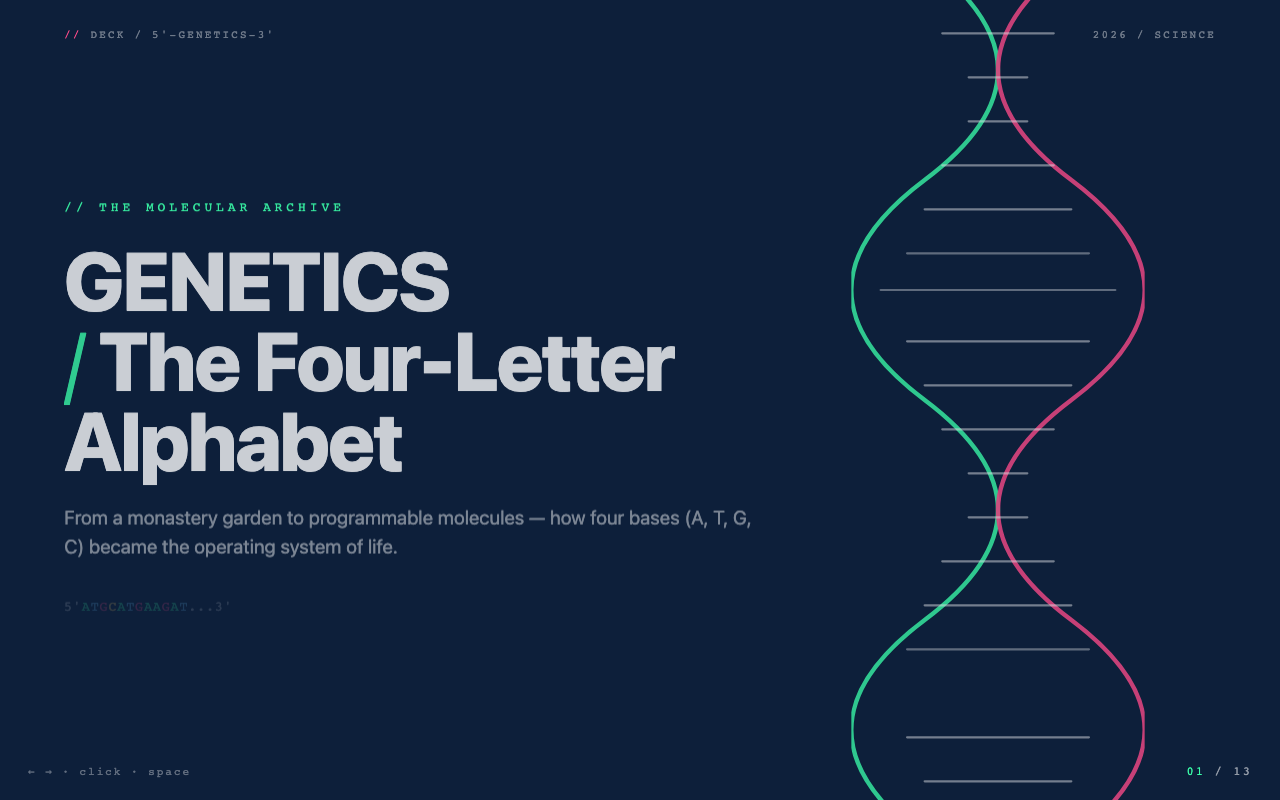
From a 19th-century monk counting peas to a CRISPR pipette in a high school lab. The story of how a four-letter alphabet runs every life on Earth.

StandaloneDownload
Sandboxed deck
Open raw

About this HTML presentation

This Shipslides page presents Genetics as an interactive HTML presentation deck in the Science catalog with 17 slides. The share page keeps the uploaded deck sandboxed while exposing readable context, topics, and a slide outline for viewers and search engines.

From a 19th-century monk counting peas to a CRISPR pipette in a high school lab. The story of how a four-letter alphabet runs every life on Earth. Key sections include: Gen e tics.; One monk . Eight years. 28,000 peas.; The double helix.; How a gene becomes a protein.; Sixty-four codons, twenty amino acids.; 46 bundles. 3.2 Gb of DNA.; What's in the genome.; Above the genes.; Errors are the engine.; Who built the field..

Key sections

  • 01Gen e tics.
  • 02One monk . Eight years. 28,000 peas.
  • 03The double helix.
  • 04How a gene becomes a protein.
  • 05Sixty-four codons, twenty amino acids.
  • 0646 bundles. 3.2 Gb of DNA.
  • 07What's in the genome.
  • 08Above the genes.
  • 09Errors are the engine.
  • 10Who built the field.
  • 11From peas to gene drives.
  • 12CRISPR -Cas9.
  • 13What breaks.
  • 14What we should do.
  • 15What's next.
  • 16Still open.
  • 17Watch & read.

Topics covered

Slide outline
  1. 01Gen e tics.
  2. 02One monk . Eight years. 28,000 peas.
  3. 03The double helix.
  4. 04How a gene becomes a protein.
  5. 05Sixty-four codons, twenty amino acids.
  6. 0646 bundles. 3.2 Gb of DNA.
  7. 07What's in the genome.
  8. 08Above the genes.
  9. 09Errors are the engine.
  10. 10Who built the field.
  11. 11From peas to gene drives.
  12. 12CRISPR -Cas9.
  13. 13What breaks.
  14. 14What we should do.
  15. 15What's next.
  16. 16Still open.
  17. 17Watch & read.
Page data
Canonical
https://shipslides.com/d/science-genetics
Category
Science
Size
35.6 KB
Updated
2026-05-17
LLM text
https://shipslides.com/d/science-genetics/llms.txt

Presentation Transcript

Detailed slide-by-slide text content extracted from this presentation.

Slide 01

One monk. Eight years. 28,000 peas.

  • P.01 / 16 — Mendel
  • Gregor Mendel, an Augustinian friar in Brno, crossed thousands of Pisum sativum plants between 1856 and 1864 and discovered three things that contemporaries failed to grasp:
  • DiscretenessInherited traits don't blend; they segregate.
  • IndependenceDifferent traits assort independently.
  • DominanceSome alleles mask others.
  • Published 1866 in an obscure Brünn journal. Rediscovered 1900 by de Vries, Correns, and Tschermak — the same year Bateson coined "genetics."
  • Punnett Square — Aa × Aa
  • 3 : 1 phenotypic ratio. 1 : 2 : 1 genotypic.
Slide 02

The double helix.

  • P.02 / 16 — DNA Structure
  • Watson, Crick, and Wilkins shared the 1962 Nobel for the structure; Rosalind Franklin's Photo 51 had given it away. Two anti-parallel sugar-phosphate strands, paired bases inside, 10.5 bp per turn, ~2 nm wide.
  • A — T2 H-bonds
  • G — C3 H-bonds
  • 5'→3'directionality
  • ~2 mper diploid cell
  • 3.2 Gbphuman genome
  • ~20,000protein-coding genes
Slide 03

How a gene becomes a protein.

  • P.03 / 16 — Central Dogma
  • 1 — TRANSCRIPTION
  • RNA polymerase II reads a DNA gene and synthesizes a complementary mRNA. Eukaryotic mRNA is then capped, polyadenylated, and spliced.
  • 2 — TRANSLATION
  • Ribosome reads mRNA codons (3 nt each). 64 codons → 20 amino acids + stop. tRNAs deliver. Result: a polypeptide.
  • 3 — FOLDING
  • The peptide chain folds (sometimes with chaperones) into a 3D shape — α-helices, β-sheets, motifs, domains. Function follows form.
  • The genetic code is universal (with a handful of exceptions): the same codons mean the same amino acids in E. coli, in oak, and in you. Strong evidence for common descent.
Slide 04

Sixty-four codons, twenty amino acids.

  • P.04 / 16 — The Code
  • Marshall Nirenberg, Har Gobind Khorana, and Robert Holley cracked the codon table by 1966 (Nobel 1968). Most amino acids are encoded by multiple codons — a redundancy that buffers against mutations at the third position ("wobble").
  • AUG: methionine, also START. UAA, UAG, UGA: STOP.
  • 33 = 27 · 43 = 64
  • The code's redundancy is not random — chemically similar amino acids share similar codons, so single-base errors tend to be conservative.
  • Sample codons
  • AUGMet (start)
  • UUU / UUCPhe
  • GAA / GAGGlu
  • UGGTrp
  • CCNPro (4 codons)
  • CGN, AGA, AGGArg (6)
  • UAA / UAG / UGASTOP
Slide 05

46 bundles. 3.2 Gb of DNA.

  • P.05 / 16 — Chromosomes
  • Each human somatic cell carries 46 chromosomes — 23 pairs, 22 autosomal and one sex pair (XX or XY). Each chromosome is a single, long DNA molecule wound around histones into nucleosomes, then into 30 nm fibers, into loops, into chromatids.
  • Sex chromosomes evolved from a regular autosome pair ~166 Mya in mammals; the Y has shed most of its content and now carries ~70 protein-coding genes vs. the X's ~800.
  • Chr 1249 Mb · ~2,000 genes
  • Chr 2148 Mb · trisomy → Down syndrome
  • Chr X155 Mb · X-inactivation, Lyonization
  • Chr Y57 Mb · SRY locus
  • mtDNA16.5 kb · maternally inherited
Slide 06

What's in the genome.

  • P.06 / 16 — Genome
  • ~1.5%protein-coding
  • ~25%introns/regulators
  • ~50%transposable elements
  • ~20%repeats, structural
  • For decades the non-coding portion was called "junk DNA"; the ENCODE Project (2012) reported biochemical activity in > 80 % of the genome, though "function" remains contested. Much of the regulatory grammar — enhancers, insulators, lincRNAs — lives there.
Slide 07

Slide 7

No text content on this slide.

Slide 08

Above the genes.

  • P.08 / 16 — Epigenetics
  • Epigenetics: heritable changes in gene expression that don't alter the DNA sequence. The two main marks:
  • DNA methylation5-methylcytosine, mostly at CpG sites; usually represses transcription.
  • Histone modificationsAcetylation (often activating), methylation (context-dependent), phosphorylation, ubiquitination.
  • Cellular differentiation is largely epigenetic: a liver cell and a neuron in your body share the same genome but read it differently. Some marks survive mitosis; a small fraction may even pass through meiosis (transgenerational, debated).
  • Examples
  • X-inactivationOne of two X chromosomes silenced in mammalian females (Xist lncRNA).
  • ImprintingMaternal/paternal copies expressed differently — IGF2, H19.
  • Dutch Hunger Winter1944–45 famine cohort showed altered methylation decades later.
  • CancerAberrant methylation of tumor suppressors silences them.
Slide 09

Errors are the engine.

  • P.09 / 16 — Mutation
  • Point
  • Substitution of one base. Synonymous (silent), missense, or nonsense. ~1 in 10⁹ per base per division after proofreading.
  • Indel
  • Insertion or deletion. If not a multiple of 3 in coding region, frame-shift; usually catastrophic.
  • Structural
  • Inversions, translocations, duplications, copy-number variants. Important in evolution and in disease (BCR-ABL, Charcot–Marie–Tooth).
  • A human zygote inherits ~70 de novo mutations relative to the parental genomes — most neutral, a few deleterious, very rarely a beneficial one.
Slide 10

Who built the field.

  • P.10 / 16 — Architects
  • Mendel
  • 1822–84 · particulate inheritance.
  • Morgan
  • 1866–1945 · fly chromosomes; sex-linkage.
  • Avery
  • 1877–1955 · DNA as transforming principle.
  • Franklin
  • 1920–58 · X-ray crystallography of DNA.
  • Watson & Crick
  • 1953 · structure paper.
  • McClintock
  • 1902–92 · transposons.
  • Doudna & Charpentier
  • CRISPR-Cas9 · Nobel 2020.
  • Mello & Fire
  • RNA interference · Nobel 2006.
Slide 11

From peas to gene drives.

  • P.11 / 16 — Timeline
  • 1865Mendel reads "Experiments on Plant Hybrids" to the Brünn Society.
  • 1869Friedrich Miescher isolates "nuclein" from white-blood-cell pus.
  • 1900Mendel rediscovered. Bateson coins "genetics" 1905.
  • 1944Avery, MacLeod, McCarty: DNA, not protein, is the genetic material.
  • 1953Watson & Crick model the double helix from Franklin's data.
  • 1966Genetic code fully decoded.
  • 1977Sanger sequencing; first viral genome (φX174) read.
  • 1983PCR — Kary Mullis amplifies DNA in a tube.
  • 1990–2003Human Genome Project: $3 B, 13 yr, 92 % of euchromatin.
  • 20071000 Genomes Project; HapMap completes; GWAS era begins.
  • 2012Doudna & Charpentier publish CRISPR-Cas9 as a programmable nuclease.
  • 2020mRNA vaccines deployed against SARS-CoV-2 within 11 months.
  • 2022T2T consortium completes the gapless human genome (3.055 Gbp).
  • 2024First base-edit therapy approved for sickle-cell disease (Casgevy).
Slide 12

CRISPR-Cas9.

  • P.12 / 16 — CRISPR
  • CRISPR-Cas9 is a programmable molecular scissor. The Cas9 protein, guided by a 20-nt guide RNA you design, cuts DNA at a specific site. The cell repairs it — by error-prone NHEJ (knock-out) or HDR with a template (knock-in).
  • Originally a bacterial immune system: archived viral DNA (CRISPR repeats) as templates to chop matching invaders. Doudna and Charpentier showed in 2012 it could be retargeted at will. Awarded the 2020 Nobel.
  • Base editing (Liu, 2016) and prime editing (Liu, 2019) edit without double-strand breaks. They underlie 2024's approved therapies for sickle-cell disease and β-thalassemia.
Slide 13

What breaks.

  • P.13 / 16 — Disease Genetics
  • Mendelian
  • Single-gene disorders. ~7,000 known. Sickle-cell (HBB), cystic fibrosis (CFTR), Huntington's (HTT). Highly penetrant; relatively rare.
  • Polygenic
  • Hundreds to thousands of variants of small effect. Type 2 diabetes, schizophrenia, height. Polygenic risk scores predict probabilistically.
  • Somatic / Cancer
  • Mutations accumulated over a lifetime. Driver vs. passenger. KRAS, TP53, BRCA1/2, EGFR. Tumor genomics now routine.
Slide 14

What we should do.

  • P.14 / 16 — Ethics
  • The 2018 birth of CRISPR-edited twins by He Jiankui shocked the field — heritable germline editing in humans had been a self-imposed red line since the 1975 Asilomar conference. He served three years in Chinese prison. The moratorium on germline edits remains in force; somatic edits are progressing rapidly.
  • Other live debates: gene drives in wild populations; DTC genetic testing privacy; reproductive screening; equitable access to expensive therapies (Casgevy: $2.2 M/dose).
  • Three lines
  • 1Somatic vs. germline
  • 2Therapy vs. enhancement
  • 3Individual vs. species-level effect
  • Each line is a moving negotiation between technology, regulation, and values.
Slide 15

What's next.

  • P.15 / 16 — Frontier & Open Questions
  • Pangenome
  • A reference graph that captures structural variation across populations, replacing the linear GRCh38.
  • In utero editing
  • Fetal CRISPR for monogenic diseases — animal proof of concept; first human trials approaching.
  • Synthetic genomes
  • Yeast Sc2.0 nearly complete; bacterial genome write at the megabase scale routine.
  • Still open.
  • Q.01What fraction of non-coding DNA is functional, by what definition?
  • Q.02How is gene regulation written in cis-regulatory grammar?
  • Q.03What sets the speciation rate? Why some genomes diverge and others don't?
  • Q.04Can we predict phenotype from genotype for complex traits?
  • Q.05How heritable is epigenetic state across generations?
Slide 16

Watch & read.

  • P.16 / 16 — Go Deeper
  • Veritasium & Kurzgesagt — CRISPR
  • Kurzgesagt's "Genetic Engineering Will Change Everything Forever – CRISPR" — the field's most-watched explainer.
  • Watch ↗
  • References
  • WatsonMolecular Biology of the Gene (8e, 2017)
  • MukherjeeThe Gene (2016)
  • Doudna & SternbergA Crack in Creation (2017)
  • Strachan & ReadHuman Molecular Genetics
  • NHGRIgenome.gov educational pages
Remove this deck