shipslides
Business13 slides0 views

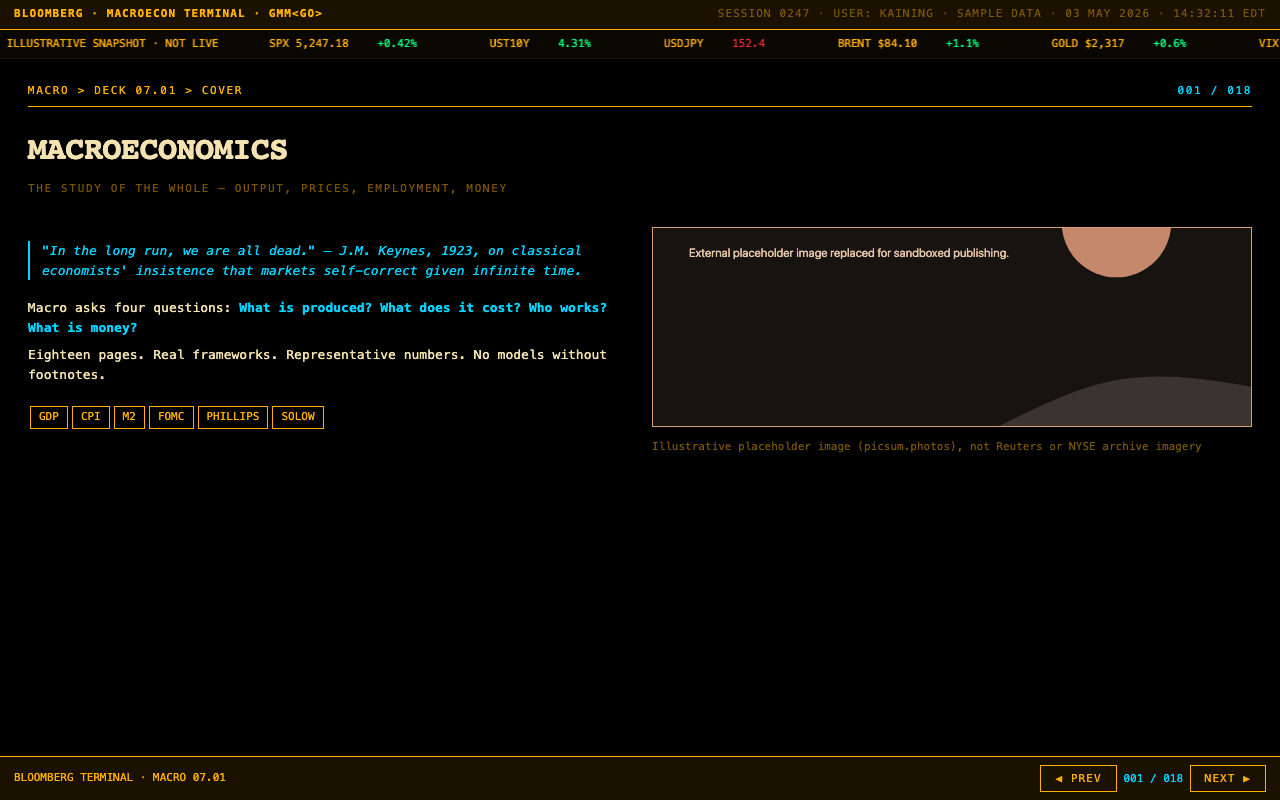
Macroeconomics — GDP, Inflation, the Cycle

A short field guide to the economy at the level of nations — output, prices, employment, money, and the long, uncertain arts of measuring and managing them.

StandaloneDownload
Sandboxed deck
Open raw

About this HTML presentation

This Shipslides page presents Macroeconomics — GDP, Inflation, the Cycle as an interactive HTML presentation deck in the Business catalog with 13 slides. The share page keeps the uploaded deck sandboxed while exposing readable context, topics, and a slide outline for viewers and search engines.

A short field guide to the economy at the level of nations — output, prices, employment, money, and the long, uncertain arts of measuring and managing them. Key sections include: MACROECONOMICS GDP, Inflation, the Cycle; The four numbers that frame the conversation.; GDP, decomposed.; Expansion. Peak. Contraction. Trough. Repeat.; Inflation: too much money chasing too few goods.; Central banks: the (mostly) independent monetary authority.; Two goals. Often pulling in opposite directions.; Money: M1, M2 — and the great expansion since 2008.; Fiscal policy: spending, taxes, deficits.; Three traditions, one long argument..

Key sections

  • 01MACROECONOMICS GDP, Inflation, the Cycle
  • 02The four numbers that frame the conversation.
  • 03GDP, decomposed.
  • 04Expansion. Peak. Contraction. Trough. Repeat.
  • 05Inflation: too much money chasing too few goods.
  • 06Central banks: the (mostly) independent monetary authority.
  • 07Two goals. Often pulling in opposite directions.
  • 08Money: M1, M2 — and the great expansion since 2008.
  • 09Fiscal policy: spending, taxes, deficits.
  • 10Three traditions, one long argument.
  • 112008 and 2020: different illnesses, different medicines.
  • 12Macroeconomics is humbling.
  • 13For further reading and watching.
Slide outline
  1. 01MACROECONOMICS GDP, Inflation, the Cycle
  2. 02The four numbers that frame the conversation.
  3. 03GDP, decomposed.
  4. 04Expansion. Peak. Contraction. Trough. Repeat.
  5. 05Inflation: too much money chasing too few goods.
  6. 06Central banks: the (mostly) independent monetary authority.
  7. 07Two goals. Often pulling in opposite directions.
  8. 08Money: M1, M2 — and the great expansion since 2008.
  9. 09Fiscal policy: spending, taxes, deficits.
  10. 10Three traditions, one long argument.
  11. 112008 and 2020: different illnesses, different medicines.
  12. 12Macroeconomics is humbling.
  13. 13For further reading and watching.
Page data
Canonical
https://shipslides.com/d/catalog-business-macroeconomics
Category
Business
Size
58.1 KB
Updated
2026-05-17
LLM text
https://shipslides.com/d/catalog-business-macroeconomics/llms.txt

Presentation Transcript

Detailed slide-by-slide text content extracted from this presentation.

Slide 01

MACROECONOMICS GDP, Inflation, the Cycle

  • Bulletin / Issue 01
  • A short field guide to the economy at the level of nations — output, prices, employment, money, and the long, uncertain arts of measuring and managing them.
  • DocumentBULL-2026-001
  • Pages13
  • ClassificationOPEN / EDUCATIONAL
Slide 02

The four numbers that frame the conversation.

  • Section 02 / The Aggregates
  • Output · Jobs · Prices · External balance
  • Macro is the study of economies in aggregate. Strip away the millions of transactions, and four headline numbers do most of the talking.
  • GDP — Output
  • $28.6T
  • Total value of goods and services produced. The single biggest scoreboard. (US, 2024 est.)
  • Unemployment
  • 3.9%
  • Share of the labor force without work and looking. Lagging and noisy, but politically loud.
  • Inflation (CPI YoY)
  • 3.2%
  • Rate at which the general price level is rising. The central bank's primary obsession.
  • Trade Balance
  • -$773B
  • Exports minus imports. Persistently negative for the US for half a century.
  • Each number is a compromise. GDP misses unpaid labor and ecological harm. Unemployment misses the discouraged. CPI is a basket that only roughly resembles your basket. The trade balance pretends a nation is one big company. They are still the best summary we have.
  • IndicatorTypeFrequencyLag
  • GDPOutputQuarterly~30 days
  • PayrollsLaborMonthly~5 days
  • CPIPricesMonthly~10 days
  • TradeExternalMonthly~40 days
Slide 03

GDP, decomposed.

  • Section 03 / National Accounts
  • The expenditure identity — and what slips through
  • Expenditure approach
  • GDP=C+I+G+(X − M)
  • C — Consumption
  • ~68%
  • Households buying things. Cars, rent, haircuts, streaming subscriptions. The dominant US driver.
  • I — Investment
  • ~18%
  • Business capex, residential housing, inventories. Volatile; the cyclical engine.
  • G — Government
  • ~17%
  • Federal, state, and local spending on goods and services. Excludes transfers.
  • (X − M)
  • ~-3%
  • Net exports. Subtracts off the import bill. Persistently negative for the US.
  • What GDP misses
  • Unpaid labor. Childcare, eldercare, housework — economically vital, statistically invisible.
  • Distribution. A country can grow while most people stagnate. GDP says nothing about who got it.
  • Quality of life. Commute times, air quality, leisure, social trust — none counted.
  • Environmental cost. A forest cut and sold adds to GDP; the missing forest does not subtract.
  • Black markets & informal economies. Significant fractions in many countries.
  • "Goal posts have been moved, leaving GDP a metric that explains less and less of what we actually care about."
  • — Joseph Stiglitz, on alternatives to GDP
  • GPIHDISPI
  • Alternative metrics — Genuine Progress Indicator, Human Development Index, Social Progress Index — exist but none has dethroned GDP. We measure what we can.
Slide 04

Expansion. Peak. Contraction. Trough. Repeat.

  • Section 04 / The Cycle
  • The business cycle has been observed since at least the 19th century
  • Figure 4.1 — Idealized Business Cycle
  • Output / time, with the four canonical phases
  • Expansion
  • Output rising, hiring, optimism, credit easy. Lasts on average 65 months in postwar US.
  • Peak
  • Capacity strained, wages bid up, inflation stirs, central bank tightens.
  • Contraction
  • Output falls, layoffs, defaults rise. NBER calls a "recession" in retrospect.
  • Trough
  • The bottom. Hiring resumes quietly. Stocks have usually already turned.
Slide 05

Inflation: too much money chasing too few goods.

  • Section 05 / Prices
  • And the Phillips curve, which mostly held — until it didn't
  • Inflation has two clean stories that rarely tell the whole truth on their own:
  • Demand-pull. Spending outruns capacity. Hot economy, tight labor, price pressure builds.
  • Cost-push. Supply shocks — oil, chips, ports — push input costs into final prices.
  • Expectations. If everyone thinks 5% is normal, contracts and wages bake it in. Self-fulfilling.
  • Monetary. "Always and everywhere a monetary phenomenon," argued Friedman. Print enough; eventually it shows up.
  • The Phillips Curve — the original 1958 finding — claimed an inverse relationship between unemployment and inflation. The 1970s stagflation broke the simple version. We now use augmented versions with expectations baked in, but the relationship is unstable.
  • Figure 5.1 — Phillips Curve, US
  • Unemployment vs. inflation. Tidy in the 60s. Less so since.
Slide 06

Central banks: the (mostly) independent monetary authority.

  • Section 06 / Monetary Authority
  • The most consequential job description nobody reads
  • A central bank issues a country's currency, sets short-term interest rates, supervises banks, and acts as lender of last resort. In most modern economies it operates at arm's length from the elected government — controversial but, in most arguments, defensible.
  • BankRegionFoundedMandatePolicy RateBalance Sheet
  • Federal ReserveUnited States1913Dual: jobs + prices5.25%$7.4T
  • European Central BankEurozone (20)1998Price stability ~2%3.75%€6.5T
  • Bank of JapanJapan1882Price stability 2%0.50%¥760T
  • Bank of EnglandUnited Kingdom1694Price stability 2% + financial stability5.00%£900B
  • People's Bank of ChinaChina1948Currency, growth, stability (state-aligned)3.45%¥45T
  • Their main tools
  • Policy rate. The price of overnight money. Everything else is priced from this.
  • Open-market operations. Buy or sell government bonds to expand or shrink the money supply.
  • Reserve requirements. How much banks must hold against deposits. Largely zero in the US since 2020.
  • Forward guidance. Talking. Sometimes the most powerful tool of all.
  • "The Federal Reserve is independent within government, not of it." Independence is a political bargain. It survives as long as the bank avoids being seen as either a political actor or a passive technocrat — a narrow line.
Slide 07

Two goals. Often pulling in opposite directions.

  • Section 07 / Dual Mandate
  • Federal Reserve Reform Act, 1977
  • Maximum Employment
  • Goal one
  • Not zero unemployment — that's impossible. The target is the lowest rate consistent with stable prices, sometimes called NAIRU (non-accelerating inflation rate of unemployment), estimated around 4–5%.
  • Tools: lower rates to stimulate hiring; QE to push money into risk assets and through the economy.
  • Price Stability
  • Goal two — formal target: 2% PCE
  • Why 2% rather than 0? A small positive buffer gives room to cut rates in downturns and avoids the deflationary trap that haunted Japan for decades.
  • Tools: raise rates, sell bonds, signal hawkishness — all of which slow demand and, hopefully, prices.
  • The conflict. When inflation is high and unemployment is rising — the 1970s, briefly 2022 — the dual mandate forces a choice. Volcker chose prices in 1979–82; unemployment hit 10.8%. Most observers, eventually, called it the right call. None of them wanted to make it.
Slide 08

Money: M1, M2 — and the great expansion since 2008.

  • Section 08 / Money Supply
  • QE made central-bank balance sheets a household phrase
  • M1 — Narrow money
  • $18.0T
  • Currency in circulation + checking deposits + traveler's checks. The money you can spend right now.
  • M2 — Broader
  • $21.7T
  • M1 + savings deposits + small time deposits + retail money funds. The most-watched aggregate.
  • Fed Balance Sheet
  • $7.4T
  • Down from $9T peak (2022). Was $0.9T pre-2008. Eight times larger in fifteen years.
  • Figure 8.1 — Fed Balance Sheet, 2003–2025 ($ trillions)
  • Three rounds of QE, then QT. The line that scared a generation of monetarists.
  • QE is buying long-duration bonds with newly created reserves; QT is letting those bonds mature without reinvestment. The mechanics are simple. The macro implications are still being argued.
Slide 09

Fiscal policy: spending, taxes, deficits.

  • Section 09 / The Other Lever
  • Monetary's louder cousin — and the one with a vote
  • Fiscal policy is what the legislature does. Two big knobs:
  • Spending. Roads, defense, transfers, research. Goes directly into GDP via G — and indirectly via C.
  • Taxes. Take less, leave more in private hands; take more, cool the economy down.
  • Multipliers. A dollar of spending may yield $0.50 to $2 of GDP depending on slack, type of spending, and method of finance. Disputed in detail.
  • Automatic stabilizers. Unemployment insurance and progressive taxes do counter-cyclical work without anybody voting on it.
  • YearUS Deficit% of GDPDebt / GDP
  • 2000+$236B+2.3%55%
  • 2009−$1.4T−9.8%82%
  • 2015−$438B−2.4%100%
  • 2020−$3.1T−14.7%126%
  • 2024−$1.8T−6.3%123%
  • Persistent peacetime deficits at 5%+ of GDP are historically unusual. Debate over their consequences has been running for thirty years. Nobody has won it.
  • Discretionary
  • Voted on each year — defense, infrastructure, agencies. Visible, contested, slow.
  • Mandatory / Entitlement
  • Social Security, Medicare, Medicaid. Two-thirds of US federal outlays. Politically untouchable.
  • Interest on Debt
  • $890B in 2024 — now larger than the defense budget. Compounding mathematics, finally visible.
Slide 10

Three traditions, one long argument.

  • Section 10 / Schools of Thought
  • Macro is a discipline whose questions outlast its answers
  • Keynesian
  • Keynes · Hansen · Samuelson · Krugman
  • Markets clear slowly. Recessions are demand failures. Government should spend in the bust and save in the boom — what Keynes called "in the long run we are all dead."
  • Won the 1930s–60s. Lost credibility in 1970s stagflation. Returned, in chastened form, after 2008.
  • Monetarist
  • Friedman · Schwartz · Lucas
  • Money supply growth is the master variable. Steady, rule-based monetary policy beats discretion. Fiscal stimulus is mostly noise; central banks should target inflation and otherwise stay out of the way.
  • Won the 1970s–90s. Strict version (M2 targeting) failed empirically, but inflation-targeting independent central banks won.
  • MMT — Modern Monetary Theory
  • Wray · Kelton · Mosler
  • A government with monetary sovereignty cannot run out of its own currency. The real constraint is inflation and real resources, not bond markets. Spend until you hit capacity; tax to pull demand out when needed.
  • Mostly heterodox. Got a hearing post-2020. Critics argue 2021–22 inflation was its real-world stress test, and it failed.
  • What practitioners actually believe — most working macroeconomists are eclectic. They reach for Keynesian tools in slumps, monetarist discipline in inflations, and ignore MMT until somebody puts it on a campaign poster. Pure adherents are rarer than the textbooks suggest.
Slide 11

2008 and 2020: different illnesses, different medicines.

  • Section 11 / Two Recent Crises
  • Comparative anatomy of two modern recessions
  • 2008 — Global Financial Crisis
  • A balance-sheet recession
  • Cause: Housing bubble + securitized subprime + leveraged interbank funding. Lehman fails Sept 15, 2008; credit freezes. Real economy follows.
  • Response: Bailouts (TARP, $700B), Fed funds rate to 0–0.25%, QE1/2/3 expanding balance sheet from $0.9T to $4.5T, ARRA fiscal stimulus ($787B).
  • Result: Slow grinding recovery. Unemployment took six years to return to pre-crisis levels. No inflation, contrary to monetarist warnings.
  • 2020 — COVID Recession
  • An exogenous shock
  • Cause: Pandemic + voluntary and mandated shutdowns of activity. Not a financial crisis — a public health one with macro consequences.
  • Response: Faster and bigger. Fed to zero in two weeks, balance sheet from $4T to $9T. CARES Act + follow-ons: ~$5T fiscal — checks, PPP, expanded UI, child tax credit.
  • Result: V-shaped recovery — unemployment back to 4% in two years. Then a multi-year inflation spike (peak 9.1% CPI, 2022) that took until 2024 to tame.
  • Metric2008 GFC2020 COVIDNote
  • Peak unemployment10.0%14.7%Both severe; COVID was sharper, briefer.
  • Time to pre-crisis jobs~76 mo.~24 mo.Recovery speed differed dramatically.
  • Fiscal stimulus~$1.5T~$5.0T2020 ≈ 25% of GDP across all packages.
  • Subsequent inflation peak2.7% (2011)9.1% (2022)The trade-off, in one row.
Slide 12

Macroeconomics is humbling.

  • Section 12 / The Honest Assessment
  • A profession with mixed predictive record and good intentions
  • If you've spent a few hours on the previous slides and feel slightly less certain than when you started — good. That's where most working macroeconomists are too.
  • The 2008 crisis surprised most of the profession. Standard models had no banks. The IMF, in 2007, projected continued global growth.
  • The 2021–22 inflation surprised most of the profession. "Transitory" was the consensus call. It was not transitory.
  • Long-run growth is poorly understood. Why does productivity slow? Why did the post-1970s slowdown happen? Honest answer: we have hypotheses.
  • Causation is brutal. No control group. No re-runs. "What if Volcker had hesitated" cannot be tested. We argue from a single tape.
  • "It's much easier to write down a model in which deficits cause a crisis than to predict when, or whether, an actual crisis will occur." Macroeconomic prediction has accuracy in good times and humility in bad ones — and rarely the reverse.
  • What the discipline does well
  • Identifies trade-offs others ignore.
  • Has a defensible vocabulary for policy debates.
  • Most of the time, central banks now avoid the worst tail outcomes (1930s, 1970s).
  • The useful posture: Treat macro forecasts as scenarios, not predictions. Distrust anyone — economist, pundit, podcaster — selling certainty. The economy is a complex adaptive system observed through noisy quarterly data, governed by feedback loops that include the very models we use to study it.
Slide 13

For further reading and watching.

  • Closing / References & Further Study
  • An incomplete starter library
  • Books & papers
  • Keynes, J.M. The General Theory of Employment, Interest, and Money (1936).
  • Friedman, M. & Schwartz, A. A Monetary History of the United States (1963).
  • Mankiw, N.G. Macroeconomics. The standard textbook; readable.
  • Blanchard, O. Macroeconomics. The other standard textbook.
  • Reinhart, C. & Rogoff, K. This Time is Different (2009). Eight centuries of financial folly.
  • Bernanke, B. The Courage to Act (2015). Insider account of the GFC response.
  • Kelton, S. The Deficit Myth (2020). The MMT case, presented sympathetically.
  • Tooze, A. Crashed (2018). The 2008 crisis as global political event.
  • Sargent, T. "The Ends of Four Big Inflations" (1982). Expectations and credibility.
  • Phillips, A.W. "The Relation Between Unemployment and the Rate of Change of Money Wage Rates" (1958).
  • Video
  • Macroeconomics, explained
  • youtube.com/results?search_query=macroeconomics+explained
  • Federal Reserve & monetary policy
  • youtube.com/results?search_query=federal+reserve+monetary+policy
  • Data sources
  • FRED — Federal Reserve Bank of St. Louis. The single best free macro database.
  • BEA — US Bureau of Economic Analysis. GDP and national accounts.
  • BLS — Bureau of Labor Statistics. Jobs, prices, productivity.
  • IMF WEO — World Economic Outlook. Comparable global data.
  • — end of Bulletin No. 01 —
Remove this deck