shipslides
Business53 slides0 views

Macroeconomics · Terminal

The study of the whole — output, prices, employment, money

StandaloneDownload
Sandboxed deck
Open raw

About this HTML presentation

This Shipslides page presents Macroeconomics · Terminal as an interactive HTML presentation deck in the Business catalog with 53 slides. The share page keeps the uploaded deck sandboxed while exposing readable context, topics, and a slide outline for viewers and search engines.

The study of the whole — output, prices, employment, money Key sections include: MACROECONOMICS; What is GDP?; U.S. 2024 Composition; Three Ways to Measure; Real vs. Nominal; Inflation: When Money Loses; What is Money?; Monetary Aggregates · U.S. 2024; The Quantity Theory; Unemployment.

Key sections

  • 01MACROECONOMICS
  • 02What is GDP?
  • 03U.S. 2024 Composition
  • 04Three Ways to Measure
  • 05Real vs. Nominal
  • 06Inflation: When Money Loses
  • 07What is Money?
  • 08Monetary Aggregates · U.S. 2024
  • 09The Quantity Theory
  • 10Unemployment
  • 11Types
  • 12NAIRU
  • 13Okun's Law
  • 14The Business Cycle
  • 15Schools of Thought
  • 16Classical / Neoclassical
  • 17Keynesian
  • 18Monetarist
  • 19New Classical / RBC
  • 20New Keynesian
  • 21MMT
  • 22The Federal Reserve
  • 23Tools
  • 24The Taylor Rule
Slide outline
  1. 01MACROECONOMICS
  2. 02What is GDP?
  3. 03U.S. 2024 Composition
  4. 04Three Ways to Measure
  5. 05Real vs. Nominal
  6. 06Inflation: When Money Loses
  7. 07What is Money?
  8. 08Monetary Aggregates · U.S. 2024
  9. 09The Quantity Theory
  10. 10Unemployment
  11. 11Types
  12. 12NAIRU
  13. 13Okun's Law
  14. 14The Business Cycle
  15. 15Schools of Thought
  16. 16Classical / Neoclassical
  17. 17Keynesian
  18. 18Monetarist
  19. 19New Classical / RBC
  20. 20New Keynesian
  21. 21MMT
  22. 22The Federal Reserve
  23. 23Tools
  24. 24The Taylor Rule
  25. 25Fiscal Policy
  26. 26Multiplier
  27. 27Automatic Stabilizers
  28. 28U.S. Federal Outlays 2024
  29. 29Open Economy
  30. 30Balance of Payments
  31. 31Mundell-Fleming Trilemma
  32. 32Long-Run Growth
  33. 33Solow Model
  34. 34Endogenous Growth
  35. 35Case Study: Volcker Disinflation
  36. 36Case Study: 2008 Financial Crisis
  37. 37Policy Response
  38. 38What we learned
  39. 39Case Study: Japan's Lost Decades
  40. 40Diagnosis
  41. 41Common Errors
  42. 42Confusing nominal with real
  43. 43Government ≠ household
  44. 44Fallacy of composition
  45. 45Lucas critique
  46. 46Trade balance ≠ winning
  47. 47Money printer go brr
  48. 48Frameworks at a Glance
  49. 49Recommended Reading & Watching
  50. 50Books
  51. 51YouTube
  52. 52Data sources to bookmark
  53. 53End of Session
Page data
Canonical
https://shipslides.com/d/business-macroeconomics
Category
Business
Size
32.4 KB
Updated
2026-05-17
LLM text
https://shipslides.com/d/business-macroeconomics/llms.txt

Presentation Transcript

Detailed slide-by-slide text content extracted from this presentation.

Slide 01

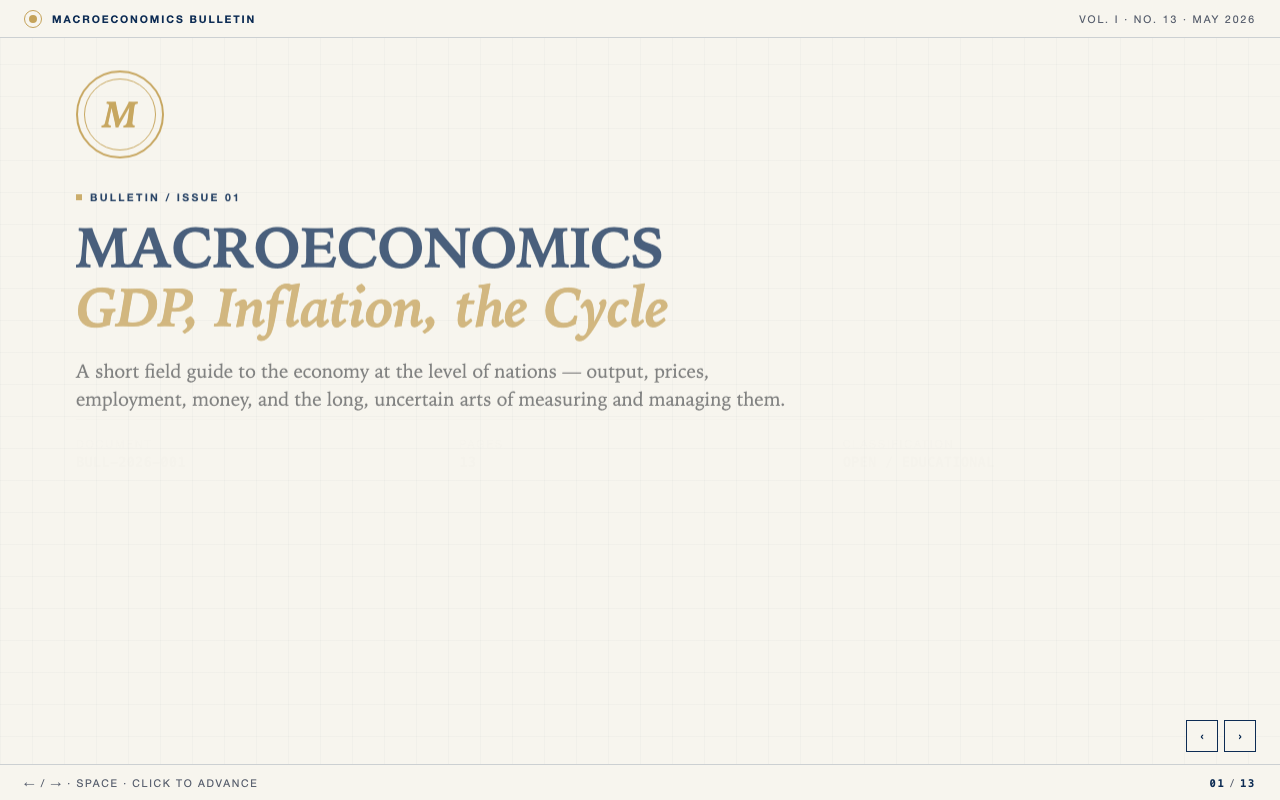
MACROECONOMICS

  • MACRO > DECK 07.01 > COVER001 / 018
  • The study of the whole — output, prices, employment, money
  • "In the long run, we are all dead." — J.M. Keynes, 1923, on classical economists' insistence that markets self-correct given infinite time.
  • Macro asks four questions: What is produced? What does it cost? Who works? What is money?
  • Eighteen pages. Real frameworks. Representative numbers. No models without footnotes.
  • GDPCPIM2FOMCPHILLIPSSOLOW
  • Illustrative placeholder image (picsum.photos), not Reuters or NYSE archive imagery
Slide 02

What is GDP?

  • MACRO > GDP COMPOSITION002 / 018
  • Gross Domestic Product is the market value of all final goods and services produced within a country in a year. The accounting identity:
  • Y = C + I + G + (X − M)
  • U.S. 2024 Composition
  • Consumption dominates. The U.S. is, in macro terms, a giant shopping mall.
  • Three Ways to Measure
  • EXPENDITURESum what is spent: C+I+G+NX
  • INCOMESum what is earned: wages, rents, profits, interest
  • PRODUCTIONSum value-added at every firm
  • All three should give the same answer. They never quite do — the gap is the "statistical discrepancy."
  • Real vs. Nominal
  • Nominal GDP uses current prices. Real GDP holds prices constant to a base year, isolating volume change.
Slide 03

Inflation: When Money Loses

  • MACRO > INFLATION003 / 018
  • Inflation is the rate at which the general price level rises. The CPI tracks a basket of ~80,000 goods and services priced monthly by the BLS.
  • Demand-pullToo much money chasing too few goods. War spending, stimulus.
  • Cost-pushInputs (oil, wages) rise. 1973 OPEC, 1979 Iran.
  • Built-inWage-price spiral. Workers expect inflation, demand raises.
Slide 04

What is Money?

  • MACRO > MONEY004 / 018
  • Money has three jobs: medium of exchange store of value unit of account. Failure at any one is monetary collapse (Weimar 1923, Zimbabwe 2008, Venezuela 2017).
  • Monetary Aggregates · U.S. 2024
  • AggregateIncludesApprox ($T)
  • M0Physical currency + bank reserves at Fed5.4
  • M1M0 + checking deposits + traveler's checks18.0
  • M2M1 + savings + small time deposits + retail MMF21.0
  • The Quantity Theory
  • M · V = P · Y
  • Money supply × velocity = price level × real output. Milton Friedman's bumper sticker: "Inflation is always and everywhere a monetary phenomenon." The 2020–22 episode tested this — M2 jumped 26% in 2020, inflation followed in 2022.
Slide 05

Unemployment

  • MACRO > UNEMPLOYMENT005 / 018
  • The headline U-3 rate is the share of the labor force actively seeking work. The BLS publishes six measures (U-1 through U-6).
  • Types
  • FRICTIONALBetween jobs. Healthy economies have ~3-4%.
  • STRUCTURALSkills mismatch. Coal miners in Appalachia.
  • CYCLICALRecession. Spikes in 2009 (10%), 2020 (14.7%).
  • SEASONALSki instructors in July.
  • NAIRU
  • Non-Accelerating Inflation Rate of Unemployment — the lowest jobless rate that doesn't trigger inflation. Estimated at 4.0–4.5% in the U.S.
  • Okun's Law
  • Each 1pp rise in unemployment ≈ 2pp loss in GDP. A rule, not a law.
Slide 06

The Business Cycle

  • MACRO > BUSINESS CYCLES006 / 018
  • NBER dates U.S. recessions. Since 1945, the average expansion lasted ~65 months; the average recession, ~11 months.
  • EpisodeYearsTriggerPeak Unempl.
  • Great Depression1929–33Stock crash, banking panic, Smoot-Hawley25%
  • Volcker Recession1980–82Fed funds to 20% to crush inflation10.8%
  • Great Recession2007–09Subprime mortgage crisis, Lehman fall10.0%
  • COVID Recession2020 (Feb–Apr)Pandemic shutdown14.7%
Slide 07

Schools of Thought

  • MACRO > SCHOOLS007 / 018
  • Classical / Neoclassical
  • Smith, Ricardo, Marshall. Markets clear. Wages and prices flexible. Say's Law: supply creates its own demand. Government should stay out.
  • Keynesian
  • Keynes (1936). Aggregate demand drives output in the short run. Sticky wages. Spend in recessions; the multiplier amplifies effect.
  • Monetarist
  • Friedman, Schwartz. Money matters. The Fed caused the Depression by letting M2 fall a third. Rules over discretion.
  • New Classical / RBC
  • Lucas, Prescott. Rational expectations. Cycles are real shocks (productivity), not money illusions. Stimulus is futile.
  • New Keynesian
  • Mankiw, Romer, Woodford. Microfounded sticky prices, monopolistic competition. The synthesis behind every modern central bank model.
  • MMT
  • Wray, Kelton. Sovereigns issuing their own currency cannot involuntarily default. Tax policy, not bond markets, controls inflation. Heterodox.
Slide 08

The Federal Reserve

  • MACRO > FED008 / 018
  • Founded 1913 after the Panic of 1907. Dual mandate (1977): maximum employment AND stable prices (interpreted as 2% PCE).
  • Tools
  • FED FUNDS RATETarget overnight interbank rate. Set 8x/yr by FOMC.
  • OPEN MARKET OPSBuy/sell Treasuries to add/drain reserves.
  • IORBInterest on reserve balances — sets the floor.
  • DISCOUNT WINDOWEmergency lending to banks.
  • QE / QTLarge-scale asset purchases. Balance sheet went from $0.9T (2008) to $9T (2022).
  • FORWARD GUIDANCEPublic commitments to future paths. Words as policy.
  • The Taylor Rule
  • i = r* + π + 0.5(π − π*) + 0.5(y − y*)
  • John Taylor's 1993 prescription. Most central banks track deviations from this benchmark even if they don't follow it mechanically.
Slide 09

Fiscal Policy

  • MACRO > FISCAL009 / 018
  • Government taxing and spending. Distinct from monetary policy, run by Treasury + Congress.
  • Multiplier
  • If MPC = 0.8, an extra $1 of spending → $1/(1−0.8) = $5 of GDP. In recessions, multipliers are larger; near full employment, they shrink toward zero.
  • Automatic Stabilizers
  • Unemployment insurance, progressive tax brackets — kick in without legislation.
  • U.S. Federal Outlays 2024
  • SS 22% · Medicare/Medicaid 25% · Defense 13% · Net Interest 13% · Other 27%
  • Net interest is the fastest-growing line item. CBO projects it overtakes defense in 2025 and Medicare by 2032.
Slide 10

Open Economy

  • MACRO > INTERNATIONAL010 / 018
  • Balance of Payments
  • The current account (trade in goods, services, income) plus the capital account must equal zero. The U.S. runs persistent current-account deficits (~3% of GDP); foreigners send capital back as Treasuries and stock.
  • Mundell-Fleming Trilemma
  • Pick two. You cannot have all three.
Slide 11

Long-Run Growth

  • MACRO > GROWTH011 / 018
  • Solow Model
  • Y = A · Kα · L1−α
  • Output depends on capital, labor, and total factor productivity (A). With diminishing returns to K, growth eventually slows — unless A keeps rising.
  • Endogenous Growth
  • Romer (1990): ideas don't run out. Investment in R&D, human capital, and institutions sustains A. Lucas: "Once you start thinking about growth, it's hard to think about anything else."
Slide 12

Case Study: Volcker Disinflation

  • MACRO > CASE: VOLCKER012 / 018
  • August 1979. Paul Volcker becomes Fed Chair. CPI is at 11%, headed to 14%. Confidence in money is collapsing.
  • YearFed Funds PeakCPIUnempl.Note
  • 197915.5%11.3%5.9%Volcker installed Aug
  • 198020.0%13.5%7.5%Carter loses election
  • 198119.0%10.3%8.5%Reagan begins
  • 198214.0%6.1%10.8%Severe recession
  • 19839.6%3.2%9.6%Inflation broken
  • Lesson: anchoring expectations is everything. Volcker traded jobs for credibility — and a 30-year era of low inflation was born.
Slide 13

Case Study: 2008 Financial Crisis

  • MACRO > CASE: GFC013 / 018
  • Subprime mortgages packaged into MBS, sliced into CDOs, rated AAA. House prices fall ~30% from 2006 peak. Bear Stearns (Mar '08), Fannie/Freddie (Sep 7), Lehman (Sep 15), AIG (Sep 16).
  • Policy Response
  • TARP $700B Treasury equity injections Fed funds to 0–0.25% QE1 ($1.7T MBS+UST) ARRA $831B fiscal stimulus
  • Total bank losses globally: ~$2.8T (IMF). U.S. household wealth fell ~$16T peak-to-trough.
  • What we learned
  • Macroprudential matters. Basel III raised capital requirements; living wills; CCAR stress tests. The 2023 SVB run showed the work isn't done.
Slide 14

Case Study: Japan's Lost Decades

  • MACRO > CASE: JAPAN014 / 018
  • Nikkei peaked Dec 29, 1989 at 38,915. It would not see that level again for 34 years (Feb 2024). Nominal GDP in 2023 was below 1995.
  • Diagnosis
  • Asset-price collapse → balance-sheet recession (Koo). Firms paying down debt regardless of zero rates. BoJ tries every tool: ZIRP, QE, YCC, negative rates. Population aged faster than policy.
  • "Japan is the world's leading indicator." — Larry Summers, on secular stagnation
Slide 15

Common Errors

  • MACRO > PITFALLS015 / 018
  • Error 1Confusing nominal with real
  • "Wages have never been higher." Sure — in dollars. Adjusted for CPI, U.S. real median wages have grown ~17% since 1979.
  • Error 2Government ≠ household
  • A sovereign that issues its own currency in floating-rate regime cannot be forced to default. Solvency constraint binds via inflation, not bond auction failure.
  • Error 3Fallacy of composition
  • If everyone saves more at once, aggregate demand falls and income drops. Prudent for one, paradox for all.
  • Error 4Lucas critique
  • Models estimated under one policy regime break down when policy changes — because expectations adapt.
  • Error 5Trade balance ≠ winning
  • A current-account deficit means more goods consumed than produced — paid for by exporting assets. It is not a P&L statement.
  • Error 6Money printer go brr
  • QE adds reserves, not deposits. Whether it raises CPI depends on bank lending and demand. 2009–2019 showed it can be deflationary.
Slide 16

Frameworks at a Glance

  • MACRO > FRAMEWORKS016 / 018
  • FrameworkKey InsightYear
  • IS-LMGoods and money markets jointly determine output and ratesHicks 1937
  • Phillips CurveShort-run trade-off between unemployment and inflationPhillips 1958
  • AS-ADAggregate supply/demand framework for prices and output1970s
  • Solow-SwanCapital accumulation drives growth, but A drives convergence1956
  • Mundell-FlemingOpen-economy IS-LM; the trilemma1962-63
  • RBCCycles from real productivity shocksKydland-Prescott 1982
  • DSGEMicrofounded, stochastic, dynamic — modern central bank workhorse1990s–
  • Taylor RuleRate-setting reaction function1993
  • MMTCurrency-issuer can spend without bond market consent1990s
Slide 17

Recommended Reading & Watching

  • MACRO > READING017 / 018
  • Books
  • Keynes — The General Theory (1936) Friedman & Schwartz — A Monetary History of the United States (1963) Reinhart & Rogoff — This Time Is Different (2009) Kindleberger — Manias, Panics & Crashes Krugman — The Return of Depression Economics Mankiw — Macroeconomics textbook
  • YouTube
  • Khan Academy — Macroeconomics full course
  • Bloomberg — Bloomberg Markets and Finance channel
  • CNBC — CNBC Money documentaries
  • Ray Dalio — "How the Economic Machine Works" (30 min)
  • Data sources to bookmark
  • FRED.stlouisfed.org · BEA.gov · BLS.gov · IMF.org/data · OECD.stat
Slide 18

End of Session

  • MACRO > TERMINAL EXIT018 / 018
  • "It's tough to make predictions, especially about the future." — Yogi Berra (also attributed to Niels Bohr)
  • The economy is a 25-trillion-dollar weather system. The models are crude. The data is laggy and revised. The schools are loud. And yet — every two months we get a CPI print that moves a hundred million household decisions.
  • That's what makes macro the most fun and the most humbling field in social science.
  • EXIT TERMINAL · GMM<CANCEL>
  • ← Catalog · Business & Economics index · Vol. VII · Deck 01
Remove this deck