shipslides
Future13 slides0 views

Energy Transition / Fossils to Electrons

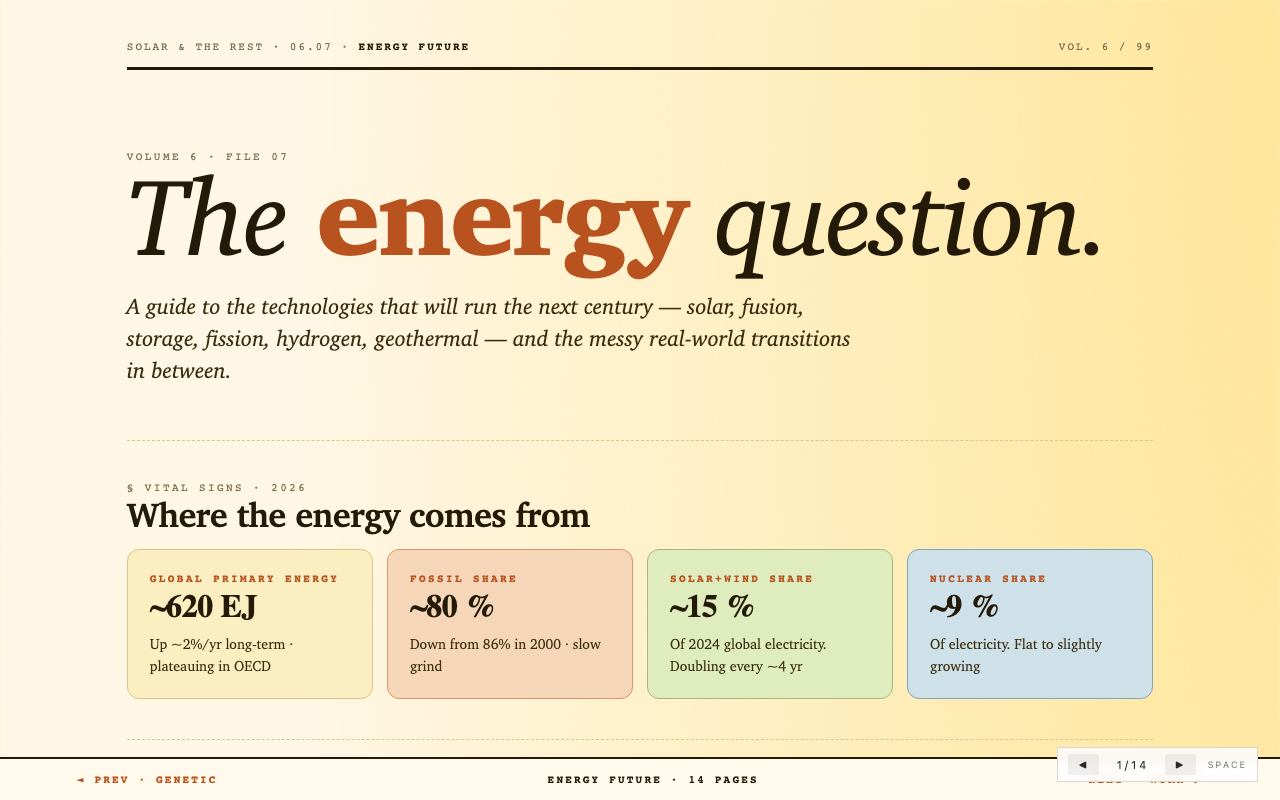
The defining infrastructure project of the century. Cheap solar, cheap batteries, an electrified everything — and a deployment problem the size of every...

StandaloneDownload
Sandboxed deck
Open raw

About this HTML presentation

This Shipslides page presents Energy Transition / Fossils to Electrons as an interactive HTML presentation deck in the Future catalog with 13 slides. The share page keeps the uploaded deck sandboxed while exposing readable context, topics, and a slide outline for viewers and search engines.

The defining infrastructure project of the century. Cheap solar, cheap batteries, an electrified everything — and a deployment problem the size of every grid on earth. Key sections include: ENERGY TRANSITION Fossils to electrons; Eighty percent of human energy is still combustion.; The economics already won.; The strategy is one word: electrons.; When the wind stops, what then?; Stationary storage went from niche to commodity.; The 100-hour problem is still open.; Useful, but not for everything.; The dispatchable clean baseload.; We will need to suck CO₂ out of the sky..

Key sections

  • 01ENERGY TRANSITION Fossils to electrons
  • 02Eighty percent of human energy is still combustion.
  • 03The economics already won.
  • 04The strategy is one word: electrons.
  • 05When the wind stops, what then?
  • 06Stationary storage went from niche to commodity.
  • 07The 100-hour problem is still open.
  • 08Useful, but not for everything.
  • 09The dispatchable clean baseload.
  • 10We will need to suck CO₂ out of the sky.
  • 11A new map of energy power.
  • 12of the technology to decarbonize is commercially available today.
  • 13The fastest infrastructure rebuild in history. Not fast enough.
Slide outline
  1. 01ENERGY TRANSITION Fossils to electrons
  2. 02Eighty percent of human energy is still combustion.
  3. 03The economics already won.
  4. 04The strategy is one word: electrons.
  5. 05When the wind stops, what then?
  6. 06Stationary storage went from niche to commodity.
  7. 07The 100-hour problem is still open.
  8. 08Useful, but not for everything.
  9. 09The dispatchable clean baseload.
  10. 10We will need to suck CO₂ out of the sky.
  11. 11A new map of energy power.
  12. 12of the technology to decarbonize is commercially available today.
  13. 13The fastest infrastructure rebuild in history. Not fast enough.

Page data
Canonical
https://shipslides.com/d/catalog-future-energy-transition
Category
Future
Size
44.6 KB
Updated
2026-05-17
LLM text
https://shipslides.com/d/catalog-future-energy-transition/llms.txt

Presentation Transcript

Detailed slide-by-slide text content extracted from this presentation.

Slide 01

ENERGY TRANSITION Fossils to electrons

  • Catalog · Energy · 2026 brief
  • The defining infrastructure project of the century. Cheap solar, cheap batteries, an electrified everything — and a deployment problem the size of every grid on earth.
  • Scope13 slides · global
  • FrameTech ready, deployment lagging
  • Horizon2026 — 2050
  • MoodRealistic optimism
Slide 02

Eighty percent of human energy is still combustion.

  • 02 · The setup
  • Despite a decade of headlines, fossil fuels — coal, oil, gas — supply roughly four-fifths of primary energy globally. The transition is real, but it is a multi-decade rebuild of every grid, every car fleet, every furnace.
  • Global primary energy mix · 2024 est.
  • Fossil share of primary energy
  • ~79%
  • Coal, oil, and gas. Down from 87% in 2000 — a real but glacial shift.
  • Annual clean energy investment
  • $2.0T
  • Now nearly 2× annual fossil capex. The capital flywheel has flipped.
  • Years of buildout ahead
  • 25–30
  • Even on aggressive deployment, full primary-energy decarbonization is a multi-decade project.
Slide 03

The economics already won.

  • 03 · The cost curves
  • Solar modules, wind turbines, lithium-ion cells: each on a learning curve that has crushed cost faster than almost any forecast. The transition's hardest argument has dissolved.
  • Cost decline · 2014 = 100
  • Utility solar LCOE since 2010
  • −90%
  • Now the cheapest source of bulk electricity ever priced.
  • Onshore wind LCOE since 2010
  • −70%
  • Bigger turbines, bigger rotors, capacity factors above 50% in best sites.
  • Lithium-ion pack price since 2010
  • −90%
  • From ~$1,200/kWh to under $115. The single biggest enabler of EVs and grid storage.
Slide 04

The strategy is one word: electrons.

  • 04 · Electrify everything
  • Replace every combustion engine with a motor, every furnace with a heat pump, every flame with resistive or inductive heat. Electrification roughly triples energy efficiency for the same end-use service.
  • Vehicles
  • EV drivetrain efficiency vs. internal combustion. Tank-to-wheel — and global EV share is now ~22% of new car sales.
  • Heat (homes)
  • 3–4×
  • Heat pump COP vs. resistive heating. Even cold-climate models now outperform gas furnaces.
  • Industry
  • ~30%
  • Of industrial heat is below 200°C — already in reach of electric or heat pump tech today.
  • Trucks & rail
  • 2030s
  • Battery-electric and catenary trucks crossing TCO breakeven this decade.
  • The flow
Slide 05

When the wind stops, what then?

  • 05 · The grid problem
  • The grid was built for steady, dispatchable thermal plants. Solar peaks at noon. Wind is intermittent. Demand peaks at evening. Bridging this gap — flexibility — is the central engineering challenge.
  • Daily generation vs. demand · illustrative
  • Five flexibility levers
  • Storage — batteries, pumped hydro, thermal
  • Transmission — long-haul HVDC connecting weather zones
  • Demand response — shift loads (EV charging, industrial)
  • Dispatchable clean — nuclear, hydro, geothermal
  • Overbuild & curtail — cheaper than storage at the margin
  • Permitting time · US transmission line
  • 10+ yrs
  • The grid problem is half engineering, half paperwork. Lines, not panels, are the bottleneck.
Slide 06

Stationary storage went from niche to commodity.

  • 06 · Battery storage
  • Lithium iron phosphate (LFP) chemistry — cheap, safe, abundant — is now the workhorse of grid-scale storage. Deployment is doubling every two years.
  • Global grid battery capacity · 2024
  • ~180 GW
  • From under 5 GW in 2018. The fastest-scaling new asset class on the grid.
  • LFP cell pack price · 2024
  • $95/kWh
  • Below the $100 threshold once considered the EV inflection. Storage TCO scales accordingly.
  • Typical duration deployed today
  • 2 — 4 hr
  • Right-sized for the evening solar gap. The economics work; longer duration is a different game.
  • 2030 forecast capacity
  • ~1.5 TW
  • 8× growth in 6 years. China is ~50% of installs; Texas is the single largest market by state.
  • SOURCES · BNEF, IEA, EMBER · LFP = LITHIUM IRON PHOSPHATE
Slide 07

The 100-hour problem is still open.

  • 07 · Long-duration storage
  • Lithium handles hours. But weeks of low wind, or seasonal mismatches, demand storage that lithium can't economically supply. A research frontier with several promising chemistries — none yet at commodity scale.
  • Iron-air
  • Form Energy's bet. Uses oxidation/reduction of iron — abundant, cheap, low energy density. Theoretical cost ~$20/kWh, 100-hour discharge. pilot
  • 100hr
  • Pumped hydro
  • Old, proven, ~95% of world storage today. Geographically limited, slow to permit. Closed-loop projects expanding. mature
  • ~80%
  • Round-trip efficiency
  • Thermal & flow
  • Molten salts, hot rocks, vanadium flow batteries. Modular, scalable, but immature economics. The wild-card category. research
  • 10+ yrs
  • To scale
Slide 08

Useful, but not for everything.

  • 08 · Hydrogen
  • Hydrogen is the Swiss Army knife people are tempted to use as a hammer. The honest case is narrow: industry, aviation, shipping, fertilizer. Not cars. Not home heat.
  • Where hydrogen wins
  • Steel — DRI process replacing coking coal
  • Ammonia / fertilizer — already 70 Mt H₂/yr, today fossil-derived
  • Refineries — substituting grey H₂ with green
  • Long-haul aviation — via synthetic fuels (e-kerosene)
  • Shipping — ammonia or methanol bunker fuel
  • Where hydrogen loses
  • Passenger cars — 3× round-trip energy loss vs. battery EV
  • Home heating — heat pumps win on cost and efficiency
  • Grid balancing < 12 hr — batteries cheaper
  • Light trucks — battery TCO crossing over
  • Green H₂ cost target · 2030
  • $2/kg
  • Today's cost (electrolysis)
  • $5–7
  • Global H₂ demand · 2024
  • ~95 Mt
  • Of which is "green"
  • <1%
Slide 09

The dispatchable clean baseload.

  • 09 · Nuclear
  • Existing reactors run, life-extended, deliver carbon-free electrons 90%+ of the time. New construction is hard. SMRs are the bet. Fusion is the long shot.
  • Existing fleet
  • ~440 reactors globally provide ~9% of electricity. Average capacity factor: 92%. License extensions to 80 years are now routine in the US.
  • 2,500
  • TWh/yr · clean baseload
  • SMRs (next 10 yrs)
  • Small modular reactors: 50–300 MW, factory-built, designed for rapid siting near data centers and industrial loads. NuScale, X-Energy, Kairos, BWX leading.
  • ~2030
  • First commercial deployments
  • Fusion (long term)
  • NIF achieved net energy gain (Q>1) in 2022. Commonwealth, Helion, TAE racing toward demonstration plants. Realistic commercial timeline: 2040s+.
  • 2040+
  • Commercial earliest case
Slide 10

We will need to suck CO₂ out of the sky.

  • 10 · Carbon removal
  • Even on a near-perfect transition, residual emissions from agriculture, aviation and cement remain. Net-zero pathways assume gigatonnes per year of CO₂ removal by mid-century. Today: thousands of tonnes. The gap is six orders of magnitude.
  • Direct air capture cost · today
  • $600/t
  • Down from $1,200 a decade ago. Climeworks, Heirloom, 1PointFive scaling first plants.
  • Required by 2050 (IPCC pathways)
  • 5–10 Gt
  • Per year. Today's removal capacity: ~0.01 Mt. A factor-of-1,000,000 industry to build.
  • Target cost
  • $100/t
  • The threshold for affordable, scaled removal. Plausible by 2035 with learning curves.
  • The CDR portfolio
  • DAC — direct air capture, geologic storage. Pure but energy hungry.
  • BECCS — bioenergy + CCS. Land use trade-offs.
  • Enhanced weathering — crushed silicate rock on fields.
  • Ocean alkalinity — speculative, gigatonne potential.
  • Forests / soils — cheap, real, but reversible.
  • Mineralization — CO₂ + basalt → stable carbonates (Iceland's CarbFix).
Slide 11

A new map of energy power.

  • 11 · Geopolitics
  • Oil reshaped the 20th century. Lithium, copper, nickel, rare earths and silicon-wafer fabs will reshape the 21st. Every transition mineral has a single dominant processor — usually China.
  • Refined lithium
  • ~65%
  • China's share of global processing. Australia digs it; China refines it.
  • Cobalt mining
  • ~70%
  • DRC origin. ~80% of refining → China.
  • Polysilicon for PV
  • ~80%
  • Of world production in China, mostly Xinjiang.
  • Rare earth refining
  • ~85%
  • Magnets for wind turbines and EV motors. Effectively a single-source supply chain.
  • Friend-shoring response
  • The US Inflation Reduction Act, EU Critical Raw Materials Act, Japan's KSM strategy, Australia's "Future Made" all push the same playbook: subsidize domestic processing, partner with allies, decouple selectively from China.
  • The honest constraint
  • Decoupling is expensive and slow. Mines take 10–15 years from discovery to production. Refining requires capital, environmental permitting, and a workforce that has migrated overseas. The mineral race may define the 2030s.
Slide 12

of the technology to decarbonize is commercially available today.

  • 12 · Honest assessment
  • 99%
  • The hard part isn't invention. It's permitting, transmission, supply chains, workforce, and political will. The transition is now an execution problem.
  • What's working
  • Solar + storage on commodity learning curves
  • EVs hitting price parity in major markets
  • $2T/yr clean energy capex flywheel
  • China driving manufacturing scale
  • What's stuck
  • Transmission permitting (10+ yr cycles)
  • Industrial heat > 500°C
  • Aviation, heavy shipping fuels
  • Long-duration storage economics
  • Carbon removal at scale
  • What it needs
  • Permitting reform — fast
  • Long-distance HVDC networks
  • Mineral supply diversification
  • Skilled trades workforce 5×
  • Carbon prices that bite
Slide 13

The fastest infrastructure rebuild in history. Not fast enough.

  • 13 · Closing & references
  • We have the tools. The cost curves cooperate. The remaining work is political, logistical, and physical — every grid, every fleet, every furnace, in 25 years.
  • ▶ YouTube · search
  • Energy Transition — Explained
  • Big-picture explainers on the global shift from combustion to electrification.
  • youtube.com/results?search_query=energy+transition+explained
  • ▶ YouTube · search
  • Lithium Battery Grid Storage
  • Deep dives on stationary storage, LFP chemistry, and grid-scale deployment.
  • youtube.com/results?search_query=lithium+battery+grid+storage
  • FurtherIEA · World Energy Outlook
  • DataEmber, BNEF, IRENA
  • BooksSmil · Griffith · Helm
  • Slides13 of 13 · end
Remove this deck