shipslides
Future14 slides0 views

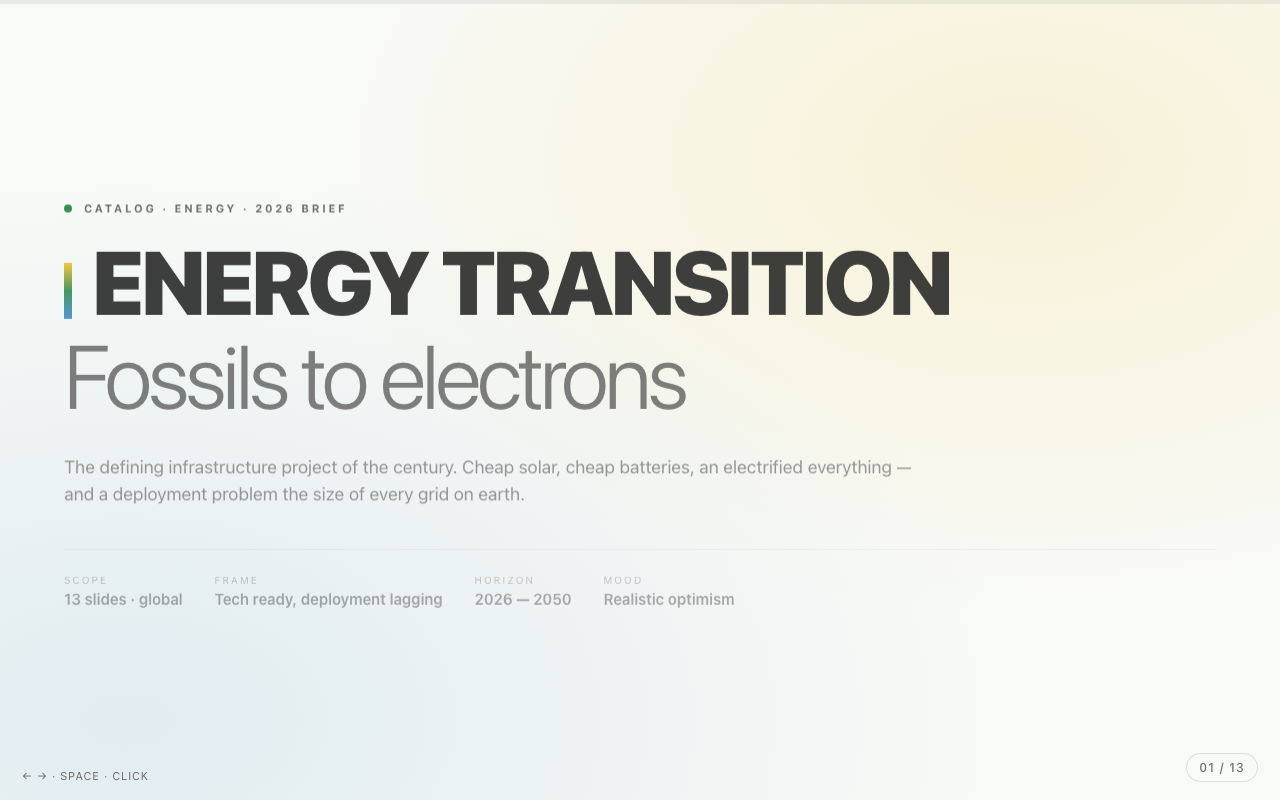
Energy Future

A guide to the technologies that will run the next century — solar, fusion, storage, fission, hydrogen, geothermal — and the messy real-world transitions in...

StandaloneDownload
Sandboxed deck
Open raw

About this HTML presentation

This Shipslides page presents Energy Future as an interactive HTML presentation deck in the Future catalog with 14 slides. The share page keeps the uploaded deck sandboxed while exposing readable context, topics, and a slide outline for viewers and search engines.

A guide to the technologies that will run the next century — solar, fusion, storage, fission, hydrogen, geothermal — and the messy real-world transitions in between. Key sections include: The energy question.; Where the energy comes from; The story is solar; The 30-years-away technology, perhaps not; How a tokamak confines plasma; Batteries, and beyond batteries; Fission's second chance; The molecule with a marketing problem; The dark horse; Who to read.

Key sections

  • 01The energy question.
  • 02Where the energy comes from
  • 03The story is solar
  • 04The 30-years-away technology, perhaps not
  • 05How a tokamak confines plasma
  • 06Batteries, and beyond batteries
  • 07Fission's second chance
  • 08The molecule with a marketing problem
  • 09The dark horse
  • 10Who to read
  • 11Recommended source
  • 12Three energy futures
  • 13Indicators · 2026–2030

Topics covered

Slide outline
  1. 01The energy question.
  2. 02Where the energy comes from
  3. 03The story is solar
  4. 04The 30-years-away technology, perhaps not
  5. 05How a tokamak confines plasma
  6. 06Batteries, and beyond batteries
  7. 07Fission's second chance
  8. 08The molecule with a marketing problem
  9. 09The dark horse
  10. 10Who to read
  11. 11Recommended source
  12. 12Three energy futures
  13. 13Indicators · 2026–2030
Page data
Canonical
https://shipslides.com/d/future-energy-future
Category
Future
Size
27.8 KB
Updated
2026-05-17
LLM text
https://shipslides.com/d/future-energy-future/llms.txt

Presentation Transcript

Detailed slide-by-slide text content extracted from this presentation.

Slide 01

The energy question.

  • Volume 6 · File 07
  • A guide to the technologies that will run the next century — solar, fusion, storage, fission, hydrogen, geothermal — and the messy real-world transitions in between.
Slide 02

Where the energy comes from

  • § Vital signs · 2026
  • Global primary energy
  • ~620 EJ
  • Up ~2%/yr long-term · plateauing in OECD
  • Fossil share
  • ~80 %
  • Down from 86% in 2000 · slow grind
  • Solar+wind share
  • ~15 %
  • Of 2024 global electricity. Doubling every ~4 yr
  • Nuclear share
  • ~9 %
  • Of electricity. Flat to slightly growing
Slide 03

The story is solar

  • §1 · The solar S-curve
  • Solar PV cost has fallen ~90% since 2010. Module prices crossed $0.10/W in 2024. Levelized cost of utility solar is now below $30/MWh in best sites — cheaper than the operating cost of paid-off coal. Kommersant, IEA, Bloomberg NEF, RethinkX all project the trend continues.
  • Why it ate everything else
  • Wright's Law learning rate: ~28% per doubling
  • Modular: deployable from rooftop to gigawatt
  • No moving parts; falling balance-of-system costs
  • Capacity factor now 18–28% with trackers
  • forecast Solar passes coal globally as the largest power source by 2027–28; passes everything else by 2035–40.
  • Photo · utility solar · cheaper than the cheapest fossil power, in most insolation bands.
Slide 04

Slide 4

  • §2 · S-curve · figure
  • After IRENA, Lazard LCOE, BNEF tracker. Schematic.
Slide 05

The 30-years-away technology, perhaps not

  • §3 · Fusion
  • Fusion has been "30 years away" since 1955. The 2020s have changed the picture in two ways: NIF achieved net energy gain (Q>1) on shot N221204 in December 2022; and a wave of well-capitalized private fusion companies (CFS, TAE, Helion, Tokamak Energy, ZAP) target pilot plants in the 2030s.
  • PlayerConceptPilot targetNotes
  • ITERTokamak (D-T, superconducting)First plasma 2034 (delayed)~$25B+ international consortium
  • Commonwealth Fusion (CFS)Tokamak (HTS magnets)SPARC ~2027 · ARC ~2032MIT spinout; HTS magnet bet
  • HelionField-reversed config (D-He3)Polaris 2024–25Direct electrical conversion
  • TAEFRC, p-B11Late 2030sAneutronic ambition
  • Tokamak EnergySpherical tokamakDemo 2030sUK · STEP collaboration
  • ZAP EnergyZ-pinch (sheared flow)Pilot 2030sCompact, cheap if it works
  • scenario First commercial-scale fusion electron added to a grid: optimistically 2032, more plausibly 2035–40. Fusion does not solve the 2030 climate problem.
Slide 06

How a tokamak confines plasma

  • §4 · Tokamak diagram
  • Magnetic confinement of D-T plasma · neutron flux × Li blanket → tritium breeding + heat → steam turbine.
Slide 07

Batteries, and beyond batteries

  • §5 · Storage
  • Li-ion · LFP
  • $~80/kWh
  • 2024 spot · CATL, BYD. 4-hour grid storage now competitive.
  • Sodium-ion
  • $~60–70/kWh
  • Stationary & entry EVs. CATL Naxtra, HiNa, Faradion.
  • Iron-air
  • 100-hr duration
  • Form Energy · ~$20/kWh capex target. Multi-day storage.
  • Vanadium flow
  • decoupled MWh
  • Long cycle life; vanadium price volatility.
  • Pumped hydro
  • ~95% of installed
  • Still the dominant grid storage by GWh worldwide.
  • Thermal
  • molten salt · sand
  • Antora, Rondo, Polar Night. Industrial heat.
Slide 08

Fission's second chance

  • §6 · Nuclear
  • Public opinion on nuclear has reversed in many countries since 2020 — pre-pandemic skepticism gave way to climate-driven pragmatism. France ordered six new EPR2 reactors in 2022; Sweden reversed a phase-out; Japan restarted idled units; the US passed the IRA's nuclear PTC.
  • Three nuclear bets
  • Conventional Gen-III+ — AP1000, EPR, APR1400. Proven, expensive, slow to build in West (Vogtle 3/4 12yr +$30B over budget).
  • Small Modular Reactors (SMRs) — NuScale (cancelled 2023 first project), Holtec, X-energy, Rolls-Royce. Factory-built, target $100/MWh. First operating units 2028–32. scenario
  • Gen-IV — Natrium (TerraPower, Wyoming), Aurora (Oklo), molten-salt (Kairos, Terrestrial Energy). 2030s timelines.
  • Fuel: HALEU bottleneck (high-assay low-enriched uranium). Russia is the dominant supplier; Western capacity ramping but tight through 2030.
Slide 09

The molecule with a marketing problem

  • §7 · Hydrogen
  • Most hydrogen today (~95%) is "gray" — made from natural gas, emits CO₂. The clean alternative, "green" hydrogen from electrolysis, currently costs $4–7/kg vs $1–2 for gray. Bloomberg, IEA, Liebreich agree: hydrogen will play a real role in steel, ammonia, shipping, aviation — and will be a bad fit for cars and home heating.
  • Hydrogen Ladder · Liebreich
  • Tier A: fertilizer ammonia, refining, methanol, hydrogenation
  • Tier B: steel (DRI), high-grade industrial heat
  • Tier C: long-haul shipping (NH3 carrier)
  • Tier D: aviation (synfuel feedstock)
  • Tier G: home heating, light vehicles, peaking power — bad fit
  • forecast Green H2 reaches $2/kg in best sites by 2032; mass deployment in tier A/B follows.
Slide 10

The dark horse

  • §8 · Geothermal
  • Enhanced geothermal systems (EGS) take the well-drilling expertise that the shale-oil revolution built and turn it on hot dry rock. Fervo Energy's Cape Station (Utah, 400 MW under construction 2024–28), Eavor's closed-loop concept, and the DOE's Frontier Observatory have moved EGS from concept to early commercial.
  • The promise: 24/7 dispatchable clean baseload, geographically widespread, drilling depths of 4–7 km. The hard part: cost-down to $50/MWh-equivalent, and inducing seismicity safely.
  • scenario 50–100 GW of EGS by 2035 in optimistic deployment scenarios. Could be the second large dispatchable clean source after nuclear.
Slide 11

Who to read

  • §9 · Voices
  • Vaclav SmilEnergy scaling realism; How the World Really Works
  • Saul GriffithRewiring America; electrify everything
  • Hannah RitchieOur World in Data; Not the End of the World
  • Jesse JenkinsPrinceton ZERO Lab; transition modeling
  • Michael LiebreichHydrogen ladder; energy realism
  • Bret KugelmassLast Energy; nuclear advocacy
  • Daniel YerginEnergy historian; The Quest, The New Map
  • Ramez NaamSolar S-curves; technology forecasting
  • "The energy transition is happening. It is also happening too slowly." — a paraphrase of every honest analyst.
Slide 12

Recommended source

  • §10 · Watch
  • Real Engineering · "The Truth About Solar" / "Why ITER Will Take Forever"
  • Brian McManus's deep-dive engineering channel. Pair with Just Have a Think (UK) and Practical Engineering for grid topics.
  • youtube.com/@RealEngineering →
  • Kurzgesagt · "The Pursuit of Wonder · Fusion"
  • 10-minute primer on why fusion is hard, where the milestones are, and what NIF actually accomplished.
  • youtube.com/@kurzgesagt →
Slide 13

Three energy futures

  • §11 · 2050 scenarios
  • A · The cheap-solar world
  • Abundance
  • Solar+wind+storage default. Electrification of everything; H2 for hard-to-abate. Fusion arrives, doesn't displace solar.
  • B · Mixed bag
  • Nuclear + renewables
  • SMR fleet of 200+ units; geothermal scales; gas remains as transition fuel longer than expected.
  • C · Stuck transition
  • Coal endures
  • Permitting, grid, materials bottlenecks limit clean buildout. Climate path closer to SSP3-7.0.
Slide 14

Indicators · 2026–2030

  • §12 · What to watch
  • Solar deployment rate · 600 GW/yr → 1 TW/yr inflection
  • Battery prices crossing $50/kWh
  • SPARC first plasma · 2026–27
  • First operating SMR (US, UK, Canada) · 2028–32
  • Permitting reform in US, EU — grid interconnection queues
  • Critical-mineral supply chains (Li, Ni, Co, rare earths) — recycling & sodium swap
Remove this deck