shipslides
History13 slides0 views

The Silk Road — Caravans across Eurasia

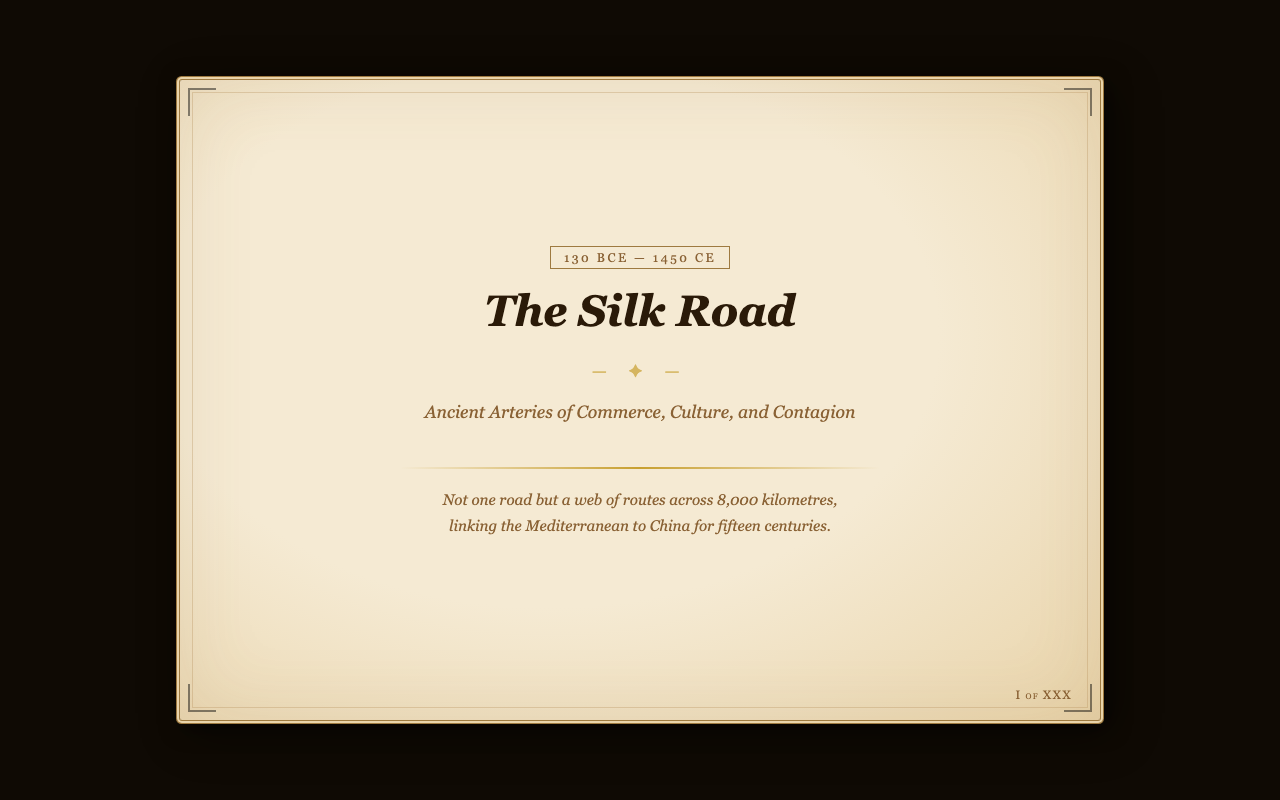
N The Silk Road Caravans across Eurasia ~ 200 BC · 1450 AD A history in thirteen panels I. Origins — A Han Envoy Heads West In 138 BC , Emperor Wu of the...

StandaloneDownload
Sandboxed deck
Open raw

About this HTML presentation

This Shipslides page presents The Silk Road — Caravans across Eurasia as an interactive HTML presentation deck in the History catalog with 13 slides. The share page keeps the uploaded deck sandboxed while exposing readable context, topics, and a slide outline for viewers and search engines.

N The Silk Road Caravans across Eurasia ~ 200 BC · 1450 AD A history in thirteen panels I. Origins — A Han Envoy Heads West In 138 BC , Emperor Wu of the Han dispatched the diplomat Zhang Qian to find allies against the Xiongnu. He was captured for a decade, escaped, and returned with reports of vast civilizations beyond the Pamirs — Bactria, Parthia, Ferghana. Key sections include: The Silk Road; I. Origins — A Han Envoy Heads West; II. Not One Road — A Network; III. The Traders; IV. Goods, Both Ways; V. The Bigger Trade — Ideas; VI. The Tang Apogee (618 – 907); VII. The Mongol Pax (1206 – 1368); VIII. The Plague Rides West (~1346); IX. The Maritime Silk Road.

Key sections

  • 01The Silk Road
  • 02I. Origins — A Han Envoy Heads West
  • 03II. Not One Road — A Network
  • 04III. The Traders
  • 05IV. Goods, Both Ways
  • 06V. The Bigger Trade — Ideas
  • 07VI. The Tang Apogee (618 – 907)
  • 08VII. The Mongol Pax (1206 – 1368)
  • 09VIII. The Plague Rides West (~1346)
  • 10IX. The Maritime Silk Road
  • 11X. Decline of the Overland Routes
  • 12XI. Modern Echoes
  • 13XII. Further Reading & Watching
Slide outline
  1. 01The Silk Road
  2. 02I. Origins — A Han Envoy Heads West
  3. 03II. Not One Road — A Network
  4. 04III. The Traders
  5. 05IV. Goods, Both Ways
  6. 06V. The Bigger Trade — Ideas
  7. 07VI. The Tang Apogee (618 – 907)
  8. 08VII. The Mongol Pax (1206 – 1368)
  9. 09VIII. The Plague Rides West (~1346)
  10. 10IX. The Maritime Silk Road
  11. 11X. Decline of the Overland Routes
  12. 12XI. Modern Echoes
  13. 13XII. Further Reading & Watching
Page data
Canonical
https://shipslides.com/d/catalog-history-silk-road
Category
History
Size
30.6 KB
Updated
2026-05-17
LLM text
https://shipslides.com/d/catalog-history-silk-road/llms.txt

Presentation Transcript

Detailed slide-by-slide text content extracted from this presentation.

Slide 01

The Silk Road

  • Caravans across Eurasia
  • ~ 200 BC · 1450 AD
  • A history in thirteen panels
Slide 02

I. Origins — A Han Envoy Heads West

  • In 138 BC, Emperor Wu of the Han dispatched the diplomat Zhang Qian to find allies against the Xiongnu. He was captured for a decade, escaped, and returned with reports of vast civilizations beyond the Pamirs — Bactria, Parthia, Ferghana.
  • His mission opened formal Chinese contact with Central Asia. By the 1st century AD, Han silks were reaching Rome, where senators lamented the bullion drain — Pliny the Elder estimated 100 million sesterces a year flowing east.
  • "He saw cities walled with brick, and grapes that became wine." — paraphrased from the Shiji
Slide 03

II. Not One Road — A Network

  • "The Silk Road" is a 19th-century coinage (Ferdinand von Richthofen, 1877). On the ground it was a braided web of caravan tracks, mountain passes, and oasis cities — chosen each year by water, weather, and warlords.
  • From the Levant to Chang'an, ~6,400 km — but few traders ever traveled the whole way.
Slide 04

III. The Traders

  • Goods passed through dozens of hands. The road belonged to many peoples; none of them were called "Silk Road merchants."
  • Sogdians
  • Iranian-speaking traders from Samarkand & Bukhara. Their language was the lingua franca of the road for centuries.
  • Bactrians & Persians
  • Caravan organizers, animal breeders, money-changers — masters of the central corridors.
  • Arabs
  • After the 7th century, dominant from Damascus to the Indian Ocean rim — and across Saharan offshoots.
  • Radhanite Jews
  • Multilingual merchants who linked Christendom, Islam, and India — recorded by Ibn Khordadbeh, c. 870.
  • Chinese
  • Silk producers, monks (Xuanzang), and from Tang times resident merchants in oasis cities.
  • Indians, Tibetans, Uyghurs
  • Buddhist networks, mountain pass-keepers, steppe middlemen — all with their share of the staffing.
Slide 05

IV. Goods, Both Ways

  • Westbound from China
  • Silk — light, valuable, almost a currency
  • Porcelain & lacquerware
  • Tea (later), rhubarb, cinnamon
  • Paper & (much later) gunpowder
  • Eastbound to China
  • Ferghana horses — "heavenly" warhorses
  • Roman & Sasanian glass
  • Gold, silver, gems, ivory, coral
  • Spices, frankincense, woolen carpets
  • Grapes, alfalfa, cucumbers, walnuts
  • Most goods changed hands many times; prices multiplied tenfold or more by journey's end.
Slide 06

V. The Bigger Trade — Ideas

  • If silk paid the carriers, ideas reshaped the civilizations they passed through.
  • Buddhism walked east with monks and merchants — by the 4th c. AD, cave monasteries from Bamiyan to Dunhuang.
  • Paper moved west: Chinese craftsmen captured at Talas (751) brought the technique to Samarkand, then Baghdad, then Europe.
  • Mathematics: Indian numerals, Persian algebra (al-Khwarizmi), Chinese magic squares — all crossed the road.
  • Religions: Manichaeism, Nestorian Christianity, Zoroastrianism, and later Islam all rode the caravans into China.
  • Technologies: stirrups, the compass, sericulture (smuggled west by Byzantine monks, c. 552), printing.
  • "What truly traveled the Silk Road was not goods, but knowledge in the saddlebags between them."
Slide 07

VI. The Tang Apogee (618 – 907)

  • Under the Tang, Chang'an was the largest, most cosmopolitan city on Earth — perhaps one million residents inside its walls, with dedicated quarters for Sogdian, Persian, Arab, and Indian merchants.
  • The Tang state actively patrolled the routes. Garrisons in the Tarim oases kept caravans safe. Persian refugees from Sasanid Iran (post-651) settled at the imperial court.
  • In 751, Tang armies met the Abbasids at Talas. The defeat ended Chinese westward expansion — but seeded paper-making across Islam.
Slide 08

VII. The Mongol Pax (1206 – 1368)

  • Under Genghis Khan and his heirs, a single political order stretched from the Yellow Sea to the Black Sea. For the first time, a merchant could in principle travel coast-to-coast under one law and one passport (the paiza).
  • The Yam — a state postal relay system, ~1,400 stations, fresh horses every 40 km.
  • Tolerance of religions; cosmopolitan courts at Karakorum, Khanbaliq (Beijing), Tabriz.
  • Marco Polo (1271 – 1295) reached Kublai's court and went home with stories Europe could barely believe.
  • Ibn Battuta, William of Rubruck, Rabban Bar Sauma — the road's golden generation of travel writers.
  • "A maiden bearing a nugget of gold could walk alone from one end of the empire to the other." — attributed legend
Slide 09

VIII. The Plague Rides West (~1346)

  • The same routes that moved silk and silver moved Yersinia pestis. Outbreaks in Inner Asia in the 1330s spread along caravan tracks to the Crimea — and from there into the holds of Genoese ships.
  • Within a decade, the Black Death killed perhaps a third of Europe and a comparable share of Western Asia. The Mongol order, already fraying, lost its grip on the central corridor.
  • "The road of riches was also the road of pestilence."
  • ~ 75M –200M
  • estimated dead, 14th c. pandemic
Slide 10

IX. The Maritime Silk Road

  • Long before "the" Silk Road declined, a parallel sea route was already humming — monsoon-driven Indian Ocean traffic between the Red Sea, East Africa, India, Southeast Asia, and southern China.
  • Roman traders sailed to Muziris (Kerala) by the 1st c. AD; Chinese ports like Guangzhou and Quanzhou hosted Persian and Arab quarters.
  • By the 13th c., Chinese junks of 1,000 tons crossed routinely to Hormuz.
  • Zheng He (1405 – 1433) led seven Ming treasure fleets — up to 300 ships, 28,000 men — as far as Mogadishu and the Swahili coast.
  • Then, abruptly, the Ming turned inward: shipyards burned, voyages ended.
  • The ocean would soon belong to others.
Slide 11

X. Decline of the Overland Routes

  • The 15th century delivered a triple blow:
  • The breakup of the Mongol khanates raised tolls and risk.
  • The Ottoman conquest of Constantinople (1453) tightened the Levant choke-point.
  • Portuguese caravels rounded Africa (Vasco da Gama, 1498) — bypassing the middlemen entirely.
  • Spices that had cost a fortune in Venice could now be loaded directly in Calicut. The economic logic of the caravan collapsed.
Slide 12

XI. Modern Echoes

  • The routes never truly closed. Caravans dwindled but did not vanish; the cities along them — Samarkand, Bukhara, Kashgar, Xi'an — kept their bones.
  • 19th c. — the "Great Game" maps the same passes Zhang Qian once crossed.
  • 1877 — Richthofen invents the phrase Seidenstraße.
  • 2013 — China announces the Belt and Road Initiative: rail, ports, fiber following the old corridors.
  • Today — freight trains run Yiwu → Madrid in ~18 days; data cables thread the Caspian floor.
  • "Geography is patient. The same valleys that suited a camel's hoof tend to suit a railway grade."
Slide 13

XII. Further Reading & Watching

  • Selected references
  • Frankopan, P. — The Silk Roads: A New History of the World (2015)
  • Hansen, V. — The Silk Road: A New History (2012)
  • Whitfield, S. — Life Along the Silk Road (1999)
  • Liu, X. — The Silk Road in World History (2010)
  • Polo, M. — The Travels (c. 1300)
  • Ibn Battuta — Rihla (c. 1355)
  • YouTube
  • Silk Road history — search on YouTube
  • Marco Polo's travels — search on YouTube
  • ✦ finis ✦
Remove this deck