shipslides
Philosophy13 slides0 views

Logic — The Form of Valid Inference

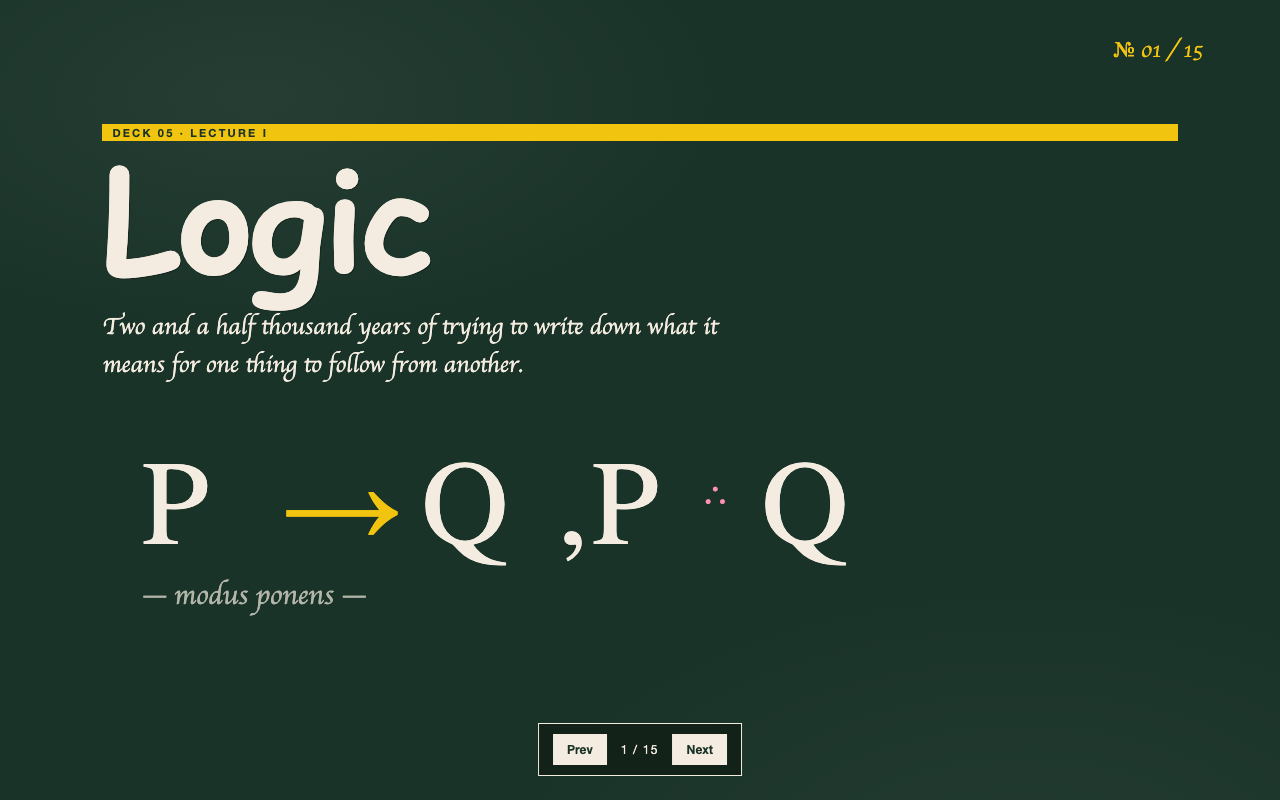
From the syllogism to incompleteness: twenty-three centuries of trying to mechanize reasoning, and the discovery that reason itself has limits.

StandaloneDownload
Sandboxed deck
Open raw

About this HTML presentation

This Shipslides page presents Logic — The Form of Valid Inference as an interactive HTML presentation deck in the Philosophy catalog with 13 slides. The share page keeps the uploaded deck sandboxed while exposing readable context, topics, and a slide outline for viewers and search engines.

From the syllogism to incompleteness: twenty-three centuries of trying to mechanize reasoning, and the discovery that reason itself has limits. Key sections include: LOGIC The form of valid inference; Aristotle · The Syllogism; Stoic Logic · Propositional Connectives; Ockham · Theory of Supposition; Frege · Begriffsschrift; Russell & Whitehead · Principia Mathematica; Russell's Paradox; Hilbert's Programme; Gödel · Incompleteness; Turing · The Halting Problem.

Key sections

  • 01LOGIC The form of valid inference
  • 02Aristotle · The Syllogism
  • 03Stoic Logic · Propositional Connectives
  • 04Ockham · Theory of Supposition
  • 05Frege · Begriffsschrift
  • 06Russell & Whitehead · Principia Mathematica
  • 07Russell's Paradox
  • 08Hilbert's Programme
  • 09Gödel · Incompleteness
  • 10Turing · The Halting Problem
  • 11Modal Logic · Necessity & Possibility
  • 12Modern Currents
  • 13References & Further Viewing
Slide outline
  1. 01LOGIC The form of valid inference
  2. 02Aristotle · The Syllogism
  3. 03Stoic Logic · Propositional Connectives
  4. 04Ockham · Theory of Supposition
  5. 05Frege · Begriffsschrift
  6. 06Russell & Whitehead · Principia Mathematica
  7. 07Russell's Paradox
  8. 08Hilbert's Programme
  9. 09Gödel · Incompleteness
  10. 10Turing · The Halting Problem
  11. 11Modal Logic · Necessity & Possibility
  12. 12Modern Currents
  13. 13References & Further Viewing
Page data
Canonical
https://shipslides.com/d/catalog-philosophy-logic
Category
Philosophy
Size
27.8 KB
Updated
2026-05-17
LLM text
https://shipslides.com/d/catalog-philosophy-logic/llms.txt

Presentation Transcript

Detailed slide-by-slide text content extracted from this presentation.

Slide 01

LOGIC The form of valid inference

  • A Brief History — Aristotle to Gödel
  • § — § — §
  • From the syllogism to incompleteness: twenty-three centuries of trying to mechanize reasoning, and the discovery that reason itself has limits.
Slide 02

Aristotle · The Syllogism

  • I. Antiquity · c. 350 B.C.
  • Prior Analytics, Book I
  • Aristotle isolated form from content. A valid argument is valid because of its shape, not its subject matter. He catalogued the moods of the categorical syllogism — three terms, three propositions, fixed structure.
  • ALL M are P.
  • ALL S are M.
  • ——————
  • ∴ ALL S are P.
  • (Mood: BARBARA, figure I)
  • Containment: S ⊂ M ⊂ P
Slide 03

Stoic Logic · Propositional Connectives

  • II. The Stoa · c. 300 B.C.
  • Chrysippus and the school of the Stoa
  • While Aristotle reasoned about classes of things, the Stoics reasoned about propositions. They built logic from whole sentences linked by connectives — and so anticipated the propositional calculus by two millennia.
  • AND p ∧ q
  • OR p ∨ q
  • IF p → q
  • NOT ¬p
  • Modus Ponens:
  • p → q
  • —————
  • ∴ q
  • Chrysippus is said to have written more than 700 logical treatises. Almost all are lost; only fragments survive in Diogenes Laertius and Sextus Empiricus.
Slide 04

Ockham · Theory of Supposition

  • III. Schoolmen · XIV cent.
  • William of Ockham (c. 1287–1347), Summa Logicae
  • The medievals took Aristotle and refined him with surgical care. Their central problem: how does a term refer in a proposition? Ockham's theory of supposition distinguished the modes by which a word stands for a thing.
  • SUPPOSITIO PERSONALIS — the term stands for the thing.
  • "Socrates is a man."
  • SUPPOSITIO SIMPLEX — for the concept.
  • "Man is a species."
  • SUPPOSITIO MATERIALIS — for the word itself.
  • "'Man' has three letters."
  • Ockham insisted that universals are signs in the mind, not entities in the world — entia non sunt multiplicanda praeter necessitatem. The razor cuts in logic too.
Slide 05

Frege · Begriffsschrift

  • IV. The Modern Birth · 1879
  • A formula language of pure thought
  • Gottlob Frege's 88-page pamphlet of 1879 is the most important event in logic since Aristotle. He invented quantifiers — the ∀ and ∃ that bind variables — and with them, predicate logic.
  • For the first time, statements like "every prime greater than two is odd" could be written in a calculus where validity was a matter of mechanical form.
  • ∀x ( P(x) → Q(x) )
  • ∃x ( P(x) ∧ R(x) )
  • ————————
  • ∴ ∃x ( Q(x) ∧ R(x) )
  • Frege's two-dimensional notation was unreadable; Peano and Russell rewrote it in the linear form we still use.
Slide 06

Russell & Whitehead · Principia Mathematica

  • V. Logicism · 1910–1913
  • Three volumes. 1,996 pages. The dream of reducing mathematics to logic.
  • If logic is the form of all valid inference, perhaps mathematics is just logic in elaborate dress. Bertrand Russell and Alfred North Whitehead set out to derive arithmetic, analysis, and set theory from a handful of logical axioms.
  • PM, Vol. I, Prop. *54.43
  • ⊢ . α, β ∈ 1 . ⊃ . (α ∩ β = Λ)
  • ≡ (α ∪ β) ∈ 2
  • "From this proposition it will follow,
  • when arithmetical addition has been
  • defined, that 1 + 1 = 2."
  • The proof of 1 + 1 = 2 arrives on page 379 of Volume I. The project nearly broke them. And then it broke.
Slide 07

Russell's Paradox

  • VI. Crisis · 1901
  • In 1901 Russell sent Frege a letter that destroyed Frege's life work just as Volume II of his Grundgesetze was at the printer.
  • Consider R, the set of all sets that are not members of themselves. Is R a member of itself?
  • Let R = { x : x ∉ x }
  • IF R ∈ R THEN R ∉ R.
  • IF R ∉ R THEN R ∈ R.
  • ∴ CONTRADICTION.
  • A set that contains itself iff it does not.
Slide 08

Hilbert's Programme

  • VII. The Program · 1920s
  • "Wir müssen wissen — wir werden wissen." — D. Hilbert, Königsberg, 1930
  • David Hilbert proposed a rescue. We will rebuild mathematics on an unshakable formal base. Three demands:
  • COMPLETE
  • Every true statement
  • can be proved within
  • the system.
  • CONSISTENT
  • No statement P and
  • its negation ¬P
  • are both provable.
  • DECIDABLE
  • A mechanical procedure
  • determines, for any P,
  • whether P is provable.
  • If completed, mathematics would be a finite, mechanical game with no remaining mysteries. The famous Entscheidungsproblem: find the algorithm.
Slide 09

Gödel · Incompleteness

  • VIII. The Limit · 1931
  • Über formal unentscheidbare Sätze, 1931
  • Kurt Gödel, age 25, demolished the program. By coding statements as numbers, he constructed a sentence G that says, in effect:
  • "This sentence has no proof in the system."
  • If G is provable, the system is inconsistent. If G is unprovable, the system is incomplete — and G is true.
  • FIRST INCOMPLETENESS
  • Any consistent formal
  • system F capable of
  • arithmetic contains
  • true statements that F
  • cannot prove.
  • SECOND INCOMPLETENESS
  • No such F can prove
  • its own consistency.
  • Proof sketch:
  • Cons(F) → G
  • F ⊬ G
  • ∴ F ⊬ Cons(F)
Slide 10

Turing · The Halting Problem

  • IX. The Machine · 1936
  • "On Computable Numbers, with an Application to the Entscheidungsproblem"
  • Five years after Gödel, Alan Turing settled the third of Hilbert's demands. He invented an idealized machine — tape, head, finite states — and asked: is there a program that decides whether any given program will eventually halt?
  • Suppose HALT(P, x) decides
  • whether program P halts on input x.
  • Define D(P):
  • IF HALT(P, P) THEN loop forever
  • ELSE halt.
  • Now consider D(D).
  • If D(D) halts → D(D) loops.
  • If D(D) loops → D(D) halts.
  • ∴ HALT cannot exist.
  • From this it follows that first-order logic has no general decision procedure. The Entscheidungsproblem has a negative answer. And, incidentally, the modern computer was born.
Slide 11

Modal Logic · Necessity & Possibility

  • X. Beyond Truth · XX cent.
  • C. I. Lewis (1918), Saul Kripke (1959)
  • Classical logic knows only that propositions are true or false. But ordinary speech distinguishes could be, must be, might have been. Modal logic adds two operators:
  • &Box; P — P is necessary
  • ♦ P — P is possible
  • ♦ P ≡ ¬&Box;¬P
  • &Box; P → P (axiom T)
  • &Box; P → &Box;&Box;P (axiom 4)
  • Possible-worlds semantics
  • Kripke's masterstroke: a sentence is necessary iff true in every accessible world; possible iff true in some.
  • Worlds and the accessibility relation
Slide 12

Modern Currents

  • XI. The Living Subject
  • Type Theory
  • Russell's stratified hierarchy of types — rebuilt by Per Martin-Löf — gives a foundation in which terms inhabit types. Modern proof assistants (Coq, Lean, Agda) compute in it.
  • Intuitionistic Logic
  • L. E. J. Brouwer rejected the law of the excluded middle: a proposition is true only when constructively provable. P ∨ ¬P is no longer free.
  • Curry–Howard
  • Propositions are types. Proofs are programs. To prove A → B is to write a function from A to B. Logic and computation are one structure seen twice.
  • Curry–Howard:
  • A → B ↔ function A → B
  • A ∧ B ↔ pair (A, B)
  • A ∨ B ↔ sum A | B
  • ∀x:A. B(x) ↔ dependent function type
Slide 13

References & Further Viewing

  • XII. Coda
  • Primary & classic texts
  • Aristotle, Prior Analytics (c. 350 B.C.).
  • William of Ockham, Summa Logicae (c. 1323).
  • G. Frege, Begriffsschrift (1879).
  • Russell & Whitehead, Principia Mathematica (1910–13).
  • K. Gödel, "Über formal unentscheidbare Sätze..." (1931).
  • A. Turing, "On Computable Numbers..." (1936).
  • S. Kripke, "Semantical Considerations on Modal Logic" (1963).
  • Lectures online
  • Gödel's incompleteness theorem — YouTube
  • Russell's paradox & set theory — YouTube
  • "The propositions of logic are tautologies.
  • The propositions of logic therefore say nothing.
  • (They are the analytical propositions.)"
  • — Wittgenstein, Tractatus, 6.1, 6.11
  • § — finis — §
Remove this deck