shipslides
Future13 slides0 views

Becoming Multiplanetary — Space Colonization

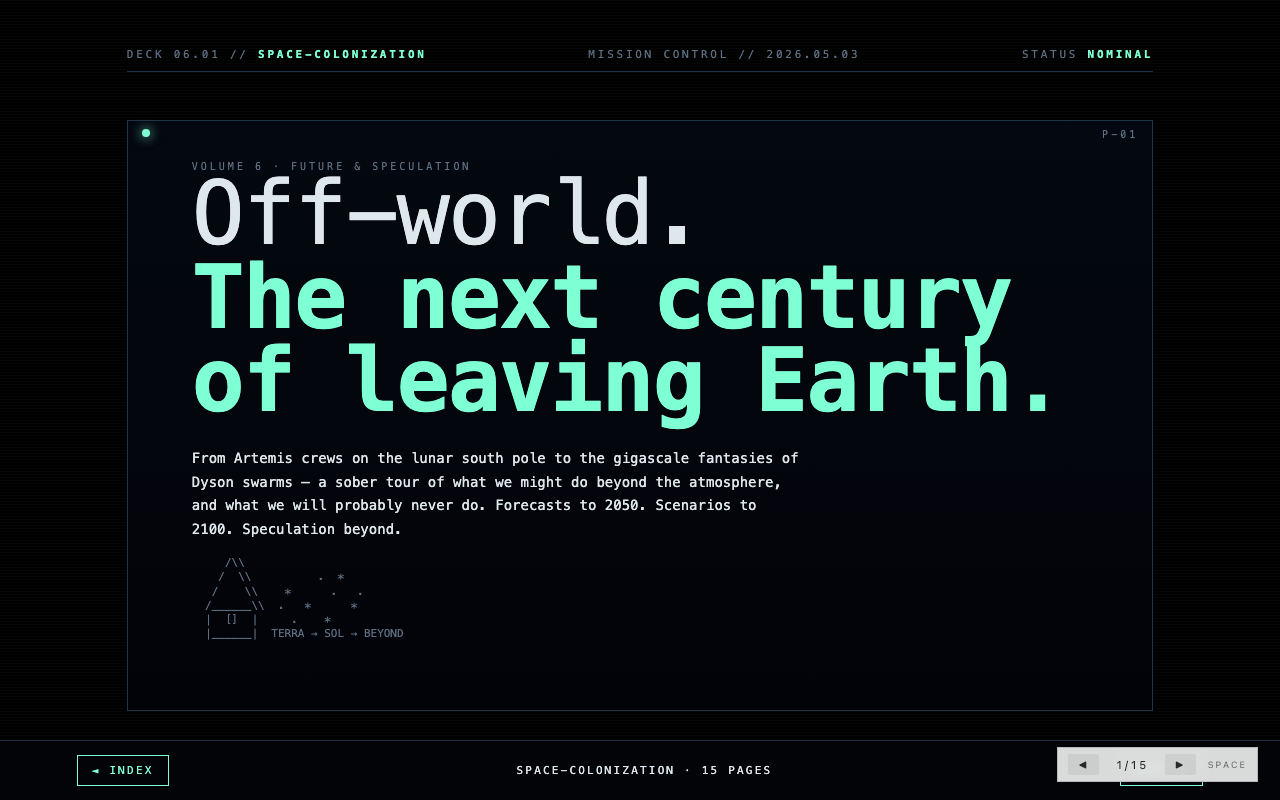
Mars · 2036 Briefing Becoming Multiplanetary. A sober tour of where humans go next — the Moon, Mars, and the very long road beyond. What is plausible. What...

StandaloneDownload
Sandboxed deck
Open raw

About this HTML presentation

This Shipslides page presents Becoming Multiplanetary — Space Colonization as an interactive HTML presentation deck in the Future catalog with 13 slides. The share page keeps the uploaded deck sandboxed while exposing readable context, topics, and a slide outline for viewers and search engines.

Mars · 2036 Briefing Becoming Multiplanetary. A sober tour of where humans go next — the Moon, Mars, and the very long road beyond. What is plausible. What is decades away. What is fantasy that still drives engineering today. Key sections include: Becoming Multiplanetary.; Why leave Earth at all?; Why not , honestly.; The Moon, first.; Industry on the gray plains.; Mars: realistic, not easy.; The surface wants you dead.; Live off the land.; How you actually get there.; The body, off-world..

Key sections

  • 01Becoming Multiplanetary.
  • 02Why leave Earth at all?
  • 03Why not , honestly.
  • 04The Moon, first.
  • 05Industry on the gray plains.
  • 06Mars: realistic, not easy.
  • 07The surface wants you dead.
  • 08Live off the land.
  • 09How you actually get there.
  • 10The body, off-world.
  • 11Asteroids, cylinders, and the very long road.
  • 12What is plausible, by when.
  • 13Keep going.
Slide outline
  1. 01Becoming Multiplanetary.
  2. 02Why leave Earth at all?
  3. 03Why not , honestly.
  4. 04The Moon, first.
  5. 05Industry on the gray plains.
  6. 06Mars: realistic, not easy.
  7. 07The surface wants you dead.
  8. 08Live off the land.
  9. 09How you actually get there.
  10. 10The body, off-world.
  11. 11Asteroids, cylinders, and the very long road.
  12. 12What is plausible, by when.
  13. 13Keep going.
Page data
Canonical
https://shipslides.com/d/catalog-future-space-colonization
Category
Future
Size
29.5 KB
Updated
2026-05-17
LLM text
https://shipslides.com/d/catalog-future-space-colonization/llms.txt

Presentation Transcript

Detailed slide-by-slide text content extracted from this presentation.

Slide 01

Becoming Multiplanetary.

  • Mars · 2036 Briefing
  • A sober tour of where humans go next — the Moon, Mars, and the very long road beyond. What is plausible. What is decades away. What is fantasy that still drives engineering today.
  • 13 Slides
  • Use ← →
  • A catalog briefing · 2026
Slide 02

Why leave Earth at all?

  • Slide 02 · The Case For
  • Three honest answers, ranked from cosmic to civic.
  • 1. Backup civilization
  • Asteroids, supervolcanoes, engineered pathogens, runaway climate. A second self-sufficient biosphere is an insurance policy on the species.
  • 2. Frontier expansion
  • Resources, scientific surface area, new economies. Most of the matter and energy in the solar system is not on Earth.
  • 3. Forcing function
  • Closed-loop life support, robotics, materials, medicine — solving "live off Earth" forces breakthroughs that flow back home.
Slide 03

Why not, honestly.

  • Slide 03 · The Case Against
  • Skepticism is not the enemy of ambition — it is its calibration.
  • Cost
  • A self-sustaining off-world settlement is a multi-trillion-dollar, multi-decade undertaking — even with reusable launch.
  • Biology
  • Microgravity wrecks bones and eyes. Cosmic rays damage DNA. We have never gestated a mammal off Earth.
  • Ethics
  • Who owns Mars? Who decides the laws? What about contamination — forward and back?
  • Opportunity cost
  • The same trillions could harden Earth: climate, pandemics, education. The choice is not free.
Slide 04

The Moon, first.

  • Slide 04 · Stepping Stone
  • Three days, not nine months. A natural proving ground for everything Mars demands — at one-fiftieth the travel time.
  • Delta-v: ~6 km/s from low-Earth orbit to lunar surface — tractable.
  • Water ice at permanently shadowed polar craters.
  • Artemis program targeting crewed surface return this decade.
  • Real-time comms — 1.3-second light delay vs. minutes to Mars.
Slide 05

Industry on the gray plains.

  • Slide 05 · Lunar Economy
  • The Moon is not a destination — it is an industrial site that happens to be in the sky.
  • Regolith oxygen
  • Lunar soil is ~45% oxygen by mass. Molten regolith electrolysis turns dirt into breathable air and rocket oxidizer.
  • Fuel depots
  • Cislunar propellant from polar ice. Refuel above Earth's gravity well — every onward mission gets cheaper.
  • Far-side telescopes
  • Radio-quiet, vacuum, stable surface. The far side is the best radio-astronomy site in the inner solar system.
Slide 06

Mars: realistic, not easy.

  • Slide 06 · The Next Step
  • A 6–9 month transfer along a Hohmann ellipse. Launch windows open every ~26 months when Earth and Mars align.
  • Earth–Mars: ~225 million km at closest approach.
  • Comm latency: 4 to 24 minutes one-way.
  • Solar day (sol): 24h 39m — almost Earth-like.
  • Year: 687 Earth days.
Slide 07

The surface wants you dead.

  • Slide 07 · Hostile by Default
  • Mars looks like a desert. It is not. Every parameter is wrong.
  • 38% gravity
  • Long-term effects on bone, muscle, fluid balance — unknown. We have only microgravity data.
  • 1% atmosphere
  • Mostly CO₂. Pressure ~6 mbar — your blood would boil unsuited. Useless for breathing, useful for ISRU.
  • Radiation
  • No magnetosphere, thin air. Surface dose ~50× Earth. Habitats need regolith shielding or buried structures.
  • Perchlorates
  • Soil laced with toxic chlorine compounds. Inhalation, agriculture, water all need careful remediation.
Slide 08

Live off the land.

  • Slide 08 · ISRU
  • In-Situ Resource Utilization. The plan is not "ship everything from Earth" — that plan does not close. The plan is to make what you need where you are.
  • Air: Sabatier reaction — CO₂ + H₂ → CH₄ + H₂O. Methane fuel and water in one step.
  • Water: Subsurface ice extraction; perchlorate filtering.
  • Oxygen: MOXIE-class CO₂ electrolysis (already demonstrated by Perseverance).
  • Bricks: Sintered or microwave-fused regolith.
Slide 09

How you actually get there.

  • Slide 09 · Architecture
  • A Mars settlement program needs three things: a heavy lifter, a transit habitat, and a surface base concept that grows.
  • SpaceX Starship: ~100–150 t to LEO, fully reusable, methane-fueled — the architecture currently most likely to deliver.
  • Mars Base Alpha: initial cluster of pressurized Starships, ISRU plant, solar arrays.
  • NASA Moon-to-Mars: Gateway, Orion, Artemis Base Camp as a stepping path.
  • Mass-to-Mars problem: a city of one million needs ~10 million tons of cargo.
Slide 10

The body, off-world.

  • Slide 10 · Biology
  • Engineering is not the bottleneck. We are.
  • Bone & muscle
  • Astronauts lose ~1–2% of bone density per month in microgravity. Mars gravity (38%) is unstudied long-term — likely better, but unknown.
  • Radiation
  • Round-trip Mars dose ~0.66 Sv — roughly a 5% lifetime cancer risk increase. Solar flares can be acutely lethal without shielding.
  • Reproduction
  • No mammal has been conceived, gestated, and born off Earth. A self-sustaining colony cannot avoid this question forever.
  • Terraforming dreams
  • Warming Mars enough for liquid water at the surface: centuries to millennia, even with optimistic methods. Worth thinking about. Not a near-term plan.
Slide 11

Asteroids, cylinders, and the very long road.

  • Slide 11 · Beyond
  • Once you live off Earth, the solar system is a kit of parts.
  • Asteroid mining
  • Metallic near-Earth asteroids hold platinum-group metals at concentrations that dwarf any Earth ore body.
  • O'Neill cylinders
  • Rotating habitats at Earth–Moon Lagrange points. Spin gravity, full sunlight, no gravity well — possibly easier than a planet.
  • Outer planets
  • Europa, Titan, Enceladus — exotic chemistry, possible biospheres, brutal distances and cold.
  • Interstellar
  • Proxima b is 4.24 ly away. With current tech: ~75,000 years. With a 0.1c starshot: 42 years — to send grams.
  • Generation ships
  • Self-contained ecosystems crewed by descendants. Engineering, sociology, ethics — all unsolved.
  • Dyson swarms
  • End-game: capture meaningful fractions of a star's output. Civilization energy budget × 10⁹.
Slide 12

What is plausible, by when.

  • Slide 12 · Honest Timeline
  • Calibrated, not cynical. Calibrated, not hyped.
  • 2030s · Lunar return, semi-permanent base
  • Artemis crewed surface stays, polar water prospecting, early ISRU demos. Plausible.
  • 2040s · First crewed Mars landing
  • Short surface stay, sample return, ISRU pilot plant. Aggressive but credible.
  • 2050s+ · Persistent Mars settlement
  • Hundreds to low thousands. Not yet self-sufficient. Earth resupply still required.
  • 2100+ · Self-sustaining off-world city
  • The actual goal. Maybe Mars, maybe O'Neill cylinders. Likely both, in some order.
  • Centuries · Interstellar
  • Probes possible this century. Crewed missions: a civilization-scale project, not a startup roadmap.
Slide 13

Keep going.

  • Slide 13 · Further Reading
  • A starting kit — books, a documentary search, and a pair of YouTube queries that will keep you busy for months.
  • Books
  • The Case for Mars — Robert Zubrin
  • A City on Mars — Kelly & Zach Weinersmith (the skeptical view)
  • The High Frontier — Gerard K. O'Neill
  • Packing for Mars — Mary Roach
  • How to Make a Spaceship — Julian Guthrie
  • YouTube searches
  • Mars colonization & SpaceX →
  • Artemis Moon program →
  • Channels worth a search
  • Everyday Astronaut
  • Scott Manley
  • Isaac Arthur (futurism)
  • PBS Space Time
  • END · BECOMING MULTIPLANETARY
  • Use ← → or click to navigate.
Remove this deck