shipslides
Philosophy13 slides0 views

Existentialism — A Brief Introduction

Not “what is the world?”

StandaloneDownload
Sandboxed deck
Open raw

About this HTML presentation

This Shipslides page presents Existentialism — A Brief Introduction as an interactive HTML presentation deck in the Philosophy catalog with 13 slides. The share page keeps the uploaded deck sandboxed while exposing readable context, topics, and a slide outline for viewers and search engines.

Not “what is the world?” Key sections include: EXISTEN T IALIS M; Søren Kierkegaard; Friedrich Nietzsche; Martin Heidegger; Jean-Paul Sartre; Simone de Beauvoir; Albert Camus; The contributions.; The critiques.; The legacy..

Key sections

  • 01EXISTEN T IALIS M
  • 02Søren Kierkegaard
  • 03Friedrich Nietzsche
  • 04Martin Heidegger
  • 05Jean-Paul Sartre
  • 06Simone de Beauvoir
  • 07Albert Camus
  • 08The contributions.
  • 09The critiques.
  • 10The legacy.
  • 11Further reading.
Slide outline
  1. 01EXISTEN T IALIS M
  2. 02Søren Kierkegaard
  3. 03Friedrich Nietzsche
  4. 04Martin Heidegger
  5. 05Jean-Paul Sartre
  6. 06Simone de Beauvoir
  7. 07Albert Camus
  8. 08The contributions.
  9. 09The critiques.
  10. 10The legacy.
  11. 11Further reading.
Page data
Canonical
https://shipslides.com/d/catalog-philosophy-existentialism
Category
Philosophy
Size
23.4 KB
Updated
2026-05-17
LLM text
https://shipslides.com/d/catalog-philosophy-existentialism/llms.txt

Presentation Transcript

Detailed slide-by-slide text content extracted from this presentation.

Slide 01

EXISTENTIALISM

  • Corrigendum — vol. I
  • a brief introduction · pamphlet nº 7
  • • • •
  • freedom — anxiety — the abyss
  • 1844 – 1980
Slide 02

I. The Question

  • Not “what is the world?”
  • but “what shall I do with my life?”
  • Existentialism turns philosophy inward. The question is no longer the architecture of the cosmos, nor the categories of pure reason — but the small, urgent, first-person predicament of being someone, in a world that does not, by itself, tell us what to be.
Slide 03

II. The Father

  • 1813 — 1855
  • Søren
  • Kierkegaard
  • “Anxiety is the dizziness of freedom.”
  • The leap of faith. Reason runs out before God; what remains is a wager taken by the whole self.
  • Subjective truth. The truth that matters is the truth one lives — passionately, in fear and trembling.
  • Anxiety (Angst). The vertigo we feel before our own infinite possibility.
  • Stages on life’s way: aesthetic → ethical → religious.
Slide 04

III. The Hammer

  • 1844 — 1900
  • Friedrich
  • Nietzsche
  • “God is dead. And we have killed him.”
  • The death of God. Not a triumph — a calamity. The old values lose their ground.
  • Will to power. Life is the drive to grow, to overcome, to create.
  • Eternal recurrence. Could you bear to live this life, in every detail, infinitely many times?
  • The Übermensch. One who invents new values after the old gods fall.
Slide 05

IV. The Forester

  • 1889 — 1976
  • Martin
  • Heidegger
  • “We are the beings for whom Being is a question.”
  • Being-toward-death. Mortality is not an event at the end — it is the horizon that makes a life mine.
  • Thrownness (Geworfenheit). We arrive in a world we did not choose, already underway.
  • The question of Being. Western philosophy forgot it; Heidegger reopens it.
  • Authenticity. Owning the life one has been thrown into.
Slide 06

V. The Café

  • 1905 — 1980
  • Jean-Paul
  • Sartre
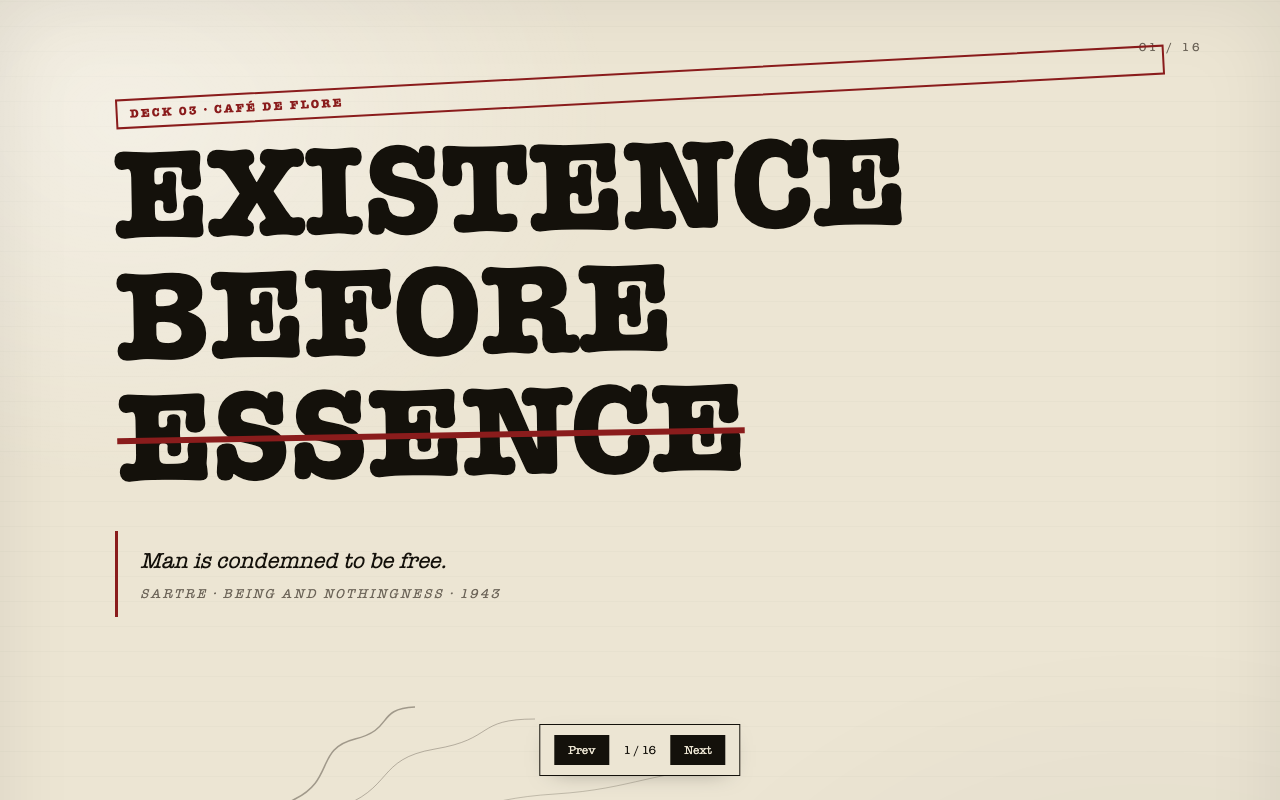
  • “We are condemned to be free.”
  • Existence precedes essence. First we are; only then do we make ourselves something.
  • Bad faith (mauvaise foi). Pretending we are not free, hiding behind roles and the gaze of others.
  • Radical freedom. No alibi — not God, not nature, not nation — can excuse us from choosing.
  • The Look. The other’s gaze fixes me, makes me an object.
Slide 07

VI. The Companion, the Equal

  • 1908 — 1986
  • Simone de
  • Beauvoir
  • “One is not born, but rather becomes, a woman.”
  • The Second Sex (1949). Founding text of modern feminism — and an existential treatise on becoming.
  • Situated freedom. Freedom is real, but always situated in a body, a culture, a history.
  • Woman as Other. Defined relative to man, denied the role of subject.
  • The ethics of ambiguity. To be human is to be both freedom and facticity at once.
Slide 08

VII. The Absurd

  • 1913 — 1960
  • Albert
  • Camus
  • “One must imagine Sisyphus happy.”
  • The absurd. The collision of human longing for meaning with the silence of the world.
  • Sisyphus. The stone always rolls back. The task is endless. And yet.
  • Revolt, not despair. To live the absurd is to refuse both suicide and false hope.
  • Lucidity. See clearly — and live anyway.
Slide 09

Slide 9

  • “
  • Man is nothing else
  • but what he
  • makes of himself.
  • — Sartre, Existentialism is a Humanism, 1946
Slide 10

VIII. What it gave us

  • The contributions.
  • A phenomenology of mood. Anxiety, boredom, nausea, dread — not weaknesses, but disclosures of how things are.
  • Authenticity. A new ethical ideal: to live as the one whose life this actually is.
  • The self as a project. Not a fixed essence, but a long, recursive act of self-making.
  • The dignity of the first person. Philosophy spoken in the voice of someone, somewhere, choosing.
  • • • •
Slide 11

IX. Where it fails

  • The critiques.
  • Too individualistic. The lone subject choosing in a void — a fiction. We are always already entangled.
  • Blind to structures. Marxists object: class, capital and history shape what we can choose. (Beauvoir partly answers this.)
  • Vague on action. Authenticity tells me to choose — not what to choose.
  • Bourgeois melancholy? A philosophy with the leisure to feel its own anxiety.
Slide 12

X. After the war, after the cafe

  • The legacy.
  • Existential therapy. Yalom, May, Frankl — meaning, mortality, freedom and isolation as core clinical concerns.
  • Agency in psychology. Self-determination, narrative identity, the self as project.
  • Modernist literature. Beckett, Kafka (read backwards), Murdoch, Bellow, Ellison — the absurd as a literary key.
  • Everyday vocabulary. “Authentic,” “bad faith,” “the absurd” — all out walking around now.
  • • • •
Slide 13

Coda

  • Further reading.
  • Kierkegaard — Fear and Trembling (1843)
  • Nietzsche — Thus Spoke Zarathustra (1883–5)
  • Heidegger — Being and Time (1927)
  • Sartre — Being and Nothingness (1943); Existentialism is a Humanism (1946)
  • Beauvoir — The Second Sex (1949); The Ethics of Ambiguity (1947)
  • Camus — The Myth of Sisyphus (1942); The Stranger (1942)
  • On screen.
  • Sartre — existentialism lectures
  • Camus — The Myth of Sisyphus
  • — FIN —
Remove this deck