shipslides
Future13 slides0 views

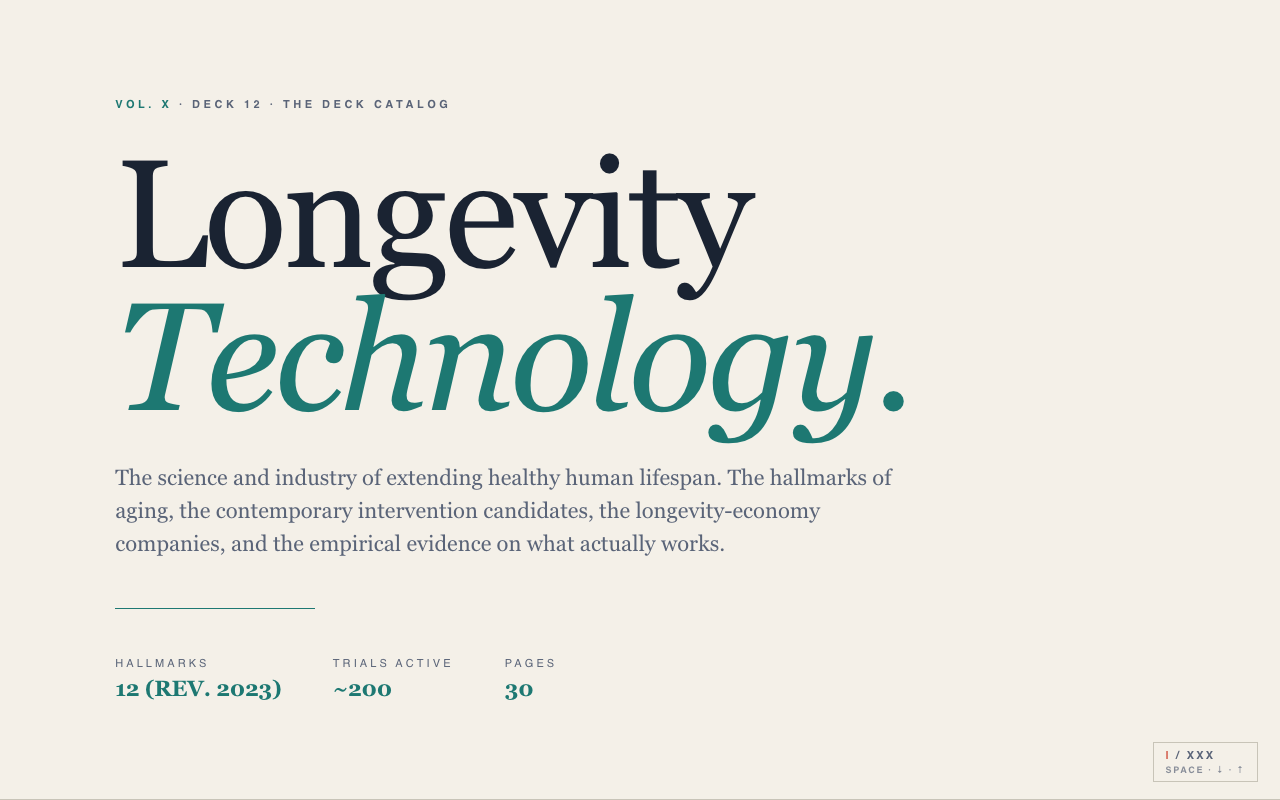
LONGEVITY / What we know about extending healthspan

A clinical-trial style tour of the hallmarks of aging, the interventions actually being tested in humans, and the honest limits of what biology will allow.

StandaloneDownload
Sandboxed deck
Open raw

About this HTML presentation

This Shipslides page presents LONGEVITY / What we know about extending healthspan as an interactive HTML presentation deck in the Future catalog with 13 slides. The share page keeps the uploaded deck sandboxed while exposing readable context, topics, and a slide outline for viewers and search engines.

A clinical-trial style tour of the hallmarks of aging, the interventions actually being tested in humans, and the honest limits of what biology will allow. Key sections include: LONGEVITY / What we know about extending healthspan; From 30 to 80 in a century — and almost none of it from anti-aging.; Lifespan vs healthspan . The goal isn't more years. It's more good years.; The Hallmarks of Aging López-Otín et al., 2013 · updated 2023; Caloric restriction moderate evidence; mTOR & rapamycin moderate evidence; Senolytics early human; Yamanaka factors preclinical Resetting the epigenetic clock; Metformin — the boring candidate moderate evidence; Exercise strongest evidence The intervention with no equal in 2026..

Key sections

  • 01LONGEVITY / What we know about extending healthspan
  • 02From 30 to 80 in a century — and almost none of it from anti-aging.
  • 03Lifespan vs healthspan . The goal isn't more years. It's more good years.
  • 04The Hallmarks of Aging López-Otín et al., 2013 · updated 2023
  • 05Caloric restriction moderate evidence
  • 06mTOR & rapamycin moderate evidence
  • 07Senolytics early human
  • 08Yamanaka factors preclinical Resetting the epigenetic clock
  • 09Metformin — the boring candidate moderate evidence
  • 10Exercise strongest evidence The intervention with no equal in 2026.
  • 11Sleep, diet, stress Foundational. Multipliers on everything else.
  • 12What's actually decades away. What's available today.
  • 13Where to go next.
Slide outline
  1. 01LONGEVITY / What we know about extending healthspan
  2. 02From 30 to 80 in a century — and almost none of it from anti-aging.
  3. 03Lifespan vs healthspan . The goal isn't more years. It's more good years.
  4. 04The Hallmarks of Aging López-Otín et al., 2013 · updated 2023
  5. 05Caloric restriction moderate evidence
  6. 06mTOR & rapamycin moderate evidence
  7. 07Senolytics early human
  8. 08Yamanaka factors preclinical Resetting the epigenetic clock
  9. 09Metformin — the boring candidate moderate evidence
  10. 10Exercise strongest evidence The intervention with no equal in 2026.
  11. 11Sleep, diet, stress Foundational. Multipliers on everything else.
  12. 12What's actually decades away. What's available today.
  13. 13Where to go next.
Page data
Canonical
https://shipslides.com/d/catalog-future-longevity
Category
Future
Size
41.9 KB
Updated
2026-05-17
LLM text
https://shipslides.com/d/catalog-future-longevity/llms.txt

Presentation Transcript

Detailed slide-by-slide text content extracted from this presentation.

Slide 01

LONGEVITY / What we know about extending healthspan

  • Catalog / Future / Longevity Science
  • A clinical-trial style tour of the hallmarks of aging, the interventions actually being tested in humans, and the honest limits of what biology will allow.
  • 13 slides
  • 9 hallmarks
  • 6 intervention classes
  • 2026 state of the field
  • Hallmarks
  • Senolytics
  • mTOR
  • Reprogramming
  • Healthspan > Lifespan
  • Use ← → or click to navigate. Press F for fullscreen.
Slide 02

From 30 to 80 in a century — and almost none of it from anti-aging.

  • 02 / The lifespan revolution
  • Global life expectancy at birth more than doubled in the 20th century. The drivers were boring and decisive: clean water, vaccines, antibiotics, obstetric care.
  • 1900 — Global LE
  • ~32 yrs
  • Infant mortality near 1-in-5
  • 2024 — Global LE
  • ~73 yrs
  • Infant mortality < 3%
  • High-income LE
  • ~82 yrs
  • Driven by infectious disease decline
  • Maximum lifespan
  • ~122 yrs
  • Unchanged. Calment, 1997.
  • The curve became a rectangle. The right edge &mdash; the wall at ~100 &mdash; barely moved.
Slide 03

Lifespan vs healthspan. The goal isn't more years. It's more good years.

  • 03 / The reframe
  • The average American spends roughly 12 years in significant chronic disease at end of life. Adding years without compressing morbidity adds suffering, not living.
  • Lifespan &mdash; total years alive.
  • Healthspan &mdash; years lived without significant chronic disease or disability.
  • Compression of morbidity &mdash; pushing the sick years into a shorter window before death (Fries, 1980).
  • "The right question isn't how long can we live, it's how well can we live for as long as we live."
Slide 04

The Hallmarks of Aging L&oacute;pez-Ot&iacute;n et al., 2013 &middot; updated 2023

  • 04 / The framework
  • Twelve interconnected processes that together describe how cells, tissues, and organisms decline. Most plausible interventions act on at least one.
  • Three layers
  • Primary causes &mdash; damage: genomic instability, telomere attrition, epigenetic drift, proteostasis loss, autophagy decline.
  • Antagonistic responses &mdash; reactions to damage: deregulated nutrient sensing, mitochondrial dysfunction, senescence.
  • Integrative &mdash; system-level: stem cell exhaustion, altered intercellular communication, chronic inflammation, dysbiosis.
  • Pink boxes mark the four added in the 2023 update.
Slide 05

Caloric restriction moderate evidence

  • 05 / Intervention &middot; CR
  • Cutting intake ~20&ndash;30% without malnutrition extends life in yeast, worms, flies, mice, and rats. In primates and humans the picture is messier.
  • Mice (well-controlled)
  • +20&ndash;40%
  • Median lifespan extension
  • Rhesus monkeys (NIA / Wisconsin)
  • ~0&ndash;10%
  • Mixed; depends on diet quality
  • Humans &mdash; CALERIE-2
  • &minus;3&ndash;7%
  • Slowed biological-age clocks; 2-yr 12% restriction
  • Mechanism touchedEffectHallmark
  • mTOR signalling&darr;Nutrient sensing
  • AMPK / sirtuins&uarr;Nutrient sensing
  • Autophagy&uarr;Proteostasis
  • Insulin sensitivity&uarr;Nutrient sensing
  • CR is the only intervention to extend lifespan in nearly every species tested. Whether humans get years or just better biomarkers is unresolved.
Slide 06

mTOR & rapamycin moderate evidence

  • 06 / Intervention &middot; mTOR
  • mTOR is the master nutrient-sensing kinase. Inhibiting it mimics fasting at the molecular level. Rapamycin (an mTOR inhibitor isolated from Easter Island soil bacteria) is the most reproducible pharmacological lifespan extender ever found in mammals.
  • NIA Interventions Testing Program &mdash; +9&ndash;14% median lifespan in mice, even started late in life.
  • PEARL trial (off-label, Mannick / Kaeberlein) &mdash; safety + biomarker signal in humans.
  • Trade-off &mdash; immunosuppression at clinical doses; intermittent low-dose may decouple this.
Slide 07

Senolytics early human

  • 07 / Intervention &middot; Senolytics
  • Senescent cells stop dividing but refuse to die. They secrete inflammatory signals (the SASP) that age neighbouring tissue. Senolytics are drugs that selectively kill them.
  • Dasatinib + Quercetin
  • D+Q
  • First combo to clear senescent cells in humans (Mayo, 2019)
  • Fisetin
  • flavonoid
  • In trials; food-derived
  • UBX-platforms
  • Bcl-xL inhibitors
  • Tissue-targeted (eye, joint)
  • Mouse studies: senolytics improve cardiac function, reduce frailty, extend median lifespan ~25%.
  • Human trials so far: small, biomarker-focused (idiopathic pulmonary fibrosis, diabetic kidney disease).
  • Open question: intermittent "hit-and-run" dosing &mdash; senescent cells take time to re-accumulate.
Slide 08

Yamanaka factors preclinical Resetting the epigenetic clock

  • 08 / Intervention &middot; Reprogramming
  • The four Yamanaka factors (OCT4, SOX2, KLF4, c-MYC &mdash; "OSKM") can revert any cell to a pluripotent state. Continuous expression causes teratomas. Partial, transient expression appears to reset epigenetic age while preserving cell identity.
  • 2016 &mdash; Belmonte: cyclic OSKM extends lifespan in progeroid mice.
  • 2020 &mdash; Sinclair: OSK (no MYC) restores vision in aged + glaucomatous mice.
  • 2026 status &mdash; Altos Labs, Retro, NewLimit pursuing safe in-vivo delivery.
  • The audacious idea: aging has an information component &mdash; epigenetic noise &mdash; that can be erased without erasing the cell.
Slide 09

Metformin &mdash; the boring candidate moderate evidence

  • 09 / Intervention &middot; Metformin
  • A 60-year-old generic diabetes drug, $4/month, with retrospective cohort data suggesting diabetics on metformin outlive non-diabetics on nothing. AMPK activator, mild mTOR effect, mitochondrial complex-I inhibitor.
  • UKPDS & CPRD &mdash; observational signals on cancer, CVD, all-cause mortality.
  • TAME trial &mdash; "Targeting Aging with Metformin" &mdash; ~3,000 adults 65&ndash;79, designed to test aging-as-indication.
  • Caveat &mdash; may blunt exercise-induced mitochondrial adaptations.
  • CohortHR mortalityn
  • Metformin diabetics vs matched non-diabetics0.85~78k
  • Metformin vs sulfonylurea0.76~250k
  • Cancer incidence (meta-analysis)0.69~210k
  • TAME primary endpointTBD~3,000
  • If TAME succeeds, the most important outcome may be regulatory: the FDA accepting "aging" as something a drug can be approved to treat.
Slide 10

Exercise strongest evidence The intervention with no equal in 2026.

  • 10 / Intervention &middot; Exercise
  • All-cause mortality
  • &minus;30%
  • Active vs sedentary
  • Cardio (Zone-2)
  • &minus;45%
  • Top vs bottom VO&#8322;max quintile
  • Strength
  • &minus;20%
  • Per SD of grip strength
  • Stability
  • &minus;84%
  • Risk of fatal fall, trained vs untrained 70+
  • What it touches
  • Mitochondrial biogenesis (PGC-1&alpha;)
  • Insulin sensitivity, glucose disposal
  • Brain BDNF, hippocampal volume
  • Bone density, sarcopenia
  • The Attia framework
  • Stability &mdash; foot, hip, scapular control
  • Strength &mdash; carry, push, pull, hinge, squat
  • Aerobic efficiency &mdash; Zone 2, ~3 hrs/week
  • Peak aerobic &mdash; VO&#8322;max intervals
Slide 11

Sleep, diet, stress Foundational. Multipliers on everything else.

  • 11 / Foundations
  • Sleep
  • 7&ndash;9 hr
  • <6 hr chronic: +13% all-cause mortality. Glymphatic clearance, memory consolidation, GH pulse.
  • Diet
  • Mediterranean
  • Highest-evidence dietary pattern; protein adequacy > 1.2 g/kg in older adults; fiber 30g+.
  • Stress / connection
  • Social
  • Loneliness mortality risk ~ smoking 15 cig/day. Allostatic load drives inflammaging.
  • "You can't out-rapamycin a bad diet, four hours of sleep, and zero friends."
  • Estimated effect of getting all three right: comparable to or larger than any pharmacological longevity intervention currently in trials.
Slide 12

What's actually decades away. What's available today.

  • 12 / Honest timelines
  • OutcomeEarliest plausibleConfidence
  • Compress morbidity by 5+ yrs in motivated individualtodayhigh
  • FDA approval of aging-as-indication (TAME-style)2030smoderate
  • Senolytic approved for chronic age-related disease2030smoderate
  • Safe in-vivo partial reprogramming, niche use2035&ndash;2045low
  • Median human lifespan > 1002070+speculative
  • "Escape velocity" / radical extensionunclearnot science yet
  • The honest summary: healthspan extension is engineering today. Lifespan extension beyond ~100 is still biology we don't fully understand.
Slide 13

Where to go next.

  • 13 / Further reading
  • Foundational papers
  • L&oacute;pez-Ot&iacute;n et al., The Hallmarks of Aging, Cell 2013 &middot; updated 2023
  • Kennedy, Berger, Kaeberlein et al., Geroscience, Cell 2014
  • Fries, Aging, natural death, and the compression of morbidity, NEJM 1980
  • Mannick et al., mTOR inhibition in older adults, 2014/2018
  • Books
  • Peter Attia &mdash; Outlive
  • David Sinclair &mdash; Lifespan
  • Nir Barzilai &mdash; Age Later
  • Andrew Steele &mdash; Ageless
  • YouTube &mdash; David Sinclair
  • Reprogramming, the information theory of aging, NAD+.
  • youtube.com/results?search_query=david+sinclair+aging
  • YouTube &mdash; Peter Attia
  • Exercise, Zone 2, the four horsemen, healthspan-first thinking.
  • youtube.com/results?search_query=peter+attia+longevity
  • end / catalog &middot; future &middot; longevity
  • Press &larr; to revisit, or Home to return to slide 1.
  • healthspan > lifespan
Remove this deck