shipslides
Art13 slides0 views

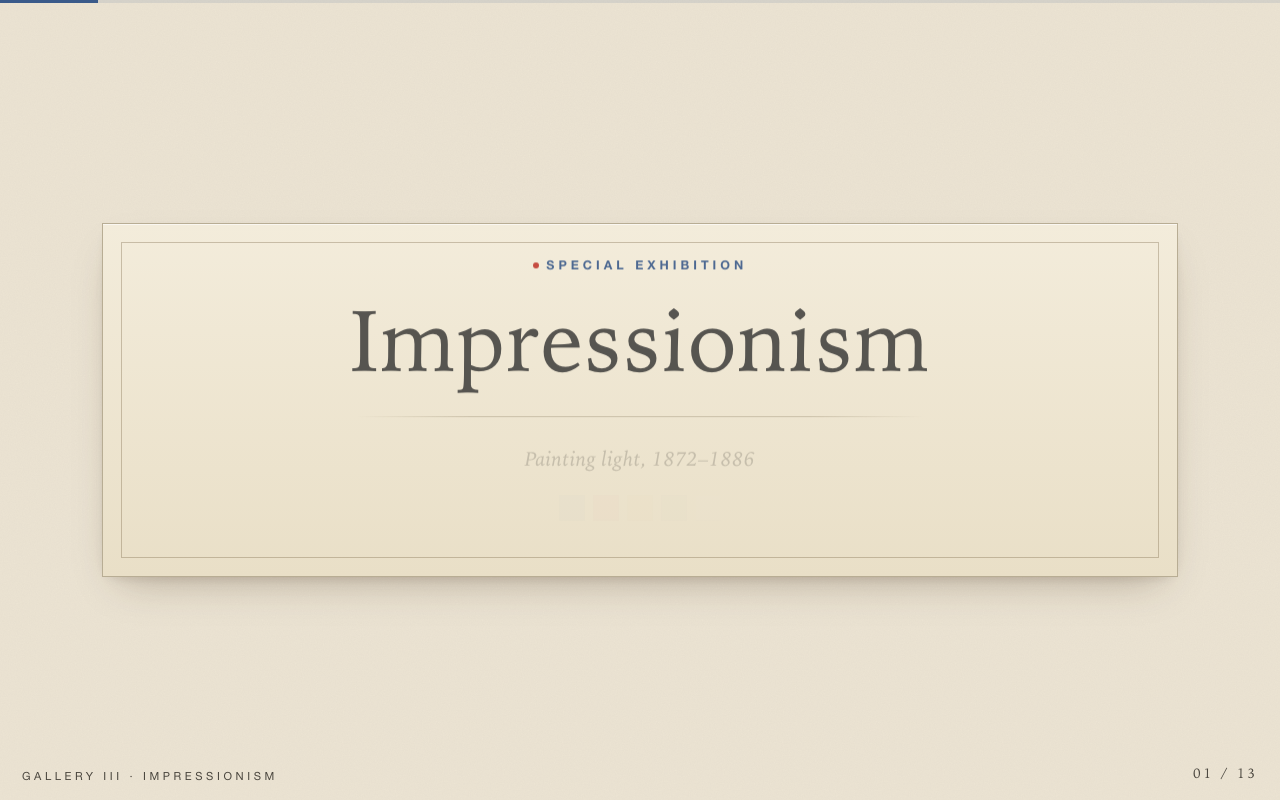
Renaissance Art — A Frescoed Gallery Deck

Florence rediscovers seeing — the eye, the line, the human form.

StandaloneDownload
Sandboxed deck
Open raw

About this HTML presentation

This Shipslides page presents Renaissance Art — A Frescoed Gallery Deck as an interactive HTML presentation deck in the Art catalog with 13 slides. The share page keeps the uploaded deck sandboxed while exposing readable context, topics, and a slide outline for viewers and search engines.

Florence rediscovers seeing — the eye, the line, the human form. Key sections include: Renaissance ART; From icon to portrait; Linear perspective — Brunelleschi's experiment; Masaccio — Trinity , 1427; Sfumato & chiaroscuro; Anatomy through dissection; Michelangelo — David & the Sistine ceiling; Raphael — School of Athens; Northern Renaissance — Van Eyck & Dürer; Venetian colore — over disegno.

Key sections

  • 01Renaissance ART
  • 02From icon to portrait
  • 03Linear perspective — Brunelleschi's experiment
  • 04Masaccio — Trinity , 1427
  • 05Sfumato & chiaroscuro
  • 06Anatomy through dissection
  • 07Michelangelo — David & the Sistine ceiling
  • 08Raphael — School of Athens
  • 09Northern Renaissance — Van Eyck & Dürer
  • 10Venetian colore — over disegno
  • 11Mannerism — unease after the High Renaissance
  • 12Why it endures — still our default for "fine art"
  • 13References & further looking

Topics covered

Slide outline
  1. 01Renaissance ART
  2. 02From icon to portrait
  3. 03Linear perspective — Brunelleschi's experiment
  4. 04Masaccio — Trinity , 1427
  5. 05Sfumato & chiaroscuro
  6. 06Anatomy through dissection
  7. 07Michelangelo — David & the Sistine ceiling
  8. 08Raphael — School of Athens
  9. 09Northern Renaissance — Van Eyck & Dürer
  10. 10Venetian colore — over disegno
  11. 11Mannerism — unease after the High Renaissance
  12. 12Why it endures — still our default for "fine art"
  13. 13References & further looking
Page data
Canonical
https://shipslides.com/d/catalog-art-renaissance
Category
Art
Size
43.1 KB
Updated
2026-05-17
LLM text
https://shipslides.com/d/catalog-art-renaissance/llms.txt

Presentation Transcript

Detailed slide-by-slide text content extracted from this presentation.

Slide 01

Renaissance ART

  • A Gallery Deck · XIII Panels
  • Florence rediscovers seeing — the eye, the line, the human form.
  • Quattrocento · Cinquecento · Florence, Rome, Venice, the North
Slide 02

From icon to portrait

  • I · The Break
  • The medieval image stood outside time. The Renaissance image steps into the room.
  • The Byzantine and Gothic icon was a window onto eternity: gold grounds, frontal saints, hierarchic scale. Figures floated; space did not exist; the painted world answered to theology, not to the eye.
  • Around 1400, Florentine workshops began to ask a heretical question: what does a person actually look like, in a room, at a moment? Backgrounds gained landscapes. Donors crept into altarpieces. Saints acquired cheekbones.
  • The shift is from symbol to observation — from worship to witnessing.
  • Before — c. 1300
  • Cimabue, Duccio
  • Gold ground, flat space, hieratic scale. Mary is largest because Mary matters most.
  • After — c. 1430
  • Masaccio, Van Eyck
  • Receding floors, cast shadows, individual faces. Mary is largest because she sits in the foreground.
  • "Painting is nothing but the representation of surfaces seen." — Alberti, 1435
Slide 03

Linear perspective — Brunelleschi's experiment

  • II · The Geometry
  • In 1413, an architect paints the Baptistery, drills a hole through the panel, and proves the world is mathematical.
  • Orthogonals converge on a single vanishing point on the horizon.
  • Filippo Brunelleschi — the same man who would raise the dome of Florence's cathedral — staged a public demonstration. He painted the octagonal Baptistery on a small panel using strict geometric projection, then drilled a peephole through the painting's vanishing point.
  • A viewer looked through the back, held a mirror in front, and saw the painted Baptistery exactly aligned with the real one. The trick proved a system: orthogonal lines converge on a vanishing point at eye level, and a tiled floor can be mapped with a ruler.
  • Two decades later, Leon Battista Alberti wrote it down. Della Pittura (1435) gave painters the recipe — the costruzione legittima — and made geometry the price of admission.
Slide 04

Masaccio — Trinity, 1427

  • III · The First Proof
  • A painted barrel vault punches a hole in a wall in Santa Maria Novella.
  • Masaccio — born Tommaso di Ser Giovanni, dead at 26 or 27 — produced in his short life the first painting that obeys Brunelleschi's geometry.
  • The Trinity fresco shows a coffered Roman vault retreating into the wall. The vanishing point sits at the viewer's eye level, on the floor of the chapel. The architecture is so accurate that 20th-century scholars reconstructed the room in plan from the painting alone.
  • Below the niche: a tomb. "I once was what you are; what I am, you shall be."
  • 3.17mcomputed depth of the painted chapel
  • 1 pt.single vanishing point at viewer eye-level
  • 26Masaccio's age, c. completion
  • The vault's coffers converge on a single point at the spectator's eye.
Slide 05

Sfumato & chiaroscuro

  • IV · Light & Smoke
  • Leonardo dissolves the line. Edges become atmosphere.
  • Chiaroscuro — light/dark — gives volume by modelling form in tone rather than outline. Sfumato goes further: edges blur into smoke, transitions become imperceptible.
  • Leonardo built the Mona Lisa in dozens of glazes, each a few microns thick. The corners of her mouth and eyes — the parts of a face that signal expression — are deliberately vague. The smile is a perceptual ambiguity, not a brushstroke.
  • In The Last Supper (1495–98), he used the same gradient logic for an entire room: light enters from the painted left, where the refectory's real windows stood. The fiction merges with the wall.
  • Sfumato
  • "In the manner of smoke"
  • Tonal transitions so gradual the eye can't locate an edge. Used for flesh, atmosphere, hair.
  • Chiaroscuro
  • Dramatic light
  • Strong contrasts of light and shadow give three-dimensional weight. Anticipates Caravaggio.
  • Unione
  • Color in harmony
  • Leonardo's term for blending hue and tone so figures sit in unified atmospheric space.
  • "Shadow is the diminution of light." — Leonardo, notebooks
Slide 06

Anatomy through dissection

  • V · The Body Opened
  • Painters became surgeons. Surgeons learned from painters.
  • Late-medieval Church doctrine permitted human dissection for medical instruction, but figures in painting were still copied from earlier figures, and figures from those. The Renaissance painter cut out the middleman.
  • Leonardo da Vinci
  • ~30 cadavers
  • Notebooks contain hundreds of anatomical drawings — muscle layers, the heart's valves, the foetus in utero. Centuries ahead of published medical atlases.
  • Michelangelo
  • The body as architecture
  • Dissected at Santo Spirito hospital in Florence as a teenager. His figures bulge with muscle that is anatomically real but emotionally exaggerated.
  • Vesalius (1543)
  • De humani corporis fabrica
  • The first accurate printed atlas of human anatomy, with woodcuts in the workshop of Titian. Renaissance art and Renaissance medicine share an engraver.
  • "He who can copy can do." — attributed to Leonardo
Slide 07

Michelangelo — David & the Sistine ceiling

  • VI · The Sculptor-Painter
  • Marble that breathes. Plaster that thunders.
  • Weight on one leg; shoulders and hips tilt in opposing axes.
  • David (1501–04) is 5.17 metres of Carrara marble holding a sling. The pose is contrapposto — weight shifted onto one leg, the body's axes counter-rotated — revived from antique sculpture and made anatomically rigorous.
  • The figure tenses in the moment before the throw. Right hand oversize, brow furrowed: he is a teenager calculating geometry against Goliath.
  • The Sistine Chapel ceiling (1508–12) is 460 m² of fresco painted in four years on a custom scaffold. Michelangelo loathed the commission — he insisted he was a sculptor — and produced one of the densest figural compositions ever attempted.
  • 5.17mDavid, marble height
  • 460 m²Sistine ceiling fresco
  • 300+figures painted
Slide 08

Raphael — School of Athens

  • VII · The Synthesis
  • Perspective, composition, and portraiture all at once.
  • Painted 1509–1511 in the Vatican's Stanza della Segnatura, the School of Athens stages every major Greek philosopher under a coffered Roman vault that openly cites Bramante's design for new St. Peter's.
  • Plato (resembling Leonardo) points up; Aristotle gestures down. Heraclitus broods on the steps with Michelangelo's face. Raphael paints himself, calmly, looking out at us from the far right. The composition is simultaneously a vanishing-point exercise, a portrait gallery of the High Renaissance, and an argument about reason.
  • Perspective
  • One-point, central
  • Vanishing point sits exactly between Plato and Aristotle — the painting's intellectual hinge.
  • Composition
  • Pyramidal grouping
  • Figures cluster in stable triangles around the central pair; movement diagonal, eyes guided.
  • Citation
  • Architecture as argument
  • The painted vault echoes Bramante's St. Peter's: ancient wisdom housed in new Rome.
  • "Where Leonardo questioned and Michelangelo strained, Raphael resolved." — a common verdict
Slide 09

Northern Renaissance — Van Eyck & Dürer

  • VIII · Beyond the Alps
  • Oil paint and the printing press. Two technologies that change vision.
  • While Florence wrestled with geometry, Flanders was perfecting oil paint. Pigments suspended in linseed oil, applied in transparent glazes, allowed Jan van Eyck (c. 1390–1441) to render hair, brass, fur, and bevelled glass with a fidelity Italian tempera could not match.
  • The Arnolfini Portrait (1434) shows a Bruges merchant and his wife in a domestic interior reflected in a convex mirror that itself contains miniature figures. The painted signature reads: "Jan van Eyck was here."
  • A century later, Albrecht Dürer (1471–1528) crossed the Alps twice, married Italian theory to Northern detail, and made the woodcut and engraving into mass-circulation art. Melencolia I, Knight, Death and the Devil, St. Jerome in his Study — printed by the thousand, distributed across Europe.
  • Oil paint
  • The Northern technology
  • Slow-drying, glaze-friendly, jewel-bright. Van Eyck did not invent oils, but he perfected layered glazing.
  • Engraving
  • Dürer's printing press
  • Cut into copper, inked, pressed. A fine drawing reproducible by the hundred — the Renaissance's first scalable image.
  • Detail as devotion
  • Symbolic micro-realism
  • A single candle, a discarded shoe, a lapdog: every Northern object carries theological weight.
Slide 10

Venetian colore — over disegno

  • IX · The Lagoon
  • Florence drew the world. Venice painted it.
  • The 16th-century debate between disegno (line, drawing, design — the Florentine virtue) and colore (color, paint, atmosphere — the Venetian one) shaped European art for two centuries afterwards.
  • Venice had moisture, shimmering canals, late sun, and a thriving trade in pigments arriving from the Levant. Its painters built form not from line but from patches of saturated color laid wet against wet on canvas.
  • Titian (c. 1488–1576)
  • The orchestra of color
  • Blazing reds, deep blues, gold flesh tones. Late works dissolve form into pure painted matter — an anticipation of Manet.
  • Tintoretto (1518–1594)
  • Speed and theatre
  • Vast canvases for the Scuola di San Rocco, painted at headlong pace. Diagonal compositions, dramatic torchlight.
  • Veronese (1528–1588)
  • Banquet pageantry
  • Silver, brocade, marble, dwarves, parrots, and Christ at supper. Investigated by the Inquisition for excess.
  • "In Venice, paint behaves like cloth and water." — a 19th-century critic
Slide 11

Mannerism — unease after the High Renaissance

  • X · The Late Hour
  • When the rules are perfected, the next generation breaks them on purpose.
  • By the 1520s, Raphael was dead, Rome had been sacked (1527), the Reformation was tearing Christendom in half, and a generation of younger painters faced an awkward question: what do you do after perfection?
  • The answer was Mannerism — maniera, "stylishness." Figures grow elongated, necks impossibly long, poses theatrical, color acidic. Space refuses to behave: foregrounds crowd, distances collapse. The classical balance of the High Renaissance is deliberately disturbed.
  • It is the visual signature of an age that no longer trusted its own confidence.
  • Parmigianino
  • Madonna with the Long Neck (c. 1535)
  • A swan-necked Virgin, an enormous infant, a column with no building, an angel crowding the frame. Beautiful and wrong.
  • Pontormo
  • Deposition (1525–28)
  • Floating bodies, pastel acid colors, no ground plane. Grief without gravity.
  • El Greco
  • Toledo, c. 1580–1614
  • Stretched figures, electric skies, and a private spiritual flame. The end of the Renaissance and the start of something else.
Slide 12

Why it endures — still our default for "fine art"

  • XI · The Long Shadow
  • Five centuries on, the Renaissance image is the one we have to argue with.
  • Every later movement defines itself against this baseline. Baroque dramatises it. Neoclassicism revives it. Realism strips its mythology. Impressionism breaks its line. Modernism abolishes its perspective. Even abstraction is a refusal of something specific: the Albertian window onto a measurable world.
  • Method
  • Geometry + observation
  • The Renaissance fused mathematical projection with empirical looking. We still teach drawing this way.
  • Subject
  • The individual face
  • The portrait as a serious genre, the self-portrait as a confession — both Renaissance inventions.
  • Status
  • Artist as intellectual
  • Painters stop being craftsmen and become "geniuses" with biographies. Vasari writes the first art-historical text.
  • "What we call art is largely what the Renaissance taught us to call art." — a working definition
Slide 13

References & further looking

  • XIII · Colophon
  • For the curious eye — lectures, walk-throughs, primary documents.
  • Reading
  • · Giorgio Vasari, Lives of the Most Excellent Painters, Sculptors, and Architects (1550, 1568).
  • · Leon Battista Alberti, Della Pittura (1435).
  • · E. H. Gombrich, The Story of Art — chs. on Quattrocento and Cinquecento.
  • · Michael Baxandall, Painting and Experience in Fifteenth-Century Italy.
  • · Frederick Hartt & David G. Wilkins, History of Italian Renaissance Art.
  • · Erwin Panofsky, Early Netherlandish Painting.
  • YouTube searches
  • Brunelleschi's perspective experiment
  • Raphael — School of Athens analysis
  • Florence · Rome · Venice · Bruges · Nuremberg
  • Fin — thank you for looking.
Remove this deck