shipslides
Health13 slides0 views

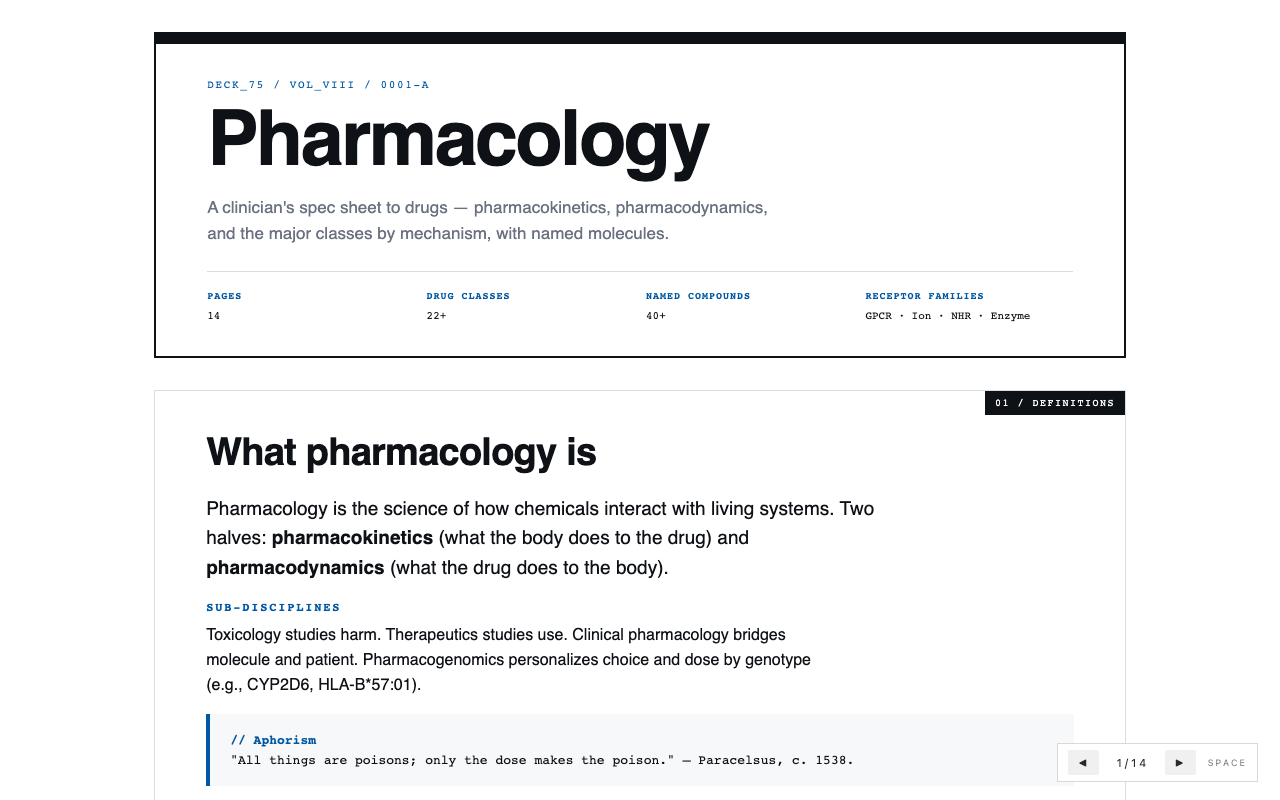
Pharmacology / How drugs find their targets

Small molecules and large biologics navigating a body of 10 13 cells, looking for the one protein they were designed to bind.

StandaloneDownload
Sandboxed deck
Open raw

About this HTML presentation

This Shipslides page presents Pharmacology / How drugs find their targets as an interactive HTML presentation deck in the Health catalog with 13 slides. The share page keeps the uploaded deck sandboxed while exposing readable context, topics, and a slide outline for viewers and search engines.

Small molecules and large biologics navigating a body of 10 13 cells, looking for the one protein they were designed to bind. Key sections include: PHARMACOLOGY / How drugs find their targets; ADME — what the body does to the drug; What the drug does to the body; Receptors and ligands — keys and locks; Enzyme inhibitors — jamming the machinery; The drugs we actually take; The therapeutic window; Drug development — 10–15 years, ~$2B; Generics and biosimilars; The price of doing pharmacological business.

Key sections

  • 01PHARMACOLOGY / How drugs find their targets
  • 02ADME — what the body does to the drug
  • 03What the drug does to the body
  • 04Receptors and ligands — keys and locks
  • 05Enzyme inhibitors — jamming the machinery
  • 06The drugs we actually take
  • 07The therapeutic window
  • 08Drug development — 10–15 years, ~$2B
  • 09Generics and biosimilars
  • 10The price of doing pharmacological business
  • 11The future of finding targets
  • 12Most R&D fails. The survivors transform medicine.
  • 13Further reading & viewing
Slide outline
  1. 01PHARMACOLOGY / How drugs find their targets
  2. 02ADME — what the body does to the drug
  3. 03What the drug does to the body
  4. 04Receptors and ligands — keys and locks
  5. 05Enzyme inhibitors — jamming the machinery
  6. 06The drugs we actually take
  7. 07The therapeutic window
  8. 08Drug development — 10–15 years, ~$2B
  9. 09Generics and biosimilars
  10. 10The price of doing pharmacological business
  11. 11The future of finding targets
  12. 12Most R&D fails. The survivors transform medicine.
  13. 13Further reading & viewing
Page data
Canonical
https://shipslides.com/d/catalog-health-pharmacology
Category
Health
Size
33.0 KB
Updated
2026-05-17
LLM text
https://shipslides.com/d/catalog-health-pharmacology/llms.txt

Presentation Transcript

Detailed slide-by-slide text content extracted from this presentation.

Slide 01

PHARMACOLOGY / How drugs find their targets

  • 01 / 13
  • Pharmacology · Vol. 09
  • Small molecules and large biologics navigating a body of 1013 cells, looking for the one protein they were designed to bind.
  • A 13-slide field guide · Press → to begin
Slide 02

ADME — what the body does to the drug

  • 02 / 13
  • Pharmacokinetics
  • Every dose runs the same gauntlet. The fraction that reaches the target is often single digits.
  • A · ABSORPTION
  • Into the bloodstream
  • Oral, IV, transdermal, inhaled. Bioavailability varies wildly — insulin orally is ~0%.
  • D · DISTRIBUTION
  • Through tissues
  • Bound to plasma proteins, partitioned by lipophilicity. The blood-brain barrier turns most drugs away.
  • M · METABOLISM
  • Broken apart
  • The liver's CYP450 enzymes chop drugs into metabolites — sometimes activating, sometimes deactivating.
  • E · EXCRETION
  • Out
  • Kidneys (urine) and bile (feces) carry the remains. Half-life sets the dosing schedule.
Slide 03

What the drug does to the body

  • 03 / 13
  • Pharmacodynamics
  • Pharmacokinetics asks where the drug goes. Pharmacodynamics asks what happens when it gets there.
  • Almost every drug works by binding a protein — a receptor, an enzyme, an ion channel, a transporter — and changing what that protein does.
  • The relationship between concentration and effect is rarely linear. Doubling the dose rarely doubles the effect. Saturate the receptors and adding more accomplishes nothing… until you hit the toxicity ceiling.
Slide 04

Receptors and ligands — keys and locks

  • 04 / 13
  • Molecular Recognition
  • AgonistActivates the receptor — mimics the natural ligand. Morphine on opioid receptors.
  • AntagnBlocks the receptor — occupies without activating. Beta-blockers, naloxone.
  • PartialActivates weakly even at full saturation — ceiling effect. Buprenorphine.
  • InverseReduces receptor activity below baseline — rare but real.
Slide 05

Enzyme inhibitors — jamming the machinery

  • 05 / 13
  • Mechanism
  • Many of the best-selling drugs in history work by sitting in an enzyme's active site so the substrate cannot.
  • HMG-CoA reductase
  • Statins
  • Block cholesterol synthesis in the liver. Atorvastatin, rosuvastatin. Among the most prescribed drugs on Earth.
  • Angiotensin-converting
  • ACE inhibitors
  • Lower blood pressure by stopping the conversion of angiotensin I → II. Lisinopril, enalapril.
  • Tyrosine kinase
  • Kinase inhibitors
  • Shut off rogue growth signals in cancer cells. Imatinib (Gleevec) turned chronic myeloid leukemia into a managed condition.
Slide 06

The drugs we actually take

  • 06 / 13
  • Therapeutic Classes
  • vs. infection
  • Antibiotics
  • Penicillins, cephalosporins, macrolides, fluoroquinolones. Selectively kill bacterial machinery our cells lack.
  • vs. pain & inflammation
  • NSAIDs
  • Ibuprofen, naproxen, aspirin. Inhibit COX enzymes to reduce prostaglandins.
  • vs. severe pain
  • Opioids
  • Morphine, oxycodone, fentanyl. Bind μ-opioid receptors. Powerfully effective — powerfully addictive.
  • vs. depression
  • Antidepressants
  • SSRIs (sertraline, fluoxetine), SNRIs, MAOIs. Modulate serotonin / norepinephrine over weeks.
  • vs. clots
  • Anticoagulants
  • Warfarin, heparin, DOACs (apixaban, rivaroxaban). Prevent strokes, treat DVT — bleeding is the price.
  • others
  • Antihypertensives, antihistamines, antidiabetics…
  • Each class targets a different receptor, enzyme, or transporter. The categories keep multiplying.
Slide 07

The therapeutic window

  • 07 / 13
  • Dose — Response
  • Every drug has a dose where it works and a dose where it kills you. The ratio is the therapeutic index.
  • WidePenicillin, ibuprofen — forgiving margins, hard to overdose accidentally.
  • NarrowWarfarin, lithium, digoxin — therapeutic and toxic doses overlap. Blood monitoring required.
  • RazorChemotherapy — the toxic dose is the therapeutic dose. The art is killing tumor cells slightly faster than the patient.
Slide 08

Drug development — 10–15 years, ~$2B

  • 08 / 13
  • From Lab to Pharmacy
  • For every approved drug, roughly 10,000 starting molecules were screened. Most of the cost is paying for the failures.
  • YR 0–3
  • Discovery
  • Identify target. Screen libraries. Find a hit.
  • YR 3–6
  • Preclinical
  • Animal toxicology, pharmacokinetics, dosing.
  • YR 6–8
  • Phase I / II
  • Healthy volunteers (safety), then small patient cohorts (efficacy).
  • YR 8–12
  • Phase III
  • Thousands of patients. Randomized, controlled, blinded.
  • YR 12–15
  • FDA Approval
  • Review, label negotiation, post-market surveillance (Phase IV).
  • Phase III is where most candidates die — a drug that works in 200 people can fail in 2,000. The attrition rate from preclinical to approval is around 90%.
Slide 09

Generics and biosimilars

  • 09 / 13
  • Patent Cliff
  • A US drug patent runs 20 years from filing — effectively 8–12 years on market before competitors can copy.
  • When the patent expires, generic manufacturers must only prove bioequivalence: the active ingredient, the same blood concentration. They skip the discovery, the trials, the failures.
  • Prices typically fall 80–90% within a year. Atorvastatin went from $5/pill to under 10¢.
  • GenericIdentical small molecule. Same ibuprofen, different label. Bioequivalence study only.
  • BiosimFor biologics (antibodies, proteins) — can't be copied exactly. Must prove "no clinically meaningful difference."
  • BrandOften relaunches as authorized generic, or evergreens via reformulation, new indication, combination product.
  • Result~90% of US prescriptions are now generic. ~20% of spending.
Slide 10

The price of doing pharmacological business

  • 10 / 13
  • Side Effects
  • No drug is selective enough to bind only its intended target. Even when it is, the target does more than one thing.
  • Predictable
  • Dose-dependent
  • Stronger dose, stronger side effect. NSAIDs and ulcers, opioids and constipation, beta-blockers and fatigue.
  • Unpredictable
  • Idiosyncratic
  • Rare reactions specific to the patient — genetic variants, immune responses. Stevens-Johnson syndrome from carbamazepine.
  • Combinatorial
  • Drug-drug interactions
  • One drug induces or inhibits the CYP enzymes that metabolize another. Grapefruit juice does this too.
  • Adverse drug events cause an estimated ~100,000 US deaths annually — many from interactions in patients on 5+ medications. Polypharmacy is the silent epidemic of modern medicine.
Slide 11

The future of finding targets

  • 11 / 13
  • What's coming
  • precision
  • Targeted therapies
  • Drugs matched to a tumor's specific mutation, not its tissue of origin. Companion diagnostics required.
  • guided missiles
  • ADCs
  • Antibody-drug conjugates: an antibody finds the cancer cell, the linked toxin kills it. Trastuzumab deruxtecan.
  • code, not protein
  • mRNA
  • Deliver instructions, let the cell build the protein. COVID vaccines were the proof; cancer vaccines are next.
  • in silico
  • AI-designed molecules
  • Generative models propose binders for a protein structure. AlphaFold made every target druggable in principle.
  • Plus: gene therapies (CRISPR, AAV), PROTACs that destroy proteins instead of inhibiting them, gut-microbiome modulators, psychedelics in psychiatry. The pipeline has never been more diverse.
Slide 12

Most R&D fails. The survivors transform medicine.

  • 12 / 13
  • The Honest Assessment
  • Pharma is the only industry where 9 of every 10 products entering human trials never sell a single dose — and the model still works.
  • It works because the winners win enormously. Statins added years of life to entire populations. ART turned HIV from a death sentence into a chronic condition. Imatinib, GLP-1 agonists, hepatitis C cures, immunotherapy — each one rewrote a chapter of medicine.
  • The criticism is fair: prices are high, marketing is aggressive, the same molecule costs different amounts in different countries for opaque reasons. The replication crisis touches preclinical research too.
  • But the alternative — no industry willing to spend a decade and $2B on a 10% shot — is not better drugs. It is no new drugs.
  • A century ago, an infected cut could kill you. A bad heart meant the funeral home. Cancer meant months. The molecules in the bottle on your nightstand are the accumulated payoff of millions of failed experiments.
  • Pharmacology is humanity's best argument that biology is, in fact, engineerable.
Slide 13

Further reading & viewing

  • 13 / 13
  • Closing
  • Three centuries of trying to make molecules behave. Below, where to keep going.
  • REFERENCES
  • BOOKGoodman & Gilman, The Pharmacological Basis of Therapeutics
  • BOOKDruin Burch, Taking the Medicine: A Short History of Medicine's Beautiful Idea
  • BOOKBen Goldacre, Bad Pharma
  • PAPERDiMasi et al., "Innovation in the pharmaceutical industry" (J. Health Econ., 2016)
  • SITEDrugBank · PubChem · ClinicalTrials.gov
  • YOUTUBE
  • → pharmacology+basics
  • → drug+development+process
  • End of deck. Press Home to restart, ← to step back.
Remove this deck