shipslides
History13 slides0 views

Roma — Imperium

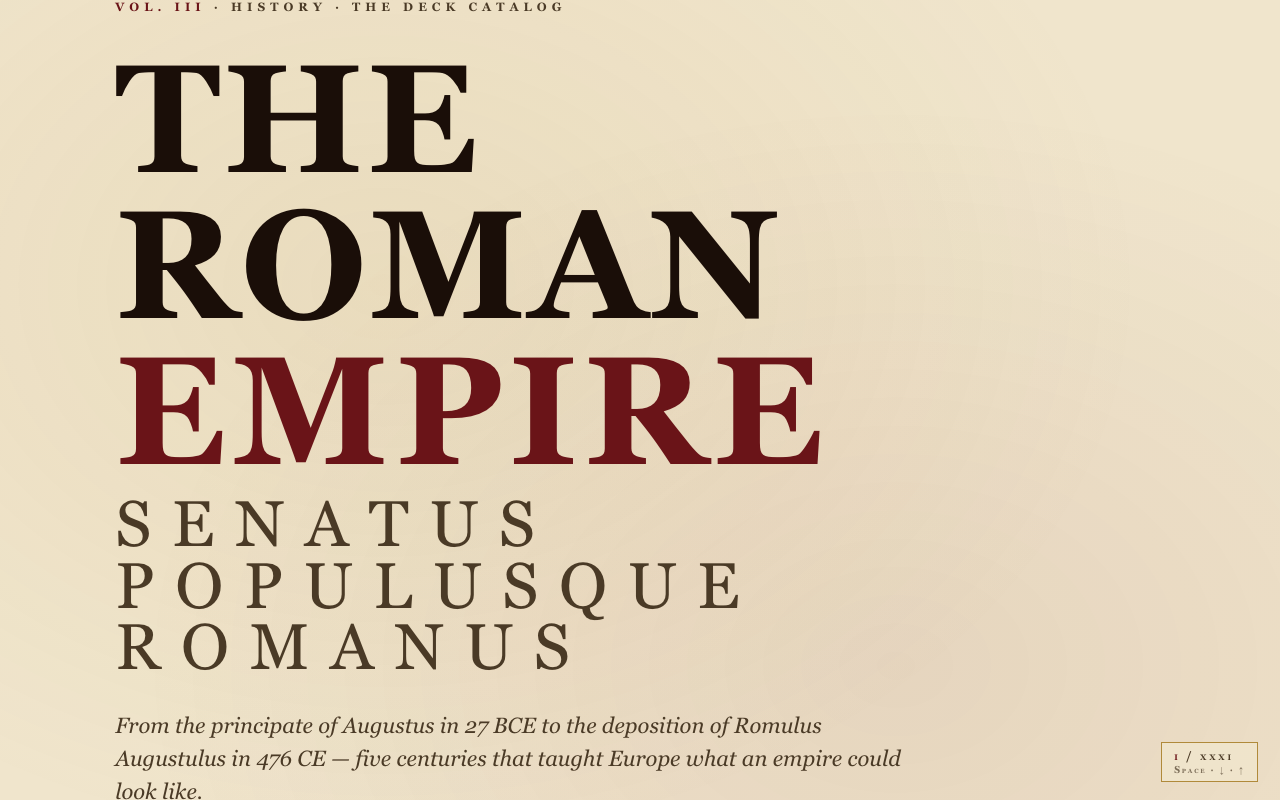
ROMA Imperium ❖ S P Q R Senātus Populusque Rōmānus — The Senate and People of Rome A thousand years, in thirteen acts. 753 BC — 476 AD.

StandaloneDownload
Sandboxed deck
Open raw

About this HTML presentation

This Shipslides page presents Roma — Imperium as an interactive HTML presentation deck in the History catalog with 13 slides. The share page keeps the uploaded deck sandboxed while exposing readable context, topics, and a slide outline for viewers and search engines.

ROMA Imperium ❖ S P Q R Senātus Populusque Rōmānus — The Senate and People of Rome A thousand years, in thirteen acts. 753 BC — 476 AD. Key sections include: ROMA; The She-Wolf and the Twins; The Republic is Born; Rome vs. Carthage; Gaius Julius Caesar; Augustus & the Principate; Greatest Extent; The Engineers' Empire; The Crisis of the Third Century; Reform, Faith, a New Capital.

Key sections

  • 01ROMA
  • 02The She-Wolf and the Twins
  • 03The Republic is Born
  • 04Rome vs. Carthage
  • 05Gaius Julius Caesar
  • 06Augustus & the Principate
  • 07Greatest Extent
  • 08The Engineers' Empire
  • 09The Crisis of the Third Century
  • 10Reform, Faith, a New Capital
  • 11Sack & Deposition
  • 12What Rome Left Behind
  • 13Further Reading & Watching
Slide outline
  1. 01ROMA
  2. 02The She-Wolf and the Twins
  3. 03The Republic is Born
  4. 04Rome vs. Carthage
  5. 05Gaius Julius Caesar
  6. 06Augustus & the Principate
  7. 07Greatest Extent
  8. 08The Engineers' Empire
  9. 09The Crisis of the Third Century
  10. 10Reform, Faith, a New Capital
  11. 11Sack & Deposition
  12. 12What Rome Left Behind
  13. 13Further Reading & Watching
Page data
Canonical
https://shipslides.com/d/catalog-history-roman-empire
Category
History
Size
39.9 KB
Updated
2026-05-17
LLM text
https://shipslides.com/d/catalog-history-roman-empire/llms.txt

Presentation Transcript

Detailed slide-by-slide text content extracted from this presentation.

Slide 01

ROMA

  • Imperium
  • ❖
  • S P Q R
  • Senātus Populusque Rōmānus — The Senate and People of Rome
  • A thousand years, in thirteen acts. 753 BC — 476 AD.
Slide 02

The She-Wolf and the Twins

  • 753 BC · The Founding Myth
  • By legend, twin princes Romulus and Remus were cast into the Tiber, suckled by a she-wolf, and raised by a shepherd. Grown, they fought to found a city on the Palatine Hill. Romulus killed Remus. The city took his name.
  • Beyond the myth: a cluster of Iron-Age villages on seven hills, perched above a river crossing, gradually fused into a town — Latin in tongue, Etruscan in early kings, mercantile in instinct.
  • "From a small thing, mighty things." — Lucretius
Slide 03

The Republic is Born

  • 509 BC · Res Publica
  • The last king, Tarquin the Proud, was overthrown. Rome became res publica — "the public thing." Power was deliberately split, balanced, and term-limited.
  • Senate
  • Three hundred elders. Advisory in theory, dominant in practice. The institution that outlived everything.
  • Consuls × 2
  • Two annually elected magistrates. Each could veto the other. Power feared itself.
  • Cursus Honōrum
  • Quaestor → Aedile → Praetor → Consul. A ladder of office, age-gated and earned.
  • A constitution mostly unwritten, mostly observed — until it wasn't.
Slide 04

Rome vs. Carthage

  • 264 — 146 BC · The Punic Wars
  • First (264–241): Sicily. Rome learns to build a navy by copying a wrecked Carthaginian ship.
  • Second (218–201): Hannibal crosses the Alps with elephants, annihilates Roman armies at Cannae — and still loses. Scipio Africanus takes the war to Africa and wins at Zama.
  • Third (149–146): Carthage is razed. "Carthāgō dēlenda est." Salt, allegedly, on the ground.
  • After Carthage, Rome had no peer in the western Mediterranean — and a hundred years of provincial wealth that the Republic could not digest.
Slide 05

Gaius Julius Caesar

  • 100 — 44 BC
  • 58–50 BC Conquest of Gaul. Eight years, a million dead, a million enslaved — and a private army loyal to Caesar, not Rome.
  • 49 BC Ordered to disband, he crosses the Rubicon. "Ālea iacta est." The die is cast.
  • 48–45 BC Civil war. Pompey killed in Egypt. Caesar emerges dictator perpetuō.
  • 44 BC The Ides of March. Twenty-three knife wounds on the Senate floor. "Et tū, Brūte?"
  • He was not the first general to march on Rome. He was the one who made it stick.
  • Reformed the calendar — 365.25 days, the Julian.
  • Wrote his own dispatches: "Vēnī, vīdī, vīcī."
  • His name became a title — Caesar, Kaiser, Tsar.
Slide 06

Augustus & the Principate

  • 27 BC — 14 AD
  • Caesar's grand-nephew Octavian outlasted Antony and Cleopatra at Actium (31 BC). Returning to Rome, he did something subtler than crowning himself king: he kept the Republic's furniture, called himself "first citizen" (prīnceps), and quietly held every meaningful office at once.
  • The Senate voted him the name Augustus — "the revered one."
  • Standing armies, professional bureaucracy, an imperial post.
  • Pax Rōmāna: roughly two centuries of relative peace across the Mediterranean.
  • "I found Rome a city of brick and left it a city of marble."
  • The Republic did not fall in a day. It was hollowed out, then ceremonially preserved — a constitutional taxidermy that lasted three hundred years.
Slide 07

Greatest Extent

  • 96 — 180 AD · The High Empire
  • Trajan (117 AD): Empire at maximum — from Britain's Tyne to the Persian Gulf, 5 million km², ~70 million people.
  • Hadrian: Pulled back. Built the Wall across northern Britain. Drew a line and meant it.
  • The Pantheon (c. 126 AD): Largest unreinforced concrete dome ever built. Still standing, still working.
  • The Five Good Emperors — Nerva to Marcus Aurelius — chose successors by adoption, not blood.
Slide 08

The Engineers' Empire

  • Ingenium Rōmānum
  • Roads: ~400,000 km, of which 80,500 paved. Designed for the speed of a courier. Omnēs viae Rōmam dūcunt.
  • Aqueducts: 11 served the city alone. Some still flow. The Pont du Gard has stood 2,000 years.
  • Concrete: opus caementicium — volcanic ash + lime + seawater. It cures harder over centuries.
  • The Legion: ~5,000 men, drilled to the point where battles were the easy part. They built the roads they marched on.
Slide 09

The Crisis of the Third Century

  • 235 — 284 AD
  • For half a century the empire nearly came apart. Roughly fifty emperors in fifty years; most died by the sword of their own troops. The currency collapsed. Plague. Inflation. Frontier breaches on every border.
  • Generals' Anarchy
  • Legions made and unmade emperors as a matter of pay raises.
  • Breakaway States
  • Gallic Empire in the west. Palmyrene Empire under Zenobia in the east. For a decade, three Romes.
  • Debasement
  • The silver denarius lost ~95% of its silver content. Trade reverted to barter in places.
  • That Rome survived at all is the surprise. It did — transformed.
Slide 10

Reform, Faith, a New Capital

  • 284 — 337 AD
  • Diocletian
  • The Tetrarchy: two senior Augustī, two junior Caesarēs. Empire too big for one man.
  • Price edicts, tax reform, a hardened bureaucracy.
  • The last great persecution of Christians.
  • Constantine
  • 312: Battle of the Milvian Bridge. "In hōc signō vincēs."
  • 313: Edict of Milan — toleration of Christianity.
  • 325: Council of Nicaea defines orthodox doctrine.
  • 330: Founds Constantinople — New Rome on the Bosphorus.
  • Two reformers bought the empire two more centuries in the west, and a thousand more in the east.
Slide 11

Sack & Deposition

  • 410 — 476 AD · The Fall in the West
  • 378: Emperor Valens dies at Adrianople — a Roman emperor killed by Goths in pitched battle. The frontiers are no longer holding.
  • 410: Alaric and the Visigoths sack Rome itself. The city had not been taken in 800 years. Jerome wept in his cell in Bethlehem.
  • 455: Vandal sack — longer, more thorough.
  • 476: The Germanic general Odoacer deposes a teenage emperor named — with mythic symmetry — Romulus Augustulus. He sends the imperial regalia to Constantinople. There is no longer a Western emperor to send them to.
  • "The decline of Rome was the natural and inevitable effect of immoderate greatness." — Edward Gibbon
  • In the east, the empire continues. They keep calling themselves Rōmaîoi — Romans — for another thousand years, until 1453.
Slide 12

What Rome Left Behind

  • Hērēditās
  • Law
  • Justinian's Corpus Iūris Cīvīlis is the trunk of every European civil-law tradition. Habeas corpus, contract, property — Roman scaffolding.
  • Language
  • Latin became Italian, Spanish, French, Portuguese, Romanian. Half the English dictionary still arrives via Latin or French.
  • Infrastructure
  • Roads still followed in modern motorways. The week. The calendar. The senate. The republic itself, as an idea.
  • The Church
  • The bishop of Rome inherited the city's prestige. Latin liturgy preserved Roman texts through the long medieval night.
  • Architecture
  • Domes, arches, concrete. Every capitol building, every triumphal arch, is a quotation.
  • The Idea
  • "Rome" became the word every later empire wanted to claim — Holy, Russian, Ottoman, American. They are all arguing with the same ghost.
Slide 13

Further Reading & Watching

  • Fīnis
  • Books
  • Mary Beard — SPQR: A History of Ancient Rome
  • Edward Gibbon — The Decline and Fall of the Roman Empire
  • Tom Holland — Rubicon
  • Peter Heather — The Fall of the Roman Empire
  • Adrian Goldsworthy — Caesar
  • YouTube
  • Fall of Rome — YouTube
  • Julius Caesar — YouTube
  • Visit
  • The Forum, Rome
  • The Pantheon, still in use
  • Pont du Gard, southern France
  • Hadrian's Wall, Northumberland
  • SPQR
  • "Sīc trānsit glōria mundī." — Thus passes the glory of the world.
Remove this deck