shipslides
Future13 slides0 views

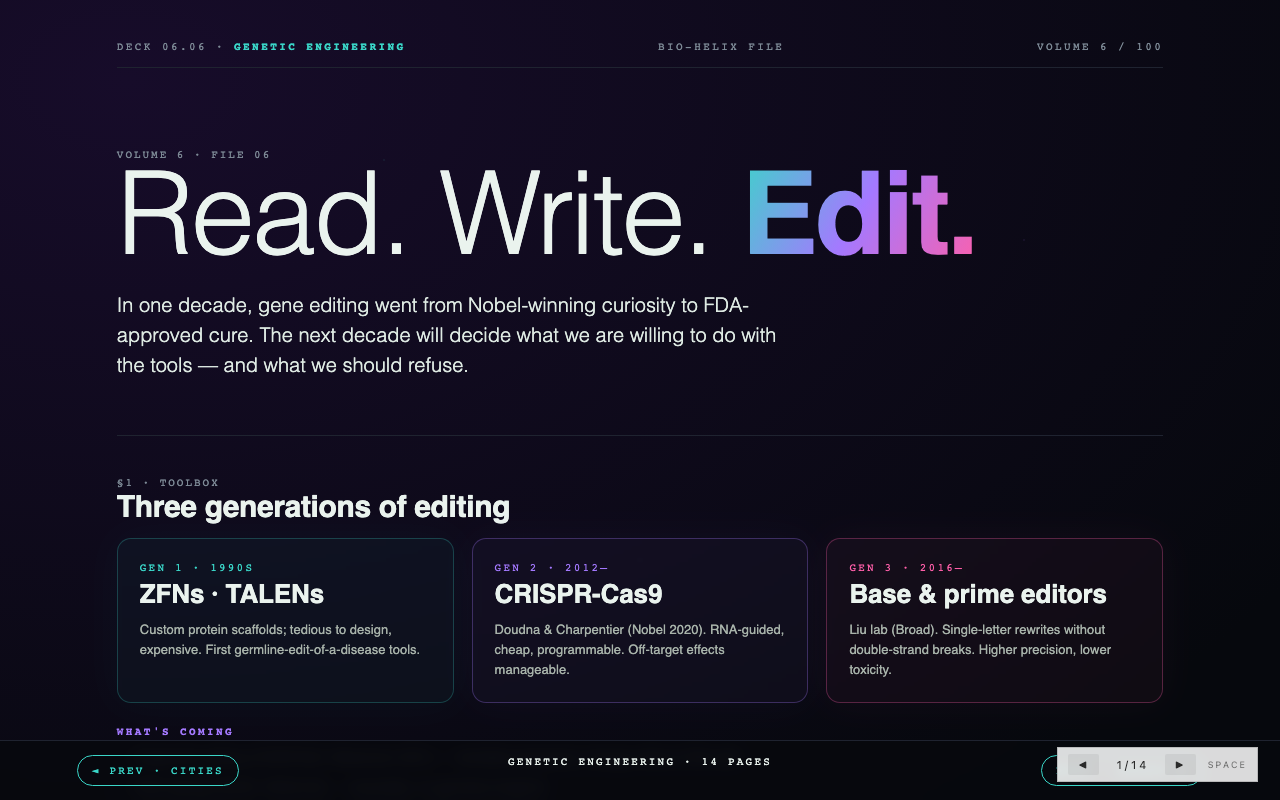
Genetic Engineering / Beyond CRISPR

From cutting DNA to rewriting it. A field-tour of base editors, prime editors, epigenetic switches, gene drives, and the engineered organisms that will...

StandaloneDownload
Sandboxed deck
Open raw

About this HTML presentation

This Shipslides page presents Genetic Engineering / Beyond CRISPR as an interactive HTML presentation deck in the Future catalog with 13 slides. The share page keeps the uploaded deck sandboxed while exposing readable context, topics, and a slide outline for viewers and search engines.

From cutting DNA to rewriting it. A field-tour of base editors, prime editors, epigenetic switches, gene drives, and the engineered organisms that will define the next decade of biology. Key sections include: GENETIC ENGINEERING Beyond CRISPR; CRISPR-Cas9, 2012; Base editing — change one letter, never break the strand; Prime editing, 2019; Epigenetic editing — turn genes on or off, no scissors; Delivery is the bottleneck; Approved therapies, today; Heritable editing — He Jiankui, 2018; Gene drives — edits that copy themselves; Xenotransplantation, edited.

Key sections

  • 01GENETIC ENGINEERING Beyond CRISPR
  • 02CRISPR-Cas9, 2012
  • 03Base editing — change one letter, never break the strand
  • 04Prime editing, 2019
  • 05Epigenetic editing — turn genes on or off, no scissors
  • 06Delivery is the bottleneck
  • 07Approved therapies, today
  • 08Heritable editing — He Jiankui, 2018
  • 09Gene drives — edits that copy themselves
  • 10Xenotransplantation, edited
  • 11De-extinction
  • 12The honest assessment
  • 13References & further viewing
Slide outline
  1. 01GENETIC ENGINEERING Beyond CRISPR
  2. 02CRISPR-Cas9, 2012
  3. 03Base editing — change one letter, never break the strand
  4. 04Prime editing, 2019
  5. 05Epigenetic editing — turn genes on or off, no scissors
  6. 06Delivery is the bottleneck
  7. 07Approved therapies, today
  8. 08Heritable editing — He Jiankui, 2018
  9. 09Gene drives — edits that copy themselves
  10. 10Xenotransplantation, edited
  11. 11De-extinction
  12. 12The honest assessment
  13. 13References & further viewing
Page data
Canonical
https://shipslides.com/d/catalog-future-genetic-engineering
Category
Future
Size
43.7 KB
Updated
2026-05-17
LLM text
https://shipslides.com/d/catalog-future-genetic-engineering/llms.txt

Presentation Transcript

Detailed slide-by-slide text content extracted from this presentation.

Slide 01

GENETIC ENGINEERING Beyond CRISPR

  • A 13-Slide Briefing · 2026
  • From cutting DNA to rewriting it. A field-tour of base editors, prime editors, epigenetic switches, gene drives, and the engineered organisms that will define the next decade of biology.
  • K. Ning
  • ·
  • Catalog Series
  • ·
  • 13 Slides
Slide 02

CRISPR-Cas9, 2012

  • Slide 02 · The Base Layer
  • A bacterial immune system, repurposed by Doudna and Charpentier into a programmable molecular scalpel. Give it a 20-letter RNA guide and it cuts that exact spot in any genome — bacteria, plant, mouse, human.
  • Programmable: swap the guide RNA, change the target.
  • Cheap: reagents cost a graduate student less than lunch.
  • Blunt: double-strand breaks heal messily; the cell improvises.
  • Foundational: every editor on the next slides is built on Cas9.
Slide 03

Base editing — change one letter, never break the strand

  • Slide 03 · Single-Letter Surgery
  • David Liu's lab, 2016. Take a deactivated Cas9 (it can find but not cut), bolt on a deaminase enzyme, and you can flip a single C to T or A to G. Most known disease mutations are point mutations — this addresses them directly.
  • CBE
  • Cytosine Base Editor
  • Converts C·G to T·A. The first base editor; useful for installing stop codons or disrupting splice sites.
  • ABE
  • Adenine Base Editor
  • Converts A·T to G·C. Engineered from a tRNA deaminase — nature didn't have a DNA version, so the lab built one.
  • Why it matters
  • No double-strand breaks
  • Far fewer indels, translocations, large deletions. The cell's repair machinery never gets to improvise.
  • Verve Therapeutics, 2022: first in-human base editing trial. One injection, lifelong cholesterol reduction by editing PCSK9 in liver cells.
Slide 04

Prime editing, 2019

  • Slide 04 · Search and Replace
  • Liu lab again. Cas9 nickase (cuts only one strand) fused to a reverse transcriptase, guided by an extended pegRNA that encodes the new sequence. The cell rewrites itself to match the template.
  • Can install any single-letter swap, plus small insertions and deletions.
  • Estimated to address ~89% of known pathogenic human variants.
  • Twin Prime, PASTE, and other variants now insert whole genes.
  • First clinical trials began 2024 (Prime Medicine, chronic granulomatous disease).
  • BEFORE
  • 5'... A T G C A G T A C ...3'
  • 3'... T A C G T C A T G ...5'
  • ↓ pegRNA template
  • AFTER
  • 5'... A T G G G T T A C ...3'
  • 3'... T A C C C A A T G ...5'
  • A precise three-letter substitution — no double-strand break, no donor template required.
Slide 05

Epigenetic editing — turn genes on or off, no scissors

  • Slide 05 · The Volume Knob
  • Fuse dead Cas9 to a transcription activator (VPR), repressor (KRAB), or methyltransferase (DNMT3A). The DNA sequence is preserved; only the chemical marks around it change. The cell keeps the new setting through divisions.
  • CRISPRa activate
  • dCas9-VPR recruits the transcription machinery; turn a gene up 10x to 1000x without touching its sequence.
  • CRISPRi interfere
  • dCas9-KRAB blocks transcription — reversibly silence a gene. Tunable, and you can switch it back.
  • CRISPRoff durable
  • A 2021 fusion that writes methyl marks — one transient hit, silencing that propagates through cell divisions.
  • The pitch: for many diseases (pain, cardiovascular risk, addiction) you don't want to permanently rewrite the genome — you want to dial the volume. Tune Therapeutics is in trials silencing PCSK9 and Hep B this way.
Slide 06

Delivery is the bottleneck

  • Slide 06 · The Hard Part
  • Editing the genome in a dish is now routine. Editing it inside a living person, in the right tissue, without breaking everything else — that is the actual frontier.
  • Lipid nanoparticles (LNPs): the mRNA-vaccine envelope. Goes naturally to liver. One dose, transient editor expression.
  • AAV vectors: stripped-down viruses. Tissue-specific tropism, but small payload (~4.7 kb) and pre-existing immunity.
  • Electroporation: for ex vivo — pull cells out, zap them, put them back. The Casgevy approach.
  • Engineered virus-like particles: deliver protein-RNA complexes directly, no DNA cargo.
  • Where edits go today
  • Liver
  • Eye
  • Muscle
  • CNS
  • Lung
  • Kidney
  • Approximate clinical viability of in vivo delivery, 2025. Liver is solved. Most other tissues are not.
Slide 07

Approved therapies, today

  • Slide 07 · In the Clinic
  • For most of the 2010s, gene therapy was a promise. By 2025 it is a billing code. Three landmarks:
  • 2023 · FDA & MHRA
  • Casgevy
  • Vertex / CRISPR Therapeutics
  • First CRISPR therapy ever approved. Edits patient's own stem cells ex vivo to reactivate fetal hemoglobin. Cures sickle cell disease and beta-thalassemia. ~$2.2M per patient.
  • 2017 · FDA
  • Luxturna
  • Spark Therapeutics
  • First FDA-approved gene therapy for an inherited disease. Subretinal AAV2 injection delivers a working copy of RPE65 — restores vision in a form of Leber congenital amaurosis.
  • 2019 · FDA
  • Zolgensma
  • Novartis
  • One-time IV infusion for spinal muscular atrophy in infants. Delivers a working SMN1 via AAV9. $2.1M list price — for years the most expensive drug in history.
  • ~20
  • Approved gene/cell therapies (US, 2025)
  • ~3,000
  • Active clinical trials worldwide
  • 7,000+
  • Known monogenic diseases — potential targets
  • $1-3M
  • Typical price tag — the next bottleneck
Slide 08

Heritable editing — He Jiankui, 2018

  • Slide 08 · The Line That Was Crossed
  • A Chinese researcher announced he had edited CCR5 in human embryos and brought twin girls (and later a third child) to term. Aim: HIV resistance. Outcome: global condemnation, three years in prison, an indefinite scientific moratorium.
  • The edits were imprecise — not the published natural variant; novel mutations whose effects are unknown.
  • Changes affect every cell, including sperm and eggs — passed to descendants forever.
  • WHO, NAS, and the UK Royal Society called for a global moratorium on clinical germline editing.
  • The technical barrier is gone. The barrier now is governance, consent, and political will.
  • Why this stays hard
  • Mosaicism. Editing reaches different cells at different rates — an embryo can carry multiple genotypes.
  • Off-targets. A mistake in the germline propagates through every future generation.
  • Pleiotropy. A "disease" gene often does many things. CCR5 disruption may raise West Nile risk.
  • Consent. The edited person never agreed; neither did their descendants.
  • For now: PGT (embryo selection) handles most heritable disease ethically. Germline editing's case is narrow.
Slide 09

Gene drives — edits that copy themselves

  • Slide 09 · CRISPR For Ecosystems
  • Normal inheritance: a trait passes to ~50% of offspring. A gene drive carries the editing machinery itself, so it converts the second chromosome too — spreading to ~100% of offspring, generation after generation, until the trait saturates a population.
  • The dilemma: a successful drive could end malaria (600,000 deaths/year). It could also unintentionally drive a species extinct, or jump to a non-target species. Daisy-chain and split drives are designed to self-limit — but no one has yet released one in the wild.
Slide 10

Xenotransplantation, edited

  • Slide 10 · Pigs As Organ Donors
  • ~17 people die every day in the US waiting for a transplant. eGenesis and Revivicor have engineered pigs with dozens of CRISPR edits — knocking out the antigens that trigger human rejection, inactivating endogenous pig retroviruses, adding human immune-regulator genes.
  • Sept 2021: NYU surgeons attach an edited pig kidney to a brain-dead recipient — it functions for 54 hours.
  • Jan 2022: University of Maryland transplants a 10-edit pig heart into David Bennett. Survives 60 days.
  • Mar 2024: Mass General performs the first edited pig kidney into a living patient. Survives ~2 months.
  • 2025: First formal Phase 1 clinical trials begin (United Therapeutics, eGenesis).
  • CRISPR edits in eGenesis donor pigs
  • pig glycan antigens knocked out (alpha-Gal, Neu5Gc, Sda)
  • PERV (porcine retrovirus) sites inactivated
  • human transgenes added (CD46, CD55, thrombomodulin, …)
  • ~100k
  • people on US transplant waitlist
Slide 11

De-extinction

  • Slide 11 · Reverse Gear
  • Colossal Biosciences (and others) are trying to bring back lost species — not by cloning ancient DNA (it's too degraded) but by editing the closest living relative's genome to express extinct traits.
  • Woolly Mammoth
  • Target: 2028
  • Edit Asian elephant cells with mammoth-derived alleles for cold tolerance, hair, fat. In 2024 Colossal announced elephant-derived iPSCs — a major prerequisite. Many edits still ahead.
  • Thylacine
  • Tasmanian tiger
  • Closest living relative is the fat-tailed dunnart, a mouse-sized marsupial. The genome gap is enormous. Colossal sequenced a 110-year-old specimen in 2024.
  • Dodo
  • Extinct ~1681
  • Edit Nicobar pigeon (closest relative) cells. In 2025 Colossal achieved primordial germ cell culture in pigeons — the bird-genetics equivalent of iPSCs.
  • The honest framing: what's actually being made is an elephant with mammoth-like traits, not a mammoth. The technology spinning out (large-scale editing, exotic IVF, cell reprogramming) may matter more than any resurrected animal — particularly for endangered-species rescue.
Slide 12

The honest assessment

  • Slide 12 · Where We Actually Are
  • Real and growing
  • Somatic editing for monogenic disease: working, approved, scaling.
  • Liver-targeted in vivo editing: a platform with dozens of programs.
  • Engineered T-cells for cancer: a new pillar of oncology.
  • Pig organs in human bodies: now a clinical reality, not a thought experiment.
  • Crops with bespoke traits: deregulated edits in wheat, tomato, soy.
  • Fraught and unresolved
  • Heritable editing: technically near, ethically and politically nowhere near consensus.
  • Gene drives: reversibility uncertain; first wild release will set precedent for all biology.
  • Polygenic enhancement: marketing outpaces science; modest selection effects only.
  • Cost and access: $2M therapies don't scale to global disease burden as built.
  • Off-targets: the long tail of "we won't know for 30 years."
  • The next decade is less about new editors and more about delivery, durability, and decisions — technical, regulatory, and moral.
Slide 13

References & further viewing

  • Slide 13 · Going Deeper
  • Reading
  • Doudna & Sternberg, A Crack in Creation (2017)
  • Walter Isaacson, The Code Breaker (2021)
  • Kevin Davies, Editing Humanity (2020)
  • Liu lab papers: Nature 2017 (ABE), Nature 2019 (prime editing)
  • Innovative Genomics Institute — innovativegenomics.org
  • Broad Institute editing primer — broadinstitute.org
  • Watch
  • YOUTUBE · SEARCH
  • CRISPR gene editing — the future
  • Talks from Doudna, Liu, Zhang; documentary primers
  • YOUTUBE · SEARCH
  • He Jiankui — the CRISPR babies
  • News reporting, ethics panels, interviews after release
  • GENETIC ENGINEERING / Beyond CRISPR
  • Catalog Series · 2026
  • End of deck — press ← to revisit.
Remove this deck