shipslides
Future14 slides0 views

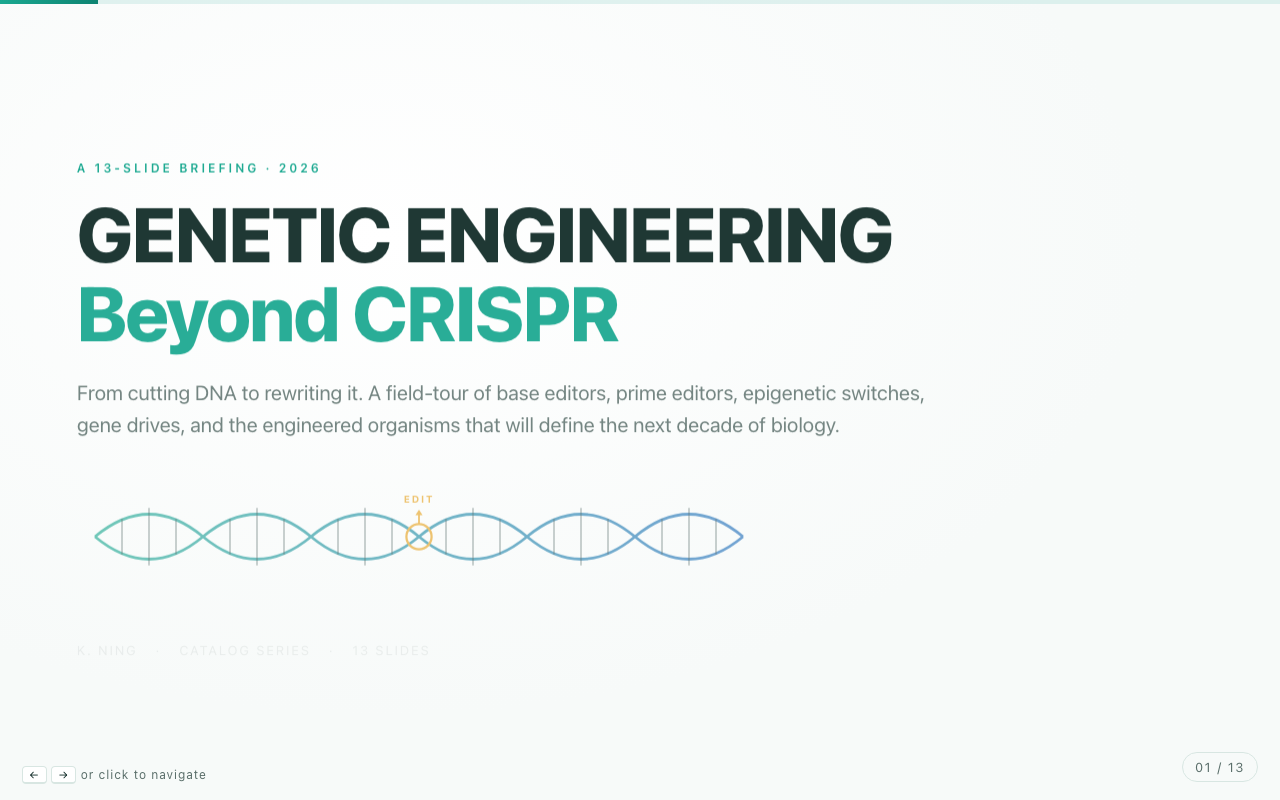
Genetic Engineering

In one decade, gene editing went from Nobel-winning curiosity to FDA-approved cure. The next decade will decide what we are willing to do with the tools —...

StandaloneDownload
Sandboxed deck
Open raw

About this HTML presentation

This Shipslides page presents Genetic Engineering as an interactive HTML presentation deck in the Future catalog with 14 slides. The share page keeps the uploaded deck sandboxed while exposing readable context, topics, and a slide outline for viewers and search engines.

In one decade, gene editing went from Nobel-winning curiosity to FDA-approved cure. The next decade will decide what we are willing to do with the tools — and what we should refuse. Key sections include: Read. Write. Edit.; Three generations of editing; How a guide RNA finds a single base in 3 billion; What edits exist as medicine; The malaria question; The He Jiankui line; Beyond editing — designing genomes; Programmable life, in pieces; Cost of reading and writing DNA; Dual-use is the central problem.

Key sections

  • 01Read. Write. Edit.
  • 02Three generations of editing
  • 03How a guide RNA finds a single base in 3 billion
  • 04What edits exist as medicine
  • 05The malaria question
  • 06The He Jiankui line
  • 07Beyond editing — designing genomes
  • 08Programmable life, in pieces
  • 09Cost of reading and writing DNA
  • 10Dual-use is the central problem
  • 11Who is shaping this
  • 12Recommended source
  • 13What stays speculative
  • 14Indicators · 2026–2030
Slide outline
  1. 01Read. Write. Edit.
  2. 02Three generations of editing
  3. 03How a guide RNA finds a single base in 3 billion
  4. 04What edits exist as medicine
  5. 05The malaria question
  6. 06The He Jiankui line
  7. 07Beyond editing — designing genomes
  8. 08Programmable life, in pieces
  9. 09Cost of reading and writing DNA
  10. 10Dual-use is the central problem
  11. 11Who is shaping this
  12. 12Recommended source
  13. 13What stays speculative
  14. 14Indicators · 2026–2030
Page data
Canonical
https://shipslides.com/d/future-genetic-engineering
Category
Future
Size
28.6 KB
Updated
2026-05-17
LLM text
https://shipslides.com/d/future-genetic-engineering/llms.txt

Presentation Transcript

Detailed slide-by-slide text content extracted from this presentation.

Slide 01

Read. Write. Edit.

  • Volume 6 · File 06
  • In one decade, gene editing went from Nobel-winning curiosity to FDA-approved cure. The next decade will decide what we are willing to do with the tools — and what we should refuse.
Slide 02

Three generations of editing

  • §1 · Toolbox
  • Gen 1 · 1990s
  • ZFNs · TALENs
  • Custom protein scaffolds; tedious to design, expensive. First germline-edit-of-a-disease tools.
  • Gen 2 · 2012–
  • CRISPR-Cas9
  • Doudna & Charpentier (Nobel 2020). RNA-guided, cheap, programmable. Off-target effects manageable.
  • Gen 3 · 2016–
  • Base & prime editors
  • Liu lab (Broad). Single-letter rewrites without double-strand breaks. Higher precision, lower toxicity.
  • What's coming
  • Epigenetic editing (CRISPRoff, Weissman 2021) — heritable expression change without DNA edit
  • RNA editing (ADAR, RESCUE) — reversible, no germline footprint
  • Programmable retroelements / bridge RNAs (Arc Institute, 2024)
Slide 03

How a guide RNA finds a single base in 3 billion

  • §2 · CRISPR · Diagram
  • After Doudna & Charpentier 2012; Liu base-editor 2016; prime-editor 2019.
Slide 04

What edits exist as medicine

  • §3 · Approved & in clinic
  • TherapyTargetStageYear
  • Casgevy (exa-cel)Sickle-cell & β-thalassemia · BCL11A KO ex vivoFDA, EMA, MHRA approved2023
  • Lyfgenia · bb305Sickle-cell · gene addition (lentivirus)FDA approved2023
  • HemgenixHemophilia B · AAV gene therapyFDA approved · $3.5M list2022
  • Verve VERVE-101HeFH · in vivo base edit of PCSK9Phase 1b2023–
  • NTLA-2001ATTR amyloidosis · in vivo Cas9Phase 32024–
  • Editas EDIT-301Sickle-cell · γ-globin reactivationPhase 1/22024–
  • Beam BEAM-101Sickle-cell · base editingPhase 1/22024–
  • forecast By 2030 we expect 10–20 approved gene-edit therapies, mostly for monogenic diseases. Polygenic disease editing remains experimental.
Slide 05

The malaria question

  • §4 · Gene drives
  • Gene drives bias inheritance so an engineered allele spreads faster than Mendelian rates. Anopheles-suppressing drives (Target Malaria, Imperial College, Crisanti lab) crashed caged populations to extinction in Italian biocontainment by 2018. The technical question is solved. The ethical and regulatory question — release into the wild — is not.
  • The hard questions
  • Reversibility. Daisy drives (Esvelt, MIT) are designed to die out, but unproven at scale.
  • Consent. Mosquitoes don't respect borders. Whose democratic process governs?
  • Ecological cascade. Anopheles isn't a keystone species, but absence-of-evidence isn't evidence-of-absence.
  • Dual use. The same toolkit could target useful insects.
  • scenario First open-environment release likely 2027–32 in Burkina Faso or São Tomé, after Phase 4-equivalent safety review.
Slide 06

The He Jiankui line

  • §5 · Germline
  • In November 2018, He Jiankui announced he had edited the CCR5 gene in human embryos that were carried to term — twin girls Lulu and Nana. The announcement provoked global condemnation, He's imprisonment (released 2022), and a near-universal moratorium on germline editing in clinic.
  • The science: the edits were imprecise, the rationale (HIV resistance) thin, the consent forms misleading. The episode established the international norm: germline editing is technically possible, currently irresponsible, and not (yet) ethically supportable.
  • The five accepted reasons
  • Off-target risks not fully characterized
  • Mosaicism — embryo-stage edits don't distribute uniformly
  • Long-term inheritance unknown — multi-generational
  • Less risky alternatives (PGT-M, IVF selection) exist
  • Equity/eugenic concerns at population scale
  • contested The line will be tested again — likely first by a wealthy parent with a Mendelian-disease child, in a permissive jurisdiction.
Slide 07

Beyond editing — designing genomes

  • §6 · Synthetic biology
  • Synthetic biology asks: what if we wrote genomes from scratch? Craig Venter's JCVI synthesized Mycoplasma laboratorium in 2010; Sc2.0 (Boeke et al.) wrote the entire yeast genome by 2024. The toolkit:
  • DNA synthesis
  • ~$0.05/bp
  • Twist, IDT, Ansa Bio. Down 1000× since 2003.
  • Standard parts
  • Registry of BioBricks
  • iGEM (MIT) since 2003. Modular promoters, RBSes, terminators.
  • Cell-free systems
  • PURE · TXTL
  • Run synthetic circuits without a cell. Liu, Murray labs.
  • Genome writers
  • Sc2.0 · synGenomes
  • Designer chromosomes, refactored codes (Church Mb-scale).
Slide 08

Programmable life, in pieces

  • §7 · Xenobots & living machines
  • Bongard, Levin & Blackiston (2020): "xenobots" — assemblies of frog skin and cardiac cells, evolved in silico, that swim, push pellets, and self-replicate by kinematic assembly. Not a normal organism. Not a robot. Some new category we don't yet have a word for.
  • Anthrobots (Levin lab, 2023) — multi-cellular structures from human tracheal cells. Show neural-tissue repair effects in vitro.
  • scenario Living therapeutics — engineered consortia for the gut, the wound bed, the bloodstream — are a more tractable near-term application than xenobots themselves.
Slide 09

Cost of reading and writing DNA

  • §8 · Diagram · S-curve
  • After NHGRI sequencing-cost data; Carlson curves; Twist Bio & Ansa Bio reports. Schematic.
Slide 10

Dual-use is the central problem

  • §9 · Biosecurity
  • Drexler in 1986 worried about gray goo. The contemporary worry is more specific: cheap DNA synthesis, available pathogen sequences, and AI-assisted protein design lower the bar to engineering pandemic-class agents. Kevin Esvelt's papers (2017, 2022) lay out the case bluntly.
  • Synthesis screening. IGSC member companies screen orders against hazardous-sequence databases. Coverage is partial.
  • Information hazards. Some research (gain-of-function, certain pandemic-pathogen sequences) may be unsafe to publish.
  • AI uplift. Frontier labs evaluate whether models offer non-trivial uplift to bioweapon synthesis. Anthropic, OpenAI, DeepMind have biorisk evals.
  • Hardware. Benchtop synthesizers will eventually be cheap enough that screening at the order step matters more than at the user step.
  • "The scariest thing about pandemic-grade biotechnology is how few people it takes." — Kevin Esvelt
Slide 11

Who is shaping this

  • §10 · Voices
  • Jennifer DoudnaBerkeley · CRISPR co-discoverer · Innovative Genomics Institute
  • Emmanuelle CharpentierMax Planck Berlin · co-Nobel 2020
  • Feng ZhangBroad · CRISPR mammalian use; bridge RNAs (Arc, 2024)
  • David LiuBroad · base & prime editing
  • George ChurchHarvard · Genome Project Write; mammoth de-extinction (Colossal)
  • Kevin EsveltMIT · gene drives, biosecurity, daisy drives
  • Michael LevinTufts · xenobots, basal cognition
  • Eric DrexlerEngines of Creation (1986); molecular nanotech ground theorist
  • Françoise BaylisBioethicist · germline-editing critic; Altered Inheritance (2019)
Slide 12

Recommended source

  • §11 · Watch
  • Kurzgesagt · "Genetic Engineering Will Change Everything Forever"
  • The 2016 video that introduced CRISPR to ~30M viewers. Aged remarkably well.
  • youtube.com/@kurzgesagt →
  • Lex Fridman × Jennifer Doudna
  • Hour-plus on origins, ethics, the Broad-Berkeley patent fight, and where the science is going.
  • youtube.com/@lexfridman →
Slide 13

What stays speculative

  • §12 · Frontier · 2050
  • Polygenic enhancement. Embryo selection is shipping; effect sizes are small. Editing 100s of variants in vivo, safely, is decades away. scenario
  • Mammoth / thylacine de-extinction. Colossal Biosciences has cells, edit pipelines, and elephant surrogates. First mammoth-elephant hybrid maybe 2028. scenario
  • Synthetic genomes for production hosts. Sc2.0 finishes; bacterial chassis with refactored genetic codes deployed in industry. forecast
  • Programmable cell therapies. CAR-T 4.0; in vivo CAR generators; logic-gated kill switches. forecast
  • Designer babies, mass scale. Implausible without a major regulatory shift. fiction-adjacent
Slide 14

Indicators · 2026–2030

  • §13 · What to watch
  • First in-vivo base-edit therapy approval (Verve, Beam)
  • Open-environment gene drive trial
  • Outcome of WHO & UNESCO heritable-genome-editing reviews
  • Synthesis-screening federal mandate (US Executive Order 14110 successor)
  • Sc2.0 yeast complete; commercial deployment
  • First polygenic embryo selection birth-cohort outcome data (5+ yr)
Remove this deck