shipslides
Mathematics13 slides0 views

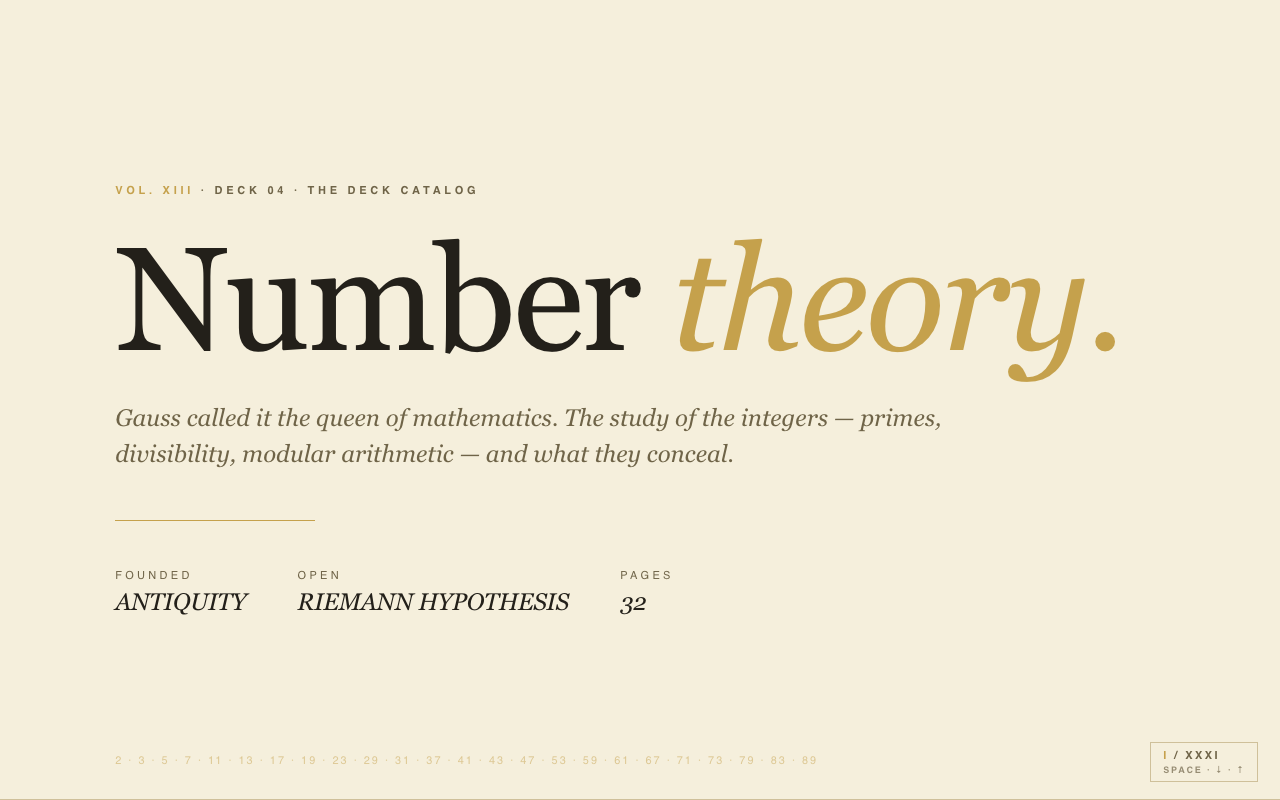
Number Theory — The Queen of Mathematics

2 3 “Mathematics is the queen of the sciences, and number theory is the queen of mathematics.” — C. F. Gauss ❦ ❦ Chapter I The Integers §1. The playing...

StandaloneDownload
Sandboxed deck
Open raw

About this HTML presentation

This Shipslides page presents Number Theory — The Queen of Mathematics as an interactive HTML presentation deck in the Mathematics catalog with 13 slides. The share page keeps the uploaded deck sandboxed while exposing readable context, topics, and a slide outline for viewers and search engines.

2 3 “Mathematics is the queen of the sciences, and number theory is the queen of mathematics.” — C. F. Gauss ❦ ❦ Chapter I The Integers §1. The playing field The Integers The integers ℤ = { … , −3, −2, −1, 0, 1, 2, 3, … } form the bedrock of arithmetic — discrete, unbounded, equipped with addition and multiplication. Key sections include: Number Theory; The Integers; The Primes are Infinite; Every Integer is Prime, Uniquely; How to Catch a Prime; The Prime Number Theorem; Modular Arithmetic; Fermat's Little Theorem; Diophantine Equations; Fermat's Last Theorem.

Key sections

  • 01Number Theory
  • 02The Integers
  • 03The Primes are Infinite
  • 04Every Integer is Prime, Uniquely
  • 05How to Catch a Prime
  • 06The Prime Number Theorem
  • 07Modular Arithmetic
  • 08Fermat's Little Theorem
  • 09Diophantine Equations
  • 10Fermat's Last Theorem
  • 11Cryptography & Beyond
  • 12What We Do Not Know
  • 13Further Reading
Slide outline
  1. 01Number Theory
  2. 02The Integers
  3. 03The Primes are Infinite
  4. 04Every Integer is Prime, Uniquely
  5. 05How to Catch a Prime
  6. 06The Prime Number Theorem
  7. 07Modular Arithmetic
  8. 08Fermat's Little Theorem
  9. 09Diophantine Equations
  10. 10Fermat's Last Theorem
  11. 11Cryptography & Beyond
  12. 12What We Do Not Know
  13. 13Further Reading
Page data
Canonical
https://shipslides.com/d/catalog-math-number-theory
Category
Mathematics
Size
36.0 KB
Updated
2026-05-17
LLM text
https://shipslides.com/d/catalog-math-number-theory/llms.txt

Presentation Transcript

Detailed slide-by-slide text content extracted from this presentation.

Slide 01

Number Theory

  • A Treatise on
  • The Queen of Mathematics
  • “Mathematics is the queen of the sciences, and number theory is the queen of mathematics.”
  • — C. F. Gauss
Slide 02

§1. The playing field

  • Chapter IThe Integers
  • The Integers
  • The integers ℤ = { … , −3, −2, −1, 0, 1, 2, 3, … } form the bedrock of arithmetic — discrete, unbounded, equipped with addition and multiplication.
  • Positive the natural numbers, ℕ
  • Negative their additive inverses
  • Zero the still center, an Indian gift to algebra
  • Every non-empty subset of ℕ has a least element.
Slide 03

§2. The atoms of arithmetic

  • Chapter IIPrimes
  • The Primes are Infinite
  • A prime p > 1 has no divisors save 1 and itself. The first few:
  • 2, 3, 5, 7, 11, 13, 17, 19, 23, 29, 31, …
  • There exist infinitely many primes.
  • Suppose, for contradiction, that the primes are finite: p₁, p₂, …, pn. Form N = p₁·p₂·⋯·pn + 1. Then N is divisible by some prime q. But q cannot equal any pi, for that would imply q ∣ 1. So q is a new prime — contradicting our list.
  • A proof of crystalline economy — twenty-three centuries old, and still untouched.
Slide 04

§3. The fundamental theorem

  • Chapter IIIUnique Factorisation
  • Every Integer is Prime, Uniquely
  • Every integer n > 1 may be written as a product of primes n = p₁a₁ · p₂a₂ · ⋯ · pkak, and this factorisation is unique up to order.
  • Examples — the unique decompositions:
  • 12 = 2² · 3
  • 360 = 2³ · 3² · 5
  • 1001 = 7 · 11 · 13
  • 2026 = 2 · 1013
  • Fig. 1The factor tree of 360.
Slide 05

§4. The sieve and its descendants

  • Chapter IVFinding Primes
  • How to Catch a Prime
  • Eratosthenes, c. 240 B.C. — the librarian of Alexandria. Strike out multiples of 2, then 3, then 5… what remains is prime.
  • Trial Division — test divisors up to √n. Honest, slow.
  • Miller–Rabin, 1976 — a probabilistic test exploiting Fermat's little theorem. Practically certain in microseconds.
  • AKS, 2002 — deterministic polynomial-time primality. A theoretical jewel.
  • Fig. 2The sieve to 30, with an Ulam spiral.
Slide 06

§5. The density of primes

  • Chapter VDistribution
  • The Prime Number Theorem
  • Let π(n) denote the number of primes ≤ n. The primes thin out — but with breathtaking regularity.
  • As n → ∞,
  • π(n) ~ n / ln(n)
  • that is, π(n) · ln(n) / n → 1.
  • Fig. 3The prime counting function π(n) against its smooth approximation.
Slide 07

§6. Clock arithmetic

  • Chapter VICongruences
  • Modular Arithmetic
  • Two integers are congruent modulo n if their difference is divisible by n:
  • a ≡ b (mod n) ⟺ n ∣ (a − b)
  • So 17 ≡ 5 (mod 12) — both have remainder 5 when divided by 12. Time, days of the week, hours on a clock: all modular.
  • Gauss formalised the notation in his 1801 masterwork Disquisitiones Arithmeticae, written at age 24 — and the subject was reborn.
  • Fig. 4ℤ/12ℤ: the clock.
Slide 08

§7. A jewel of congruence

  • Chapter VIIFermat
  • Fermat's Little Theorem
  • Let p be prime. For every integer a,
  • ap ≡ a (mod p)
  • Equivalently, if gcd(a,p)=1, then ap−1 ≡ 1 (mod p).
  • A small theorem with vast consequences. It underlies:
  • The Miller–Rabin probabilistic primality test.
  • The correctness of the RSA cryptosystem.
  • Euler's generalisation: aφ(n) ≡ 1 (mod n).
  • Fermat scribbled it in a letter; the first published proof came from Euler, a century later.
Slide 09

§8. Equations in integers

  • Chapter VIIIDiophantus
  • Diophantine Equations
  • A Diophantine equation demands integer solutions. The simplest non-trivial example:
  • x² + y² = z²
  • Pythagorean triples — (3,4,5), (5,12,13), (8,15,17), (7,24,25), … infinitely many, all generated by
  • x = m²−n², y = 2mn, z = m²+n²
  • for coprime m > n > 0 of opposite parity.
  • Fig. 5The (3,4,5) Pythagorean triple.
Slide 10

§9. Three and a half centuries

  • Chapter IXFermat's Last Theorem
  • Fermat's Last Theorem
  • For any integer n > 2, the equation
  • xn + yn = zn
  • has no solutions in positive integers x, y, z.
  • Fermat wrote in the margin of his Diophantus:
  • “Cuius rei demonstrationem mirabilem sane detexi, hanc marginis exiguitas non caperet.” — I have discovered a truly marvellous proof of this, which this margin is too narrow to contain.
  • It withstood Euler, Sophie Germain, Kummer, generations of attack. In 1995, Andrew Wiles — after seven years of secret labour — proved the modularity of semistable elliptic curves, from which Fermat's Last Theorem cascaded as a corollary.
  • ❦ ❦ ❦
Slide 11

§10. Number theory now

  • Chapter XThe Modern Cathedral
  • Cryptography & Beyond
  • RSA & Public Key
  • 1977 — Rivest, Shamir, Adleman. The hardness of factoring large semi-primes secures the world's banking, commerce, secrets. Number theory keeps your messages.
  • Elliptic Curves
  • Cubic curves y² = x³ + ax + b over finite fields. The arithmetic of their rational points fueled Wiles's proof and now powers ECC, used in TLS and blockchains.
  • The Langlands Program
  • Robert Langlands, 1967 — a vast web of conjectures linking number theory, representation theory, and harmonic analysis. A “grand unified theory” of mathematics, still being charted.
  • Galois representations ↔ automorphic forms.
  • The queen now wears digital robes.
Slide 12

§11. Mysteries that abide

  • Chapter XIOpen Problems
  • What We Do Not Know
  • All non-trivial zeros of ζ(s) = Σ 1/ns have real part ½. — A million-dollar Clay Prize. Equivalent to the deepest statements about the distribution of primes.
  • There are infinitely many primes p such that p + 2 is also prime. Zhang (2013): infinitely many prime gaps less than 70 million. Polymath then drove the bound below 250.
  • Every even integer n > 2 is the sum of two primes. Verified for n < 4 × 10¹⁸; proven for none.
  • The simplest questions hide the deepest secrets. Such has always been her way.
Slide 13

Further Reading

  • ColophonReferences
  • ❦ ❦ ❦
  • Books
  • G. H. Hardy & E. M. Wright, An Introduction to the Theory of Numbers (1938).
  • C. F. Gauss, Disquisitiones Arithmeticae (1801).
  • K. Ireland & M. Rosen, A Classical Introduction to Modern Number Theory.
  • S. Singh, Fermat's Enigma (1997).
  • J. Derbyshire, Prime Obsession.
  • Euclid, Elements, Books VII–IX.
  • Video Lectures
  • Fermat's Last Theorem & Andrew Wiles — the documentary and lectures.
  • Prime Numbers, Explained — visual primers and proofs.
  • A Final Word
  • “God may not play dice with the universe, but something strange is going on with the prime numbers.” — Paul Erdős
  • — Finis —
Remove this deck