shipslides
Philosophy13 slides0 views

Ethics — How should one live?

Five frameworks. One trolley. A persistent question. The brief atlas of moral philosophy.

StandaloneDownload
Sandboxed deck
Open raw

About this HTML presentation

This Shipslides page presents Ethics — How should one live? as an interactive HTML presentation deck in the Philosophy catalog with 13 slides. The share page keeps the uploaded deck sandboxed while exposing readable context, topics, and a slide outline for viewers and search engines.

Five frameworks. One trolley. A persistent question. The brief atlas of moral philosophy. Key sections include: ETHICS / How should one live?; Three roads to the good.; Aristotle — excellence as habit.; Kant — duty before consequence.; Bentham & Mill — the felicific calculus.; Rawls & Scanlon — what could we all agree to?; Gilligan & Noddings — the ethics of relation.; One death to save five ?; New problems for old frameworks.; Beneath the frameworks, a deeper question..

Key sections

  • 01ETHICS / How should one live?
  • 02Three roads to the good.
  • 03Aristotle — excellence as habit.
  • 04Kant — duty before consequence.
  • 05Bentham & Mill — the felicific calculus.
  • 06Rawls & Scanlon — what could we all agree to?
  • 07Gilligan & Noddings — the ethics of relation.
  • 08One death to save five ?
  • 09New problems for old frameworks.
  • 10Beneath the frameworks, a deeper question.
  • 11Real moral life is messier than any rule.
  • 12Morality without God?
  • 13Where to continue.
Slide outline
  1. 01ETHICS / How should one live?
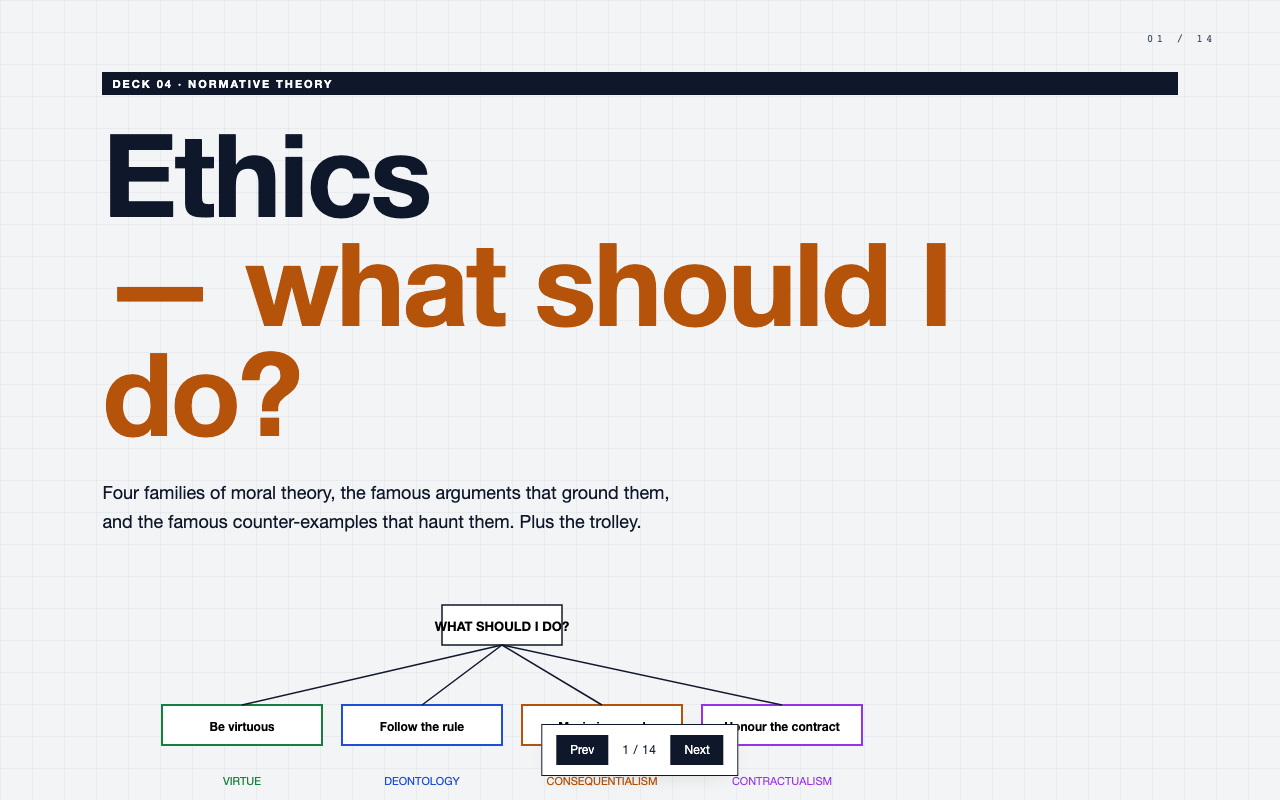
  2. 02Three roads to the good.
  3. 03Aristotle — excellence as habit.
  4. 04Kant — duty before consequence.
  5. 05Bentham & Mill — the felicific calculus.
  6. 06Rawls & Scanlon — what could we all agree to?
  7. 07Gilligan & Noddings — the ethics of relation.
  8. 08One death to save five ?
  9. 09New problems for old frameworks.
  10. 10Beneath the frameworks, a deeper question.
  11. 11Real moral life is messier than any rule.
  12. 12Morality without God?
  13. 13Where to continue.
Page data
Canonical
https://shipslides.com/d/catalog-philosophy-ethics
Category
Philosophy
Size
36.6 KB
Updated
2026-05-17
LLM text
https://shipslides.com/d/catalog-philosophy-ethics/llms.txt

Presentation Transcript

Detailed slide-by-slide text content extracted from this presentation.

Slide 01

ETHICS / How should one live?

  • Treatise No. 4◆How should one live?
  • A Field Guide in 13 Cards
  • Five frameworks. One trolley. A persistent question. The brief atlas of moral philosophy.
Slide 02

Three roads to the good.

  • 02 / The Map◆Three Major Traditions
  • Western moral philosophy clusters around three ancient questions. They are less rivals than different lenses on the same fog.
  • Agent-centered
  • Virtue Ethics
  • What kind of person should I be? Focus on character, habits, and human flourishing.
  • II.
  • Act-centered
  • Deontology
  • What rules must I follow? Some acts are right or wrong regardless of outcome.
  • III.
  • Outcome-centered
  • Consequentialism
  • What results should I produce? An act is right if its consequences are best.
Slide 03

Aristotle — excellence as habit.

  • 03 / Tradition I◆Virtue Ethics
  • No. 001 · Lyceum
  • Aristotle
  • 384–322 BC · Athens
  • “We are what we repeatedly do. Excellence, then, is not an act, but a habit.”
  • Eudaimonia — flourishing — is the human end. Each virtue is a Golden Mean between extremes: courage between cowardice and recklessness, generosity between miserliness and waste. Character is forged through practice, not principle.
  • Verdict · Live Well
Slide 04

Kant — duty before consequence.

  • 04 / Tradition II◆Deontology
  • No. 002 · Königsberg
  • Immanuel Kant
  • 1724–1804 · Prussia
  • “Act only on that maxim by which you can at the same time will that it should become a universal law.”
  • The Categorical Imperative: morality is reason’s law. Lying, breaking promises, treating persons as mere means — forbidden, full stop. People possess dignity, not price. The right is prior to the good.
  • Verdict · Do Your Duty
Slide 05

Bentham & Mill — the felicific calculus.

  • 05 / Tradition III◆Utilitarianism
  • No. 003
  • Jeremy Bentham
  • 1748–1832
  • “The greatest happiness of the greatest number is the foundation of morals and legislation.”
  • Pleasure good, pain bad — sum it up across all sentient beings. Quantitative hedonism.
  • Verdict · Maximize Utility
  • No. 004
  • John Stuart Mill
  • 1806–1873
  • “Better to be Socrates dissatisfied than a fool satisfied.”
  • Refines Bentham — not all pleasures equal. Higher (intellectual) pleasures rank above lower. Liberty matters as a precondition for utility.
  • Verdict · Quality Counts
Slide 06

Rawls & Scanlon — what could we all agree to?

  • 06 / Tradition IV◆Contractualism
  • No. 005
  • John Rawls
  • 1921–2002
  • “Justice is fairness — the principles you would choose behind a veil of ignorance.”
  • Imagine designing society without knowing your race, talent, or wealth. You’d demand equal liberties and accept inequality only if it benefits the least advantaged.
  • Verdict · Fair Terms
  • No. 006
  • T. M. Scanlon
  • b. 1940
  • “An act is wrong if it could be reasonably rejected by anyone affected.”
  • Morality as justifiability to others. We owe each other reasons — principles no one could refuse on grounds of fairness.
  • Verdict · Justifiable
Slide 07

Gilligan & Noddings — the ethics of relation.

  • 07 / Tradition V◆Care Ethics
  • No. 007
  • Carol Gilligan
  • b. 1936
  • “A different voice — one that hears responsibility before rules.”
  • Critiqued Kohlberg’s “justice” ladder for missing women’s reasoning: contextual, narrative, attentive to relationships.
  • Verdict · Listen
  • No. 008
  • Nel Noddings
  • 1929–2022
  • “Caring is the foundation: a face met, not a maxim applied.”
  • Moral life begins in concrete encounter — mother and child, friend and friend. Abstract universals come second, if at all.
  • Verdict · Stay Close
Slide 08

One death to save five?

  • 08 / The Test◆The Trolley Problem
  • Framework
  • Pull the lever?
  • Why
  • Utilitarian
  • YES
  • Five lives outweigh one. Math is math.
  • Kantian
  • Using the one as a means to others’ ends violates dignity.
  • Virtue
  • IT DEPENDS
  • What would the person of practical wisdom do?
  • Care
  • SUSPEND
  • Refuses the abstraction; demands the actual relations.
Slide 09

New problems for old frameworks.

  • 09 / The Frontier◆Contemporary Dilemmas
  • The toughest cases are those the founding theorists never imagined.
  • AI Ethics
  • Should an autonomous vehicle be a Kantian or a utilitarian? Who is responsible when no human acts? Can a system without consciousness bear moral weight?
  • Animal Rights
  • Singer extends utilitarianism: if suffering counts, species is irrelevant. Regan extends Kant: animals as ends in themselves.
  • Intergenerational Justice
  • What do we owe people not yet born? Discount their welfare? Rawls’ veil suggests treat them as equals.
  • Climate
  • Diffuse harm, distributed cause, distant victim. Every framework strains. Collective action where individual choice barely registers.
Slide 10

Beneath the frameworks, a deeper question.

  • 10 / Metaethics◆Are Moral Facts Real?
  • Position I
  • Realism
  • Moral facts exist independently — like mathematical truths. Cruelty is wrong, full stop.
  • Position II
  • Anti-realism
  • No moral facts — only attitudes, emotions, projections. “Wrong” expresses disapproval.
  • Position III
  • Constructivism
  • Moral truths are made, not found — products of rational agreement among agents.
Slide 11

Real moral life is messier than any rule.

  • 11 / Practice◆Phronesis
  • Rules underdetermine action. Two principles always conflict. Three values cannot all be honored. Wisdom is the faculty of knowing what this case demands.— The lesson of every applied ethicist
  • Particulars matter
  • The same act in different contexts is a different act. Lying to a friend, lying to a tyrant.
  • Frameworks as tools
  • Pluralists carry several frameworks the way a carpenter carries chisels. Each reveals what others hide.
  • Moral residue
  • Even right choices leave regret. Tragic dilemmas have no clean exit. The mature agent accepts this.
Slide 12

Morality without God?

  • 12 / The Persistent Question◆Foundations
  • Dostoevsky’s worry: “If God is dead, all is permitted.” Most modern frameworks reply: no. Reason, consequence, contract, character — each grounds ethics elsewhere.
  • The Worry
  • If no commander, no command?
  • Divine command theory: right is what God wills. Without God, what binds? Why care about Kant’s reason or Mill’s utility?
  • Skeptic
  • The Reply
  • The Euthyphro returns.
  • Plato asked: is it good because the gods love it, or do they love it because it is good? If the latter — goodness stands on its own, regardless of any commander.
  • Verdict · Stands
Slide 13

Where to continue.

  • 13 / Coda◆Further Reading
  • Books
  • Aristotle — Nicomachean EthicsThe original treatise on virtue and flourishing.
  • Kant — Groundwork of the Metaphysics of MoralsThe categorical imperative, in 80 dense pages.
  • Mill — UtilitarianismBrief, lucid, the case for consequences.
  • Rawls — A Theory of JusticeThe veil of ignorance, fully developed.
  • Williams — Ethics and the Limits of PhilosophyWhy theory may not save us.
  • Anscombe — Modern Moral PhilosophyThe essay that revived virtue ethics.
  • Lectures & Videos
  • YouTube · Search
  • The Trolley Problem — explainers
  • YouTube · Search
  • Michael Sandel — Justice (Harvard)
  • “The unexamined life is not worth living.” — Socrates, in Plato’s Apology. The ethical life starts here: not with the right answer, but with the willingness to keep asking.
Remove this deck