shipslides
History18 slides0 views

The Renaissance

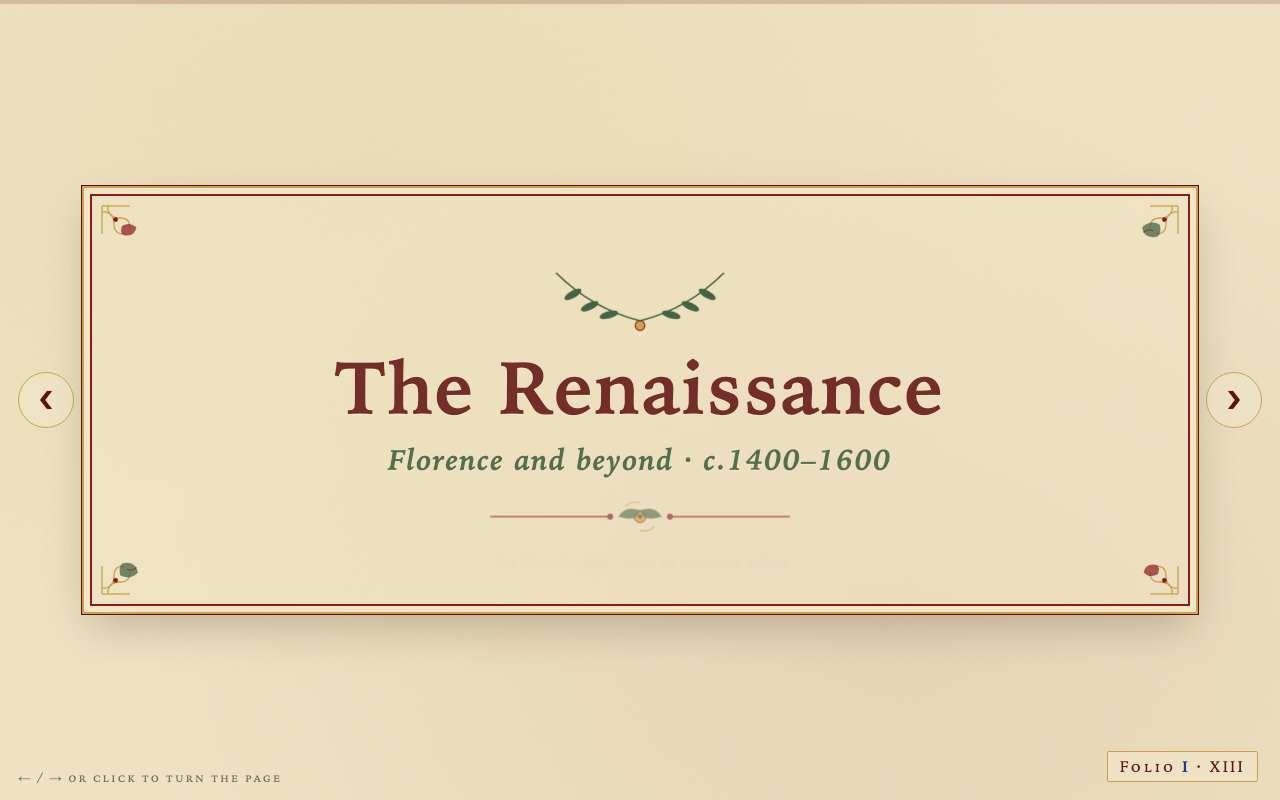
Liber Quintus · History · Deck V The Renaissance Florence · the Medici · Leonardo · the recovery of the human measure

StandaloneDownload
Sandboxed deck
Open raw

About this HTML presentation

This Shipslides page presents The Renaissance as an interactive HTML presentation deck in the History catalog with 18 slides. The share page keeps the uploaded deck sandboxed while exposing readable context, topics, and a slide outline for viewers and search engines.

Liber Quintus · History · Deck V The Renaissance Florence · the Medici · Leonardo · the recovery of the human measure Key sections include: The Renaissance; Contents; What Was Reborn; The City on the Arno; The Early Masters; The Pater Patriae; The Humanists; Il Magnifico; Da Vinci; Buonarroti.

Key sections

  • 01The Renaissance
  • 02Contents
  • 03What Was Reborn
  • 04The City on the Arno
  • 05The Early Masters
  • 06The Pater Patriae
  • 07The Humanists
  • 08Il Magnifico
  • 09Da Vinci
  • 10Buonarroti
  • 11The High Renaissance
  • 12Venice & Bellini
  • 13The Northern Renaissance
  • 14Machiavelli
  • 15A New Heaven
  • 16The Reformation
  • 17The Long Echo
  • 18Where to go from here

Topics covered

Slide outline
  1. 01The Renaissance
  2. 02Contents
  3. 03What Was Reborn
  4. 04The City on the Arno
  5. 05The Early Masters
  6. 06The Pater Patriae
  7. 07The Humanists
  8. 08Il Magnifico
  9. 09Da Vinci
  10. 10Buonarroti
  11. 11The High Renaissance
  12. 12Venice & Bellini
  13. 13The Northern Renaissance
  14. 14Machiavelli
  15. 15A New Heaven
  16. 16The Reformation
  17. 17The Long Echo
  18. 18Where to go from here
Page data
Canonical
https://shipslides.com/d/history-renaissance
Category
History
Size
265.1 KB
Updated
2026-05-17
LLM text
https://shipslides.com/d/history-renaissance/llms.txt

Presentation Transcript

Detailed slide-by-slide text content extracted from this presentation.

Slide 01

The Renaissance

  • Liber Quintus · History · Deck V
  • Florence · the Medici · Leonardo · the recovery of the human measure
  • In the matter of fourteen, fifteen, and sixteen hundreds. Compiled with care from the chronicles of Florence, Rome, Venice, Milan, and the courts of Urbino and Mantua.
  • — folio i —
Slide 02

Contents

  • Index of the work
  • Folio i — Frontispiece
  • Folio ii — This index
  • Folio iii — What was reborn
  • Folio iv — Florence in 1400
  • Folio v — The early masters
  • Folio vi — Cosimo and the Medici
  • Folio vii — The humanists
  • Folio viii — Lorenzo the Magnificent
  • Folio ix — Leonardo da Vinci
  • Folio x — Michelangelo & the Sistine
  • Folio xi — Raphael & the High Renaissance
  • Folio xii — Venice & Bellini
  • Folio xiii — Northern Renaissance
  • Folio xiv — Machiavelli & the political mind
  • Folio xv — Science & the new heaven
  • Folio xvi — The Reformation breaks the church
  • Folio xvii — Legacy
  • Folio xviii — Read & watch
  • — folio ii —
Slide 03

What Was Reborn

  • Trecento & Quattrocento
  • The word Rinascimento ("rebirth") was used by Giorgio Vasari in 1550 to describe what had happened in Italian arts since Giotto. It is a slippery word. Nothing was literally reborn — the texts of Cicero and Vitruvius had circulated in monastic libraries throughout the Middle Ages — but a new attitude toward antiquity, toward the human body, toward perspective and proportion, toward the living world as a worthy subject, took hold in Italy in the fourteenth century and travelled, with letters and traders, across Europe over the next two hundred years.
  • The shock of the Black Death (1347–51), which killed perhaps half the population of Italy, plays a part in any honest account. So does the rediscovery of Greek scholarship after the Council of Florence (1439) and the fall of Constantinople (1453), which brought Greek scholars and manuscripts west. So does the printing press of Johannes Gutenberg around 1450, which made the recovered classics affordable. The Renaissance was not a date but a long shift in what literate Europeans understood themselves to be doing when they thought.
  • "He awakens us, no longer the slave of the Schoolmen, to a fresh and personal seeing of the world." — Jacob Burckhardt, 1860
  • — folio iii —
Slide 04

The City on the Arno

  • Florence · circa 1400
  • Florence in 1400 was a republic of about 60,000 people, governed by a constantly rotating Signoria of guildsmen, dominated economically by the wool and silk trades and a precocious banking sector. Its currency, the gold florin, was the international reserve of the Mediterranean. Its rivals — Milan, Venice, Pisa, Naples, the Papal States — kept the peninsula in a permanent low-grade war that paradoxically protected the cultural autonomy of each city.
  • The cathedral of Santa Maria del Fiore had been begun in 1296 but stood roofless for a century: nobody knew how to span its 45-metre octagonal crossing. In 1418 the goldsmith Filippo Brunelleschi proposed a self-supporting double-shell dome with a herringbone brick pattern requiring no centring. The dome was completed in 1436. Its silhouette is what tourists still photograph; it was, in its day, the most audacious engineering on the continent.
  • — folio iv —
Slide 05

The Early Masters

  • Pioneers
  • Giotto (c. 1267–1337) — the Scrovegni frescoes at Padua (1305) gave figures weight, gravity, and a place in believable space. Giotto's revolution preceded everything else.
  • Brunelleschi (1377–1446) — dome, hospital of the Innocenti, the first systematic linear perspective.
  • Donatello (c. 1386–1466) — the bronze David (c. 1440), the first freestanding nude since antiquity, made for the Medici garden.
  • Masaccio (1401–28) — the Brancacci Chapel frescoes used Brunelleschi's perspective to make scripture inhabit a real room.
  • Alberti (1404–72) — wrote De Pictura (1435) and De Re Aedificatoria (1452), Renaissance manuals that codified perspective and architectural orders.
  • Fra Angelico (c. 1395–1455) — the cells of San Marco, painted for Cosimo's Dominicans.
  • Together this Florentine generation invented, by about 1450, what European art would do for the next four centuries.
  • — folio v —
Slide 06

The Pater Patriae

  • Cosimo de' Medici · 1389–1464
  • Cosimo "il Vecchio" inherited the Medici Bank from his father in 1429 and made it the largest financial institution in Europe, with branches from Bruges to Constantinople, including the Vatican account that handled the Papal Tithe. Cosimo never held formal office in the Florentine government — that would have been bad republican manners. He simply made sure that the men in office owed him something.
  • His private spending on Florence was unprecedented: the rebuilding of San Lorenzo, the cells of San Marco, his villa at Careggi, the Palazzo Medici by Michelozzo, and — most importantly — a personal library that grew into the Biblioteca Medicea Laurenziana. Cosimo employed Niccolò Niccoli to scour Europe for Latin and Greek manuscripts and Marsilio Ficino to translate Plato. The first complete Latin Plato in a millennium was a Medici project.
  • His grandson Lorenzo "il Magnifico" (1449–92) inherited and expanded the role: poet, patron, statesman, brother of the assassinated Giuliano. The Medici would furnish Florence with two more dukes, two queens of France, and four popes, ending only with Anna Maria Luisa, who in 1737 willed the family's collections to the Tuscan state on condition they never leave Florence. They have not.
  • — folio vi —
Slide 07

The Humanists

  • Studia Humanitatis
  • Humanism was, in its original sense, a curriculum: grammar, rhetoric, history, poetry, and moral philosophy, all studied in classical Latin and (after 1397) Greek, on the model of Cicero and Quintilian. Petrarch (1304–74) is the conventional founder; he hunted down forgotten Cicero letters in cathedral archives. Coluccio Salutati, chancellor of Florence, made humanism the city's quasi-official ideology.
  • The next generation included Leonardo Bruni (translator of Aristotle), Poggio Bracciolini (who unearthed Lucretius's De Rerum Natura at a German monastery in 1417), Lorenzo Valla (who in 1440 proved philologically that the Donation of Constantine was a medieval forgery), and Pico della Mirandola, whose Oration on the Dignity of Man (1486) is sometimes called the "manifesto of the Renaissance." Its argument: that man is the only creature without a fixed nature and may rise toward the angels or sink toward the beasts as he chooses.
  • "O highest and most marvellous felicity of man! To him it is granted to have whatever he chooses, to be whatever he wills."— Pico della Mirandola, Oratio de Hominis Dignitate, 1486
  • — folio vii —
Slide 08

Il Magnifico

  • Lorenzo · 1469–1492
  • Lorenzo de' Medici took control of Florence at twenty after his father Piero's death. He ruled — informally, as had Cosimo — for twenty-three years. He survived the Pazzi Conspiracy of 26 April 1478, in which his brother Giuliano was murdered at the cathedral altar during High Mass; the response, in which the conspirators were hanged from the windows of the Palazzo della Signoria, was painted with terrible accuracy by the boy Leonardo, who was twenty-six.
  • Lorenzo's circle gathered at his villa in Careggi: Ficino translating Plato, Pico arguing for the unity of religious truth, Poliziano composing Latin verse and the Italian Stanze. Botticelli painted the Primavera and Birth of Venus for a Medici cousin, probably to a programme suggested by Poliziano. The young Michelangelo Buonarroti, twelve years old, was taken into the Medici palace as an apprentice and ate at Lorenzo's table.
  • Lorenzo died on 8 April 1492. Within two years the French invaded Italy, the Medici were expelled, and Girolamo Savonarola, the Dominican preacher of repentance, was burning vanities in the Piazza della Signoria. He himself was burned there in May 1498. The high Renaissance was about to migrate to Rome.
  • — folio viii —
Slide 09

Da Vinci

  • Leonardo · 1452–1519
  • Leonardo, born out of wedlock at Vinci near Florence, was apprenticed at fourteen to Andrea del Verrocchio. Vasari claims that on seeing the young Leonardo's contribution to a Verrocchio painting, the master vowed never to paint again. Leonardo went to Milan in 1482 to serve Ludovico Sforza, where he produced The Last Supper (1495–98) on a refectory wall using a poorly chosen oil-tempera technique that began to deteriorate within his lifetime.
  • His notebooks — about 7,000 surviving pages, written right-to-left in mirror script — describe heart valves, fetal development, the geology of stratified rock, the diffusion of light, helicopters, parachutes, and a tank. He completed perhaps fifteen paintings, of which the Mona Lisa (begun c. 1503) and Virgin of the Rocks are the most famous. He painted with maddening slowness, abandoning commissions, dissecting cadavers, building war machines for whoever was paying, and dying in 1519 at the French court of Francis I, who claimed to have held his head as he died.
  • — folio ix —
Slide 10

Buonarroti

  • Michelangelo · 1475–1564
  • Michelangelo was the longest-lived and the most contradictory of the great Renaissance artists. The Pietà (1499) in St Peter's was carved when he was twenty-four; the David (1501–04) is a single block of Carrara marble that Florence had been arguing about for forty years. Pope Julius II summoned him to Rome to design his tomb; instead, he was made to paint the Sistine Chapel ceiling (1508–12), 500 square metres of fresco he had never wanted to undertake, completed lying on his back on a scaffold he had designed himself.
  • The Last Judgment (1536–41) on the Sistine altar wall was painted in the Counter-Reformation atmosphere of the 1530s; its nudity caused scandal even before he had finished. He took over the rebuilding of St Peter's in 1546, designed Rome's Capitoline Square, wrote about three hundred sonnets — some to a young Roman nobleman, some to the poet Vittoria Colonna — and died in 1564 at eighty-eight, having outlived his pupils and most of his patrons.
  • — folio x —
Slide 11

The High Renaissance

  • Raphael · 1483–1520
  • Raphael Sanzio of Urbino arrived in Rome in 1508 at twenty-five and was given, by Julius II, the rooms of the Vatican apartments. The School of Athens (1509–11) on the wall of the Stanza della Segnatura is a Renaissance manifesto in fresco: Plato and Aristotle at the centre, Pythagoras and Euclid at the margins, Heraclitus modelled on Michelangelo, and Raphael himself looking out from the back. He painted Madonnas, society portraits, and tapestry cartoons; he ran the largest workshop in Rome; he was made architect of St Peter's after Bramante's death; and he died on his thirty-seventh birthday, possibly of fever, possibly, says Vasari, of overexertion in love.
  • Raphael's death in 1520, the Sack of Rome by mutinous Imperial troops in 1527, and Michelangelo's relocation to a more austere later style mark the close of the High Renaissance. What followed — Pontormo, Bronzino, Parmigianino — historians call Mannerism, and it was Italy's response to the discovery that perfection had a ceiling.
  • — folio xi —
Slide 12

Venice & Bellini

  • La Serenissima
  • Venice's Renaissance arrived a generation after Florence's and looked different — more colour, less line; more atmosphere, less geometry. Giovanni Bellini's altarpieces taught the city how light fell on cloth. His pupils Giorgione and Titian — particularly Titian (c. 1488–1576), who lived to nearly ninety — invented the modern oil painting: layered glazes, broken brushwork, a saturation of pigment that nobody before could afford. Tintoretto and Veronese later filled the city's churches with vast theatrical machines.
  • Venice's other contribution was the printed book. Aldus Manutius's Aldine Press (founded 1494) issued Greek classics in pocket octavo editions, invented italic type, and used the dolphin-and-anchor mark. The Aldine Press is the deep ancestor of every paperback you have ever owned.
  • — folio xii —
Slide 13

The Northern Renaissance

  • North of the Alps
  • The Renaissance crossed the Alps in two directions and arrived in northern Europe with its own genius. Jan van Eyck of Bruges (d. 1441) had already perfected oil painting before any Italian; the Arnolfini Portrait (1434) is denser with detail than any contemporary Italian work. Hieronymus Bosch in 's-Hertogenbosch painted his hallucinated triptychs at the turn of the sixteenth century. Albrecht Dürer of Nuremberg (1471–1528), who travelled twice to Italy, brought back perspective and proportion and forwarded an extraordinary series of woodcuts and engravings (the Melencolia I, the Knight, Death and the Devil) that defined what the printed image could be.
  • Erasmus of Rotterdam (1466–1536), the most famous humanist of the early sixteenth century, edited the Greek New Testament (1516) and wrote In Praise of Folly (1511) — a satire of clerical corruption that arguably prepared the soil for the Reformation he then refused to join. His friend Thomas More wrote Utopia (1516); Hans Holbein painted them both.
  • — folio xiii —
Slide 14

Machiavelli

  • Politics · 1513
  • "It is better to be feared than loved, if one cannot be both."— Niccolò Machiavelli, Il Principe, ch. xvii, 1513
  • Niccolò Machiavelli, a senior Florentine civil servant under the post-Medici republic, was tortured and exiled when the Medici returned in 1512. From a small farm at San Casciano he wrote, in the evenings, the slim treatise Il Principe (1513), addressed to Lorenzo's grandson Giuliano. The book was an attempt to win readmission to politics; it failed. It also founded modern political science, by treating the state as a problem of effectiveness rather than virtue. The longer Discourses on Livy (1517) is a republican companion to the more famous, more cynical Prince.
  • — folio xiv —
Slide 15

A New Heaven

  • Astronomy · Medicine · Cartography
  • The Renaissance's contribution to natural knowledge has been undervalued. Nicolaus Copernicus, a Polish canon trained partly at Padua, published De Revolutionibus Orbium Coelestium in 1543, on his deathbed: the sun, not the earth, sat at the centre. Andreas Vesalius's De Humani Corporis Fabrica, also 1543, replaced Galen's animal-based anatomy with detailed human dissections, beautifully illustrated by Titian's workshop. Gerardus Mercator's projection (1569) made navigation arithmetic. The compass, the printing press, gunpowder — what Francis Bacon would later call the three transforming inventions — were Renaissance commonplaces.
  • Galileo Galilei trained his improved telescope on the moon in 1609, and the four moons of Jupiter the following year, breaking the medieval certainty that the heavens were perfect and immutable. The Renaissance physical world ends, in some sense, with the Roman Inquisition's condemnation of Galileo in 1633, but the genie was out.
  • — folio xv —
Slide 16

The Reformation

  • 1517 · Wittenberg
  • On 31 October 1517, the Augustinian friar Martin Luther sent his Ninety-Five Theses against the sale of indulgences to the Archbishop of Mainz; whether or not he also nailed them to the door of the Wittenberg Castle Church, copies were soon being printed across Germany. Within a decade Lutheranism had taken root in much of Saxony, Brandenburg, Württemberg, and the Scandinavian kingdoms. Calvin's reform reached Geneva (1536), then Scotland and the Netherlands. Henry VIII broke with Rome in 1534 over an annulment.
  • The Catholic Counter-Reformation, formalised at the Council of Trent (1545–63), responded with the Jesuits, the Index of Prohibited Books, and a more disciplined Roman art (Bernini, the Baroque). Religious wars — the Schmalkaldic, the French Wars of Religion, the Dutch Revolt, the catastrophic Thirty Years' War (1618–48) — dominated the next century and a half. The unified Latin Christendom that the Renaissance had taken for granted was over.
  • — folio xvi —
Slide 17

The Long Echo

  • Legacy
  • To list the Renaissance's bequests is almost to list modernity. Linear perspective — the rendering of three dimensions on a flat surface as our eyes report them — became the default of Western image-making until the twentieth century. The vernacular literatures (Dante, Petrarch, Cervantes, Shakespeare) gave the European nations the languages they would think in. The printed book detached learning from monasteries. The signed self-portrait, beginning with Dürer's 1500 image as Christ, founded the modern idea of the artist as autonomous self.
  • The Renaissance also bequeathed — and we should not pretend otherwise — the slave trade, the colonial extractive empires of Spain and Portugal, and a tradition of European cultural superiority that has done immense damage. The same impulse that admired Cicero made conquistadors believe Aztec civilisation was a kind of barbarism. To celebrate the Renaissance honestly is to hold both its achievements and its ruptures in the same hand.
  • — folio xvii —
Slide 18

Where to go from here

  • Read & watch
  • Jacob Burckhardt, The Civilization of the Renaissance in Italy (1860, still indispensable) · Lisa Jardine, Worldly Goods · Stephen Greenblatt, The Swerve · Mary Hollingsworth, The Medici · Vasari, Lives of the Artists.
  • ↑ A useful overview. Watch · Renaissance BBC documentary.
  • — folio xviii —
Remove this deck