Detailed slide-by-slide text content extracted from this presentation.
Slide 01
New Religious Movements
- ❅ ❅ ❅
- Faith Beyond Tradition: The Rise of Alternative Spiritual Paths
- From 19th-century utopias to 21st-century digital congregations
- 1 / 22
Slide 02
What Are New Religious Movements?
- A New Religious Movement (NRM) is any faith community or spiritual practice that has emerged since the mid-19th century and exists outside the mainstream religious traditions of a given society. The term was adopted by scholars in the 1970s as a neutral alternative to the pejorative label "cult."
- Key Characteristics
- Founded by a charismatic leader or prophet
- Claims novel revelation or reinterpretation
- High-demand membership commitments
- Often countercultural in orientation
- What They Are Not
- Not necessarily dangerous or coercive
- Not confined to any single culture or era
- Not always small -- some number millions
- Not monolithic in structure or belief
- "One generation's heresy is another generation's orthodoxy." -- Rodney Stark, sociologist of religion
- 2 / 22
Slide 03
NRMs by the Numbers
- Scholars estimate that between 10,000 and 20,000 new religious movements have emerged worldwide since 1800. While most remain tiny, some have grown into major global faiths.
- ~16M
- Latter-day Saints worldwide
- 8.7M
- Jehovah's Witnesses
- ~12M
- Soka Gakkai members
- ~5M
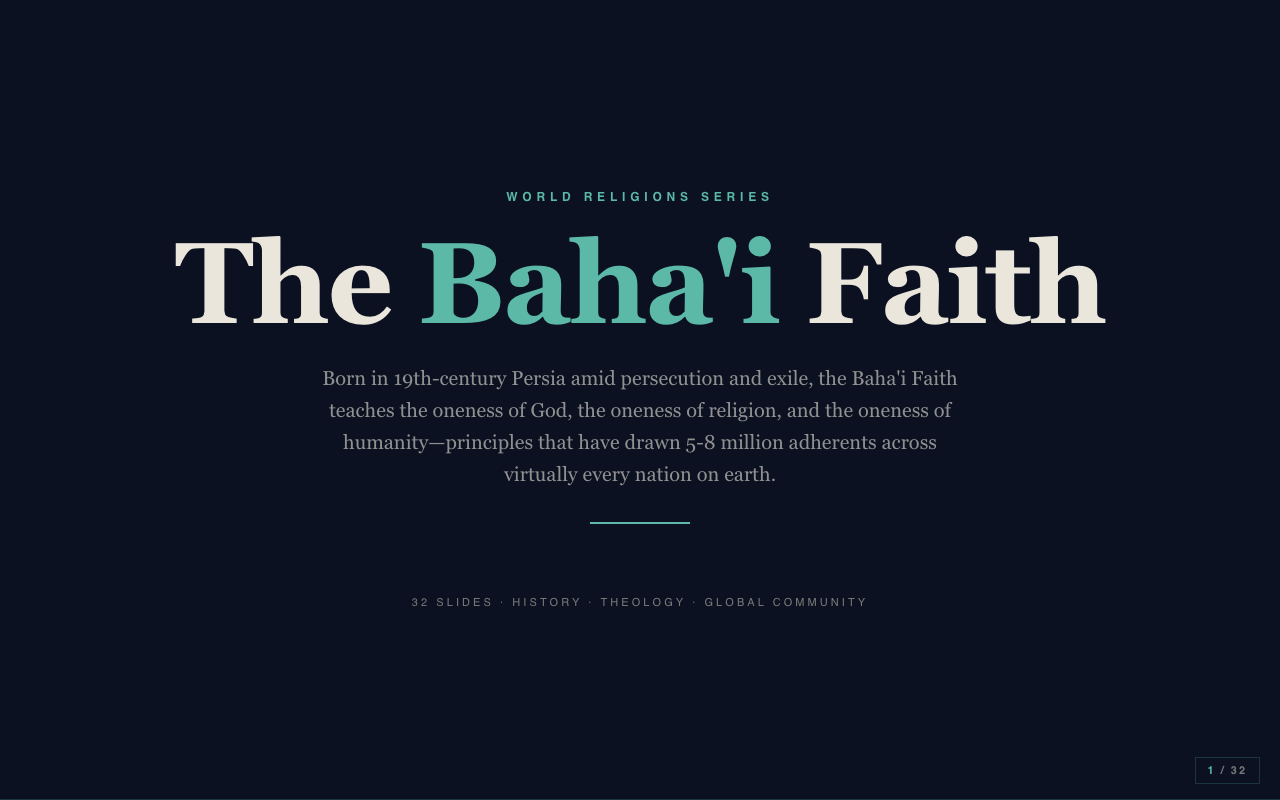
- Baha'i adherents
- Many others -- Wicca, Scientology, Falun Gong, Raelism -- have memberships that are difficult to verify, ranging from thousands to millions depending on the source.
- 3 / 22
Slide 04
Historical Roots: 19th-Century Ferment
- The 1800s saw an explosion of new faiths, especially in the United States, driven by the Second Great Awakening, Enlightenment rationalism, and contact with Asian religions.
- 1830
- Joseph Smith publishes the Book of Mormon, founding the Church of Jesus Christ of Latter-day Saints in Fayette, New York.
- 1844
- The Bab declares his mission in Shiraz, Persia, launching the Babi movement that would become the Baha'i Faith.
- 1870s
- Mary Baker Eddy establishes Christian Science; Helena Blavatsky co-founds the Theosophical Society (1875).
- 1879
- Charles Taze Russell begins publishing Zion's Watch Tower, precursor to the Jehovah's Witnesses.
- 4 / 22
Slide 05
The Latter-day Saints
- The Church of Jesus Christ of Latter-day Saints (LDS) is the most successful NRM to originate in America. Founded by Joseph Smith in 1830, it now has over 16 million members across 170+ countries and territories.
- Core Beliefs
- The Book of Mormon as additional scripture alongside the Bible
- Continuing revelation through a living prophet
- Baptism for the dead and temple ordinances
- The potential for human beings to achieve exaltation
- Growth and Controversy
- The LDS Church survived persecution, the murder of its founder (1844), the trek to Utah under Brigham Young, and the politically explosive abandonment of polygamy (1890). Today it operates the largest genealogical database in the world, runs Brigham Young University, and wields significant economic power with estimated assets exceeding $100 billion.
- 5 / 22
Slide 06
Jehovah's Witnesses
- Emerging from Charles Taze Russell's Bible Student movement in the 1870s, the Jehovah's Witnesses became a distinct organization under Joseph Rutherford in the 1930s. Today they number 8.7 million active publishers in 240 countries.
- Distinctive Practices
- Door-to-door proselytizing as a core duty
- Refusal of blood transfusions (based on Acts 15:29)
- Political neutrality -- no voting, no military service
- No celebration of birthdays or Christmas
- Organizational Structure
- Governed by a Governing Body in Warwick, NY
- Over 120,000 congregations worldwide
- Literature published in 1,000+ languages
- jw.org is one of the most translated websites globally
- The Witnesses have faced repeated persecution: banned in Nazi Germany, the Soviet Union, and several modern states including Russia (since 2017).
- 6 / 22
Slide 07
Japan's New Religions
- Japan has been one of the world's most prolific producers of NRMs. Scholars identify several "waves": early 19th century, post-Meiji Restoration (1868), and post-World War II.
- Soka Gakkai (1930)
- A lay Buddhist organization rooted in Nichiren Buddhism. Claims ~12 million members worldwide. Closely linked to the Komeito political party. Emphasizes chanting "Nam-myoho-renge-kyo" for personal transformation.
- Tenrikyo (1838)
- One of the oldest Japanese NRMs, founded by Nakayama Miki. Centers on the concept of "Joyous Life" and regards Tenri City as the birthplace of humanity. About 2 million followers.
- Oomoto (1892)
- A Shinto-derived movement founded by Deguchi Nao. Influenced many later NRMs. Promotes art, Esperanto, and interfaith dialogue. Heavily persecuted by the Japanese state before 1945.
- PL Kyodan (1946)
- "Perfect Liberty" teaches that life is art. Known for its massive golf courses and fireworks festivals. Emphasizes the 21 Precepts as a guide for artistic, joyful living.
- 7 / 22
Slide 08
African Independent Churches
- Africa has generated thousands of new Christian movements since the late 19th century. These "African Initiated Churches" (AICs) blend Christian doctrine with indigenous cosmologies, healing practices, and prophetic traditions.
- Major Examples
- Kimbanguism (1921)
- Founded by Simon Kimbangu in the Belgian Congo. Now the Church of Jesus Christ on Earth (EJCSK) with an estimated 5-17 million members across Central Africa. Member of the World Council of Churches since 1969.
- Zion Christian Church (1910s)
- South Africa's largest AIC with 6+ million members. Annual Easter pilgrimage to Zion City Moria draws over 1 million people, making it one of the largest religious gatherings in Africa.
- Celestial Church of Christ (1947)
- Founded by Samuel Oschoffa in Dahomey (now Benin). Known for white garments, barefoot worship, and visionary prophecy. Has spread widely across West Africa and into Europe.
- 8 / 22
Slide 09
Scientology
- Founded by science fiction author L. Ron Hubbard in 1954, the Church of Scientology is one of the most controversial NRMs in the world. It claims millions of members, though independent estimates suggest 20,000-50,000 active practitioners.
- Core Concepts
- Thetans: Immortal spiritual beings inhabiting human bodies
- Auditing: Counseling sessions using the E-meter to identify and clear "engrams" (traumatic memories)
- The Bridge to Total Freedom: A structured spiritual progression with defined levels (including the controversial OT levels)
- Xenu narrative: An esoteric origin story revealed at advanced levels, involving a galactic overlord 75 million years ago
- Controversies
- Scientology has faced allegations of financial exploitation, forced labor (the Sea Org), disconnection policies separating families, and aggressive litigation against critics. It gained U.S. tax-exempt status in 1993 after a prolonged battle with the IRS, but several European countries classify it as a commercial enterprise rather than a religion.
- 9 / 22
Slide 10
The Unification Church
- Founded by Sun Myung Moon in South Korea in 1954, the Holy Spirit Association for the Unification of World Christianity -- known as the "Moonies" -- became a lightning rod for the anti-cult movement in the 1970s-80s.
- Beliefs
- Moon as the "True Parent" and messiah fulfilling Jesus's unfinished mission
- "Divine Principle" as the core theological text
- Mass weddings (Blessing Ceremonies) as the central sacrament
- Goal of building a "Kingdom of Heaven on Earth"
- Empire and Legacy
- Owns The Washington Times, Kahr Arms, New Yorker Hotel
- True World Foods -- major sushi supplier in the U.S.
- After Moon's death (2012), split into rival factions led by family members
- Estimated 1-3 million members worldwide
- In 2022, the assassination of former Japanese PM Shinzo Abe by a man whose family was financially ruined by the church reignited global scrutiny.
- 10 / 22
Slide 11
Neo-Paganism and Wicca
- Neo-Paganism refers to a family of modern religious movements that seek to revive or reconstruct pre-Christian, nature-based spiritual traditions. The largest and best known is Wicca.
- Wicca
- Founded by Gerald Gardner in 1950s England, Wicca draws on ceremonial magic, folk traditions, and romantic medievalism. It emphasizes the worship of a Goddess and God, the observance of eight seasonal sabbats (the Wheel of the Year), and the Wiccan Rede: "An it harm none, do what ye will."
- Other Neo-Pagan Paths
- Druidry: Revives Celtic spiritual practices; the Order of Bards, Ovates and Druids (est. 1964) is the largest organization
- Heathenry / Asatru: Reconstructs Norse and Germanic polytheism; Icelandic Asatruarfelagid recognized in 1973
- Hellenism: Revival of ancient Greek religion; legally recognized in Greece since 2017
- Kemetic Orthodoxy: Reconstruction of ancient Egyptian religion
- Estimates for Neo-Pagans globally range from 1-4 million, with the fastest growth in the U.S., UK, and Australia.
- 11 / 22
Slide 12
The New Age Movement
- Less a single organization than a loose network of beliefs and practices, the New Age movement emerged in the 1960s-70s from the counterculture, drawing on Theosophy, Eastern mysticism, Western esotericism, and humanistic psychology.
- Core Themes
- Holistic worldview -- mind, body, spirit interconnection
- Personal spiritual transformation over institutional religion
- Eclecticism: mixing traditions freely
- Belief in an approaching "Age of Aquarius"
- Channeling, crystals, astrology, energy healing
- Key Figures
- Shirley MacLaine: Out on a Limb (1983) popularized reincarnation
- Deepak Chopra: Blended Ayurveda with quantum mysticism
- Eckhart Tolle: The Power of Now (1997)
- Marianne Williamson: A Course in Miracles teacher
- The New Age market -- books, retreats, supplements, apps -- was valued at over $10 billion annually by the 2020s. Critics call it a commodification of spirituality; defenders see it as democratizing access to wisdom traditions.
- 12 / 22
Slide 13
The Role of Charismatic Leadership
- Sociologist Max Weber identified "charismatic authority" as a force that can disrupt established institutions. Nearly every NRM begins with a founder who claims unique spiritual access -- revelation, enlightenment, or divine appointment.
- "The charismatic leader gains and maintains authority solely by proving his strength in life. If he wants to be a prophet, he must perform miracles." -- Max Weber, Economy and Society (1922)
- The Succession Crisis
- Weber predicted that charisma cannot be inherited -- it must be "routinized" into institutional structures. This explains why NRMs face existential crises when founders die:
- LDS Church: Succession crisis after Joseph Smith (1844) produced multiple splinter groups (RLDS, Strangites, etc.)
- ISKCON: After Prabhupada's death (1977), a guru system led to scandals and fragmentation
- Unification Church: Moon's children split into competing factions after 2012
- Rajneeshees: Dissolved after Rajneesh/Osho's deportation (1985) and death (1990), though Osho's teachings persist
- 13 / 22
Slide 14
The Anti-Cult Movement
- As NRMs proliferated in the 1960s-70s, a counter-movement emerged, driven by concerned families and mental health professionals who alleged that "cults" used brainwashing techniques to recruit and retain members.
- Key Developments
- 1971
- FREECOG (Free the Children of God) becomes one of the first organized anti-cult groups, targeting the Children of God movement.
- 1978
- The Jonestown massacre -- 918 deaths by cyanide poisoning in Guyana under Jim Jones's People's Temple -- transforms public perception of NRMs overnight.
- 1980s
- "Deprogramming" -- forcibly removing members from NRMs -- becomes a controversial practice. Ted Patrick pioneers the method. Courts eventually restrict it.
- 1995
- Aum Shinrikyo's sarin gas attack on the Tokyo subway (13 dead, thousands injured) validates worst fears about NRM violence.
- Today, scholars debate whether the "brainwashing" model is scientifically valid. Most sociologists of religion reject it, while clinical psychologists remain divided.
- 14 / 22
Slide 15
When Movements Turn Deadly
- A small fraction of NRMs have been involved in violence, mass suicide, or terrorism. These cases, though statistically rare, have profoundly shaped public perception of all NRMs.
- Jonestown (1978)
- Jim Jones's People's Temple: 918 dead in mass murder-suicide in Guyana. Originally a progressive, racially integrated church in San Francisco.
- Branch Davidians (1993)
- David Koresh's compound near Waco, Texas. 51-day FBI siege ended in fire; 76 dead including 25 children. Became a symbol of government overreach.
- Heaven's Gate (1997)
- 39 members died by mass suicide in Rancho Santa Fe, California, believing they would board a spacecraft trailing Comet Hale-Bopp. Led by Marshall Applewhite.
- Aum Shinrikyo (1995)
- Shoko Asahara's Japanese doomsday group released sarin gas on Tokyo's subway. 13 killed, 6,000+ injured. The group had attempted multiple bioweapon attacks.
- Scholars note common risk factors: apocalyptic urgency, isolation from society, absolute authority of a single leader, and perceived external threat.
- 15 / 22
Slide 16
South Asian-Origin Movements in the West
- The 1960s counterculture opened the door for Hindu, Buddhist, and Sikh-derived movements to gain Western followings.
- ISKCON / Hare Krishna (1966)
- Founded by A.C. Bhaktivedanta Swami Prabhupada in New York. Rooted in Gaudiya Vaishnavism. Known for public chanting (kirtan), vegetarianism, and the Bhagavad Gita As It Is. ~500,000 core members, millions of congregational participants.
- Transcendental Meditation (1958)
- Maharishi Mahesh Yogi introduced TM to the West; the Beatles' 1968 visit to Rishikesh was a watershed moment. TM emphasizes a simple mantra-based technique; claims 5+ million practitioners. Now positions itself as secular "stress reduction."
- Osho / Rajneesh Movement
- Bhagwan Shree Rajneesh attracted thousands to his Oregon commune (Rajneeshpuram, 1981-85). Infamous for bioterror attack in The Dalles. After his death (1990), his teachings found new life as a meditation/self-help brand.
- 3HO / Sikh Dharma (1969)
- Harbhajan Singh Khalsa (Yogi Bhajan) introduced Kundalini Yoga and Sikh practices to American counterculture youth. Founded the Yogi Tea brand. Faced posthumous allegations of sexual abuse.
- 16 / 22
Slide 17
UFO Religions
- The flying saucer era (post-1947) spawned a distinct category of NRMs that replace angels, gods, or spirits with extraterrestrial beings as the source of divine guidance.
- Major UFO-Based Movements
- Raelism (1974): Founded by Claude Vorilhon (Rael) in France. Claims humanity was created by alien scientists called the Elohim. Advocates sexual liberation and human cloning. ~100,000 claimed members in 100+ countries.
- Aetherius Society (1955): Founded by George King in London. Combines yoga, Christianity, and UFO contactee claims. Members "charge" spiritual batteries on mountains to aid planetary healing.
- Unarius Academy of Science (1954): Founded by Ernest and Ruth Norman in California. Ruth Norman ("Uriel") predicted a mass alien landing that never arrived.
- Heaven's Gate (1974-1997): Combined Christian eschatology with belief in extraterrestrial salvation. Ended in the 1997 mass suicide.
- "The contactee narrative is essentially a modernized shamanic journey -- the medium travels not to the spirit world but to a spaceship." -- Christopher Partridge, UFO Religions (2003)
- 17 / 22
Slide 18
NRMs in the Digital Age
- The internet has transformed how NRMs recruit, communicate, and evolve. It has also empowered ex-members and critics in unprecedented ways.
- Online-Native Movements
- QAnon (2017): Blurs politics and apocalyptic belief; scholars debate whether it qualifies as an NRM
- Kopimism (2010): Swedish "religion" that sacralizes file-sharing and information freedom
- Digital Discordianism: Chaotic internet spirituality rooted in the 1963 Principia Discordia
- Digital Tools for Existing NRMs
- Scientology's aggressive SEO and online advertising
- Jehovah's Witnesses' JW Broadcasting (launched 2014)
- Hillsong and megachurches live-streaming globally
- TikTok witchcraft ("WitchTok") reaching millions
- The internet is a double-edged sword: it facilitates recruitment but also provides platforms for ex-member testimonies, leaked documents, and investigative journalism that would have been impossible in earlier decades.
- 18 / 22
Slide 19
Legal Status and State Responses
- Governments vary enormously in how they classify and regulate NRMs. The tension between religious freedom and public safety remains unresolved.
- Permissive Approaches
- United States: First Amendment protections; IRS grants tax-exempt status
- United Kingdom: Charity Commission reviews on case-by-case basis
- Brazil: Constitutional freedom of belief; large NRM diversity
- Restrictive Approaches
- France: MIVILUDES agency monitors "cultic deviances" since 2002
- China: Banned Falun Gong (1999); strict state control of all religions
- Russia: 2017 ban on Jehovah's Witnesses; Yarovaya Law restricts proselytizing
- The European Court of Human Rights has issued landmark rulings protecting NRM members' rights, including Jehovah's Witnesses of Moscow v. Russia (2010) and Church of Scientology of Moscow v. Russia (2007).
- 19 / 22
Slide 20
Why Do People Join?
- Popular culture imagines NRM members as gullible or psychologically damaged, but decades of research show a more complex picture.
- Sociological Findings
- Social networks matter most: Lofland and Stark (1965) found that personal relationships, not doctrine, drive initial conversion
- Seekership: Many joiners are actively searching for meaning after a period of personal crisis or transition
- Rational choice: Rodney Stark argues that people weigh spiritual costs and benefits like any other decision
- Demographics: NRM joiners tend to be young (18-30), educated, middle-class, and from less religious families
- Most leave voluntarily: Studies show the majority of NRM members depart within 2-5 years without intervention
- "The typical cult member is not a zombie but a seeker -- someone who has tried other answers and found them wanting." -- Eileen Barker, The Making of a Moonie (1984)
- 20 / 22
Slide 21
From Sect to Mainstream
- Every major world religion was once a new religious movement. Christianity began as a Jewish sect; Islam was a radical reform movement in 7th-century Arabia; Buddhism challenged Brahmanical orthodoxy.
- The "Sect-to-Church" Trajectory
- Sociologists H. Richard Niebuhr and later Rodney Stark described how movements evolve:
- Cult/Sect phase: High tension with surrounding society, charismatic leadership, strict demands
- Denomination phase: Second-generation members moderate demands; bureaucracy replaces charisma
- Church phase: Full integration with mainstream society; low tension, low demand
- Movements in Transition Today
- The LDS Church is arguably transitioning from denomination to mainstream church
- The Baha'i Faith has gained recognition at the United Nations and in interfaith dialogue
- Soka Gakkai International operates as a respected Buddhist NGO at the UN
- Wicca and Neo-Paganism gained U.S. military chaplaincy recognition in the 2000s
- 21 / 22
Slide 22
The Perpetual Search
- ❅ ❅ ❅
- New religious movements are not an aberration but a permanent feature of human civilization. Every era of social upheaval -- industrialization, colonialism, world wars, digital revolution -- produces new prophets and new communities of meaning.
- The challenge for democratic societies is to protect both religious freedom and vulnerable individuals -- to recognize that today's despised sect may be tomorrow's established church, while acknowledging that unchecked charismatic authority can cause genuine harm.
- "The human need for meaning is as fundamental as the need for food and shelter. New religious movements remind us that this need will always find new forms of expression."
- -- Lorne Dawson, Comprehending Cults (2006)
- 22 / 22