Religion Slides
A curated collection of interactive HTML presentation decks, slide outlines, and topics covering Religion.
Popular presentations about Religion
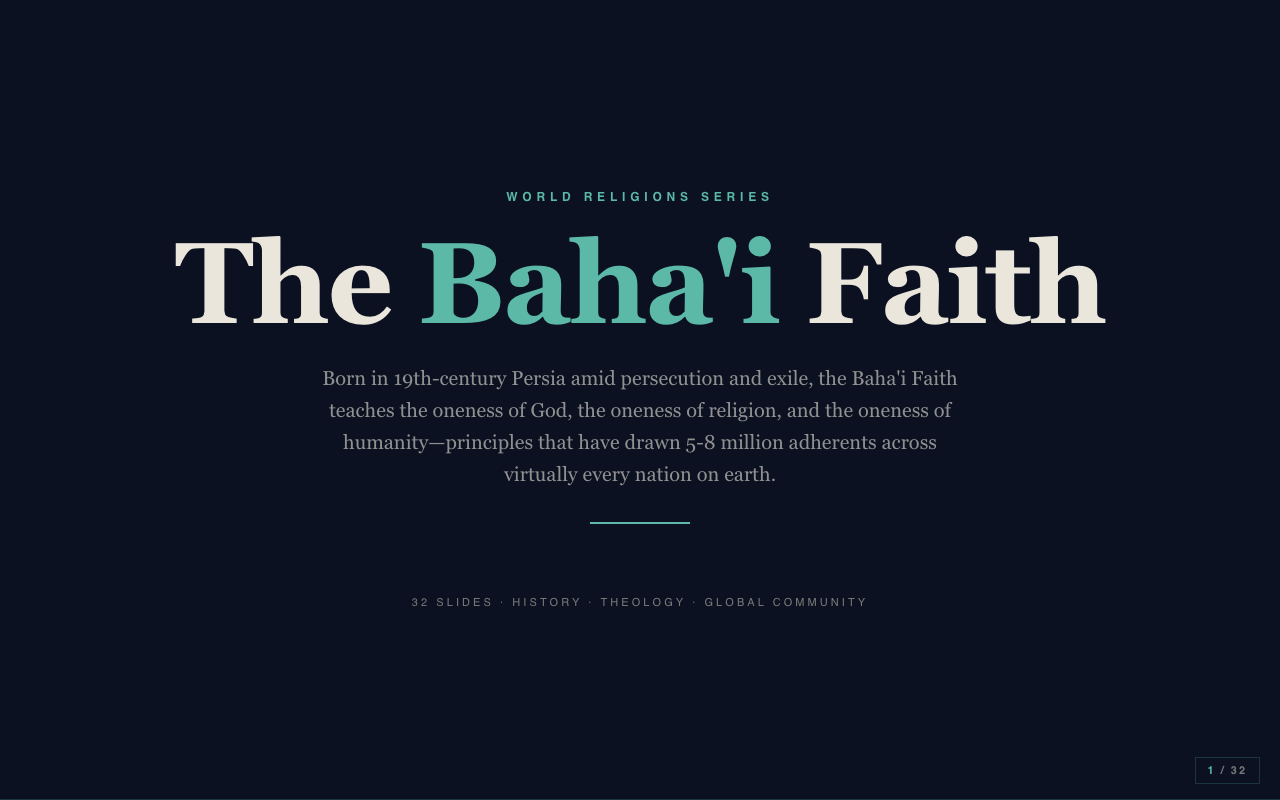
The Baha'i Faith — Unity, Revelation, and a World Civilization
On May 23, 1844, a young merchant in Shiraz, Persia declared himself the Bab ("the Gate")—a divine messenger heralding the imminent arrival of a greater prophet.
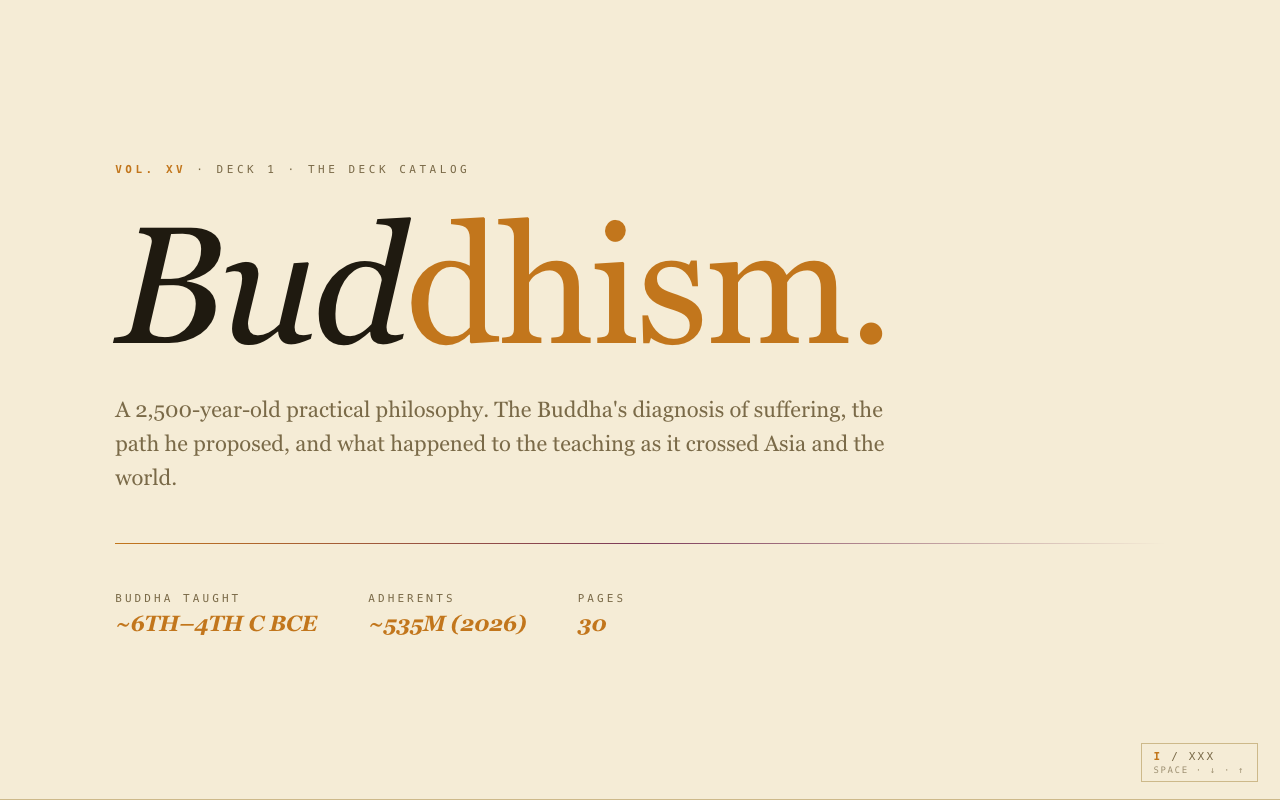
Buddhism
Buddhism is what the Buddha taught and what his followers — across 2,500 years and a continent — made of the teaching. It is one of the largest world religions; it is also a distinctive philosophical and contemplative tradition that arguably stands on its own without religious claims.
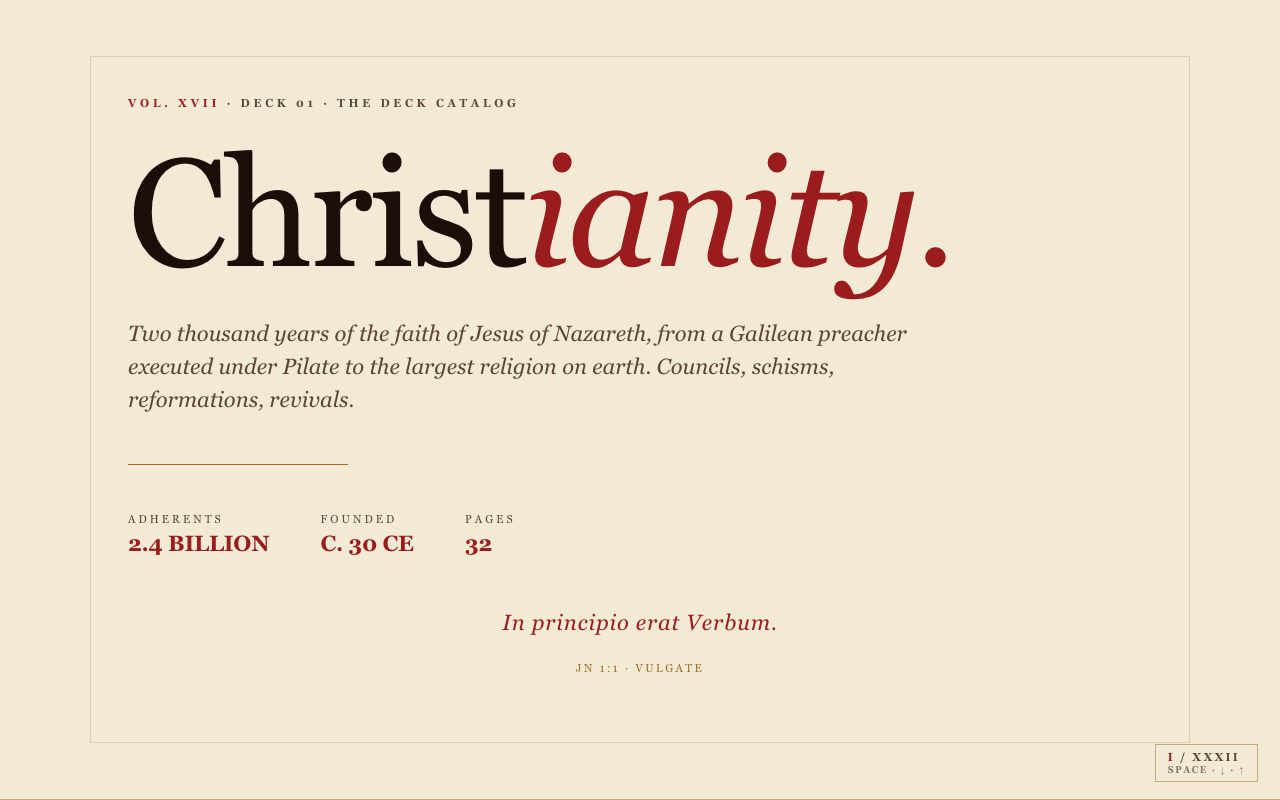
Christianity
Christianity is the faith that the Galilean Jew Jesus of Nazareth, executed by the Romans around 30 CE, was raised from the dead and is the Messiah promised in the Hebrew scriptures — the Son of God through whom the world is reconciled to its maker.
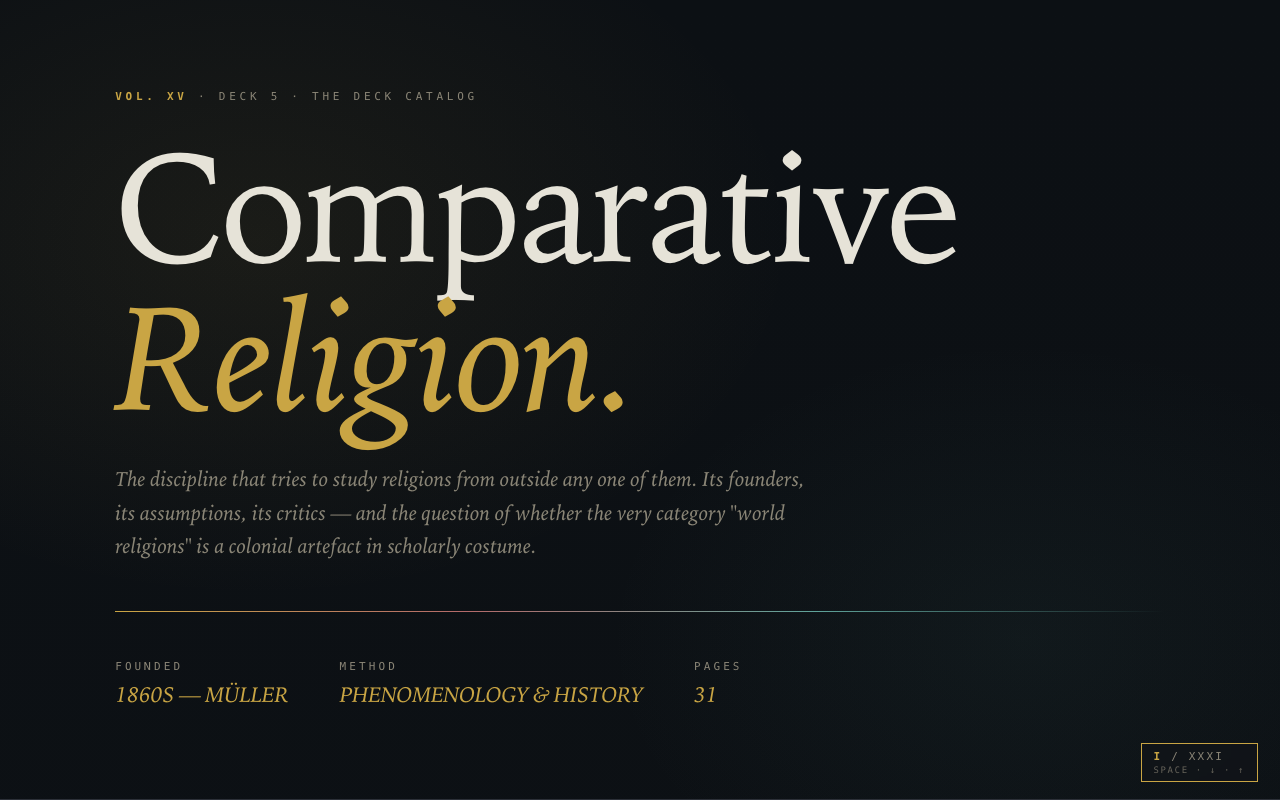
Comparative Religion
"He who knows one, knows none." Friedrich Max Müller's phrase, lifted from Goethe and applied to religions, became the founding aphorism of comparative religion in the 1870s. To understand any single tradition you have to compare it with others, because what looks like the essence of your own from inside is just one variant from outside.
Hinduism
Hinduism is not one religion. It is the term Westerners coined in the nineteenth century for an enormous family of traditions, philosophies, ritual systems, and devotional movements that grew on the Indian subcontinent over four thousand years.
Indigenous Religions
A category of necessity, not of nature. The world's roughly 370 million indigenous people belong to thousands of distinct peoples — Yoruba, Maori, Lakota, Sami, Aboriginal Australian, Inuit, Ainu, Quechua, Hopi, Bantu, Sentinelese — each with its own cosmology, ritual life, kinship and land relations. Lumping them as a single religious category is itself a colonial gesture. We do it because the alternative is...
Jainism
The Path of Non-Violence and Liberation
Judaism
A religion, an ethnicity, a peoplehood, a textual tradition, and an argument. Judaism is what the Jewish people have done with the covenant they understand themselves to share with the God of Abraham. It has lasted, in continuously identifiable form, for some 3,000 years.
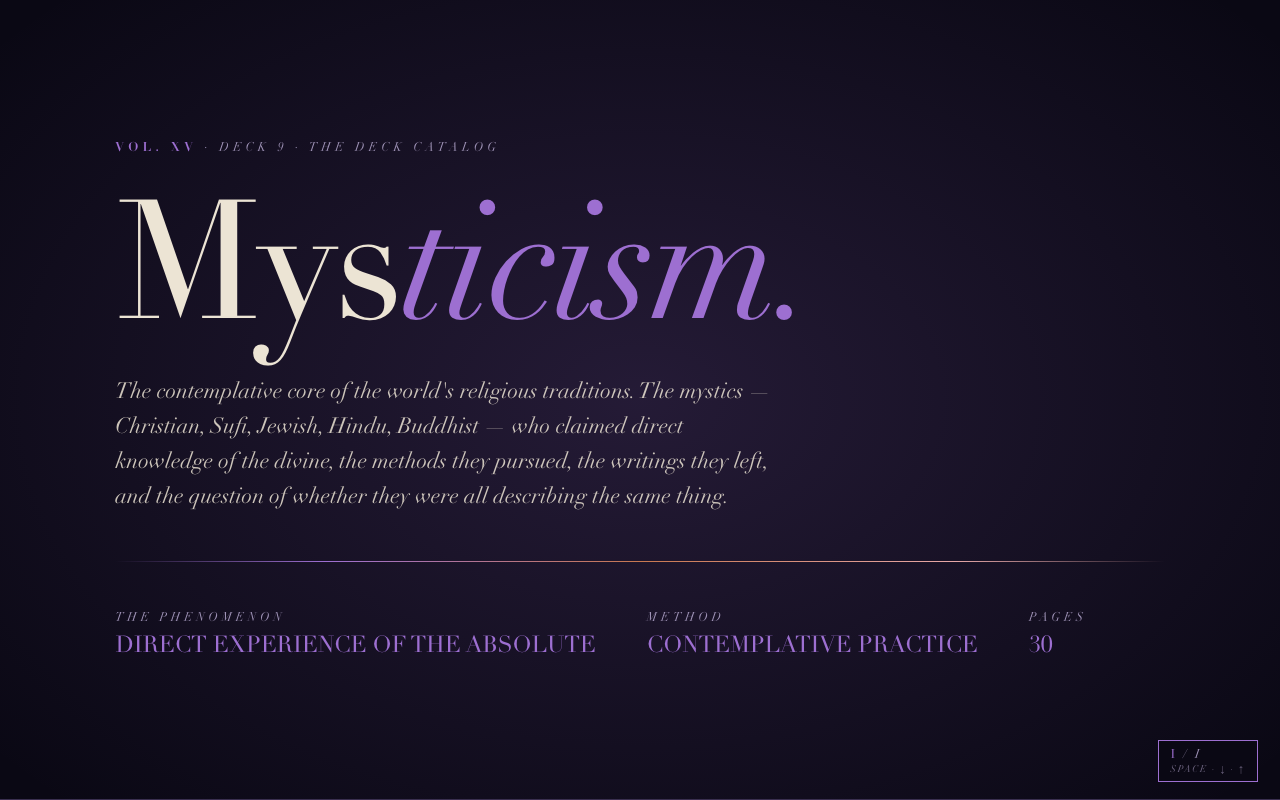
Mysticism
A claim of direct, non-mediated experience of ultimate reality, found in some practitioners of every major religious tradition and in some practitioners of none. The mystics report something they did not invent. The traditions surround that report with framework, technique, and warning.
New Religious Movements
Faith Beyond Tradition: The Rise of Alternative Spiritual Paths
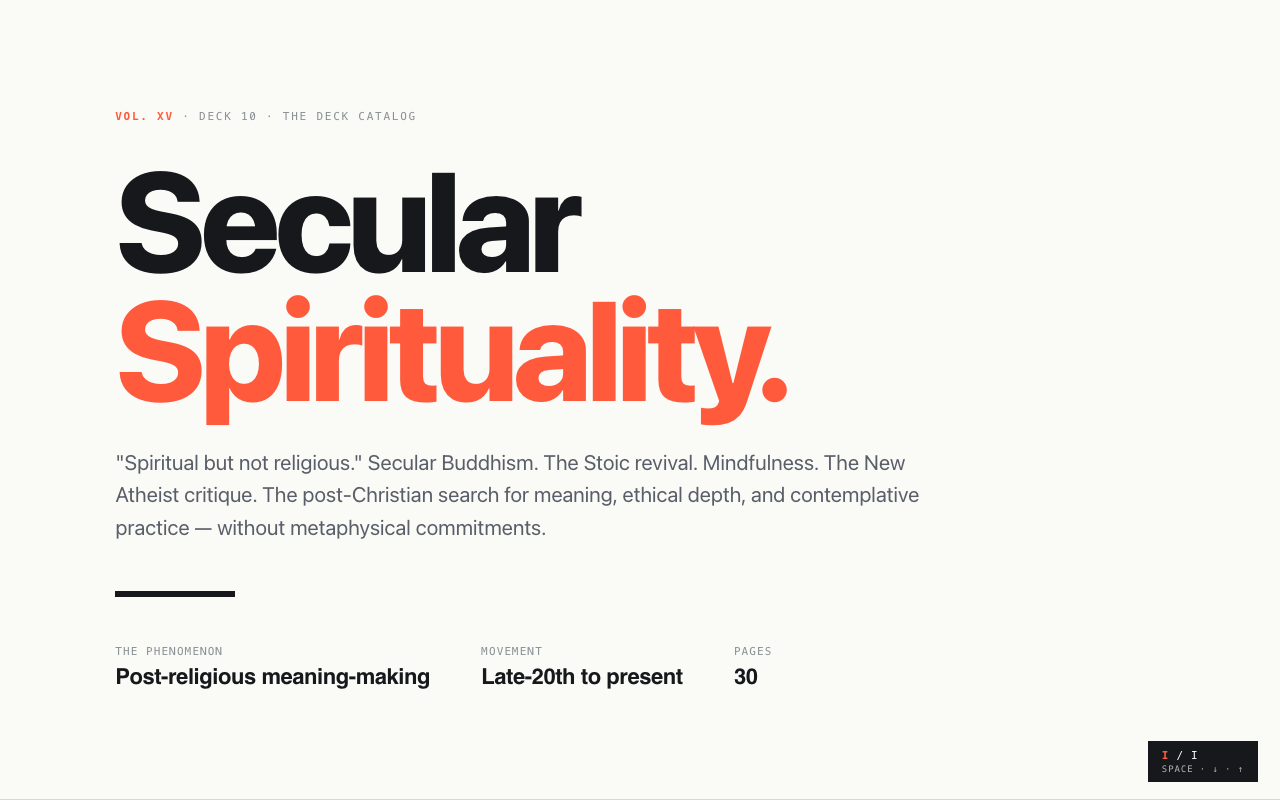
Secular Spirituality
A growing category of modern life: people who have left, or never joined, organised religion, but who pursue contemplative practice, ethical commitment, and a sense of meaning that earlier generations would have called religious. The "spiritual but not religious." The seculars-with-a-practice. The post-Christian, post-Jewish, post-anything seekers who do not want the institutions but do want the depth.
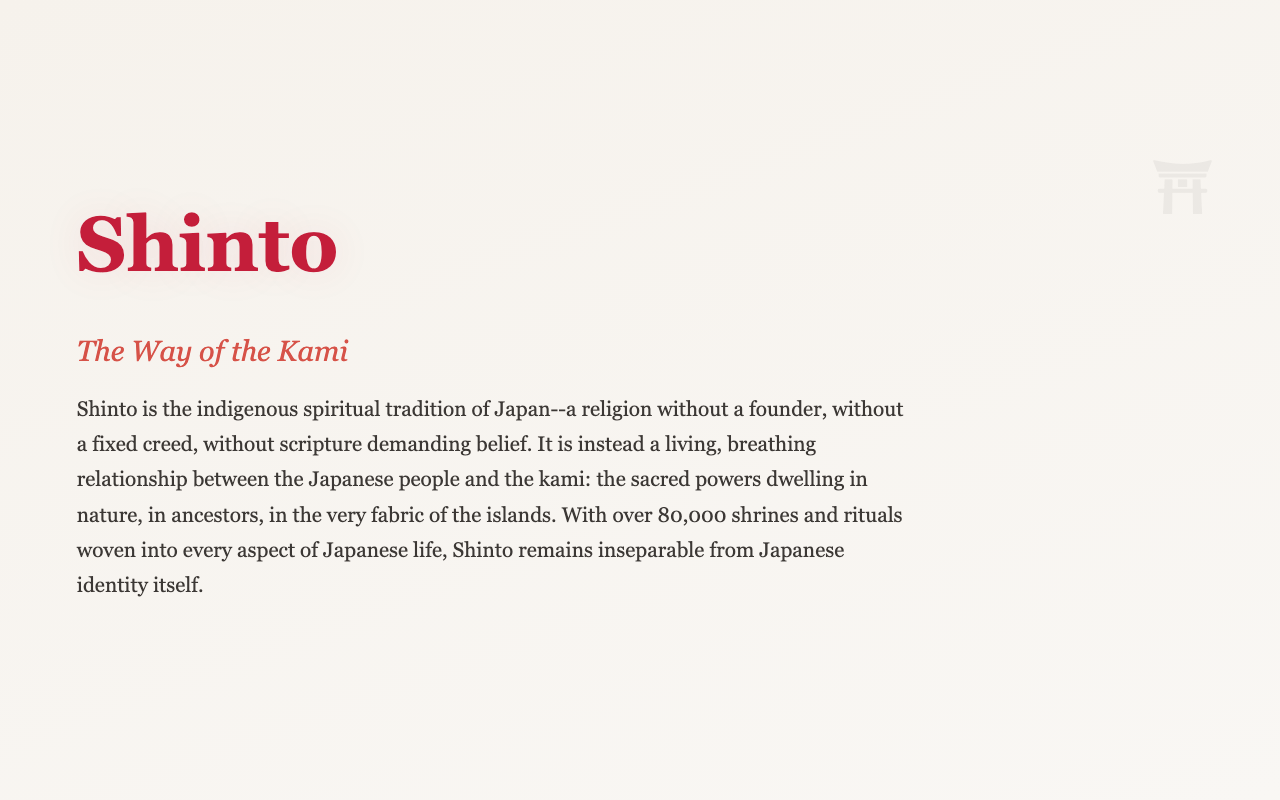
Shinto
The Way of the Kami
Sikhism
The Path of the Guru
Sufism — The Mystical Heart of Islam
Tasawwuf—the Arabic term for Sufism—is the inner, mystical dimension of Islam, concerned not merely with correct practice (sharia) but with the purification of the heart and direct knowledge of God (ma'rifa).
Taoism & Confucianism
Chinese civilisation has been shaped, more than by any other intellectual force, by the long conversation between two indigenous traditions. Confucianism — the way of human propriety, ritual, social harmony, and educated cultivation. Taoism — the way of nature, spontaneity, non-coercion, and the dao that exceeds names. Each defines itself partly in relation to the other.
Zoroastrianism
The World's First Monotheistic Faith