Detailed slide-by-slide text content extracted from this presentation.
Slide 01
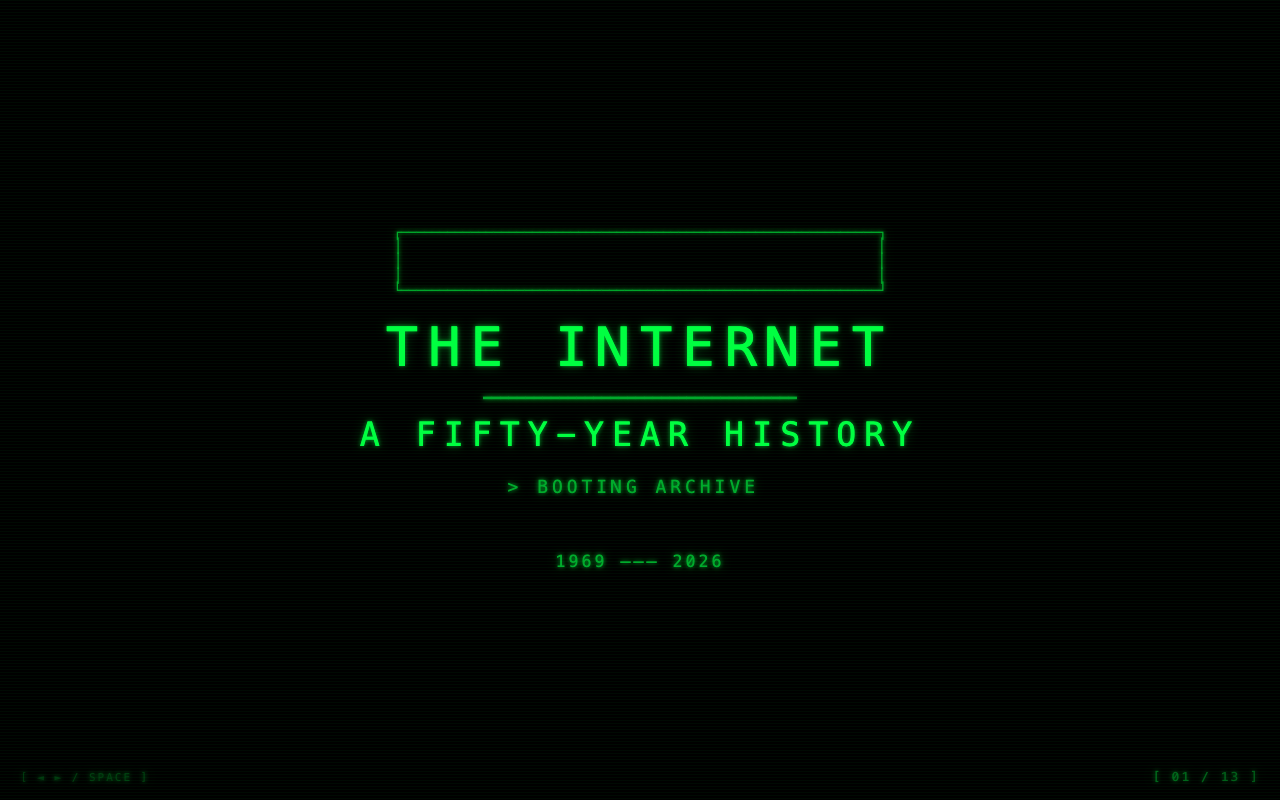
THE
INTERNET
STORY
- // From ARPANET to the AI Web
- How a Cold War military communications experiment became the largest network humanity has ever built — reshaping commerce, culture, politics, and cognition along the way.
- ARPANETTCP/IPWWWWeb 2.0Platform EraAI Web
- 1 / 30
Slide 02
The Numbers That Define the Network
- Scale of the Internet Today
- The internet is the largest engineered system ever built — a collection of 90,000+ autonomous networks linked by a common protocol, carrying more information daily than all the world's libraries combined.
- 5.4BInternet users globally (2024)
- 5MTerabytes/day of traffic
- 1.8BWebsites indexed
- 333BEmails sent daily
- 2 / 30
Slide 03
Sputnik and the Birth of ARPA
- Origins · 1957–1969
- The Soviet launch of Sputnik in 1957 shocked the US defense establishment. President Eisenhower created the Advanced Research Projects Agency (ARPA) in 1958 to ensure America wouldn't be surprised again. One of its programs would fund the creation of the first computer network.
- J.C.R. Licklider's 1963 memo described a "galactic network" of interconnected computers through which anyone could access data and programs. His vision was not defensive — it was about human-computer interaction and the sharing of intellectual resources. He planted the seeds of the internet in ARPA's Information Processing Techniques Office (IPTO).
- 1957Sputnik launched. ARPA created by Eisenhower to prevent technological surprise.
- 1961Leonard Kleinrock publishes packet-switching theory — the mathematical foundation for breaking messages into discrete data packets for transmission.
- 1962Paul Baran (RAND) designs distributed network topology for resilience — no single point of failure.
- 1967Larry Roberts designs ARPANET at ARPA. Four nodes planned: UCLA, SRI, UC Santa Barbara, University of Utah.
- 3 / 30
Slide 04
lo
- First Message · 1969
- // October 29, 1969. 22:30.
- // UCLA node to Stanford Research Institute node.
- // First ARPANET message attempted: "LOGIN"
- UCLA > l
- SRI > got the l
- UCLA > o
- SRI > got the o
- UCLA > g
- SRI > [system crash]
- // First message sent: "lo"
- // First crash: immediately.
- // The internet was born in a crash.
- Charley Kline, a UCLA student, sent the message. The operator at SRI was Bill Duvall. The world's first networked communication was shorter than intended — and the internet has been crashing and recovering ever since.
- 4 / 30
Slide 05
TCP/IP: The Internet's Common Language
- The Foundation Protocols · 1974–1983
- ARPANET initially ran on a protocol called NCP. Vint Cerf and Bob Kahn designed Transmission Control Protocol / Internet Protocol (TCP/IP) in 1974, published in the landmark paper "A Protocol for Packet Network Interconnection." Their key insight: the network itself wouldn't guarantee delivery — that was the endpoints' job.
- TCP/IP was adopted as the standard for ARPANET on January 1, 1983 — "flag day." Every computer on the network switched over simultaneously. This is the technical birthday of the internet as we know it — the moment a single, open protocol connected all nodes regardless of hardware or operating system.
- TCP: Transmission Control Protocol
- Breaks data into packets, numbers them, ensures delivery, reorders on arrival. The reliable layer. "Did all the pieces arrive? In order?"
- IP: Internet Protocol
- Addresses and routes individual packets across networks. Each device gets an IP address. Packets find their own way — no guaranteed path, just best effort. "Where does each packet go?"
- 5 / 30
Slide 06
Early Applications That Defined the Net
- Email, FTP, DNS · 1971–1984
- Email (1971)
- Ray Tomlinson sent the first email between ARPANET nodes and chose the @ symbol to separate user name from host. Email quickly dominated ARPANET traffic — people used military communications infrastructure to arrange who was bringing lunch.
- FTP (1971)
- File Transfer Protocol allowed sharing of programs and documents between hosts. The primary use case of early ARPANET: researchers sharing software and data. Still in use for bulk file transfers.
- DNS (1983)
- Domain Name System translates human-readable names (google.com) to IP addresses (142.250.80.46). Paul Mockapetris invented it to replace a single HOSTS.TXT file — the network had grown too large for one central file to maintain.
- 6 / 30
Slide 07
Tim Berners-Lee's Gift to the World
- The World Wide Web · 1989–1993
- In March 1989, Tim Berners-Lee, a physicist at CERN, submitted a proposal to his supervisor titled "Information Management: A Proposal." His supervisor wrote "vague but exciting" on the cover. That proposal became the World Wide Web — arguably the most consequential invention of the 20th century.
- Berners-Lee invented three things simultaneously: HTML (a markup language for documents), HTTP (a protocol for transferring them), and URLs (addresses for finding them). He refused to patent any of it, releasing the web into the public domain in 1993. His act of deliberate openness created the conditions for everything that followed.
- // First website, still live:
- http://info.cern.ch
- // First HTML ever written:
- <HEADER>
- <TITLE>The World Wide Web</TITLE>
- </HEADER>
- <BODY>
- <h1>World Wide Web</h1>
- <p>The WorldWideWeb (W3) is a wide-area
- hypermedia information retrieval
- initiative...</p>
- </BODY>
- 7 / 30
Slide 08
Mosaic, Netscape, and the Gold Rush
- The Browser Wars · 1993–1999
- Marc Andreessen and Eric Bina created Mosaic at NCSA in 1993 — the first graphical web browser that displayed images inline with text. It was downloaded 2 million times in its first year. The web went from academic curiosity to mass phenomenon.
- Andreessen left for Silicon Valley and co-founded Netscape in 1994. Netscape Navigator became the dominant browser. Microsoft, recognizing its existential threat, bundled Internet Explorer with Windows 95 and gave it away free. The browser wars — Netscape vs. IE — triggered the first major antitrust case against Microsoft. Netscape lost. But the web won.
- 1993Mosaic browser released by NCSA. First graphical browser. Web traffic grows 341,634% in one year.
- 1994Netscape founded. Yahoo! founded. The web becomes commercial.
- 1995Windows 95 ships with IE 1.0. Amazon and eBay launch. Java introduced.
- 1998DOJ files antitrust suit against Microsoft. Google founded in a Menlo Park garage.
- 8 / 30
Slide 09
The First Bubble
- The Dot-Com Era · 1995–2001
- Between 1995 and 2000, venture capital flooded into internet companies with no viable business model, powered by the belief that first-mover advantage and eyeballs would eventually translate into profits. The NASDAQ peaked at 5,048 on March 10, 2000 — then lost 78% of its value by 2002.
- What Failed
- Pets.com (sock puppet, $82M IPO → bankruptcy in 268 days). Webvan ($1.2B raised, grocery delivery too early). Boo.com (£80M, fashion e-commerce, 6 months). Kozmo.com (1-hour delivery, 2000). Flooz.com (internet currency).
- What Survived and Won
- Amazon (lost 93% of value in crash, rebuilt). Google (IPO delayed to 2004; focused on search revenue). eBay (marketplace model with real transactions). Priceline. Expedia. The crash cleared the field for companies with real business models.
- 9 / 30
Slide 10
PageRank and the Information Age
- Search and Google · 1998–2007
- Larry Page and Sergey Brin's insight was elegant: web pages that are linked to by many other pages are probably more authoritative than pages with few links. PageRank treated the web as a citation network — the same logic journals use to assess academic papers. The resulting search quality was dramatically better than competitors.
- Google's AdWords (2000), later AdSense, created the economic model that would define the internet's next two decades: search is free; advertising pays for it; advertising is targeted by search intent — making it vastly more valuable per dollar than broadcast advertising. The surveillance capitalism model was born.
- — Google's user acquisition cost per search
- $279B
- — Google's 2024 advertising revenue
- 8.5B
- — Google searches per day
- 10 / 30
Slide 11
The Death of the Dial-Up World
- Broadband and Always-On · 1999–2006
- The dial-up internet of the 1990s (28.8–56 Kbps) required disconnecting from phone calls to go online, loaded pages line by line, and made any file larger than 1MB an ordeal. Broadband (DSL, cable) changed everything: always on, fast, and enabling new categories of use that dial-up simply couldn't support.
- By 2004, US broadband penetration passed dial-up for the first time. By 2006, YouTube was serving 100 million videos per day — impossible on dial-up. The web shifted from text-heavy pages to multimedia; from waiting for pages to load to streaming; from occasional use to continuous connectivity.
- Napster (1999): peer-to-peer music sharing pioneered digital media distribution before being killed by the recording industry. Demonstrated what broadband enabled.
- BitTorrent (2001): decentralized P2P file sharing; still carries huge fraction of internet traffic
- VoIP (Skype, 2003): voice calls over internet; disrupted telecom industry
- YouTube (2005): user-generated video; acquired by Google 2006 for $1.65B
- iTunes Music Store (2003): digital music distribution with rights management
- 11 / 30
Slide 12
The Participatory Web
- Web 2.0 · 2004–2010
- Tim O'Reilly coined "Web 2.0" in 2004 to describe a shift from static web pages to dynamic, user-generated content platforms. The web became writable, not just readable. Anyone could publish without knowing HTML. The platform model emerged: own the infrastructure, let users create the value.
- Blogs (2000–)
- Movable Type, WordPress, Blogger — publishing for anyone with something to say. By 2006, Technorati indexed 57 million blogs. Professional journalists competed with distributed amateur networks.
- Wikipedia (2001–)
- The largest encyclopedia ever created by volunteers with no financial incentive. 62 million articles in 329 languages. Empirical studies show comparable accuracy to Britannica for science articles.
- Social Networks (2004–)
- Friendster → MySpace → Facebook. The social graph became the killer app — identity, relationships, and communication in one platform. Facebook reaches 1 billion users in 2012.
- 12 / 30
Slide 13
Slide 13
- "The web as I envisaged it, we have not seen it yet. The future is still so much bigger than the past."— Tim Berners-Lee, World Wide Web inventor
- 1991Year the Web was opened to the public
- 1993Year CERN released Web royalty-free
- 10BWeb pages today (indexed and unindexed)
- 13 / 30
Slide 14
"An iPod, a Phone, and an Internet Device"
- The iPhone Moment · 2007
- January 9, 2007: Steve Jobs unveils the iPhone. "The most advanced phones out there are called smartphones," he said. "The problem is they're not so smart." The iPhone combined multi-touch, a real web browser, and the internet into a pocket computer. Within three years, it had redefined mobile computing globally.
- The iPhone's impact on the internet was as consequential as the browser's in 1993. Suddenly, billions of people had internet access in their pockets, always on, with a camera and GPS. Mobile internet usage overtook desktop in 2016 globally. The entire behavioral pattern of online interaction shifted: shorter sessions, social media, apps, location-aware services, real-time everything.
- 2007iPhone launched. Android follows 9 months later. App stores change how software is distributed.
- 2008App Store launches with 500 apps. App economy is born. Airbnb, Uber, Instagram (all 2008-10) are mobile-first.
- 2012Mobile internet users surpass desktop in most Asian markets. The majority of the world accesses internet first via phone.
- 2016Global mobile internet traffic passes desktop. Google shifts to mobile-first indexing. Mobile ad spend surpasses desktop.
- 14 / 30
Slide 15
Facebook, Twitter, and the Social Graph
- The Social Media Era · 2006–2016
- Facebook launched to Harvard students in 2004, opened to all in 2006, and reached 1 billion users in 2012. Twitter's 140-character constraint created a new form of public discourse — brief, immediate, viral. YouTube democratized video creation. Instagram (2010) made visual communication the dominant social mode.
- The social media business model crystallized: free service → engagement maximization → behavioral data → targeted advertising. The product is not the platform — the product is the user's attention, and the customers are advertisers. This asymmetry has profound implications for trust, privacy, and the nature of public discourse.
- Platform Timeline
- 2004 — Facebook (Harvard dorm room, 1M users in first month)
- 2005 — YouTube (garage, $1.65B Google acquisition 2006)
- 2006 — Twitter (140 characters, Odeo pivot)
- 2010 — Instagram (Kevin Systrom, $1B Facebook acquisition 2012)
- 2011 — Snapchat (disappearing messages; $3B Zuckerberg offer declined)
- 2016 — TikTok (ByteDance; 1B users by 2021)
- 15 / 30
Slide 16
Amazon's Unexpected Side Business
- Cloud Computing · 2006–Present
- Amazon Web Services (AWS) launched in 2006 — born from Amazon's need to standardize its own internal infrastructure after years of building compute capacity for retail. When they offered excess capacity to outside developers, they accidentally created the cloud computing industry.
- Cloud computing fundamentally changed the economics of software: instead of buying servers upfront (capital expenditure), companies rent compute on demand (operating expenditure). Startups could now launch with $1,000 instead of $100,000. AWS enabled the startup explosion of 2008–2016 and now generates $100B+ annually — more profit than Amazon's retail business.
- 33% — AWS global cloud market share (2024)
- $107B — AWS annual revenue (2024)
- 28 — AWS geographic regions worldwide
- 16 / 30
Slide 17
Who Controls the Pipes?
- Net Neutrality
- Net neutrality is the principle that internet service providers (ISPs) must treat all internet traffic equally — not throttling Netflix to favor their own streaming service, not charging content companies for faster delivery. Tim Wu coined the term in 2003; the debate has dominated internet policy for two decades.
- The US FCC classified broadband as a telecommunications service (and thus subject to neutrality rules) in 2015 under Obama — then reversed course in 2017 under Trump. The Biden FCC attempted to restore net neutrality rules in 2024. The outcome remains legally contested. The principle is also contested globally: India maintains strong neutrality; European rules are more permissive.
- Without net neutrality: ISPs can create fast lanes (paid) and slow lanes (unpaid)
- Comcast throttled BitTorrent traffic 2007 — FCC attempted to punish, courts overturned
- Throttling Netflix: Comcast and AT&T both slowed Netflix before neutrality rules
- AT&T exempting its own streaming from data caps ("zero-rating") — competitive advantage through pipe ownership
- The argument against: ISPs should be able to manage congestion and monetize network investment
- 17 / 30
Slide 18
The Price of Free
- Privacy and Surveillance
- Edward Snowden's 2013 revelations showed that the NSA was conducting mass surveillance of internet communications through programs like PRISM, which compelled tech companies to provide access to user data, and XKeyscore, which processed vast quantities of internet metadata. The reaction shocked much of the world and triggered global encryption adoption.
- Shoshana Zuboff's concept of "surveillance capitalism" (2019) formalized what many sensed: digital platforms accumulate behavioral data not to provide better service but to predict and modify human behavior for profit. The asymmetry of information between platforms and users is the defining economic relationship of the internet age.
- Google's ad business processes 1.2 trillion searches/year; each is a signal
- Facebook's shadow profiles track non-users via Like buttons on external sites
- Location data sold by data brokers tracks individuals across apps
- GDPR (EU, 2018): first major privacy regulation with real penalties — up to 4% of global revenue
- Apple's App Tracking Transparency (2021) cost Facebook/Meta $10B in annual revenue
- 18 / 30
Slide 19
Five Companies That Run the Internet
- The Platform Economy
- The post-2010 internet is largely controlled by five companies — Google, Amazon, Apple, Microsoft, and Meta — sometimes called GAAMM. Together they have market capitalizations exceeding $10 trillion, employ hundreds of thousands, and mediate most of what users do online.
- The network effects and data advantages of these incumbents have proven nearly insurmountable. Startups that threaten them are acquired (Instagram, WhatsApp, YouTube, Twitch, Nest, Beats) or replicated (Google+ trying to replicate Facebook, Facebook Stories replicating Snapchat). The competitive dynamics of the platform era favor consolidation.
- Google: search (90% share), Android (72% mobile share), YouTube, Maps, Gmail
- Amazon: e-commerce (40% US), cloud (33% global), advertising (growing fast)
- Apple: hardware ecosystem, App Store (exclusive iOS distribution), services
- Microsoft: enterprise software, Azure (22% cloud), Teams, LinkedIn, GitHub, OpenAI partnership
- Meta: Facebook, Instagram, WhatsApp — 3.3 billion daily active users across family of apps
- 19 / 30
Slide 20
The Infodemic: When Virality Harms Truth
- Disinformation and Democracy
- Social media platforms optimized for engagement discovered that emotionally arousing content — outrage, fear, disgust — spreads faster than neutral content. This created a systematic bias toward sensationalism, misinformation, and political extremism: not because platforms wanted these outcomes but because engagement algorithms rewarded them.
- The 2016 US election, Brexit campaign, COVID-19 infodemic, and multiple political crises around the world have been shaped in part by viral misinformation amplified through social platforms. The speed of the internet exceeds the speed of fact-checking — a structural asymmetry that makes accurate correction of false information extremely difficult.
- MIT study (2018): false news spreads 6× faster on Twitter than true news
- Facebook's own research found algorithm amplified divisive content
- WhatsApp group chain letters spread health misinformation in India, causing lynchings
- Myanmar genocide: UN documented Facebook's role in spreading anti-Rohingya hatred
- Content moderation: Facebook employs ~35,000 moderators globally
- 20 / 30
Slide 21
The Internet Beneath the Internet
- The Dark Web and Tor
- The "dark web" is a portion of the web accessible only through specialized software (principally Tor — The Onion Router), which encrypts traffic and bounces it through multiple relays to anonymize users. Tor was originally developed by the US Navy for government communications.
- The dark web contains legitimate privacy-preserving uses (journalists contacting sources, dissidents in authoritarian countries, domestic violence survivors) alongside illegal marketplaces (Silk Road until 2013, its successors). The technical architecture is neutral; the uses range from noble to criminal — which is also true of the regular web.
- Three Layers of the Web
- Surface Web: Indexed by search engines. Accessible to anyone. ~5% of all web content by volume.
- Deep Web: Not indexed — paywalled content, private databases, internal networks, email, cloud storage. ~95% of web content. Normal and legitimate.
- Dark Web: Requires Tor or similar. Small subset of deep web. Estimated 0.1% of total web by content.
- 21 / 30
Slide 22
Who Governs the Internet?
- Internet Governance
- The internet has no single governing authority — it's a loose coalition of technical bodies, governments, and private organizations. ICANN (Internet Corporation for Assigned Names and Numbers) manages the Domain Name System and IP address allocation. IETF (Internet Engineering Task Force) develops technical standards through consensus. The W3C (World Wide Web Consortium) standardizes web technologies.
- This multi-stakeholder governance model, while imperfect, has prevented capture by any single government or corporation. China's "Great Firewall" and Russia's Sovereign Internet law represent national attempts to create bordered internets — at odds with the founding architecture of a global, borderless network.
- ICANN — DNS root, IP allocation, domain name disputes
- IETF — open standards process; anyone can participate; "rough consensus and running code"
- W3C — HTML, CSS, accessibility standards; Tim Berners-Lee founded
- IGF (Internet Governance Forum) — UN body for multi-stakeholder internet policy dialogue
- ITU (International Telecommunication Union) — UN agency, spectrum allocation
- 22 / 30
Slide 23
The Decentralization Experiment
- Blockchain and Web3 · 2009–Present
- Bitcoin (2009, Satoshi Nakamoto) introduced the blockchain — a distributed, immutable ledger maintained by cryptographic consensus rather than a central authority. Ethereum (2015, Vitalik Buterin) added programmability through smart contracts, enabling decentralized applications (dApps).
- The "Web3" vision is an internet where users own their data, identity, and digital assets through cryptographic keys rather than platform accounts. The reality has been more mixed: spectacular cryptocurrency speculation (and crashes), NFT boom and bust, and limited adoption of genuinely decentralized applications outside financial speculation.
- Bitcoin: electronic cash without banks; $1T+ market cap at peak 2021
- Ethereum: smart contracts enabling DeFi, NFTs, DAOs
- NFTs: $25B market 2021, collapsed 2022–2023 with few lasting applications
- DeFi: decentralized lending, borrowing, trading; $100B+ TVL at peak
- Stablecoins: USDC, Tether — bridge between crypto and fiat; essential payment infrastructure
- 23 / 30
Slide 24
How the Internet Reshaped Retail
- E-Commerce
- Amazon started in 1994 as an online bookstore. Jeff Bezos chose books because they had more SKUs than any physical store could stock and were easy to ship. The underlying insight was not about books — it was about a store with unlimited shelf space and global reach. Amazon extended this to everything.
- Global e-commerce reached $6.3 trillion in 2023 — roughly 20% of all retail. But the internet's impact on retail goes beyond what's sold online: showrooming (viewing in store, buying online), price comparison, product review systems, and supply chain transparency have transformed the entire retail experience, including purchases made in physical stores.
- $6.3T global e-commerce 2023; projected $8.1T by 2026
- Alibaba's Singles Day: $84B in 24 hours (2021) — largest shopping event in history
- Department store closures: JC Penney, Sears, Toys R Us — the "retail apocalypse"
- BNPL (Buy Now Pay Later): Klarna, Affirm — fintech layered on e-commerce
- Social commerce: TikTok Shop, Instagram Shopping — content-to-purchase integration
- 24 / 30
Slide 25
Who Is Still Offline?
- The Global Digital Divide
- 2.6 billion people — roughly 33% of the world's population — remain unconnected to the internet. The geography is stark: high-income OECD countries have 90%+ connectivity; Sub-Saharan Africa averages 36%. The divide is also demographic: younger, male, urban, and higher-income individuals connect first within any country.
- Connectivity is increasingly recognized as essential infrastructure — the electricity or clean water of the digital age. Unconnected populations are excluded from digital services, e-government, remote education, telehealth, and economic opportunities that require internet access. The digital divide compounds existing inequalities.
- 67% — Global internet penetration rate (2024)
- 36% — Internet penetration: Sub-Saharan Africa
- 93% — Connectivity via mobile (not broadband) in developing world
- 25 / 30
Slide 26
The Internet at War
- Cybersecurity
- Every advance in internet capability has been matched by advances in exploitation. Cyber attacks on critical infrastructure, elections, financial systems, and healthcare have made cybersecurity a national security priority. The internet's founding architecture — designed for resilience and openness, not security — creates inherent vulnerabilities.
- Stuxnet (2010) was the first cyberweapon demonstrated to cause physical destruction — it destroyed Iranian centrifuges while displaying normal readings. It normalized state-sponsored cyberattacks as a tool of geopolitics. Since then, the SolarWinds supply chain attack (2020), Colonial Pipeline ransomware (2021), and the Microsoft Exchange vulnerabilities have demonstrated the systemic fragility of internet-connected infrastructure.
- $8 trillion global annual cost of cybercrime (2023); projected $10.5T by 2025
- Ransomware attacks on hospitals, utilities, and governments have cost lives
- Zero-day vulnerabilities — unknown software flaws — trade for $1M+ on dark web markets
- Nation-state actors: Russia (APT28), China (APT41), North Korea (Lazarus Group), Iran
- Internet of Things security: 15B+ connected devices, most with minimal security
- 26 / 30
Slide 27
ChatGPT and the AI Inflection
- AI and the Web
- ChatGPT reached 100 million users in two months — the fastest consumer product adoption in history. Released in November 2022, it demonstrated that large language models trained on internet text could hold coherent, useful conversations across virtually any domain. It was the moment AI moved from research lab to mainstream consciousness.
- The AI web is now reshaping internet discovery: AI-generated summaries in search reduce clicks to original sources; AI writing tools flood the internet with synthetic content; recommendation algorithms grow more accurate and more opaque. The internet trained on human text is now generating content that future AI systems will train on — a recursive loop whose long-term consequences are genuinely unknown.
- ChatGPT: 0 to 100M users in 2 months (Netflix took 3.5 years)
- Google Bard/Gemini, Microsoft Copilot: AI integrated into search and productivity
- Generative AI content: estimated 57% of internet content was AI-generated or AI-assisted by 2024
- AI agents: autonomous systems capable of browsing, writing code, and taking actions online
- Model collapse: models trained on AI-generated data degrade — the feedback loop problem
- 27 / 30
Slide 28
The Internet's Physical Infrastructure
- Subsea Cables
- The internet feels ethereal — but it runs on physical infrastructure. More than 99% of global internet traffic travels through 400+ subsea fiber optic cables stretching 1.3 million kilometers across ocean floors. These cables — not satellites — carry virtually all international data.
- A single cut in a major cable (by an anchor, earthquake, or sabotage) can slow internet connectivity for millions of people. The 2022 Tonga volcanic eruption severed the country's only undersea cable, cutting it off from the global internet for weeks. In 2024, suspected sabotage cut cables in the Baltic Sea, raising European security concerns.
- 400+ submarine cable systems globally; total capacity: petabits per second
- Hyperscale companies (Google, Meta, Microsoft, Amazon) own 30%+ of subsea cable capacity
- Satellites (Starlink): fills gaps in coverage but high latency limits performance vs. fiber
- Internet Exchange Points (IXPs): physical locations where networks interconnect; Amsterdam, London, Frankfurt are dominant
- Data centers: 8,000+ worldwide; Google, Amazon, Microsoft operate private networks spanning continents
- 28 / 30
Slide 29
What Comes After the Web?
- The Future
- Spatial Computing
- AR/VR merging physical and digital environments. Apple Vision Pro, Meta Quest — early form factors. The Metaverse vision hasn't materialized at scale, but spatial interfaces are coming.
- Agentic Web
- AI agents that browse, book, buy, and communicate on users' behalf. The web designed for humans must evolve to serve AI-to-AI interaction at scale. APIs over web pages; machine-readable content.
- Decentralized Identity
- Users owning their identity and data through cryptographic credentials rather than platform accounts. W3C's DID standard, government digital identity programs, and passwordless authentication are converging.
- 29 / 30
Slide 30
lo
first internet message, 1969
hello, world
5.4 billion people, 2024
- // 55 years of packets
- The internet was not designed to be what it became. It was built on the assumption of good faith among small numbers of trusted researchers — and scaled to billions of anonymous users without ever revisiting that assumption. Its next chapter will be defined by whether humanity can govern this infrastructure as wisely as it built it.
- ARPANETTCP/IPWWWWeb 2.0AI
- 30 / 30