Literature Slides
A curated collection of interactive HTML presentation decks, slide outlines, and topics covering Literature.
Popular presentations about Literature
African Literature
A Continent of Voices, Worlds, and Words
Children's Literature
Books written for children, illustrated for children, published for children, and read by children — sometimes also by their parents, and often, decades later, by the children's children.
Comics
Comics — sequential art with text and image working together — is among the youngest narrative forms (200 years vs. millennia for novels) and among the most expansive in technique. The medium ranges from Sunday-paper strips to literary graphic novels in the Pulitzer-and-MacArthur firmament.
Contemporary Fiction
Contemporary, in this deck, is roughly 2000 to now. Twenty-six years of literary fiction. Three observable shifts.
Dystopian Fiction
Imagined Futures, Present Warnings
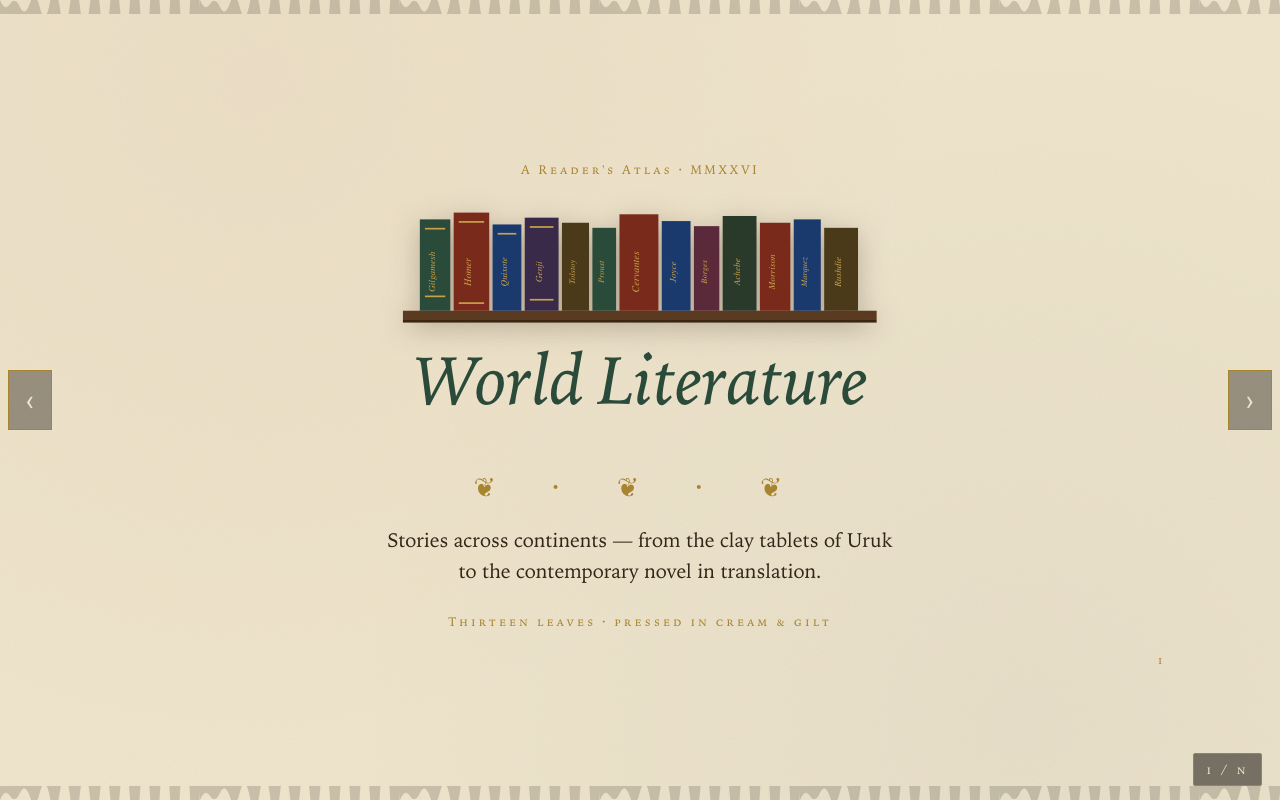
World Literature — Stories Across Continents
Stories across continents — from the clay tablets of Uruk to the contemporary novel in translation.
Epic & Myth
Almost every culture that has produced a literature has produced an epic — a long, formal, poetic account of how its people came to be where they are.
The Essay Tradition
An essay is a piece of prose that thinks. Argument is welcome but not required; the form's distinguishing feature is the visible movement of a mind — turning a question over, qualifying, doubting, returning, surprising itself.
Horror Fiction
Literature of Dread, Terror, and the Unknown
Lit-Journ
Some journalism is literature. The work that happens when a reporter brings novelistic technique — scene, character, voice, pacing — to the documentary task produces a hybrid that is more than its parts.
Literary Criticism
How We Read, Interpret, and Judge Texts
Literary Modernism
Modernism, in literature, is the period when writers stopped assuming the inherited forms of the 19th century could carry what they wanted to say.
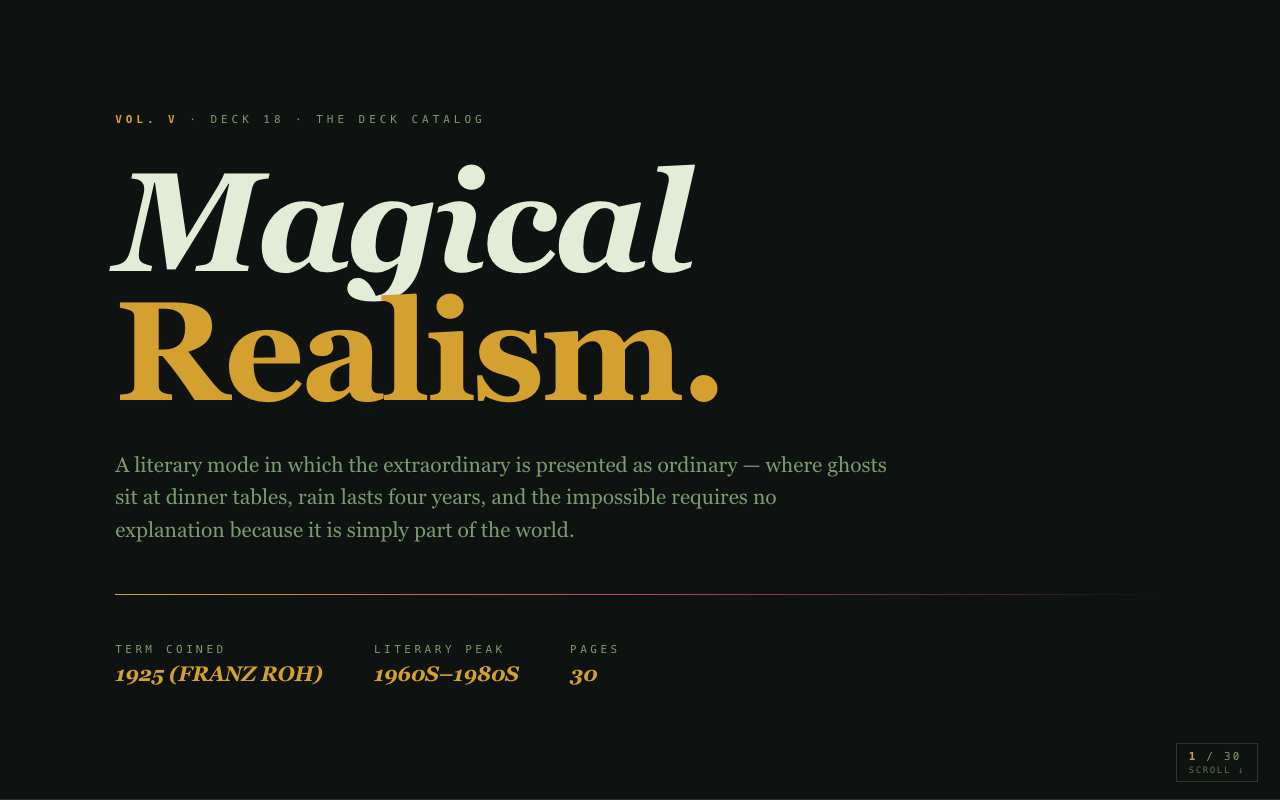
Magical Realism
Magical realism is not fantasy. It is not surrealism. It is a mode of narration in which miraculous events occur within an otherwise realistic framework — and no one is surprised. The magic is not escape; it is the texture of lived experience in places where history itself is stranger than fiction.
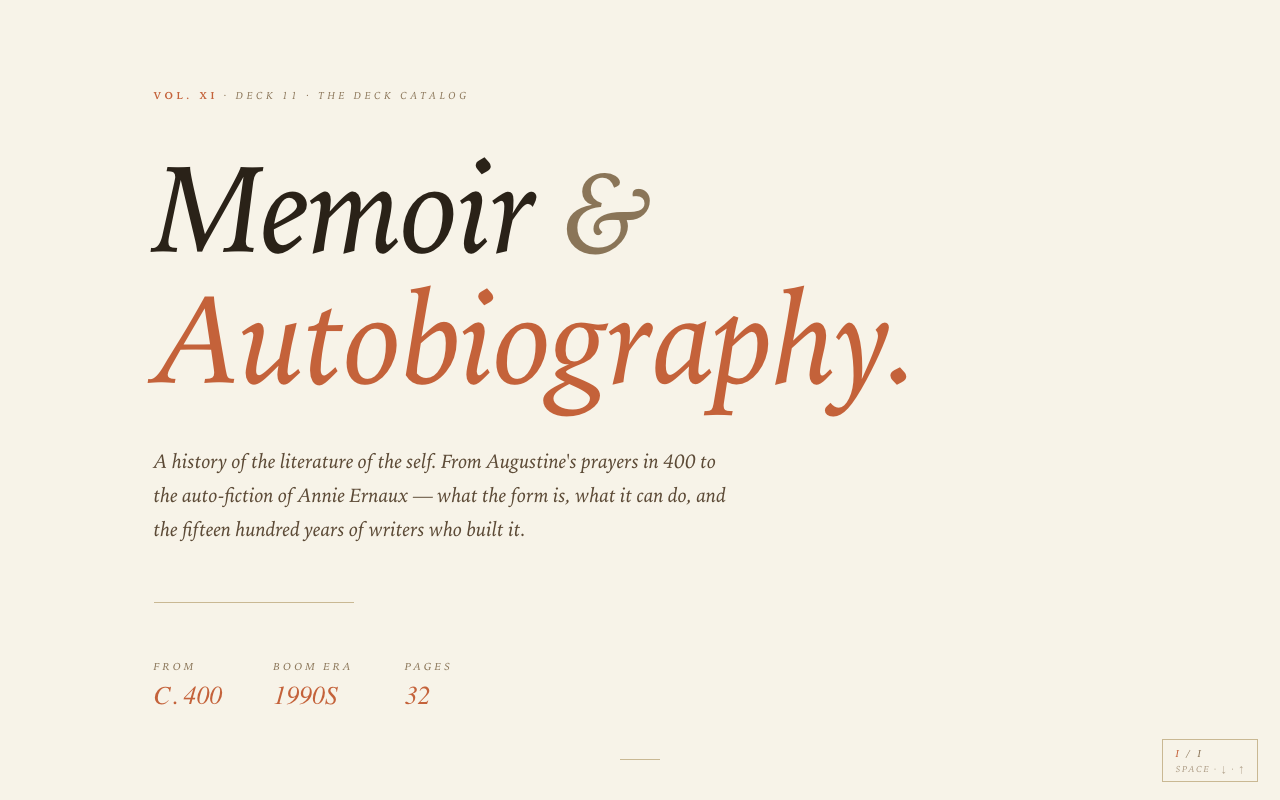
Memoir & Autobiography
Autobiography is the story of a life. Memoir is the story of a moment, a relationship, a question, an obsession — told from inside a life. Auto-fiction is the recognition that the story we tell about ourselves was never simply true.
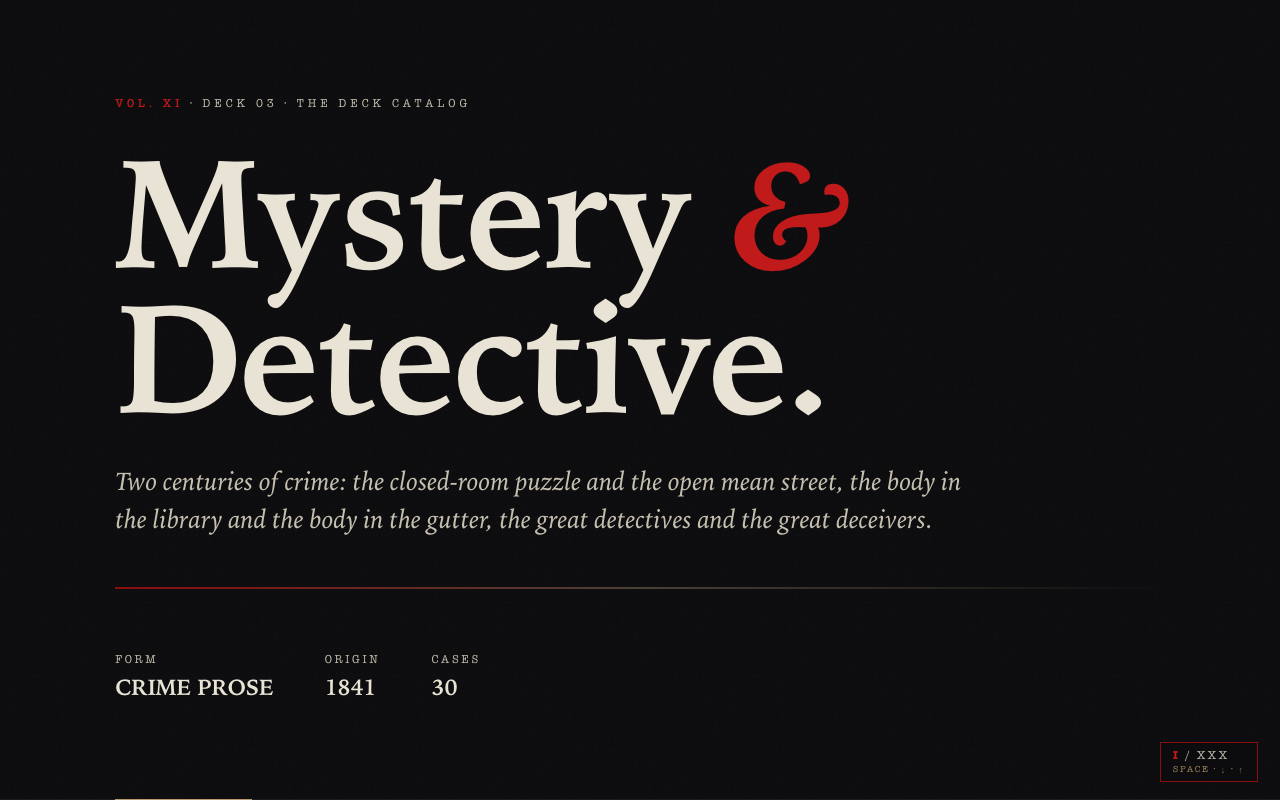
Mystery & Detective Fiction
The detective story is the only literary form in which the reader is officially permitted to enjoy a corpse. Its central labour is to make the disordered legible: to take a death, a deception, or an absence, and reorganise the world around it until the reader sees what was always there.
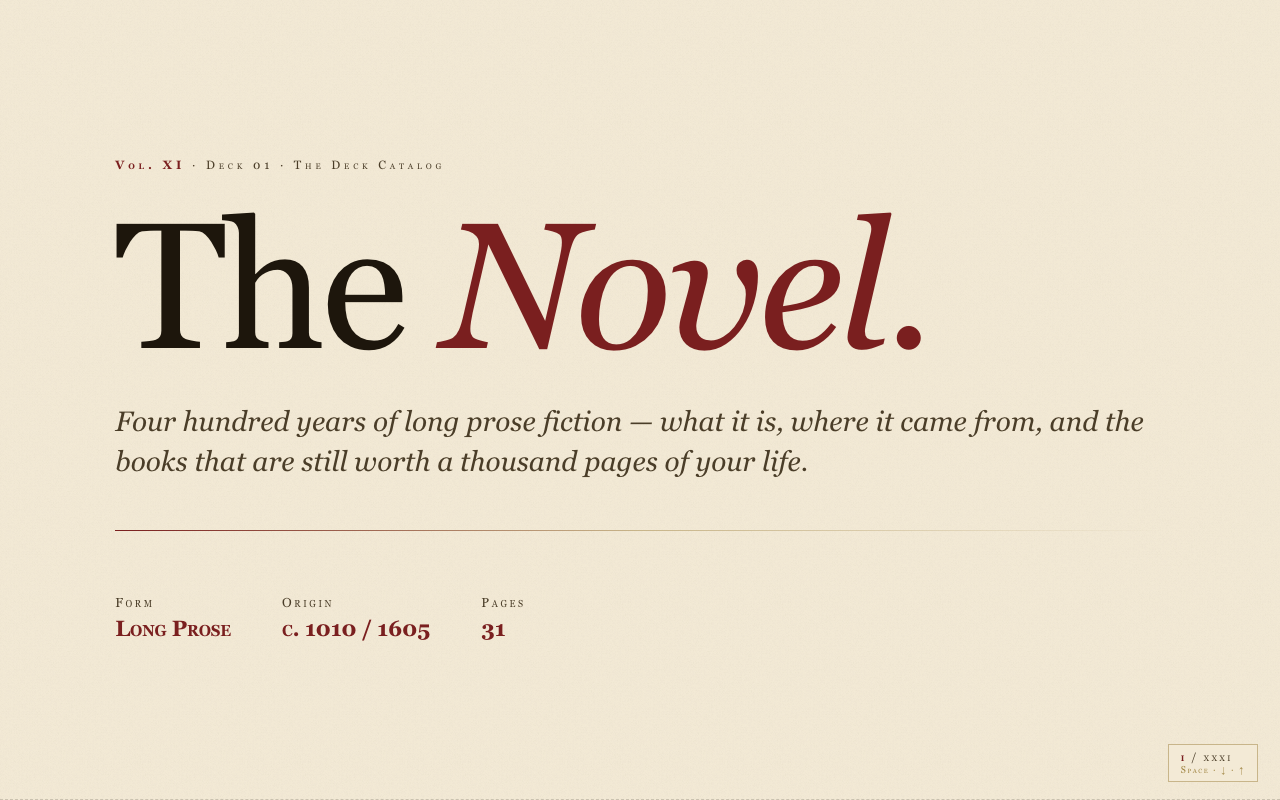
The Novel
A novel is a long prose fiction, almost always told in chapters, almost always concerned with the interior life of at least one ordinary person, and almost always reading like one piece of writing rather than a collection.
Poetry
The single fact that distinguishes poetry from prose is the line. Where a sentence ends because a thought is finished, a line ends because the poet has decided so. That decision is the form.
Science Fiction
Science fiction is the literature that takes one premise its world does not allow — a different physics, a different history, a different species — and follows the consequences with a straight face.
Short Fiction
A short story is the form a writer uses when a single effect is the whole point. It does in twenty pages what a novel needs three hundred for and what a poem refuses to do at all.
World Literature
Almost everything you have not yet read. The English-speaking world publishes roughly 3% of its books in translation; in France, the figure is over 20%; in Germany, 12%; in Korea and Sweden, around 25%. The Anglophone reader's literary map is, by default, missing most of the world.