Detailed slide-by-slide text content extracted from this presentation.
Slide 01
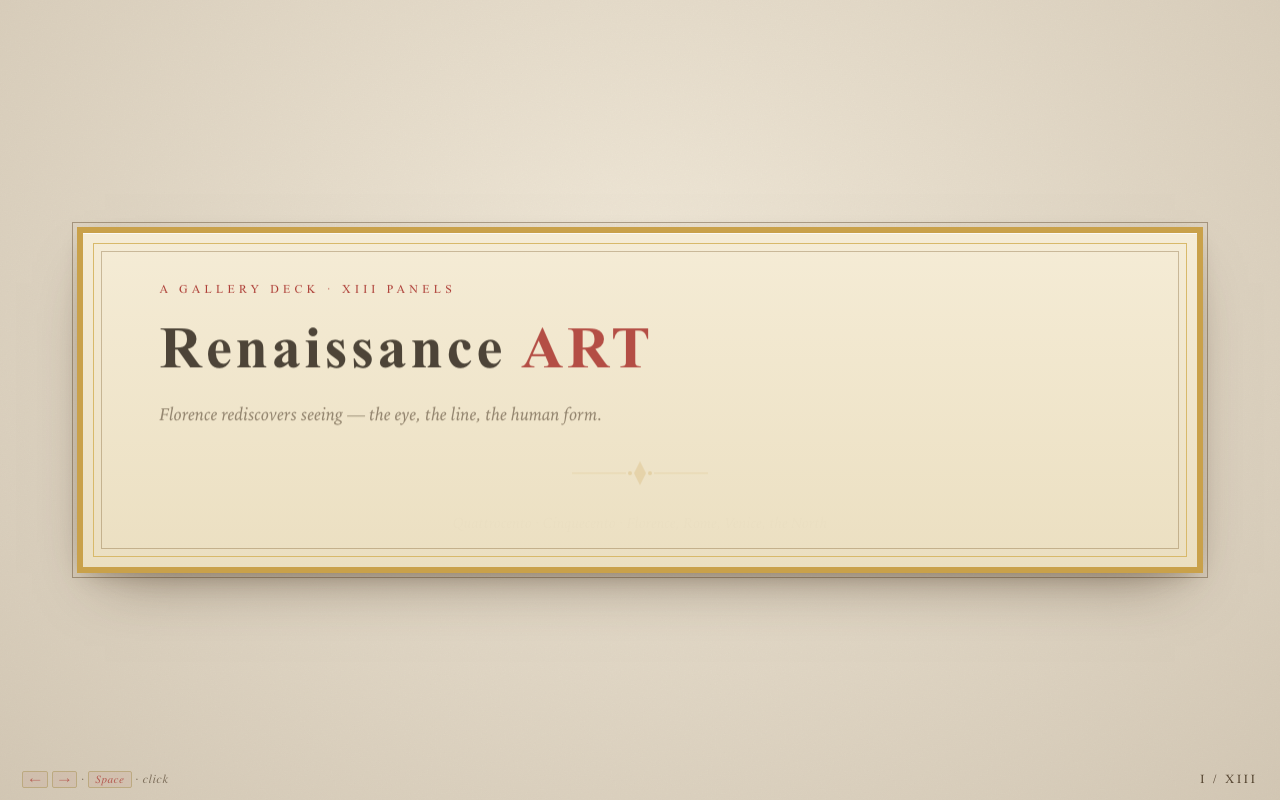
Renaissance Art
- ✦ ✦ ✦
- A Visual History
- The rebirth of classical ideals, the discovery of perspective, and the flowering of human genius across Italy and Europe — 1300 to 1600.
- HumanismPerspectivePatronageSfumatoChiaroscuro
- 1 / 30
Slide 02
What Was the Renaissance?
- Origins
- The Renaissance — Italian for "rebirth" — was a cultural and intellectual movement that began in Florence around 1300 and spread across Europe. It marked a decisive break from medieval scholasticism, reviving Greek and Roman learning while placing humanity, not God, at the center of artistic inquiry. Artists became celebrated individuals rather than anonymous craftsmen, and their studios became laboratories of scientific and aesthetic discovery.
- 300Years of Dominance
- 6Major City-States
- 1,000+Works Survived
- 2 / 30
Slide 03
Giotto di Bondone
- Proto-Renaissance · c. 1280–1370
- Giotto shattered the flat Byzantine convention. His figures in the Scrovegni Chapel (1304–06) occupy believable space, express recognizable emotion, and cast shadows. Dante immortalized him in the Divine Comedy as the greatest living painter.
- Giotto's innovations — foreshortening, naturalistic drapery, psychological depth — were radical leaps that established the grammar every later Renaissance artist would refine. He is rightly called the father of Western painting.
- Scrovegni Chapel
- 38 fresco scenes depicting the lives of the Virgin and Christ. Painted in Padua, they represent the first coherent narrative cycle in Western art — the room itself a painted manuscript.
- 3 / 30
Slide 04
Florence: Why Here?
- Geography of Genius
- Economic Power
- Florence's wool and banking guilds made it the financial capital of Europe. The Medici Bank held accounts for popes and princes, and that wealth flowed directly into commissions.
- Civic Competition
- City-states competed for prestige through art. When Florence's Baptistery needed new bronze doors in 1401, the resulting competition between Ghiberti and Brunelleschi launched an era.
- Humanist Learning
- Greek scholars fleeing Constantinople (1453) brought manuscripts. The Platonic Academy at Careggi made Florence a center of classical philosophy and neo-Platonic thought.
- The Medici Patron Network
- Cosimo and Lorenzo de' Medici supported Donatello, Botticelli, Leonardo, and Michelangelo. Without stable patronage, none of their careers would have been possible at that scale.
- 4 / 30
Slide 05
Linear Perspective
- The Great Breakthrough
- In 1413, Filippo Brunelleschi demonstrated that space could be rendered mathematically on a flat surface. Leon Battista Alberti codified the rules in Della pittura (1435): all parallel lines converge at a single vanishing point on the horizon.
- Vanishing Point
- All orthogonals meet at a single eye-level point, creating the illusion of infinite recession.
- Foreshortening
- Objects diminish in size with distance in precise mathematical ratios — the grid of the real world.
- Atmospheric Perspective
- Distant forms lose saturation and sharpness — a principle Leonardo mastered in landscape backgrounds.
- 5 / 30
Slide 06
Donatello and the Classical Body
- Sculpture · Early Renaissance
- Donato di Niccolò di Betto Bardi — Donatello — single-handedly reinvented sculpture. His bronze David (c. 1440s) was the first freestanding nude male since antiquity: sensual, contrapposto-posed, psychologically ambiguous.
- His Gattamelata (1453) in Padua revived the Roman imperial equestrian tradition. His reliefs introduced pictorial perspective into three dimensions — a feat no sculptor had attempted since Rome fell.
- St. George marble relief, Orsanmichele — 1415
- Feast of Herod bronze relief — 1423
- Cantoria singing gallery — 1433
- Bronze David — c. 1440s
- Gattamelata equestrian statue — 1453
- Mary Magdalene wood sculpture — c. 1455
- 6 / 30
Slide 07
Sandro Botticelli
- Medici Florence · 1478–1485
- Botticelli's mythological allegories for Lorenzo de' Medici's circle represent the fusion of pagan antiquity and Renaissance humanism. His figures hover between worlds — neither fully corporeal nor transcendent — with a melancholy grace unique in art history.
- Primavera (c. 1482)
- Nine figures in an orange grove — a neo-Platonic meditation on love and generation drawing on classical sources and contemporary poetry.
- Birth of Venus (c. 1484)
- Venus emerges from the sea on a shell — the first large-scale mythological nude of the Renaissance, quoting an ancient statue type known from descriptions.
- Late Savonarola Period
- After 1494, Botticelli's style turned austere and penitential. He reportedly burned his own secular work and devoted himself to devotional imagery.
- 7 / 30
Slide 08
Leonardo da Vinci
- The Universal Man
- Born illegitimate in Vinci in 1452, Leonardo apprenticed under Verrocchio in Florence. His curiosity transcended art: notebooks filled with studies of anatomy, hydraulics, flight, optics, geology, and engineering.
- His paintings are few — perhaps 20 survive — but each redefined what painting could achieve. He invented sfumato (soft-edged forms dissolved in atmospheric haze) and elevated portraiture from status record to psychological probe.
- Annunciation — Uffizi, c. 1472
- Adoration of the Magi — unfinished, 1481
- Virgin of the Rocks — 1483–86
- Last Supper — Milan refectory, 1495–98
- Mona Lisa — c. 1503–19, Louvre
- St. John the Baptist — final painting, c. 1516
- 8 / 30
Slide 09
Mona Lisa: Why This One?
- The Most Famous Painting in the World
- Leonardo worked on the portrait of Lisa Gherardini for years. He carried it to France when he entered the service of Francis I, and it remained royal property after his death in 1519.
- Sfumato Mastery
- The corners of her mouth and eyes are dissolved in shadow, creating ambiguity that no description resolves — her expression shifts as you look.
- Geological Background
- The landscape depicts two different geological eras at different horizon levels, reflecting Leonardo's studies of erosion and time.
- Celebrity Through Theft
- The 1911 theft by Vincenzo Peruggia made it a newspaper sensation. Two years missing made it globally famous in the age of mass print.
- 9 / 30
Slide 10
Raphael Sanzio
- High Renaissance · Rome 1508–1520
- Born in Urbino in 1483, Raphael absorbed Perugino's gentle style before arriving in Florence to study Leonardo and Michelangelo. His synthesis — clarity, harmony, grace — defined the High Renaissance ideal that academic painters would revere for centuries.
- Pope Julius II summoned him to Rome in 1508 to decorate the papal apartments. The School of Athens (1509–11) remains the supreme statement of Renaissance humanism: all the ancient philosophers inhabiting a single luminous space.
- School of Athens
- Plato and Aristotle stand at center, surrounded by Socrates, Euclid, Pythagoras, and others — Raphael included portraits of Leonardo (as Plato) and Michelangelo as Heraclitus, seated alone on a step.
- 10 / 30
Slide 11
Michelangelo and Marble
- The Divine One
- Michelangelo considered himself primarily a sculptor. His figures appear to strain against marble, as if consciousness itself is fighting free of inert stone — what he called releasing the figure already inside.
- 1498–99Pietà — St. Peter's Basilica. Mary holds the dead Christ with a serenity that belies grief. Michelangelo signed the sash — his only signed work.
- 1501–04David — 17 feet of Carrara marble. Depicts the moment before battle — tense, coiled, alert — not triumph. Placed in the Piazza della Signoria as civic symbol.
- 1513–16Moses — San Pietro in Vincoli. Veins in his arms seem to pulse. Freud wrote an entire essay trying to understand him.
- 1519–34Medici Tombs — Night, Day, Dawn, Dusk recline on the sarcophagi. Time personified in marble — the most philosophical sculpture ever conceived.
- 11 / 30
Slide 12
The Sistine Ceiling
- 1508–1512 · Vatican
- Pope Julius II commissioned Michelangelo to paint the ceiling — a commission he initially resisted, believing painting inferior to sculpture. He designed nine scenes from Genesis framed by ignudi, Prophets, and Sibyls.
- Working largely alone, lying on a scaffold 60 feet up, he completed 5,000 square feet of fresco in four years. The Creation of Adam — God's finger almost touching Adam's — became the defining image of the Renaissance.
- Separation of Light from Darkness
- Creation of the Sun and Moon
- Separation of Land from Water
- Creation of Adam
- Creation of Eve
- Fall and Expulsion from Eden
- Sacrifice of Noah
- The Flood
- Drunkenness of Noah
- 12 / 30
Slide 13
The Northern Renaissance
- Beyond Italy
- Transmitted through trade, print, and traveling artists, Renaissance ideas took distinct form in Flanders, Germany, and the Netherlands — favoring oil paint, domestic interiors, and intense surface realism over grand fresco and classical architecture.
- Jan van Eyck
- Perfected oil glazing technique. The Arnolfini Portrait (1434) contains a convex mirror reflecting the entire room — a tour de force of observation and embedded meaning.
- Albrecht Dürer
- German master of engraving and woodcut. His self-portraits present the artist as Christ-like figure — radical self-assertion unprecedented north of the Alps.
- Hans Holbein
- Court painter to Henry VIII. His portraits are forensic in precision — we see the sitters' intelligence, anxiety, and politics in every face.
- 13 / 30
Slide 14
The Oil Paint Revolution
- Technology and Technique
- Before oil paint, artists worked in egg tempera — fast-drying, unforgiving, requiring confident strokes. Oil paint (refined by Flemish masters in the early 1400s) could be blended, glazed, corrected, and worked over days.
- This technical revolution made possible the soft transitions of sfumato, the warm glow of skin in Titian, the shimmering water in Venetian painting. Medium and vision co-evolved — each master pushing the material to new extremes.
- Glaze Layering
- Van Eyck applied 30+ translucent glazes over a gesso ground. Light passes through each layer and reflects back, creating luminosity that tempera could never achieve — the jewel-like quality of Flemish panels.
- 14 / 30
Slide 15
Venice: The Color Revolution
- The Venetian School · c. 1480–1580
- While Florence emphasized disegno (drawing and line), Venice championed colorito (color and atmosphere). The damp lagoon light, Byzantine heritage, and trade with the East created a painterly tradition obsessed with texture, warmth, and sensuous surface.
- Giovanni Bellini
- Patriarch of Venetian painting. His Madonnas are suffused with golden light; he mastered oil glazing to achieve unprecedented warmth in skin tones.
- Giorgione
- Invented the poesia — a painting without clear narrative, existing purely as mood. The Tempest (1508) remains one of art history's deepest mysteries.
- Titian
- Worked for 60+ years, becoming the supreme colorist of the Renaissance. His late works — loose, almost abstract brushwork — anticipate Impressionism by 300 years.
- 15 / 30
Slide 16
Slide 16
- "Titian's brush does not render forms and surfaces but creates them."— Jakob Burckhardt, The Civilization of the Renaissance in Italy
- ~99Years Lifespan
- 400+Works Attributed
- 4Habsburg Emperors Served
- 16 / 30
Slide 17
How Patronage Worked
- The Economic Engine of Art
- Renaissance art did not arise from bohemian freedom — it was commissioned. Contracts specified subject matter, pigment quality (ultramarine from lapis lazuli was more expensive than gold), dimensions, and delivery dates.
- Patrons included the Church, city guilds, confraternities, noble families, and merchant individuals. Each sought to display piety, civic virtue, or personal glory through beautiful objects.
- Church commissions: altarpieces, fresco cycles, illuminated manuscripts
- Guild commissions: facade sculptures, processional banners
- Private commissions: portraits, wedding chests (cassoni)
- Civic commissions: public fountains, equestrian monuments
- Royal courts: tapestry series, ceiling cycles, portrait galleries
- 17 / 30
Slide 18
Mannerism: Elegant Distortion
- Post–High Renaissance · c. 1520–1600
- By 1520, the High Renaissance had achieved such perfection that younger artists faced an existential problem: what comes after perfection? Mannerism was their answer — deliberately artificial, stylized, privileging elegance over naturalism.
- Pontormo
- Deposition (1528) uses acid pinks and lime greens impossible in nature; figures have no ground to stand on — they float in grief.
- Parmigianino
- Madonna with the Long Neck — elongated figures, no logical space, a half-built column going nowhere. Beautiful, unsettling, intentional.
- Bronzino
- Court portraitist to Cosimo I de' Medici. His sitters are cool, porcelain, untouchable — power expressed as emotional distance.
- 18 / 30
Slide 19
Women Artists of the Renaissance
- Hidden History
- The guild system, lack of access to live male models, and social restriction made professional careers nearly impossible for women. Yet several artists of extraordinary quality broke through — most from artistic families or convents where different rules applied.
- Sofonisba Anguissola
- Cremonese noblewoman who became court painter to Philip II of Spain. Praised by Michelangelo himself, who asked to see more of her work.
- Lavinia Fontana
- First professional woman artist in European history. Over 100 works documented, including large altarpieces, supporting an entire family through commissions.
- Plautilla Nelli
- Dominican nun in Florence who led a workshop of nuns. Her 21-foot Last Supper (1568) was recently restored and returned to public view.
- 19 / 30
Slide 20
Renaissance Architecture
- Space as Art
- Brunelleschi's dome over Florence Cathedral (completed 1436) was the first great dome since the Pantheon — built without centering. Engineers still debate exactly how he did it.
- Alberti's palaces and churches translated classical orders into new contexts. Andrea Palladio's I Quattro Libri dell'Architettura (1570) spread these principles to England, France, and eventually America's founding buildings.
- Florence Cathedral dome — Brunelleschi, 1436
- Ospedale degli Innocenti — Brunelleschi, 1445
- Tempio Malatestiano, Rimini — Alberti, c. 1450
- Palazzo Rucellai, Florence — Alberti, 1460
- St. Peter's Basilica — Bramante/Michelangelo, 1506–
- Villa Rotonda, Vicenza — Palladio, 1571
- 20 / 30
Slide 21
How Ideas Spread: The Print Revolution
- Mass Reproduction
- Gutenberg's press (c. 1450) transformed art history. Engraved reproductions spread Renaissance compositions across Europe without anyone having to travel. Raphael's designs were known in Antwerp within years of their completion.
- Woodcut
- Relief print from carved wood — bold, high-contrast. Dürer's Apocalypse series (1498) demonstrated woodcut could rival the complexity of painting.
- Engraving
- Intaglio technique — incised copper plate. Allowed finer line and tonal gradation. Marcantonio Raimondi's engravings after Raphael made the Roman painter a continental phenomenon.
- 21 / 30
Slide 22
Sacred vs. Secular Subjects
- The Great Tension
- The Renaissance did not abandon religion — the overwhelming majority of Renaissance works are devotional. But it introduced secular subject matter at unprecedented scale: mythological allegories, portraits, landscapes, and historical narratives competed with Madonna and saints for commissions.
- ~75%Religious Subject Matter
- ~15%Mythology & History
- ~10%Portraits & Genre
- 22 / 30
Slide 23
The Portrait as New Genre
- The Rise of the Individual
- The autonomous painted portrait is essentially a Renaissance invention. Medieval likenesses existed but were generic — honoring the status, not the face. Renaissance portraiture captured a specific individual's psychology.
- The profile format gave way to the three-quarter view pioneered by Flemish artists. Leonardo added the twist — sitter facing one way, gaze another — creating the dynamic presence of the Mona Lisa.
- Landmark Portraits
- Jan van Eyck — Man in a Red Turban (1433)
- Piero della Francesca — Federico da Montefeltro (1472)
- Botticelli — Giuliano de' Medici (c. 1478)
- Leonardo — Ginevra de' Benci (c. 1474)
- Raphael — Baldassare Castiglione (1514–15)
- Titian — Man with a Glove (c. 1520)
- 23 / 30
Slide 24
Anatomy: Art's Secret Science
- Science and Vision
- To paint the human body with conviction required understanding it from inside. Renaissance artists — with special dispensation or quietly at night — dissected corpses. Leonardo filled notebooks with over 200 anatomical drawings. Michelangelo's knowledge shows in every contracted muscle of the Sistine ceiling.
- Leonardo's Notebooks
- Over 30 bodies dissected, with studies of the heart valves not confirmed medically for centuries. His anatomical drawings remained unpublished and unknown for 200 years.
- Vesalius
- De Humani Corporis Fabrica (1543) — the first accurate anatomical atlas. Its woodcut illustrations, likely by a student of Titian, made science beautiful.
- Contrapposto
- The weight-shift pose — one hip raised, shoulders counterturned — requires anatomical literacy to render convincingly. Without understanding muscles and joints, no artist could pull it off.
- 24 / 30
Slide 25
The Reformation and Iconoclasm
- Crisis and Change · 1517 onward
- Luther's 95 Theses (1517) triggered theological and visual upheaval. Protestant reformers smashed religious images — destroying centuries of church art. In Zurich, Zwingli stripped churches bare. In England, the Reformation devastated monastery and parish art alike.
- Paradoxically, the Catholic response — the Counter-Reformation — unleashed even greater patronage of religious art. The Jesuits and the Council of Trent (1545–63) weaponized beauty: overwhelming art would keep the faithful in the Church.
- Protestant North
- Shift toward secular subjects — portraits, landscapes, domestic scenes. Art moved from church walls to bourgeois homes.
- Catholic South
- Explosive investment in altarpieces, ceiling frescoes, chapels. Baroque was born from the Counter-Reformation's need to dazzle.
- 25 / 30
Slide 26
The Medici: Myth and Reality
- Power and Culture
- The Medici are remembered as benevolent patrons of genius, but the truth is more complex. Cosimo the Elder used art commissioning as political currency. Lorenzo the Magnificent understood image management as well as any modern politician.
- What They Gave
- Stable financial support, legal protection, access to their palaces and libraries, and connections to the papal court — all essential for ambitious projects.
- What They Got
- Legitimacy, beauty, immortality through association. Their chapels, portraits, and monuments announced this family was not merely rich — it was civilized.
- 26 / 30
Slide 27
The Bottega: Renaissance Workshops
- How Art Was Made
- Renaissance masterworks were rarely made by one hand. The bottega was a guild-regulated enterprise: a master took apprentices at age 12–14, who spent years grinding pigments, stretching canvas, and executing underpaintings before graduating to independent commissions.
- Age 12–14Enter workshop as garzone. Learn to prepare panels, mix gesso, grind pigments.
- Age 14–18Begin drawing instruction. Copy the master's drawings and study plaster casts. Practice drapery in silver point.
- Age 18–21Work on subsidiary parts of paintings — backgrounds, drapery, angels. Execute master's designs with increasing independence.
- Age 21+Present masterpiece to guild for journeyman or master status. Take own commissions, hire apprentices, continue cycle.
- 27 / 30
Slide 28
The Renaissance Legacy
- Long Shadow
- The Renaissance established the Western art canon as a self-referential tradition: later artists consciously engaged, imitated, critiqued, and rejected Renaissance models. Academic painting taught from Renaissance masters until the Impressionists broke the chain in the 1870s.
- Its concepts — the artist as genius, the autonomous artwork as a cultural object, perspective as the default visual language, anatomy as the basis of figure drawing — shaped museums, art education, and aesthetic theory for 500 years.
- Perspective became the global default for pictorial space
- The artist-as-genius replaced the anonymous craftsman
- Naturalistic anatomy defined figure drawing into the 20th century
- Oil painting became the dominant medium for fine art
- Museums were designed around Renaissance collections
- Renaissance classicism underlies democratic architecture worldwide
- 28 / 30
Slide 29
Essential Works & Locations
- Where to See the Originals
- Florence
- Uffizi: Botticelli's Birth of Venus & Primavera, Leonardo's Annunciation. Accademia: David. Bargello: Donatello's David. Brancacci Chapel: Masaccio. Scrovegni Chapel: Giotto (Padua).
- Rome & Vatican
- Sistine Chapel: Michelangelo ceiling & Last Judgment. Stanze: Raphael's School of Athens. Villa Farnesina: Raphael's Galatea. St. Peter's: Pietà.
- Beyond Italy
- Louvre: Mona Lisa. National Gallery London: Arnolfini Portrait (van Eyck), Virgin of the Rocks. Prado: Titian portraits. Albertina, Vienna: Dürer drawings.
- 29 / 30
Slide 30
Slide 30
- ✦ ✦ ✦
- "The painter who draws by practice and judgment of the eye, without the use of reason, is like a mirror which reproduces within itself all the objects which are set opposite to it without knowledge of the same."— Leonardo da Vinci, Notebooks
- The Renaissance did not end. It became the ground on which all subsequent Western art stands — disputed, celebrated, transcended, and continuously rediscovered.
- FlorenceVeniceRome1300–1600
- 30 / 30